
MONTEGO BAY · FEBRUARY · 18.5° N
February lands Montego Bay in the middle of its dry stretch: an average high of 81.7°F, an average low of 70.8°F, and 1.65 inches of rain spread across the whole month. The Atlantic hurricane season, June 1 to November 30 on NOAA’s calendar, does not touch February at either end. For anyone flying out of a northern winter, that combination is most of the reason a February vacation on this coast gets booked at all.
What February will not hand you is the warmest water of the winter, and it will not hand you March’s afternoons either. The sea off the bay averages 81.1°F, 0.9°F below January’s 82.0°F, and the month’s average high sits 1.1°F under March’s. The trade is rain: 3.8 days with measurable rain against March’s 5.9. Four weeks in either direction moves all three of those numbers, and moves your airfare with them.
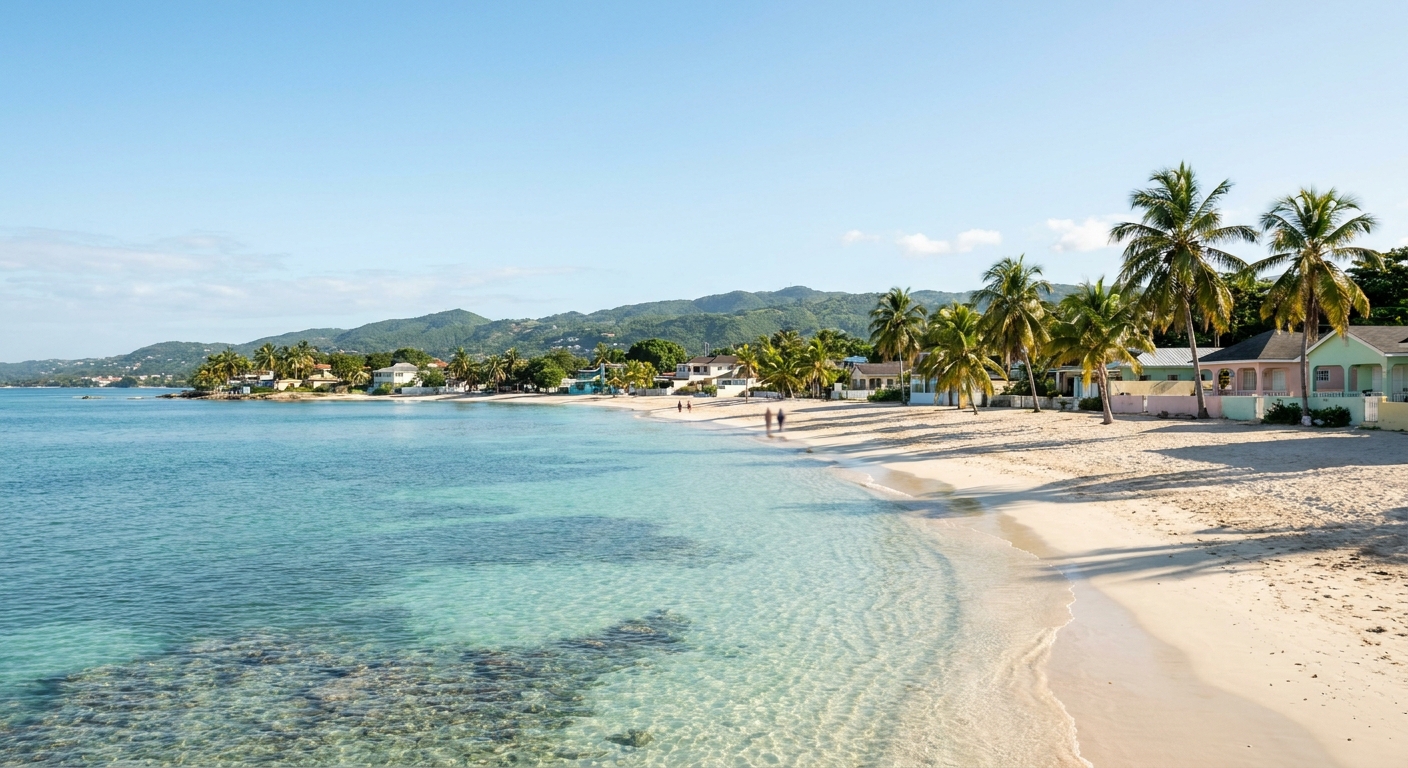
THE MONTH AT A GLANCE · MONTEGO BAY
February gives Montego Bay the driest of its three winter months, 81.7°F afternoons and an 81.1°F sea, in exchange for a 6:13 p.m. sunset and water slightly cooler than January’s.
DRIEST OF JAN TO MAR · 3.8 WET DAYS · SEA 81.1°F · OUTSIDE HURRICANE SEASON
Go for: beach mornings with the fewest wet days of the winter, 81.1°F water, Rose Hall’s US$35 night tour starting just after a 6:13 p.m. sunset, and a raft trip that needs no hurricane clause.
Think twice before: booking February for the warmest possible sea, since January reads 82.0°F and March 82.6°F, or for long outdoor evenings, since the light is gone by a quarter past six.
Climate: Open-Meteo ERA5 grid cell · Sea: Open-Meteo Marine · Storms: NOAA · full sources at the end
On this page
- Montego Bay weather in February81.7°F highs, 1.65 inches, 3.8 wet days
- Sea temperature for swimming in February81.1°F, measured as daily maxima
- How busy February is, and what the room tax costsThe US$1 to US$4 nightly room tax
- Things to do in Montego Bay in FebruaryDoctor’s Cave, Rose Hall, Martha Brae
- A two-day plan for a February weekendTwo days set to a 6:13 p.m. sunset
- February or January or March?How the three months compare, figure by figure
- Is February a good time to visit Montego Bay?Who should book February and who should shift
- Getting from Sangster airport to the hotelJamaica airport transfers
Every figure here for air temperature and rain comes from the ERA5 reanalysis, the 1991-2020 normals computed for the grid cell at 18.4762° N, 77.8939° W. That is a model reconstruction of the atmosphere over the bay rather than a thermometer read at Sangster’s runway, and an official station record would not land on exactly the same decimals. The sea reading comes from a separate marine dataset, and the sunrise and sunset times from a solar calculator run for February 15.
Montego Bay weather in February: average highs, lows and rain days
| Measure | February figure |
|---|---|
| Average high | 81.7°F |
| Average low | 70.8°F |
| Monthly rainfall | 1.65 in |
| Days with 0.10 in or more | 3.8 |
| Days with 1 in or more | 0.1 |
| Sea surface, mean of daily maxima | 81.1°F |
| Daylight on February 15 | 11 h 35 min |
The 1991-2020 normals put February’s average high at 81.7°F and its average low at 70.8°F, with 1.65 inches of rain for the month. Those come from Open-Meteo’s ERA5 series for the grid cell over Montego Bay, not from an official airport station, so read them as the shape of a February rather than as a reading taken at the fence line. A station record on the same coast would differ by a few tenths, most often on the overnight low.
Measurable rain falls on 3.8 days in an average February, which is roughly one day in eight. A day of an inch or more turns up 0.1 times per February, so about one February in ten gets a genuine soaking. In practice that means most wet spells are a shower you sit out under a beach bar roof with a coffee, and the odds of losing an entire booked day to weather are small without being zero.
Nearly eleven degrees separate the 81.7°F afternoon from the 70.8°F pre-dawn low, and the low is what people pack wrong for. A boat deck at seven in the morning, a heavily air-conditioned dining room, a hilltop restaurant after dark: each one asks for a layer nobody thinks to bring to the Caribbean in winter. One long-sleeve shirt per traveler covers it, and the packing list handles the rest of the suitcase.
On February 15 the sun clears the horizon at 6:38 a.m. and drops at 6:13 p.m. local time, for 11 hours 35 minutes of daylight. That ends the beach day earlier than most American visitors plan for: by a quarter past six the light is gone, and any drive back from Falmouth or the hills becomes a night drive. Put the water in the morning and the middle of the day, and treat anything after five as dinner rather than sightseeing.
Can you swim in Montego Bay in February? Sea temperature and what it feels like
February’s sea surface off Montego Bay averages 81.1°F. That number is the mean of daily maxima over 2015-2024, taken from Open-Meteo’s marine series, so it describes the warmest point of the day’s surface water rather than a flat 24-hour average. The true round-the-clock figure sits a shade lower, a distinction that matters more to an 8 a.m. swimmer than to anyone wading in at two in the afternoon.
At 81.1°F nobody needs a wetsuit and nobody gasps on entry. Doctor’s Cave Beach on Jimmy Cliff Boulevard charges US$8 for visitors aged 12 and over and US$4 for children under 12, and its customer service runs 08:30 to 17:30, Monday through Sunday. Arrive at 08:30 and the contrast works in your favor: the air is still near its overnight 70.8°F, and the sea is the warmer of the two by a wide margin.
Wind and swell are where our data runs out. We could not verify a February wind or wave series for this stretch of coast, so we make no claim about calm mornings or choppy afternoons rather than round one up from a brochure. The storm question is settled by the calendar: NOAA runs the Atlantic hurricane season from June 1 to November 30, peaking on September 10, and February falls outside it entirely, unlike the dates covered in our hurricane-season guide.
How busy is Montego Bay in February? Crowds, prices and the demand peak
February is a northern-hemisphere winter month, and that is a calendar fact rather than a price signal. We found no occupancy series and no month-by-month room-rate series we could stand behind, so we crown no month the year’s cheapest and none the year’s most expensive. What is documented is the set of fixed costs that do not move with the season, and they are worth knowing before you compare two quotes on the same week. Fares and routes sit with flights from the US, and the wider budget with our trip-cost page.
Booking lead time is the same story: no reliable series, so no advice dressed up as a number of weeks. On a short trip the binding constraint is the schedule of the places themselves. Rose Hall’s Haunted Night Tour runs Wednesday to Saturday only, 18:30 to 20:30, so a Sunday-to-Wednesday stay cannot have it at all. Rafting the Martha Brae takes guests in order of arrival and says plainly that reserving does not move you up the line, which makes the 09:00 opening the thing to aim at.
The Guest Accommodation Room Tax is charged per night on each occupied room and scaled to the property, not to the traveler: US$1 at a property of 1 to 51 rooms, US$2 from 51 to 100, US$4 at 101 rooms and above, complimentary rooms included. Seven nights at a large resort therefore adds US$28. Separately, the government announced a US$20 fee on each arriving air passenger whose trip starts abroad, effective August 1, 2012. We could not reconfirm that amount on a current government page, so take it with its 2012 date attached.
If one line deserves the extra spend in February, it is the ride in from the airport, because the short day makes the arrival hour matter: the light is gone by 6:13 p.m., and an evening landing turns the transfer into a night drive. Sangster International authorizes two taxi companies, JUTA and JCAL, sharing a single Authorised Airport Taxi desk just outside the Customs exit. The airport publishes no fare table, so the rate is quoted at that desk and the figures circulating on booking sites are not the operator’s. Ask there, settle it before the bags go in, and read the transfer options first.
Things to do in Montego Bay in February
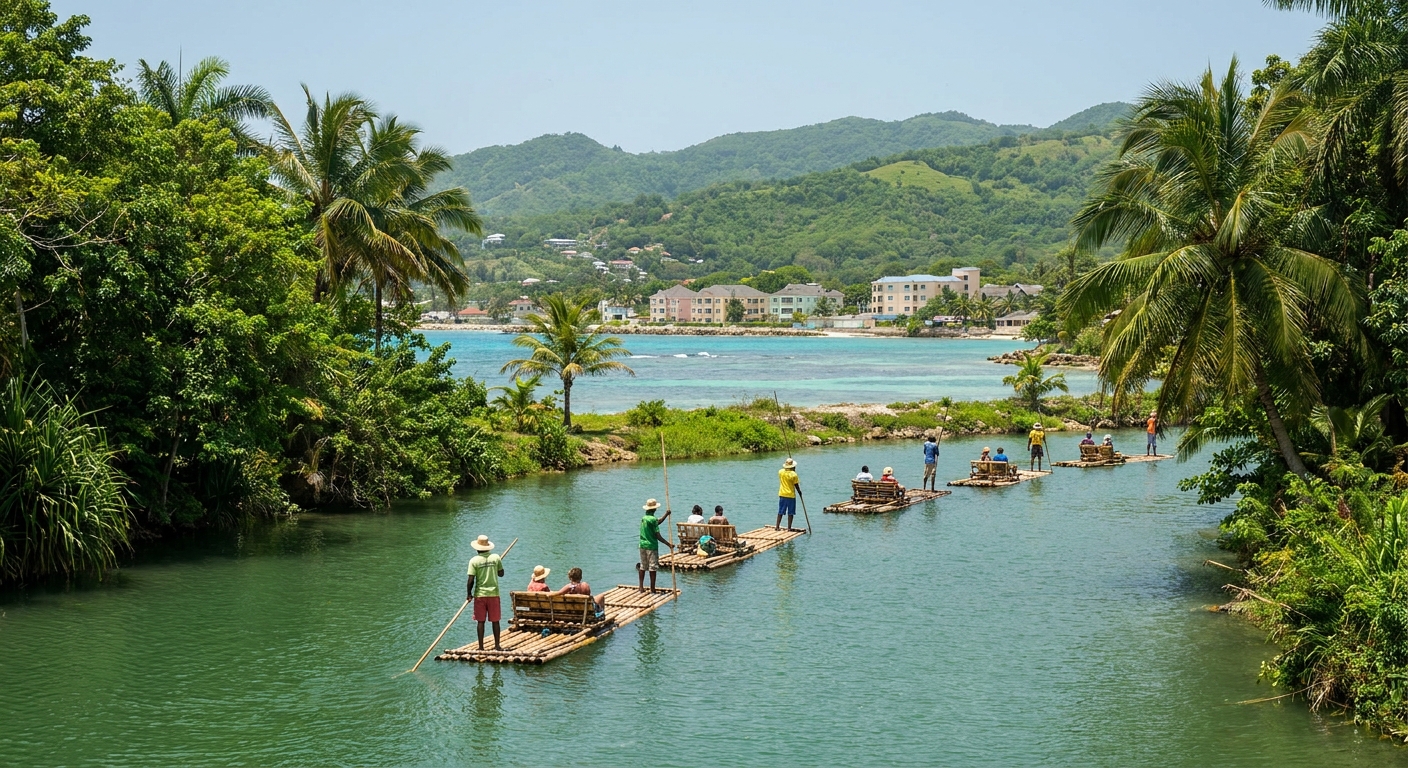
February is the driest of the winter’s three months here: 1.65 inches and 3.8 wet days, against March’s 2.18 inches and 5.9. An outdoor day booked now, the raft trip, the bird sanctuary at Anchovy, an hour in Rose Hall’s gardens, carries measurably less weather risk than the same day booked four weeks later. Nothing on the itinerary needs a storm clause either, since the hurricane season does not reach into February.
Doctor’s Cave Beach sits on Jimmy Cliff Boulevard in town, US$8 for visitors 12 and over, US$4 under 12, customer service 08:30 to 17:30 daily. Rose Hall Great House runs its Day and Garden Tour at US$30 per adult, Monday to Saturday from 09:15 to 16:00, each tour lasting 45 minutes to an hour, plus a Haunted Night Tour at US$35 from Wednesday to Saturday, 18:30 to 20:30. Rafting the Martha Brae costs US$99 for visitors and J$13,000 for Jamaicans with valid local ID, three miles in about an hour and a quarter, daily 09:00 to 16:00.
The river pays no attention to the calendar: three miles of Martha Brae in February is three miles of Martha Brae in August. The air around it changes, and so does the light. At 81.7°F the raft trip is warm rather than punishing, and the 6:13 p.m. sunset means the 18:30 night tour at Rose Hall begins 17 minutes after the sun goes down, in fading light rather than in daylight. The raft office takes all major credit and debit cards, which spares you a cash run before a 09:00 start.
On anything free, we come up short and would rather say so. We found no February event in Montego Bay with a date we could verify at source, so we name none. Rocklands Bird Sanctuary at Anchovy, where red-billed streamertails feed from a hand-held bottle, publishes no admission price we could read: three travel sites quote US$35, US$30 and US$25 for the same adult ticket, and we will not pick one of them for you. Bring cash and ask at the gate.
Montego Bay in February: a two-day itinerary
Day one runs on the morning. Sunrise is 6:38 a.m., so breakfast before eight costs nobody any sleep, and Doctor’s Cave opens at 08:30: US$8 in, straight into 81.1°F water while the air is still climbing out of the night’s 70.8°F. Stay through midday, eat late, keep the early afternoon slow and shaded. Then, on a Wednesday through Saturday, the Haunted Night Tour at Rose Hall runs 18:30 to 20:30 at US$35 and puts you at dinner by nine.
Day two belongs to the Martha Brae, which opens at 09:00 and processes guests in order of arrival, so an early start is worth more than any reservation: US$99, three miles, about an hour and a quarter on the water, closing at 16:00. If the sky turns, and on 3.8 days in an average February it does, swap to Rose Hall’s Day and Garden Tour, US$30, Monday to Saturday between 09:15 and 16:00, 45 minutes to an hour largely under a roof. Either way the light is gone at 6:13 p.m., so keep the second evening in town.
Montego Bay in February vs January and March
| Measure | January | February | March |
|---|---|---|---|
| Average high | 80.8°F | 81.7°F | 82.8°F |
| Average low | 71.1°F | 70.8°F | 71.1°F |
| Rainfall | 1.79 in | 1.65 in | 2.18 in |
| Days with 0.10 in or more | 4.2 | 3.8 | 5.9 |
| Sea surface, daily maxima | 82.0°F | 81.1°F | 82.6°F |
Across the three months the afternoon air spans exactly two degrees, from January’s 80.8°F to March’s 82.8°F, which no swimmer will feel. Rain is where they part company: February collects 1.65 inches over 3.8 wet days, January 1.79 inches over 4.2, March 2.18 inches over 5.9. The sea runs the other way, warmest in March at 82.6°F, then January at 82.0°F, with February coolest of the three at 81.1°F. All three figures come from the same reanalysis and marine series, so the comparison is like for like.
Shift four weeks forward to March and you gain 1.1°F of afternoon air and 1.5°F of sea, and you pay for it with 2.1 more wet days and half an inch more rain. Shift back to January and the sea gains 0.9°F while the afternoon loses 0.9°F, a near wash that leaves airfare, school calendars and how many nights you can take as the real deciders. February is the middle option that leans dry.
Is February a good time to visit Montego Bay?
February works for a traveler who wants water without weather risk and can live with a 6:13 p.m. sunset. It works less well for someone chasing the warmest possible sea, since both January at 82.0°F and March at 82.6°F read higher on the same dataset, and less well again for a trip built around long outdoor evenings. Families with young children get the best of the three: the fewest wet days and the smallest chance of a beach morning written off. The country-wide month calendar sets February inside the full year.
If the answer is no, March is the month to move to: 82.8°F days and 82.6°F water, the warmest pairing of the three, bought with 5.9 wet days and 2.18 inches instead of 3.8 and 1.65. Going the other way, January hands back 0.9°F of sea heat and takes 0.9°F off the afternoon, close enough to even that the choice falls to flights and the school calendar. Our January page carries that month’s figures in full.
What February holds that neither neighbor matches is a combination: the driest total of the three at 1.65 inches, the fewest wet days at 3.8, and the coolest nights, 70.8°F against 71.1°F in January and March alike. No more than two degrees separate the three months in the afternoon.
The last word
Choose the dates on the rain column rather than the thermometer: 3.8 wet days against March’s 5.9 is the real difference between two weeks that will both feel warm. Then sort the ground transport, which getting around Jamaica covers route by route. The Transport Authority identifies a licensed public passenger vehicle by five marks: a red PPV plate, a roof globe reading Taxi, route details printed on a route taxi’s front doors, a checked color code 10 cm high in 2.5 cm squares, and a driver wearing a Transport Authority badge with the Driver Identification Card aboard. We could not confirm any letter prefix on that plate, so never make the plate your only test.
Sources & data for this guide
- February normals (81.7°F / 70.8°F, 1.65 in) and the January and March figures · Open-Meteo / ECMWF ERA5, 1991-2020, grid cell 18.4762° N 77.8939° W · model reanalysis, not an official station record · checked Sep 20, 2026
- Rain days (3.8 at 0.10 in, 0.1 at 1 in) · same ERA5 series · checked Sep 20, 2026
- Sea surface 81.1°F, mean of daily maxima 2015-2024 · Open-Meteo Marine API · checked Sep 20, 2026
- Daylight 11 h 35 min, sunrise 6:38 a.m. and sunset 6:13 p.m. on February 15, converted to America/Jamaica · sunrise-sunset.org · checked Sep 20, 2026
- Atlantic hurricane season dates and the September 10 peak · NOAA National Hurricane Center · checked Sep 20, 2026
- Doctor’s Cave Beach admission (US$8 / US$4) and 08:30 to 17:30 hours · Doctor’s Cave Bathing Club, General Admission page · checked Sep 20, 2026
- Rose Hall Great House tours (US$30 day, US$35 night) and hours · rosehall.com · checked Sep 20, 2026
- Rafting the Martha Brae (US$99, J$13,000 local, 09:00 to 16:00, order of arrival, cards accepted) · jamaicarafting.com FAQ · checked Sep 20, 2026
- Guest Accommodation Room Tax tiers (US$1 / US$2 / US$4 per occupied room per night) · Tax Administration Jamaica · checked Sep 20, 2026
- US$20 arrival fee announced effective August 1, 2012 · Jamaica Information Service · we could not reconfirm the amount on a current government page · checked Sep 20, 2026
- Authorised airport taxis JUTA and JCAL, single desk outside Customs, no published fare table · MBJ Airports Limited · checked Sep 20, 2026
- PPV identification marks, with no letter prefix printed by the regulator · Transport Authority of Jamaica, Licence Types · checked Sep 20, 2026
- Rocklands Bird Sanctuary admission: no primary source we could read, reseller quotes conflict at US$35, US$30 and US$25 · checked Sep 20, 2026
- We found no occupancy series and no monthly room-rate series for Montego Bay, so we name no cheapest or busiest month. Prices and hours change · check operators when you book.
To plan your stay
- Things to Do in Montego Bay: Reef Snorkeling, Rose Hall, Rafting and the Free Beaches
- Where to Stay in Montego Bay: Neighborhoods, Resort Belts and the Walk to the Sand
- Montego Bay Airport to the City: Shuttles, Licensed Taxis and Departure-Day Timing
- Things to Know Before Going to Montego Bay: Red-Plate Taxis, the Hip Strip and Jerk Pits