
MONTEGO BAY · KNOW BEFORE YOU GO · PLATES, STREETS AND PIMENTO WOOD
Three days in Montego Bay teaches a handful of reflexes nobody prints on a schedule: which plate a licensed taxi carries, why the street with the bars is not the street with the market, and what happens downtown when a ship is in. Our desks learned each of them the slow way, mostly by standing in the wrong place at the right hour.
Entry paperwork is handled on the entry guide, the neighborhood picture on the city safety page, and the bag on the packing list. Island-wide habits, money and vendors and greetings, run on the Jamaica lessons page. The reflexes gathered here are local, and most of them lose their usefulness by the time the road reaches Falmouth.
THE LESSONS AT A GLANCE · MONTEGO BAY
Read the plate before the car, learn which of the two Montego Bays you are standing in, and answer the pit when it asks mild or hot.
SANGSTER AT THE EDGE OF TOWN · RED PPV PLATES · GLOUCESTER AVENUE AND DOWNTOWN · PIMENTO WOOD
Go for: the first and last night of a Jamaica trip, when a short ride to the terminal is worth more than a wider beach.
Think twice before: judging the whole city from Gloucester Avenue, or getting into a car whose plate you never looked at.
An experience page: editorial judgment from our trips, with every fare, time and fee left on the page that sources it
On this page
- How close Sangster airport is to Montego BaySangster airport and the city
- Taxis in Montego BayHow to tell a licensed taxi
- The Hip Strip in Montego BayGloucester Avenue and downtown
- Where to eat jerk in Montego BayThe pits and how to order
- Montego Bay travel tips12 mistakes to avoid
Is Sangster airport close to Montego Bay?
Sangster International Airport is inside the city. The runway runs along the water at the northern end of the bay, and the road out of arrivals reaches Gloucester Avenue without ever touching a highway. No other base on the island works this way: Negril, Ocho Rios and Port Antonio each open with a transfer that takes a real bite out of the arrival day. The ride into town, its fares and its timing, is set out on the airport-to-city page.
That geography is the argument for sleeping here on the first night and the last one, whatever the middle of the trip looks like. A late landing turns into dinner instead of a night drive, and an early flight home does not mean leaving another town before dawn. Choosing between the strip, the eastern resort belt and the hillside guesthouses is worked out on the where-to-stay page, and the three-day plan is built on exactly that shape.
Taxis in Montego Bay: how to tell a licensed taxi
Licensed public passenger vehicles in Jamaica carry a red PPV license plate, and the Transport Authority asks you to look for more than that: a globe on the roof with the word Taxi, the words Route Taxi and the route itself printed on the front doors, a checked band along the side — black and white on a route taxi, black and yellow on a hackney carriage — and a driver wearing a Transport Authority badge, with the Driver Identification Card in the car. The plate is the fastest of the five to read, not the only one that counts. In Montego Bay that plate does the whole job: the cars idling outside the arrivals gate, along the strip and at the market include drivers working legally and drivers who are not, and the plate separates them in a second. Look at the back of the car before you look at the driver.
The route taxi is a bus with four doors. It runs a fixed line, picks up and sets down anyone along it, fills every seat, and will not turn off for a hotel gate. Passengers call the name of a point on the route rather than an address. How those lines work across the island, and what a shared seat costs against a chartered car, is laid out on the getting-around page.
Day to day the split is easy. Charter for luggage, for the resort belt east of town and for anything after dark. Use the shared cars for daylight hops along the coast road, when the line happens to go where you are going. Riding back from Gloucester Avenue late rather than walking it is a Montego Bay habit more than a national one, and the city safety page names the stretches that thin out at night.
The Hip Strip in Montego Bay: where it is and what to do
Gloucester Avenue is the strip: a waterfront run of bars, duty-free counters, patty windows and dive shops, with the beach clubs at Doctor’s Cave and Cornwall in the middle and the craft market down at the harbor end. It was built for people who arrived by plane or by ship, and it prices accordingly. The trading city is somewhere else, downtown around Sam Sharpe Square and the Charles Gordon Market, where the produce, the buses and the hardware stalls are and where nobody offers you a catamaran. Both are Montego Bay. Only one of them shows up in the brochure, and the things-to-do page covers what earns a stop on each.
Jerk in Montego Bay: where to eat and what to order
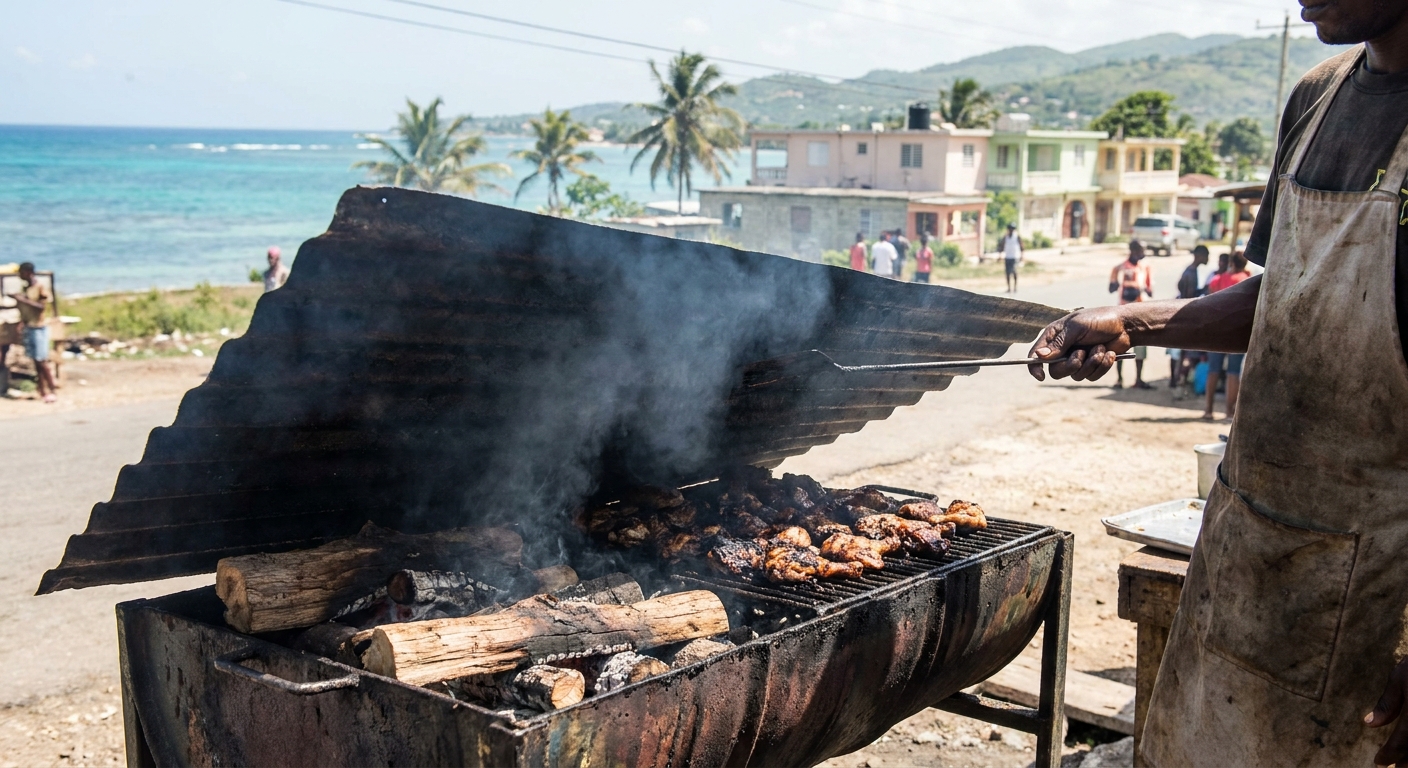
Jerk is a cooking method before it is a flavor. Seasoned chicken or pork goes over pimento wood, slow, under a sheet of zinc or inside a closed drum, and the smoke does most of the work. The bottle standing on the table is a condiment added at the end. Ask for jerk sauce on something that never met the fire and you get a different dish altogether.
You order at the pit, by the piece or by weight, and the counter question is mild or hot. Hot is not a formality here. Take it mild the first time and reach for the bottle yourself if the first bite is tame. Festival, the sweet fried dough, plus hard dough bread and roast breadfruit are the standard sides, and the meat comes back chopped through the bone with a cleaver and wrapped in foil.
Two places anchor the habit for visitors. The Pork Pit, an open-air grill at the airport end of Gloucester Avenue, is close enough to the strip hotels to reach on foot. Scotchies, out on the road east toward Ironshore and Rose Hall, is a yard of grills under zinc with picnic tables, and it is the address most drivers offer when asked. Roadside drum pans in both directions along the coast run the same method at a smaller scale.
A pit cooks a quantity and sells it, so the choice narrows as the evening runs on. Nobody takes a reservation, and the queue moves at the speed of the cleaver. Eating one jerk meal away from Gloucester Avenue changes what a visitor takes home about this city, and it costs a taxi ride each way. Carrying east, Ocho Rios runs the same fire with its own set of pits.
Montego Bay travel tips: 12 mistakes to avoid
| The lesson | The mistake it prevents |
|---|---|
| Book the first and last night in Montego Bay | Losing both ends of the trip to a transfer van |
| Check the five PPV marks, not just the plate | Getting into an unlicensed car outside arrivals |
| Treat a route taxi as a shared line, not a hire | Expecting a private ride to your hotel gate |
| Walk downtown to Sam Sharpe Square at least once | Taking Gloucester Avenue for the whole city |
| Say no thank you once, without breaking stride | A pitch that restarts every time you slow down |
| Answer mild or hot when the pit asks | Heat that nobody warned you about |
| Order jerk by the piece at the counter | Waiting at a table for service that is not coming |
| Ask for the sauce on the side | Drowning the wood smoke you came for |
| Check whether a ship is at the Freeport pier | A downtown morning at its most crowded |
| Plan the drive east and the drive west separately | Costing the Negril road like the Ocho Rios road |
| Run day trips as returns from one hotel | Packing and repacking your way along the coast |
| Take a car back from the strip late | The quiet stretch between the last bar and the door |
Reading a plate takes a second and settles the transport question for the week. The street question takes one walk: from the craft market at the harbor end of Gloucester Avenue, a short move inland puts you among produce crates and route taxi ranks, and the change in prices, noise and sales pressure arrives all at once. Nothing about that walk is unsafe by daylight, and it is the fastest correction to a first impression of the city.
Cruise days rearrange the arithmetic. With a ship alongside at the Freeport pier, the craft markets, the downtown blocks and the taxi ranks all fill within the same hour, and the excursion desks are quoting the same trips to one captive crowd. Shifting that morning to the beach, or out to the great houses east of town, steps around it, and the schedules are published well before you travel. Trips built as returns from a single base are gathered on the day-trips page.
The last word
Sources & data for this guide
- An experience page, deliberately unsourced: these are observations from our desks’ trips to Montego Bay rather than published facts
- Every checkable figure has been left where it is sourced · fares and timings on airport-to-city and getting-around, road conditions on driving, budgets on trip cost · checked Sep 11, 2026
- PPV markings, pit ordering and market etiquette are described from repeated visits, not from a survey: we hold no counts and make no claim about how common any of it is
- Re-read with the rest of the Montego Bay file in our monthly refresh · the city guide
Jamaican itineraries treat Montego Bay as a doorway, and the city behaves like one: everything is close to the gate and priced for people passing through. Knowing the plate, the two streets and the pit is what turns a passage into a stay, and none of it takes more than a day to pick up.
From the water at Cornwall Beach the afternoon flights come in over your shoulder, low across the bay, close enough to watch the gear come down. Landing and swimming inside the same afternoon is a trick no other base on this island can offer, and it is worth spending at least one arrival on.
At the craft market the refusal that works is one clear no thank you, said while still moving. Stopping is what answers, not the words. A browse reads as an opening, and that is a fair reading of it, since the stalls trade on exactly that. The wider Jamaican version of this conversation is on the country guide.
The jerk lesson lands the same way. Order mild the first time, taste it, then use the bottle. The cleaver does the portioning, the foil holds everything together as far as the sea wall, and the pimento smoke stays on your hands for the rest of the evening.
Nobody plans a Caribbean holiday around an airport. Montego Bay is where that stops being a compromise: the last morning here is still a swim and a jerk lunch rather than a long haul back along the coast road, with the ride to the terminal saved for after you have eaten.
To plan your stay
- Best Time to Visit Montego Bay: Weather, Sea Temperature and the Quiet Months
- Things to Do in Montego Bay: Reef Snorkeling, Rose Hall, Rafting and the Free Beaches
- Where to Stay in Montego Bay: Neighborhoods, Resort Belts and the Walk to the Sand
- Montego Bay Airport to the City: Shuttles, Licensed Taxis and Departure-Day Timing