
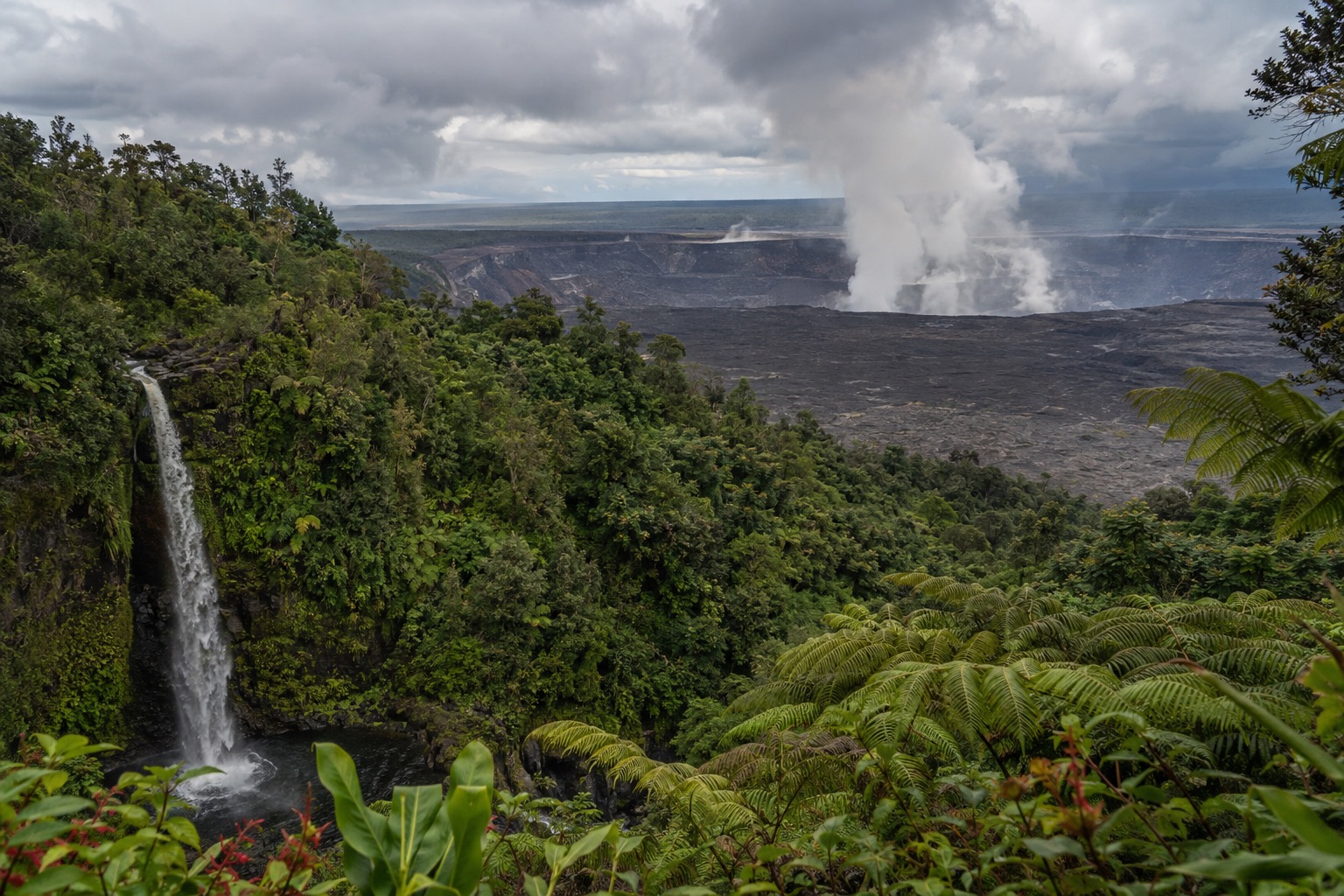
On a summer morning at the rim of Kilauea, the air is crisp, the steam rises from the ground in thin white threads, and the ohia trees and tree ferns drip with mist. In winter the same road can disappear into low cloud and a cold, steady drizzle, and the glow in the sky after dark feels even more dramatic. This is a park that sits high above the beaches, so its seasons follow altitude more than the calendar, and some months simply suit a day on the lava more than others.
When is the best time to visit Hawaii Volcanoes National Park?
The best time for most visitors is the drier stretch from late spring through early fall, roughly May to September, when the mornings are mild, the trails are drier underfoot and the views across the craters open up more often.
For sightseeing and hiking, that window is hard to beat. Walking across a crater floor or down to a sea arch is far more pleasant without a cold rain soaking through your jacket, and the gentle warmth at 4,000 feet is about as comfortable as Hawaii gets. Even then, bring a layer, because mist and a passing shower can roll in on any afternoon.
If your trip is built around beaches and the sea, treat the park as a day or two on the way. The sand is far below, on the coast, and the weather up here has little to do with the surf. Winter brings bigger waves to many shores, and summer is usually gentler on the same coasts, so read the posted warnings and the day’s surf and currents before you go in, and swim near a lifeguard only where one is on duty.
Families do well in summer, when school is out and the days are long enough for a slow morning at the lava tube and a picnic. Spring break in March fills the island with visitors and the park roads with cars, and it comes in one of the rainier months, so a family that wants quiet is better off in the shoulder weeks of May, early June or September.
Hawaii Volcanoes National Park weather by month
Temperatures hardly change through the year in the park, but the rain moves around a good deal.
| Month | Average high (°F) | Average low (°F) | Rain (in) | Rain days |
|---|---|---|---|---|
| January | 68.3 | 49.4 | 8.77 | 10.7 |
| February | 68.2 | 49.3 | 8.15 | 9.6 |
| March | 67.5 | 50.7 | 10.27 | 15.7 |
| April | 68.3 | 51.9 | 9.16 | 17.1 |
| May | 70.5 | 53.0 | 6.46 | 13.3 |
| June | 71.3 | 54.3 | 5.10 | 14.2 |
| July | 72.7 | 55.6 | 6.29 | 13.6 |
| August | 73.7 | 56.0 | 5.91 | 12.2 |
| September | 73.2 | 55.4 | 5.98 | 12.2 |
| October | 72.4 | 55.1 | 8.19 | 13.2 |
| November | 70.3 | 54.0 | 10.59 | 15.1 |
| December | 68.2 | 51.7 | 11.37 | 15.0 |
Days stay in the pleasant range all year, a little warmer in late summer and a touch cooler from December to March, with nights that call for a sweater. No month is truly dry, because the park sits where the trade winds push moisture up the slope. The difference is in how it falls: from May to October the rain tends to come as brief showers between bright spells, while November to April brings longer gray, wet stretches, with March and April the rainiest of all.
When is Hawaii Volcanoes National Park cheapest and least crowded?
The park is quietest in the shoulder months, especially May and early June, then again from September to the weeks before Thanksgiving, when school is back and the mainland crowds have thinned.
The busy times are the ones you would expect. Spring break in March, the weeks of Easter, the long summer family vacations, Thanksgiving week and the stretch from Christmas to New Year all bring full parking areas at the best-known stops and rooms that are harder to find in the towns near the park. Volcano village has only a small number of inns and cottages, so they fill early when demand rises.
In the quiet months you can walk a trail without a crowd ahead of you, and the overlooks have room to stand. A weekday morning is calmer than a weekend all year, and arriving early or staying late lets you see the park mostly to yourself.
Which months should you avoid in Hawaii Volcanoes National Park?
No month is off limits, but the wettest stretch, from November through April, is the hardest on a short visit, and March and April in particular can bring days of cloud and rain that hide the views.
The Central Pacific hurricane season runs from June 1 to November 30. Hawaii is rarely hit, but a distant system can still bring heavy rain and rough surf to the islands, so it is worth knowing where your dates fall. The first half of that season is also the most pleasant stretch for hiking, so the dates are not a reason to stay home.
Winter also means the coolest nights, and at this elevation a damp cold wind can make a morning feel colder than the thermometer suggests. Rain gear and warm layers matter more from December to March than at any other time. Summer, by contrast, is the warm, sunny side of the year, with heat that rarely goes beyond a comfortable afternoon.
Festivals and events in Hawaii Volcanoes National Park through the year
Winter holidays and the hula season
December and January bring the Christmas and New Year crowd to the Big Island, and the village of Volcano has a small-town feel with lights in the fog and fires in the lodge fireplaces. Cool, damp evenings are the norm, so it suits those who enjoy a cozy night more than a day at the beach.
In the week after Easter, Hilo hosts the Merrie Monarch Festival, the best-known hula competition in the islands. Rooms around Hilo are in short supply that week, and the road to the park fills with visitors combining the festival with a day on the volcano. If you want to see it, plan far ahead and expect a busy island.
Spring and summer celebrations
May 1 is Lei Day, celebrated all over Hawaii with flower lei, hula and music. It is a gentle, colorful moment to be on the island, and the weather around then is among the best of the year in the park, with rain easing off and warmer mornings.
On June 11 the islands honor King Kamehameha with parades and lei draped over his statues, including the one in Kapaau on the north end of the Big Island. It is a fine reason to pair a volcano visit with a drive around the island. Summer weekends also bring local fairs and food stands in many towns, with plenty of shaved ice and plate lunches.
Fall: Ironman and quiet trails
In October, the Ironman World Championship takes over Kailua-Kona on the dry west coast, and the whole island talks about it. Rooms there are scarce that week, while the park, on the opposite side of the island, is often calmer than at other times.
Fall is a good season for those who prefer trails to crowds. The air is mild, the light is soft and the rain comes back gradually toward November. It also suits a longer stay, with a night in the village of Volcano and an early morning at the crater rim before the day-trippers arrive.
Sources
- NOAA NCEI, monthly normals 1991-2020, station USC00511303, checked September 8, 2026
- sunrise-sunset.org, sunrise and sunset calculated for the 15th of the month, checked September 8, 2026
- Hawaii Department of Taxation, Tax Announcement No. 2025-03 (Transient Accommodations Tax Law Changes from 2025 Legislative Session), files.hawaii.gov/tax/news/announce/ann25-03.pdf, checked September 24, 2026
- County of Hawaii, Department of Finance, Transient Accommodations Tax (TAT) page, hawaiicounty.gov/departments/finance/transient-accommodations-tax-tat (live returned HTTP 403 on request, read via Internet Archive Wayback Machine snapshot dated August 14, 2026, same official content), checked September 25, 2026
- Hawaii Department of Taxation, County Surcharge on General Excise and Use Tax page, tax.hawaii.gov/geninfo/countysurcharge/, checked September 25, 2026
- Federal Aviation Administration, CY2024 Commercial Service Enplanements (xlsx), faa.gov/airports/planning_capacity/passenger_allcargo_stats/passenger/arp-cy2024-commercial-service-enplanements.xlsx, checked September 24, 2026
- National Park Service, "Fees & Passes", nps.gov/havo/planyourvisit/fees.htm, read September 25, 2026
- National Park Service, "NPS Geodiversity Atlas – Hawaiʻi Volcanoes National Park", nps.gov/articles/nps-geodiversity-atlas-hawai-i-volcanoes-national-park-hawai-i.htm, read September 25, 2026
- National Park Service, "Drive Chain of Craters Road", nps.gov/havo/planyourvisit/ccr_tour.htm, read September 25, 2026
- National Park Service, "Operating Hours & Seasons", nps.gov/havo/planyourvisit/hours.htm, read September 25, 2026
- National Park Service, "Current Conditions", nps.gov/havo/planyourvisit/conditions.htm, read September 25, 2026
- National Park Service, "Kīlauea Visitor Center", nps.gov/havo/planyourvisit/kvc.htm, read September 25, 2026
- U.S. Geological Survey, Hawaiian Volcano Observatory, "Kīlauea Volcano Updates", usgs.gov/volcanoes/kilauea/volcano-updates, read September 24, 2026
- USGS Hawaiian Volcano Observatory, Volcano Notice, https://volcanoes.usgs.gov/hans-public/notice/DOI-USGS-HVO-2026-09-11T16:16:02+00:00, checked September 25, 2026
- NPS, Lodging, https://www.nps.gov/havo/planyourvisit/lodging.htm, checked September 25, 2026
- NPS, News Release on Uekahuna Reopening, https://www.nps.gov/havo/learn/news/20250528-nr-uekahuna-reopens.htm, checked September 25, 2026
- NPS, Day Hike Nahuku (Thurston Lava Tube), https://www.nps.gov/havo/planyourvisit/day-hike-nahuku.htm, checked September 25, 2026
- NPS, Day Hike Kilauea Iki Trail, https://www.nps.gov/havo/planyourvisit/hike_day_kilauea-iki.htm, checked September 25, 2026
- NPS, Day Hike Puuloa Petroglyphs, https://www.nps.gov/havo/planyourvisit/hike_day_puuloa.htm, checked September 25, 2026
- NPS, Puuloa Petroglyphs, https://www.nps.gov/havo/learn/historyculture/puuloa.htm, checked September 25, 2026
- NPS, Holei Sea Arch, https://home.nps.gov/places/holei-sea-arch.htm, checked September 25, 2026
- NPS, Hawaii Volcanoes National Park expands hours and increases access to Kahuku Unit, https://www.nps.gov/havo/learn/news/20220523-nr-kahuku-hrs.htm, checked September 25, 2026
- NPS, Hike and Explore the Park's Kahuku Unit in Kau, https://www.nps.gov/havo/learn/news/hike-and-explore-kahuku.htm, checked September 25, 2026
- NPS, Camping, https://www.nps.gov/havo/planyourvisit/camp.htm, checked September 25, 2026
- NPS, Safety, https://www.nps.gov/havo/planyourvisit/safety.htm, checked September 25, 2026
- NPS, Directions, https://www.nps.gov/havo/planyourvisit/directions.htm, checked September 25, 2026
- USGS, November 27-December 10, 2022 Eruption of Mauna Loa, https://www.usgs.gov/volcanoes/mauna-loa/science/november-27-december-10-2022-eruption-mauna-loa, checked September 25, 2026
- NWS Honolulu / Central Pacific Hurricane Center, « 2026 Central Pacific Hurricane Season Outlook », weather.gov/hfo/hurricaneOutlook2026, checked September 24, 2026
To plan your stay
- Things to Do in Hawaii Volcanoes National Park: Kilauea Iki, Lava Tube, Petroglyphs and Day Trips
- Hawaii Volcanoes National Park in January: Cool Crater Rims, Rain Showers and a Two-Day Plan
- Hawaii Volcanoes National Park in February: Weather, Kilauea Hikes, Night Skies and a Two-Day Plan
- Hawaii Volcanoes National Park in March: Weather, Crater Rim Walks and Two Days Around Kilauea