
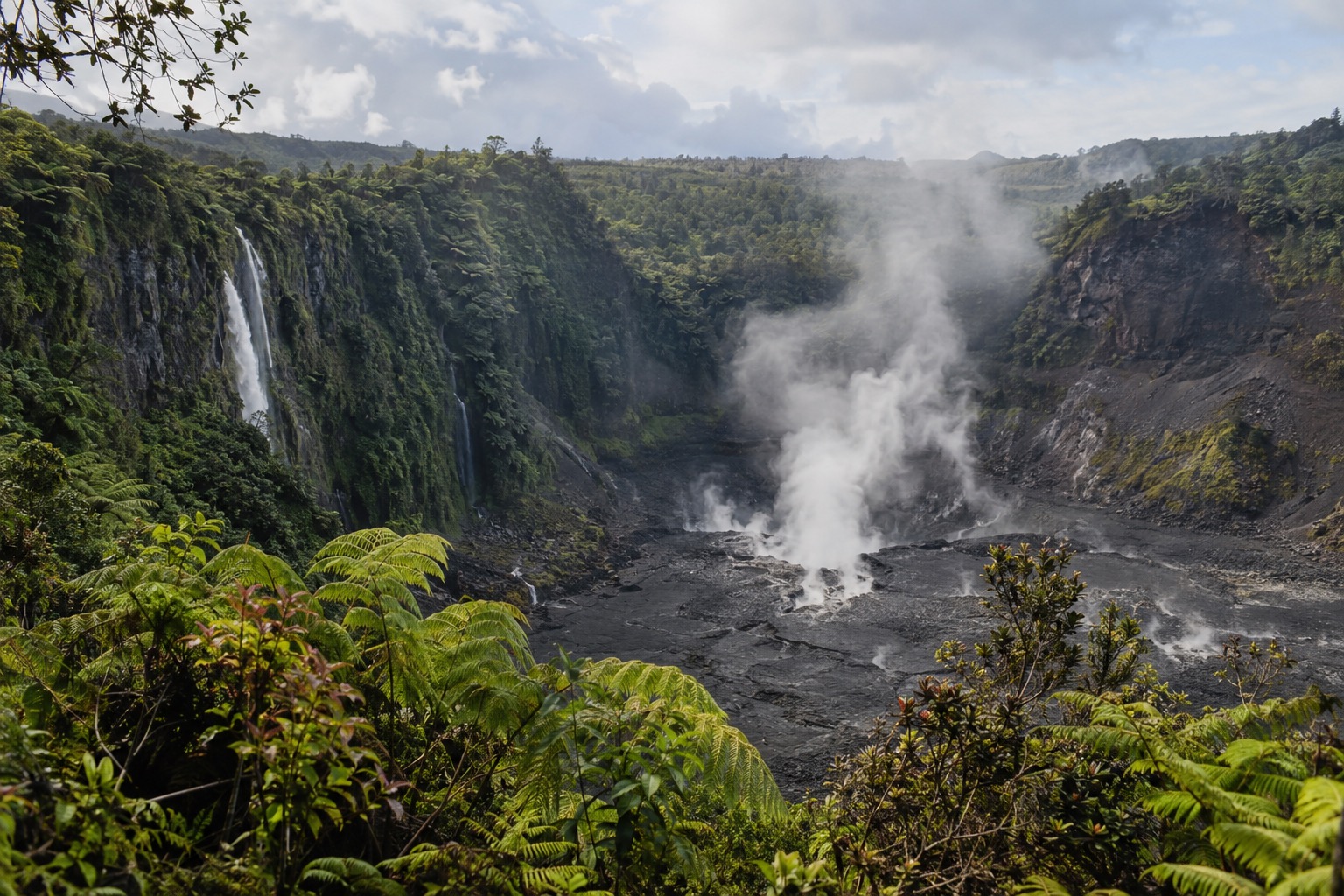
Walk across a crater floor still warm with old lava, then stop to watch ohia trees and bright red lehua blossoms push out of black rock. Hawaii Volcanoes National Park is a place of steam vents, fern forest and cliffs above the surf, all within one long day’s reach of Hilo. It suits hikers, curious families and anyone who wants to see an island still being built.
What are the best things to do in Hawaii Volcanoes National Park?
The best things to do are walking across a crater floor, descending into a lava tube, driving to the coast and reading the carved stories of the old Hawaiians. Start with these.
- Hike the Kilauea Iki Trail, because you cross the floor of a crater once filled with a lava lake.
- Walk through Nahuku (Thurston Lava Tube), a short stroll through a cave of dripping ferns.
- Drive Chain of Craters Road to the sea, a long descent from forest to black cliffs.
- Find the petroglyph field at Puuloa, where carvings cover the old lava.
- Stand at the rim for the glow of Kilauea after sunset.
- Visit the quiet Kahuku Unit for ranch history and Mauna Loa lava.
- Stay a night at Volcano House or a campground near the rim.
Sights and landmarks in Hawaii Volcanoes National Park
Nahuku (Thurston Lava Tube)
The tube is a cave left behind when lava drained away and the roof stayed put. You reach it through a rain forest of tree ferns, where the air turns damp and cool, and the path drops into a tunnel tall enough to walk through upright.
The round trip from the Kilauea Iki Overlook is 1.5 miles, and the tube is lit from 8 a.m. to 8 p.m. daily. The tiny parking area fills at midday, so arriving before 9 a.m. or after 5 p.m. keeps things calm. Early birds also hear native forest birds in the trees.
It suits nearly everyone, including grandparents and small children, though the floor can be wet. Go slowly and bring a layer, since the cave is cooler than the road.
The summit rim and the old Jaggar site
For generations, visitors lined up at the Jaggar Museum for the crater view. The building was damaged in the 2018 summit collapse and has since been taken down for good. Stones from its columns now trace its outline on the ground, a quiet memorial where scientists once watched the volcano.
Kilauea sits at about 4,091 feet, so the rim feels cool and often misty. The Kilauea Visitor Center is closed for renovation, and the park warns of closures and delays from construction at the summit, so expect some detours as you move around.
Volcano House, the historic lodge, has a dining room, lounge and gift shop with 33 guest rooms. Even without a room, it is a pleasant place to warm up with a drink and look toward the caldera.
| Site | Open | Admission |
|---|---|---|
| Hawaii Volcanoes National Park | 24 hours, every day | $30 per private vehicle (up to 14 passengers); $15 on foot or by bicycle; $25 per motorcycle |
| Nahuku lava tube lighting | 8 a.m. to 8 p.m. daily | Included with park entry |
| Kahuku Unit | 8 a.m. to 4 p.m., Thursday to Sunday | Free |
Outdoor things to do in Hawaii Volcanoes National Park
Kilauea Iki Trail
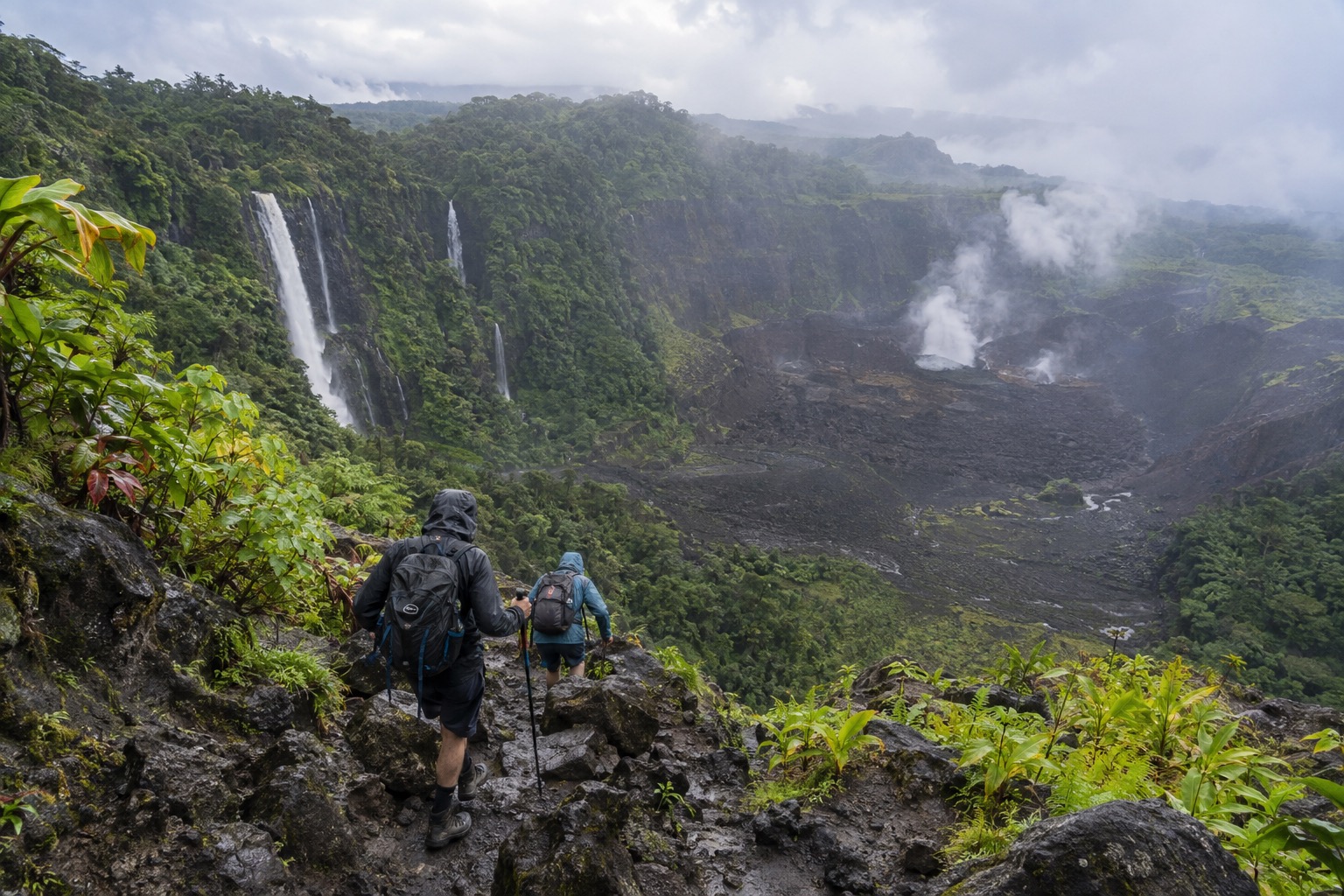
This is the park’s signature hike. You start in lush forest, switchback down a steep, rocky wall and cross the crater floor, where steam rises from cracks and the ground is a patchwork of black, gray and rust. Then you climb back out.
The loop from the overlook is 3.3 miles and takes about 2 to 3 hours. Starting at the visitor center parking area makes it a 5.3 mile outing of 3 to 4 hours. The trail is rated moderate to challenging, with a steep 400 foot descent and ascent over rocks.
It suits fit walkers in sturdy shoes. Bring water and a rain layer, because showers can arrive in minutes on the rim.
Chain of Craters Road and Puuloa
This 18.8 mile road tumbles from the summit area toward the coast through old flows, pit craters and open lava fields. Each pullout shows a different chapter of the island’s growth, and the final stretch looks out on sea cliffs and hard black shoreline.
Along the way, the Puuloa Petroglyphs Trail is a 1.4 mile round trip, about 1 to 1.5 hours. It crosses open lava to a field of roughly 23,000 carvings, one of the largest in Hawaii, with a boardwalk for close views. Go with respect and stay on the path.
Near the road’s end, the arch at Holei rises about 90 feet over the surf. Waves shaped it from a lava flow around 550 years ago, and the cliffs here are a fine place to watch the ocean do its slow work.
Camping in the park
Namakanipaio Campground sits in a eucalyptus grove at 4,000 feet, with drive-in sites at $15 a night, restrooms, water, tables and barbecue pits. The stay limit is 7 days. The same operator runs 10 refurbished camper cabins there.
Kulanaokuaiki, about 5 miles down Hilina Pali Road, is wilder. It has nine first come sites at $10 a night, with no water and no fires. Nights are cool at both, so pack warm layers.
Day trips from Hawaii Volcanoes National Park
Kahuku Unit
Kahuku is the park’s quiet corner, reached from the main entrance by a drive of about 50 minutes south along Highway 11. The entrance is near mile marker 70.5 in the Kau District, on the inland side of the road.
Trails wander past old ranching remnants and across lava flows from 1868 and 1887. A guided two mile, three hour walk called People and Land of Kahuku tells the story of the land and its ranchers. Rangers lead programs without reservations.
It is open only Thursday to Sunday from 8 a.m. to 4 p.m., so plan the day around that. It suits people who prefer open pasture and wide skies to crowds.
Hilo
Hilo is the natural pairing, a 45 minute drive along Highway 11. It is a rainy, green town of farmers markets, old storefronts and waterfront parks, a gentle change after the lava fields.
Wander the downtown streets, stop for shave ice or a bakery treat, and look for the waterfalls and gardens nearby. It is best as an afternoon outing or an easy return leg on the way to the airport.
Kailua-Kona
From the sunny west coast, the park is a long day trip. The direct route takes 2 to 2.5 hours, or 2.5 to 3 hours the scenic way through Waimea and Hilo. The drive crosses wildly different landscapes, from dry lava to pasture.
Many visitors flying into Kona make the trip in one very full day, though a night near the rim makes the schedule easier. Start early so the crater walks are not rushed.
What to eat in Hawaii Volcanoes National Park
Eating here is simple and comforting after a cool, damp hike. Volcano House serves meals and drinks with a crater view, and the nearby village has bakeries, small cafes and plate lunch counters.
A plate lunch of rice, macaroni salad and kalua pork or chicken katsu is the local standard. Look for fresh malasadas, local coffee from the Kau and Puna districts, and a bowl of hot saimin when the mist rolls in.
In Hilo, farmers market stalls offer poke, tropical fruit, and baked goods. Packing a picnic is smart, since the park itself has few food options.
Things to do in Hawaii Volcanoes National Park at night
Nights are about the sky and the glow. Kilauea is at a watch level of alert, with glow and spatter from its vents, and the rim is the place to look for the orange light against the dark.
With almost no city lights, the stars are brilliant on clear evenings. The park never closes, so there is no rush, but the air turns cold. Wear layers and bring a flashlight. Beyond that, nightlife is a quiet dinner at Volcano House or in the village, a drink by the lounge fire and an early bed.
Things to do in Hawaii Volcanoes National Park with kids
Children love the lava tube, steam vents and the sense of walking on a young landscape. The tube is short, and the boardwalk to the petroglyphs is easy to follow.
Keep in mind the altitude and the cool, wet air at the rim, so pack jackets, hats and sturdy shoes. The Kilauea Iki descent is steep, so it suits older kids who like a challenge.
Volcanic gases can affect infants, children and pregnant women, so check the air quality alert before visiting and watch conditions often. The ranger programs at Kahuku are another good choice for curious kids.
Good to know before you go
A car is the way to get around, since the park is a drive from either Hilo or Kona, and distances inside are long. The Central Pacific hurricane season runs from June 1 to November 30.
| Fee | Amount | Who pays |
|---|---|---|
| State transient accommodations tax | 11.00% | Guests staying in lodging |
| County of Hawaii accommodations tax | 3% | Guests staying in lodging |
| General excise tax pass-on (County of Hawaii) | Up to 4.7120% | Customers of businesses that pass it on |
Sources
- Hawaii Department of Taxation, Tax Announcement No. 2025-03 (Transient Accommodations Tax Law Changes from 2025 Legislative Session), files.hawaii.gov/tax/news/announce/ann25-03.pdf, checked September 24, 2026
- County of Hawaii, Department of Finance, Transient Accommodations Tax (TAT) page, hawaiicounty.gov/departments/finance/transient-accommodations-tax-tat (live returned HTTP 403 on request, read via Internet Archive Wayback Machine snapshot dated August 14, 2026, same official content), checked September 25, 2026
- Hawaii Department of Taxation, County Surcharge on General Excise and Use Tax page, tax.hawaii.gov/geninfo/countysurcharge/, checked September 25, 2026
- Federal Aviation Administration, CY2024 Commercial Service Enplanements (xlsx), faa.gov/airports/planning_capacity/passenger_allcargo_stats/passenger/arp-cy2024-commercial-service-enplanements.xlsx, checked September 24, 2026
- National Park Service, "Fees & Passes", nps.gov/havo/planyourvisit/fees.htm, read September 25, 2026
- National Park Service, "NPS Geodiversity Atlas – Hawaiʻi Volcanoes National Park", nps.gov/articles/nps-geodiversity-atlas-hawai-i-volcanoes-national-park-hawai-i.htm, read September 25, 2026
- National Park Service, "Drive Chain of Craters Road", nps.gov/havo/planyourvisit/ccr_tour.htm, read September 25, 2026
- National Park Service, "Operating Hours & Seasons", nps.gov/havo/planyourvisit/hours.htm, read September 25, 2026
- National Park Service, "Current Conditions", nps.gov/havo/planyourvisit/conditions.htm, read September 25, 2026
- National Park Service, "Kīlauea Visitor Center", nps.gov/havo/planyourvisit/kvc.htm, read September 25, 2026
- U.S. Geological Survey, Hawaiian Volcano Observatory, "Kīlauea Volcano Updates", usgs.gov/volcanoes/kilauea/volcano-updates, read September 24, 2026
- USGS Hawaiian Volcano Observatory, Volcano Notice, https://volcanoes.usgs.gov/hans-public/notice/DOI-USGS-HVO-2026-09-11T16:16:02+00:00, checked September 25, 2026
- NPS, Lodging, https://www.nps.gov/havo/planyourvisit/lodging.htm, checked September 25, 2026
- NPS, News Release on Uekahuna Reopening, https://www.nps.gov/havo/learn/news/20250528-nr-uekahuna-reopens.htm, checked September 25, 2026
- NPS, Day Hike Nahuku (Thurston Lava Tube), https://www.nps.gov/havo/planyourvisit/day-hike-nahuku.htm, checked September 25, 2026
- NPS, Day Hike Kilauea Iki Trail, https://www.nps.gov/havo/planyourvisit/hike_day_kilauea-iki.htm, checked September 25, 2026
- NPS, Day Hike Puuloa Petroglyphs, https://www.nps.gov/havo/planyourvisit/hike_day_puuloa.htm, checked September 25, 2026
- NPS, Puuloa Petroglyphs, https://www.nps.gov/havo/learn/historyculture/puuloa.htm, checked September 25, 2026
- NPS, Holei Sea Arch, https://home.nps.gov/places/holei-sea-arch.htm, checked September 25, 2026
- NPS, Hawaii Volcanoes National Park expands hours and increases access to Kahuku Unit, https://www.nps.gov/havo/learn/news/20220523-nr-kahuku-hrs.htm, checked September 25, 2026
- NPS, Hike and Explore the Park's Kahuku Unit in Kau, https://www.nps.gov/havo/learn/news/hike-and-explore-kahuku.htm, checked September 25, 2026
- NPS, Camping, https://www.nps.gov/havo/planyourvisit/camp.htm, checked September 25, 2026
- NPS, Safety, https://www.nps.gov/havo/planyourvisit/safety.htm, checked September 25, 2026
- NPS, Directions, https://www.nps.gov/havo/planyourvisit/directions.htm, checked September 25, 2026
- USGS, November 27-December 10, 2022 Eruption of Mauna Loa, https://www.usgs.gov/volcanoes/mauna-loa/science/november-27-december-10-2022-eruption-mauna-loa, checked September 25, 2026
- NOAA NCEI, monthly normals 1991-2020, station USC00511303
- NWS Honolulu / Central Pacific Hurricane Center, « 2026 Central Pacific Hurricane Season Outlook », weather.gov/hfo/hurricaneOutlook2026, checked September 24, 2026
To plan your stay
- Best Time to Visit Hawaii Volcanoes National Park: Weather, Crowds, Rain and Seasonal Events
- Hawaii Volcanoes National Park in January: Cool Crater Rims, Rain Showers and a Two-Day Plan
- Hawaii Volcanoes National Park in February: Weather, Kilauea Hikes, Night Skies and a Two-Day Plan
- Hawaii Volcanoes National Park in March: Weather, Crater Rim Walks and Two Days Around Kilauea