
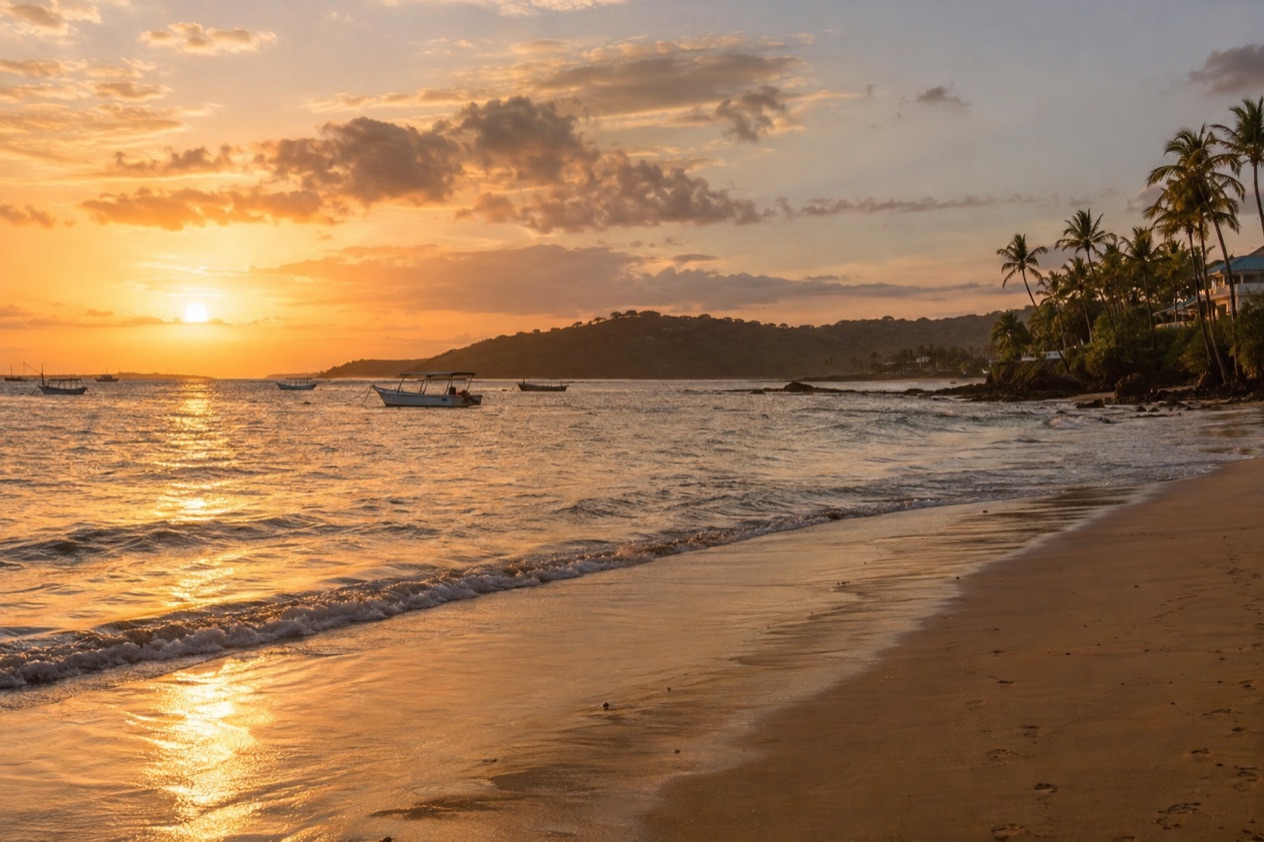
Late in the afternoon in Tamarindo, surfboards are stacked against palm trunks, the sand turns the color of honey, and half the town drifts toward the water to watch the sun drop into the Pacific. Dogs trot along the tide line, vendors fold up their stalls, and the bars on the main street begin to hum. This is the best-known beach town in Guanacaste, built around its waves and its sunsets, and it suits travelers who want a lively base with the sea at the end of the street.
Where is Tamarindo and what is it like?
Tamarindo sits on the Pacific coast of Guanacaste, in Costa Rica’s northwest, about an hour’s drive from the airport at Liberia. It is a surf and beach town with restaurants, shops and nightlife strung along one main street, and quieter beaches lying just beyond it on either side.
The town is compact and easy to read. A single road runs parallel to the sand, lined with surf shops, juice bars, pizza counters, taco stands, souvenir stalls and open-air restaurants where tables spill almost to the beach.
Sandals are the dress code, and it is common to see people walking from the water to lunch with a board under one arm. English is heard everywhere, which makes the first day easy for visitors who do not speak Spanish.
The character is social and a little busy. Tamarindo draws surfers, yoga students, families, couples on a honeymoon and a good number of foreigners who came for a week and stayed. Evenings have real energy, with live music in some bars, long dinners and a late crowd. The pace slows in the morning, when the beach belongs to joggers and early surfers and the air is still cool enough for a walk.
It is not a wilderness hideaway. Travelers looking for empty jungle, silence at night or a village with no tourist infrastructure will find the center too developed, and the main street can feel crowded in the dry months.
Those who like having a choice of restaurants within walking distance, a surf lesson before breakfast and a calmer beach a few minutes away tend to love it. The dry-forest hills behind town and the beaches around the point reward anyone who wants to leave the strip for a few hours.
One more thing shapes the place: the sea itself. Most beaches in Costa Rica do not have lifeguards or posted warnings, and rip currents are very dangerous. Tamarindo’s beach is gentle enough for first lessons, but look at the flags and the water before going in, and ask a local surf school how the waves are behaving that day.
What is there to do in Tamarindo?
Surfing, turtle country, beach hopping and the evening scene are the four reasons most people come. What sets Tamarindo apart from its neighbors is that all four sit within a few minutes of one another, so a day can run from a morning lesson to a sunset dinner without a long drive.
Learning to surf
The beach break in front of town is a classic place for beginners. Surf schools rent boards and give lessons, and you will see small groups of first-timers lined up in the whitewater every morning, instructors pushing them into waves and cheering when someone stands.
Experienced surfers go farther afield, since bigger waves break at beaches a short drive north and south. A good plan is to take a lesson here, then watch stronger surfers on the neighboring breaks before deciding whether you are ready to try them. Early mornings are the usual time, before the wind and the crowds arrive.
Playa Grande and the leatherback turtles
Just across the estuary from town, Playa Grande is a long, wide beach backed by protected land, and it is a nesting beach for leatherback turtles. It also has a reputation among surfers for powerful waves, so it feels wilder than Tamarindo’s main sand.
Leatherbacks generally nest from October through March, but seeing one is never guaranteed. Seeing a turtle is never guaranteed, and any nighttime visit must follow the park’s current rules. By day, the beach is excellent for long walks and for looking at the breaking surf from a distance.
Playa Langosta and the beach-hopping routine
Playa Langosta lies within a few minutes of town and has a calmer, more residential feel, with fewer vendors and a rocky point at one end. It is a pleasant place for a morning walk, a coffee and a quieter swim, with the usual caution about currents.
Beyond it, other beaches along this stretch of coast, such as Avellanas and Negra to the south and Flamingo and Conchal to the north, each have their own mood. Some are made for surfers, some for long, flat walks, some for snorkeling when the water is clear. A rental car or a taxi makes a beach-hopping day easy, and each stop can be as short or long as you like.
Sunsets and evenings on the main street
Sunset is the town’s daily gathering. People settle on the sand with a drink or sit at a beachfront table, and the sky usually turns orange and pink over the water. Afterward the main street fills with the smell of grilled fish and wood-fired pizza, and the bars and restaurants stay lively into the night.
Menus range from ceviche, fresh fish and casado (the classic plate of rice, beans, salad and a choice of meat or fish) to sushi and international cooking. Order a fresco, a cold fruit drink, and a plate of gallo pinto in the morning for the most local start to the day.
How many days do you need in Tamarindo?
A long weekend is enough to feel the town, and a week lets you slow down and see the coast around it. Anything shorter is rushed, especially if you are coming from the airport and want a surf lesson, a sunset and a quiet beach.
With three or four days, the rhythm is simple. Spend the first morning on the beach in front of town and take a lesson, then use the afternoon to wander the main street and watch the sunset.
The second day can go to Playa Langosta in the morning and to a guided evening near Playa Grande, if the season and your luck suit. The third day is for a farther beach, a stretch of coast you have not seen or a boat trip along the shoreline.
A full week adds breathing space. Surfers come back to the same break each morning and notice how the waves change with the tide. Others settle into a routine of yoga, long breakfasts, afternoon reading in the shade and a different restaurant every night. The pace is slow in the best sense, and a week here rarely feels long.
With more time, day trips open up. Rincon de la Vieja, a volcanic park in the hills inland, is a favorite for hikes, hot springs and waterfalls, and it makes a good contrast to the beach.
Santa Rosa National Park, to the north, is known for its dry forest and its surf breaks. Smaller beach towns up and down the Guanacaste coast, Samara and Nosara among them, suit travelers who want to compare surf scenes. Roads to the mountains can be slow, so a day trip usually means an early start.
If you arrive in the green season, plan the long outings for the mornings, because rain tends to come in the afternoon. A flexible schedule helps in any month, and the park’s official page is the place to check before heading to a volcano or a protected area, since rules change.
Where to stay in Tamarindo
The center of town, along and just off the main street, is the right base for travelers who want to walk to restaurants, surf shops and the beach. It is the liveliest area, with music and voices in the evening, so light sleepers may prefer a room set back from the road. Staying here means you can skip the car for most of the trip, and breakfast, lessons and dinner are all within a short stroll.
Playa Langosta, just south, is the calmer choice. It has a residential feel and quieter streets, and it suits couples and families who want a peaceful evening but still want town within reach. Expect to take a short walk, a taxi or a bike ride to reach the main street at night.
Across the estuary, Playa Grande attracts surfers and nature-minded visitors. It is greener and more spread out, with fewer restaurants and a deep silence at night, and it is the natural base if the turtles and the big waves are the reason for your trip. A car or a reliable ride into Tamarindo is useful for dinner.
The hills above town offer views over the bay and a cooler breeze, and many villas and condos sit there. They are good for longer stays and groups, but you will want transportation, since the walk back to the beach is steep and the road is not made for strolling in the heat.
Farther along the coast, the quieter beach communities near Avellanas, Negra and Flamingo give a different mood altogether. Staying there trades Tamarindo’s convenience for space and a slower day, and it works best for travelers who already know they want to be away from the crowd. In the dry months, when the area is busiest, booking early is wise, especially around Christmas and the weeks after.
How do you get to Tamarindo and get around?
Most visitors fly into Daniel Oduber Quiros International Airport (LIR) at Liberia, the closest airport for the Guanacaste beaches, and then drive about an hour to Tamarindo. The other international airport, Juan Santamaria (SJO) near San Jose in the Central Valley, is farther and means a longer road trip, though many visitors do use it.
From Liberia, travelers go by rental car, private shuttle or taxi, and the road is straightforward by day. The final stretch passes ranch land, dry forest and small villages. Arriving in daylight makes the last turns easier, and the scenery is part of the welcome.
Once you are in town, walking is the main way to get around. The main street, the beach, the surf shops and most restaurants are all close together, and distances are short enough to cover on foot or by bicycle, though the afternoon heat can be tiring.
A rental car gives the most freedom for beach hopping, volcano day trips and dinners away from the center.
Costa Rica’s currency is the colon, but U.S. dollars are widely accepted in tourist areas, and many hotels, tours and restaurants quote prices in dollars. Change often comes back in colones, so keep a few small bills of each for taxis and small stands. Before the trip, remember that your passport must be valid for the duration of your stay and that you need a return ticket or proof of onward travel.
When is the best time to visit Tamarindo?
December through April is the best stretch for sun, when Guanacaste has the driest and sunniest weather in the country. January is the easiest example, with hot days, warm nights and almost no rain, and the sea is warm enough for long swims. April is hotter still, with a few short showers beginning to appear, and the sea reaches a bathwater feel.
These months are also the busiest. Christmas and New Year bring crowds, higher rates and full restaurants, and the weeks around Holy Week, which moves every year, are lively with domestic and foreign visitors. If you want the dry season with a little more room, the shoulder weeks at either end often feel calmer.
The green season, from about May to November, brings afternoon showers and fewer visitors. The hills turn a deep green, the air smells of wet earth, and mornings are often bright before clouds build. July is a good example of a green month, with rain on many days but usually in short spells, and the sea stays warm.
October is the wettest month. Rain falls on nearly every day, sometimes in heavy downpours, and some roads and trails turn muddy. Surf can be strong and the water less clear.
Travelers who come then do so for quiet streets, lush scenery and an unhurried pace, with the understanding that gray, rainy days are part of the picture. Rip currents are a risk in every season, so check the flags and ask before swimming.
Good to know before you go
The U.S. State Department rates Costa Rica Level 2, ‘Exercise increased caution,’ due to crime; it says petty crime is common throughout Costa Rica and that violent crime also affects tourists, including armed robbery, homicide and sexual assault.
Bring sunscreen, a hat and a refillable water bottle, because the sun is strong even on cloudy days and the heat is constant. Small bills in dollars or colones are useful for taxis, beach stands and tips.
Keep valuables out of sight on the sand and in parked cars, as petty theft is the most common trouble for visitors. Rain can arrive quickly in the green season, so a light rain jacket belongs in the daypack, and a dry bag helps protect a phone and a camera on the beach.
Sources
- Open-Meteo / ECMWF ERA5, normals 1991-2020 computed for the grid cell at 10.2993N 85.8371W, checked October 8, 2026
- Open-Meteo Marine API, average 2015-2024, checked October 8, 2026
- U.S. Department of State, Costa Rica Travel Information, Safety and security (https://travel.state.gov/content/travel/en/international-travel/International-Travel-Country-Information-Pages/CostaRica.html), checked October 8, 2026
- U.S. Department of State, Costa Rica Travel Advisory, issued April 1, 2026 (https://travel.state.gov/content/travel/en/traveladvisories/traveladvisories/costa-rica-travel-advisory.html), read via the State Department open data API on October 8, 2026
- U.S. Department of State, Costa Rica Travel Information, Entry and exit requirements (https://travel.state.gov/content/travel/en/international-travel/International-Travel-Country-Information-Pages/CostaRica.html), checked October 8, 2026
All our pages
When to go
- Best Time to Visit Tamarindo: Dry Season, Green Season, Surf and Turtles
- Tamarindo in January: Dry-Season Weather, Surf, Santa Cruz Fiestas and a Two-Day Plan
- Tamarindo in February: Dry-Season Weather, Surf, Turtles and What to Do
- Tamarindo in March: Weather, Beach Days, Surf and a Two-Day Plan
- Tamarindo in April: Hot Dry Days, Surf Lessons, Semana Santa and Sunsets
- Tamarindo in May: Weather, Beaches, Surf and the First Green Season Rains
- Tamarindo in June: Green Season Weather, Surf and What to Do
- Tamarindo in July: Green Season Weather, Surf, Sea and a Guanacaste Holiday
- Tamarindo in August: Green Season Weather, Surf, Turtles and a Two-Day Plan
- Tamarindo in September: Green Season Rain, Independence Day Lanterns and Surf Days
- Tamarindo in October: Green Season Weather, Surf, Sunsets and Things to Do
- Tamarindo in November: Green-Season Weather, Warm Sea, Surf and What to Do
- Tamarindo in December: Dry-Season Weather, Swimming, Surf and Things to Do
Things to do
- Things to Do in Tamarindo: Surf Lessons, Leatherback Turtles, Beach Days and Sunset Evenings
- Day Trips from Tamarindo: Playa Grande, Rincon de la Vieja, Liberia and Surf Beaches