
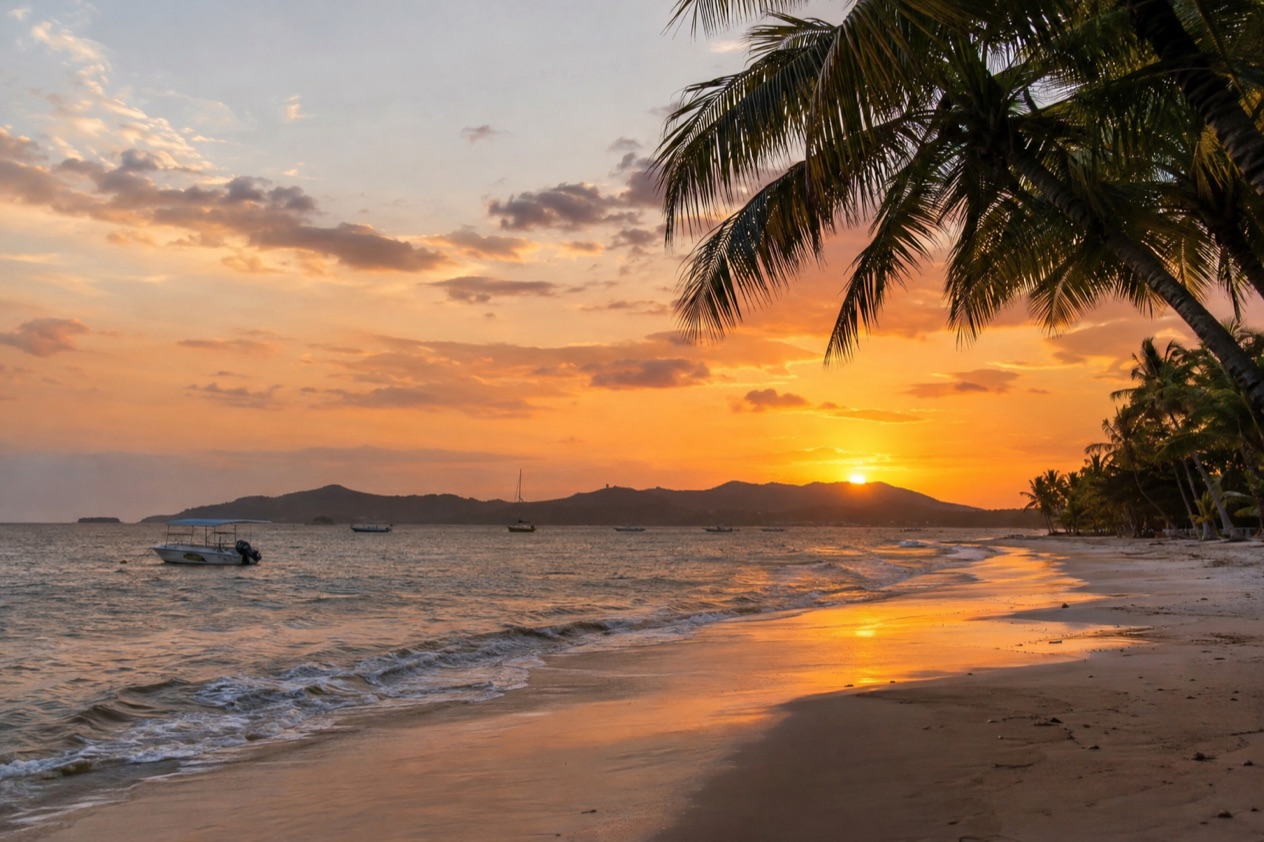
In the dry months, Tamarindo wakes to hot sun on the sand, surf instructors carrying boards down the beach before breakfast, and sunsets that pull half the town to the shoreline with a cold drink. Then the rains arrive and the hills of Guanacaste turn deep green, the afternoons fill with thunder, and the streets go quiet. Tamarindo is a beach and surf town on the Pacific coast, and the season you choose decides almost everything about the trip.
When is the best time to visit Tamarindo?
The best time for most travelers is December through April, when Guanacaste has its driest and sunniest weather, and the best time for anyone watching their budget or wanting empty beaches is the green season from May to November. Which one suits you depends on what you want from the days.
For the beach and the sea, the dry months are the easy answer. Mornings are clear, afternoons are hot, and you can plan a surf lesson, a boat outing or a long sunset on Playa Langosta without watching the sky.
For lessons, the dependable pick is the town’s beginner-friendly beach break, while anyone eager to push their limits can find larger waves at beaches a short drive to the north and south. Surfers who like a little more swell and fewer people in the lineup often look at the green season instead.
For sightseeing, the dry season again makes things simple, but the green months have their own reward. In the greenery, birds and howler monkeys become simpler to spot, hills grow lush, and the morning often stays bright until clouds gather later in the day. Plan the outdoor part of the day early and leave the late hours for a long lunch, a nap or a pool.
For budget and quiet, look at May, June and the weeks that follow. The town slows down, and the main street and beach feel less crowded. Expect rain most days, usually in the afternoon.
Families should know that March is spring break season, and Tamarindo gets loud, with groups of students, late music and a crowded beach. If you want a calmer family trip in the dry season, January and early February or the weeks right after Easter are gentler. The late dry-season heat is strong, so shade, water and midday pool breaks matter with children.
Tamarindo weather by month
Tamarindo is hot in every month, and the real difference between them is how much rain falls and how often.
| Month | Average high (°F) | Average low (°F) | Rain days | Sea (°F) |
|---|---|---|---|---|
| January | 88.5 | 75.2 | 0.4 | 83.0 |
| February | 90.4 | 75.5 | 0.2 | 83.0 |
| March | 91.7 | 76.2 | 0.5 | 85.2 |
| April | 91.6 | 77.7 | 4.2 | 85.2 |
| May | 87.2 | 77.5 | 18.7 | 87.5 |
| June | 84.4 | 76.6 | 23.0 | 86.1 |
| July | 85.0 | 76.4 | 18.0 | 85.5 |
| August | 84.7 | 76.3 | 21.9 | 85.7 |
| September | 83.2 | 75.8 | 26.7 | 86.1 |
| October | 82.5 | 75.5 | 24.8 | 85.6 |
| November | 83.5 | 75.3 | 10.5 | 83.5 |
| December | 86.1 | 75.3 | 1.4 | 83.2 |
The year has two clear halves. From December through April there is hardly any rain, and the days run from hot to very hot, with March and April at the top of the heat. May is the turning point, when rain falls on most days and the air feels thick.
From June to October the showers come nearly daily, with September and October the wettest stretch, and the afternoons are a little cooler under the clouds. November is the bridge back to the dry months, with rain on some days and a growing run of clear ones. Nights stay warm all year, so a light layer is rarely needed.
What is there to do in Tamarindo in each season?
The dry months, December to April
This is the season for everything on the water. The town’s beach break suits beginners, and surf schools rent boards and give lessons. Playa Langosta, a few minutes away, is a quieter place for a walk, and the restaurants along the main street are lively in the evening.
Playa Grande, also a few minutes from town, is a nesting beach for leatherback turtles, and the dry season is when visitors think of it for turtle evenings. Wildfires commonly occur between January and the end of May in Guanacaste, so you may see smoke or burned hillsides inland.
The green months, May to November
Mornings are the working part of the day. Surf early, take a horseback ride or a wildlife walk, and be back under a roof when the afternoon showers roll in. The landscape is at its greenest, wildlife is often easier to spot around the edges of town, and the beaches are wide and uncrowded.
This is also the time for slow pleasures: a long lunch of ceviche or a casado (the plate of rice, beans, salad and a main), a spa afternoon, a book on a covered terrace. Leave long boat days and plans that depend on a fixed sunset for another season, since cloud often covers the horizon.
Shoulder weeks and the winter holidays
November and early December are the sweet spot for many people. The rain is easing, the hills are still green, and the town is not yet full. By Christmas the dry weather is firmly in place and the beach fills with visitors for the holidays. Book early for those weeks, and expect an easy, festive mood on the sand rather than quiet.
When is Tamarindo cheapest and least crowded?
The quietest stretch is the green season, from May through October, with September and October the emptiest of all. Restaurants have free tables, the beach has room to spread out, and rooms are easier to find and to negotiate, so you often get more for the same stay.
The busiest weeks are the ones that line up with U.S. holidays. Christmas and New Year fill the town, March brings spring break crowds, and Easter week is a big moment for Costa Rican families heading to the coast. A smaller bump arrives in the middle of summer, from about early July to late August, when school vacations bring more visitors even though it is the rainy season.
If you want sun and a calmer town, aim for late January or the weeks after Easter. If you want the lowest crowds and are fine with rain, go in the first half of the green season or in the autumn, and plan your day around the clouds.
Which months should you avoid in Tamarindo?
No month is off limits, but September and October are the hardest for a beach vacation, and March and April are the hardest for anyone who dislikes heat. In those two autumn months rain falls on nearly every day, and the heaviest downpours can turn dirt roads to mud and cancel boat trips or surf sessions.
The Atlantic hurricane season runs through the autumn, and Costa Rica can still see heavy rain from tropical systems, so the wettest months are the ones to watch. Rain is the main thing to plan around, not wind, and flexible plans help.
The late dry season has its own drawbacks. Heat peaks in March and April, the sun is intense by midday, and wildfires commonly occur between January and the end of May in Guanacaste, which can leave smoke or haze. Sargassum, the floating brown seaweed, is not the usual worry here, and the winter cold fronts are mostly felt on the other side of the country.
When can you swim in Tamarindo?
The sea stays warm all year, but conditions are not always safe for swimming.
From December to March the water feels pleasant and refreshing after a hot day, and the clear weather makes it easy to be on the beach from morning to sunset. By May the sea is at its warmest, and it stays like that through the rainy months, though rain and cloud can keep you on shore.
Warm water does not mean calm water. Several drownings of U.S. tourists happen every year because rip currents are extremely hazardous, and lifeguards or warnings about unsafe conditions are missing at most beaches. Waves may run larger during the green months, so check with your hotel or a surf school about conditions that day, stay close to other swimmers, and give the beaches near town and the quieter ones up the coast the same respect.
Festivals and events in Tamarindo through the year
Winter holidays, Carnival and Easter week
Renommer la sous-section « Winter holidays and Easter week ». Local families come too, and the mood is relaxed rather than formal. December 25 and January 1 are fixed dates, and the weeks around them are among the busiest of the year.
Easter week, which moves from year to year, is when many Costa Ricans head to the coast, so the beach turns into a family gathering with picnics and music. Book ahead and expect a festive, crowded feel. Spring break in March has a younger, louder feel, with beach parties and surf events.
Nature seasons: turtles and green-season wildlife
The nature calendar here revolves around Playa Grande, where leatherback turtles come ashore to nest. The turtles come ashore at night in the months around the turn of the year, and guided visits are the way most people hope to see them. It is a chance, never a guarantee.
In the green months, the hills fill with birdsong and howler monkeys, and a guided morning walk or a boat trip along an estuary often turns up herons, kingfishers and sometimes crocodiles. Mornings are best, before the afternoon clouds.
Local fiestas and the surf calendar
Guanacaste has a strong cowboy culture, and nearby towns hold fiestas with rodeo-style events, bull riding and folk music, usually in the dry months. Ask at your hotel what is on while you are there, since dates move. Day trips to these events are a way to see a different side of the region.
If you are there for them, expect more people on the sand and more music in the evening, and take them as a chance to watch good surfers from the beach.
Sources
- Open-Meteo / ECMWF ERA5, normals 1991-2020 computed for the grid cell at 10.2993N 85.8371W, checked October 8, 2026
- Open-Meteo Marine API, average 2015-2024, checked October 8, 2026
- sunrise-sunset.org, sunrise and sunset calculated for the 15th of the month, checked October 8, 2026
- U.S. Department of State, Costa Rica Travel Information, Safety and security (https://travel.state.gov/content/travel/en/international-travel/International-Travel-Country-Information-Pages/CostaRica.html), checked October 8, 2026
- U.S. Department of State, Costa Rica Travel Advisory, issued April 1, 2026 (https://travel.state.gov/content/travel/en/traveladvisories/traveladvisories/costa-rica-travel-advisory.html), read via the State Department open data API on October 8, 2026
To plan your stay
- Things to Do in Tamarindo: Surf Lessons, Leatherback Turtles, Beach Days and Sunset Evenings
- Where to Stay in Tamarindo: Town Center, Playa Langosta, Playa Grande and How to Choose
- Tamarindo vs Jaco: Beaches, Surf, Weather and Getting There
- Day Trips from Tamarindo: Playa Grande, Rincon de la Vieja, Liberia and Surf Beaches