
ÓBIDOS · WEST OF LISBON · INSIDE THE WALLS
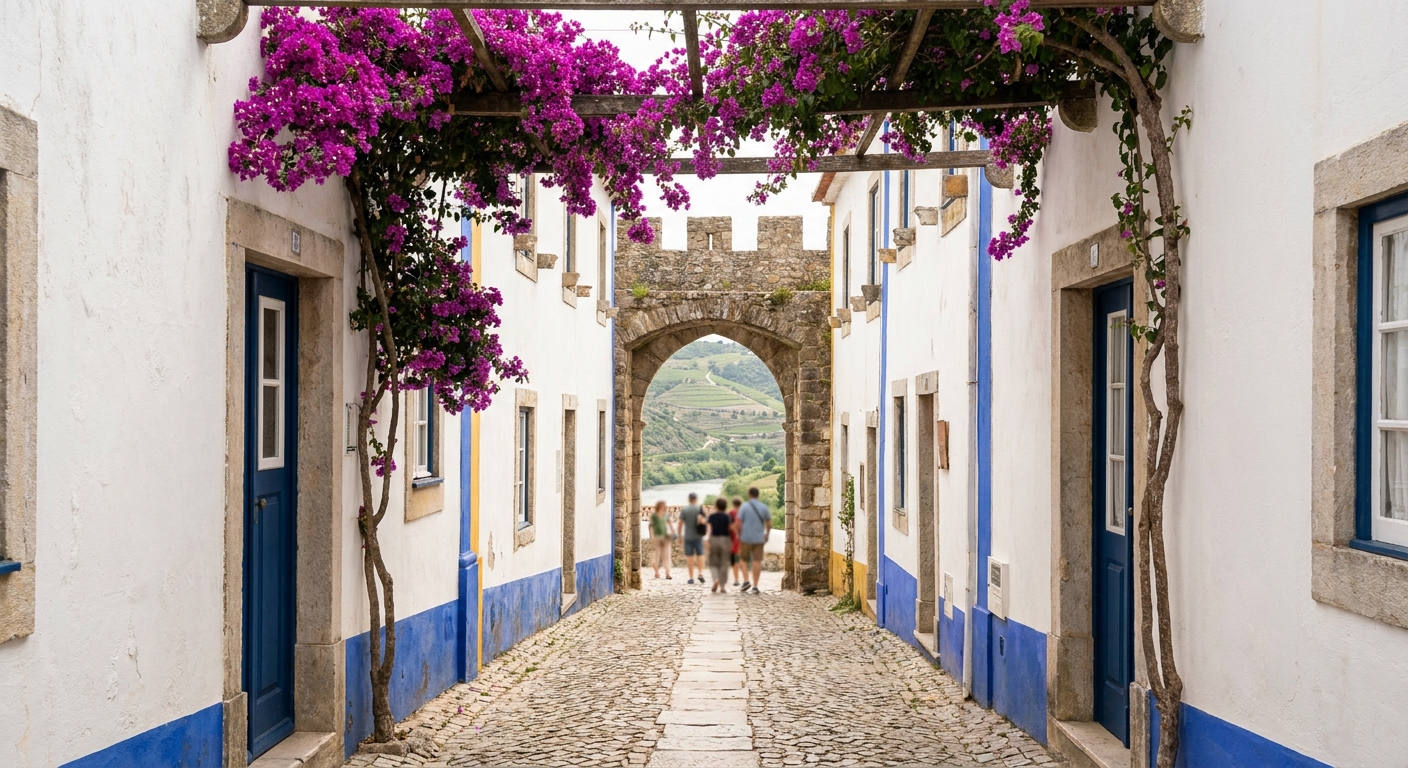
The gate does the introducing. You step off the road into the Porta da Vila, the passage bends twice inside the thickness of the wall, and blue and white azulejo panels close over your head before the village has shown you a single street. Then it opens: whitewash, painted skirting boards in blue or yellow, bougainvillea over doorways, and one lane running the length of the place to a castle. Óbidos is contained by its walls in the literal sense. Nothing important sits outside them, and nothing inside is far.
ÓBIDOS AT A GLANCE
The ramparts are both the attraction and the hazard here: walk them in daylight and with grip, keep the side lanes for the middle of the day, and decide separately whether a quiet evening is worth a room inside the gates.
WEST OF LISBON · WALLED VILLAGE · HALF DAY OR ONE NIGHT
Go for: the double bend of the Porta da Vila with its tiled panels, the painted ceiling of Santa Maria, and the side lanes one turn off the main street where the laundry is still hanging.
Think twice before: putting a child, a fear of heights or a smooth-soled shoe on the rampart walk, and before booking a room during a festival week without checking what is running in the village that weekend.
Event dates and traffic rules come from the municipality and move year to year · full sources at the end of this guide
On this page
- Things to do in ÓbidosRua Direita, Porta da Vila, Santa Maria
- Walking the Óbidos castle wallsNo handrail on much of the circuit
- When Óbidos is busiestCoach hours and the festival weeks
- One day inside the wallsMorning gate to evening street
- Where to stay in ÓbidosInside the walls, below them, or the coast
- Getting to Óbidos from LisbonCoach or car, and where to park
What to see in Óbidos on foot: Rua Direita, the Porta da Vila and Santa Maria
Rua Direita is the spine, running from the gate to the castle end, and it carries most of the shops, the ceramics, the linen and the counters pouring ginjinha de Óbidos into a small cup of chocolate. You drink the sour cherry liqueur, you eat the cup, the whole thing takes a minute. It is sold on every second doorstep and it is genuinely of this place, so treat it as the local habit rather than a find. Turn off the street at any point and the noise drops: the side lanes climb in steps between houses where people still live.
Halfway along, the square opens for the Igreja de Santa Maria, whose interior is lined with seventeenth-century tiles under a painted wooden ceiling and where royal weddings were held. Óbidos belongs to the UNESCO network of Cities of Literature, and the clearest sign of it is Livraria de Santiago, a bookshop installed in the old Igreja de São Tiago beside the castle, shelves standing where the pews were. The castle itself is a state pousada now, so the keep is for guests, but the walk up to it and the walls around it are open to everyone.
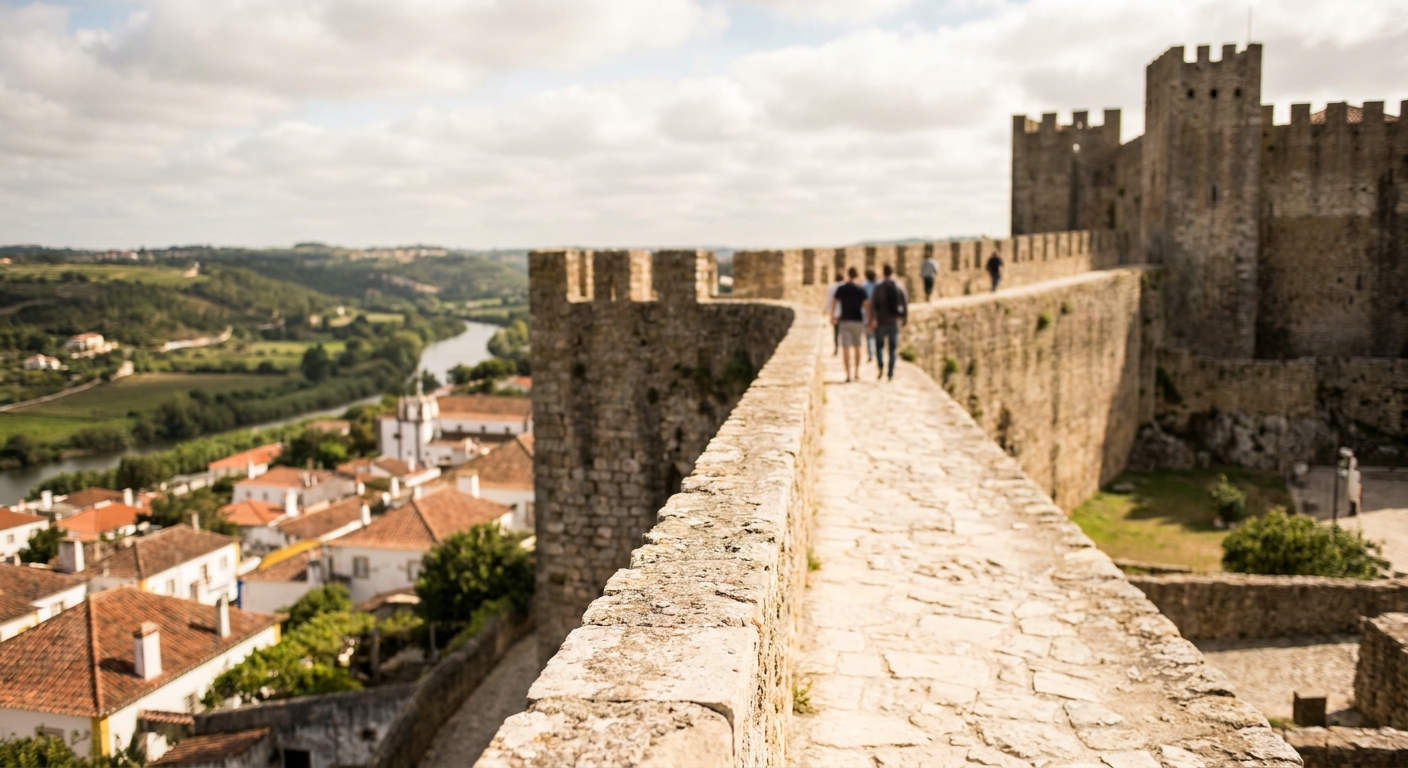
Walking the Óbidos castle walls: no handrail, and who should skip it
You can climb onto the ramparts and walk the circuit above the village, which is the single thing people come here to do. Stairs go up near the Porta da Vila and again at the castle end. From the top you look down on the tile roofs and the whitewash, out over the fields, and along the arcaded line of the old aqueduct running away toward Usseira. It is a short circuit by the standards of a fortified town, and it is where every photograph of Óbidos comes from.
It is also unprotected. Long stretches of the parapet have no handrail and no barrier on either edge, the walkway narrows and widens without warning, and the surface is worn stone with steps at uneven heights and sections that slope. Rain leaves it slick, and the exposed sides catch wind. Nothing is signposted in the way an American visitor expects from a public walkway. Our Portugal safety guide sets out the general approach; on the wall, the practical version is grip on your shoes and both hands free.
That rules the walk out for some people, and there is no shame in it: vertigo, an unsteady knee, sandals, or a toddler who bolts. A short section from the nearest stair and back down gives you the rooftops without committing to the full loop, and the view from the castle end is the same view. Families weighing it up will find the trade-off argued in our Portugal with kids guide. Keep the wall for daylight and dry stone, and leave the evening to the lanes.
When Óbidos is busiest: coach hours, the medieval market and the chocolate festival
The village is tiny and the coach parks sit just below it, which is the whole crowd problem in one sentence. Groups unload, funnel through the Porta da Vila and walk the same street, so through the middle of the day Rua Direita moves at the pace of whichever tour is ahead of you. The side lanes absorb almost none of it, because groups stay on the main line. One turn uphill and you are usually alone with somebody’s washing.
Coach itineraries run to a schedule, and the schedule ends. Late in the afternoon the parking empties, the shutters come down on the ceramics shops, and the street returns to residents and to whoever is sleeping inside the walls. Early morning works the same way in reverse, when the only vehicles in the lanes are the permitted delivery vans. The sights themselves fit comfortably into a half day, which is how our day trips from Lisbon file it. A night here is optional, and what it buys is the evening and the first hour of the morning.
Several events change the village entirely rather than merely filling it. The Mercado Medieval takes over the streets in summer with costumed stalls and a ticketed gate, the Festival Internacional de Chocolate brings its own crowds, FOLIO fills the churches and bookshops with the literary festival, and Óbidos Vila Natal runs for weeks around Christmas. Dates move from one year to the next and rooms inside the walls go early for all of them, so check the Câmara Municipal de Óbidos calendar before you book anything.
A day in Óbidos: a one-day walking itinerary
| Time of day | Where | Why then | The trap |
|---|---|---|---|
| Early morning | Porta da Vila and Rua Direita | The street belongs to deliveries and residents before the first groups arrive | Expecting the shops to be open this early |
| Mid morning | The rampart circuit | Dry stone, good light on the roofs, fewer people on the narrow stretches | Starting the wall after rain, in smooth soles |
| Midday | The side lanes off the main street | Groups stay on the spine, so one turn uphill is quiet | Fighting the crowd along Rua Direita instead of leaving it |
| Early afternoon | Igreja de Santa Maria, Livraria de Santiago | Interiors are the sensible answer to a full street | Assuming the castle is visitable: it is a pousada |
| Late afternoon | The castle end of the walls | The coach parks empty out and the village hands itself back | Leaving at the same moment as everyone else |
| Evening | Dinner in the lanes, then the street | Lit whitewash, shutters down, almost no through traffic | Attempting the unrailed wall walk in the dark |
Where to stay in Óbidos: inside the walls, below the gate, or out at the lagoon
Inside the walls means converted village houses on the lanes, a handful of small hotels, and the pousada in the castle. The reward is the hour after the last coach and the hour before the first one. The practical catch is arrival: many intramural rooms involve carrying bags in from a gate over cobbles, though some properties can arrange vehicle access or an authorized drop-off under the municipal permit system. Ask your accommodation for its exact arrival instructions when you book, and ask before you take a large suitcase.
Below the walls, the newer streets around the main road give you parking at the door, easier luggage and a walk up through the gate, which suits anyone driving on to the coast the next morning. Further out, the Lagoa de Óbidos and Foz do Arelho put you on flat lagoon water with the ocean beach beside it, a reasonable base if you are also heading for Nazaré or Ericeira. Zone thinking for the rest of the country sits in our where-to-stay guide.
Getting to Óbidos from Lisbon by coach or car, and where to park
Two ways in do the work. Express coaches run north from Lisbon and set passengers down on the road outside the walls, close to the Porta da Vila, with a short uphill walk to the gate. Driving is the other option, and it is the one that lets you continue to the coast the same afternoon. Timetables and fares change with the operator and the season, so we publish none here; our getting-around guide covers how the coach network fits together, and the car guide handles tolls and the rest.
Parking is the question everyone arrives with. Visitors normally park outside the gates, in the lots along the road below the walls, and walk in. Circulation and parking inside the village are governed by the municipality and reserved for vehicles carrying the corresponding permits: residents, owners, accommodation, services and temporary access. That is why you meet a delivery van at breakfast and nothing at all by mid-morning. Do not plan on driving to your door unless the property has told you in writing that it can be done.
As for how long to give it, the walls, the church, the bookshop and the street add up to roughly half a day at a slow pace, which is why Óbidos is so often paired with something else on the west coast. Adding a night changes the texture rather than the itinerary. Season matters more than most visitors expect, since the rampart walk is a different proposition in wet weather: the month-by-month guide holds the pattern, and the Portugal hub puts the western towns in order.
When to go. The month-by-month case for Obidos — what the normals say, when the sea is warm enough to swim and which weeks fill up — sits on the best time to visit Obidos.
The last word
Óbidos is one street, one wall and a few hundred meters of lane, and its whole character depends on the hour you meet it. At noon you are queuing behind a guide’s raised umbrella for a chocolate cup of ginjinha. By six the coach park below the Porta da Vila is a rectangle of empty asphalt, the shutters are rattling down over the ceramics, and a cat has repossessed the warm step outside the bakery. The day-trip comparison is where this fits into a Lisbon week.
If you do stay, walk the wall in daylight and give the darkness to the street instead, where the whitewash holds the lamplight and the only traffic is somebody’s dog. The village is small enough to lap twice after dinner, and the second lap, when you already know which lane comes out above the roofs, is the one worth building the evening around.
Sources & data for this guide
- Village layout, Porta da Vila, Rua Direita, Igreja de Santa Maria and the castle pousada · visitportugal.com (Turismo de Portugal) plus ground observation · checked Sep 6, 2026
- Traffic and parking inside the walls: circulation and parking are regulated by the municipality, with access for permit-holding vehicles (residents, owners, accommodation, services, temporary access). Confirm the current rules and your arrival instructions with the Câmara Municipal de Óbidos and with your property · checked Sep 6, 2026
- Events that reshape the village: Mercado Medieval, Festival Internacional de Chocolate, FOLIO and Óbidos Vila Natal. Dates shift each year and are published on the municipal and festival calendars, which is why none appear on this page · checked Sep 6, 2026
- Óbidos in the UNESCO Creative Cities network (Literature), and the bookshops installed in former churches including Livraria de Santiago · municipal literature programme · checked Sep 6, 2026
- Coach services from Lisbon and parking outside the gates: operators post seasonal timetables and fares; we publish neither here because both change · checked Sep 6, 2026
- Editorial note: the condition of the rampart walk (no handrail on much of the circuit, uneven worn steps, slippery when wet) and the afternoon emptying of the village are our own observations, not published data. We hold no visitor-number statistics for Óbidos