
ÓBIDOS · FEBRUARY · IPMA 1991-2020
A walled village on a hill, one straight street through the middle of it, whitewash trimmed in yellow and blue, and in February a thermometer that averages 58.5°F by day. Óbidos in winter is a sweater town: cold hands around a chocolate cup of ginja, wet cobbles shining under the gate, the ramparts yours for whole stretches of the afternoon.
The date gives you comfortable walking and quiet lanes. It takes away the evening: on February 15 the light is gone by 6:14 pm, and 10 hours 46 minutes is all the daylight you get to spend. Everything below is what those numbers do to a visit you have already decided to make.
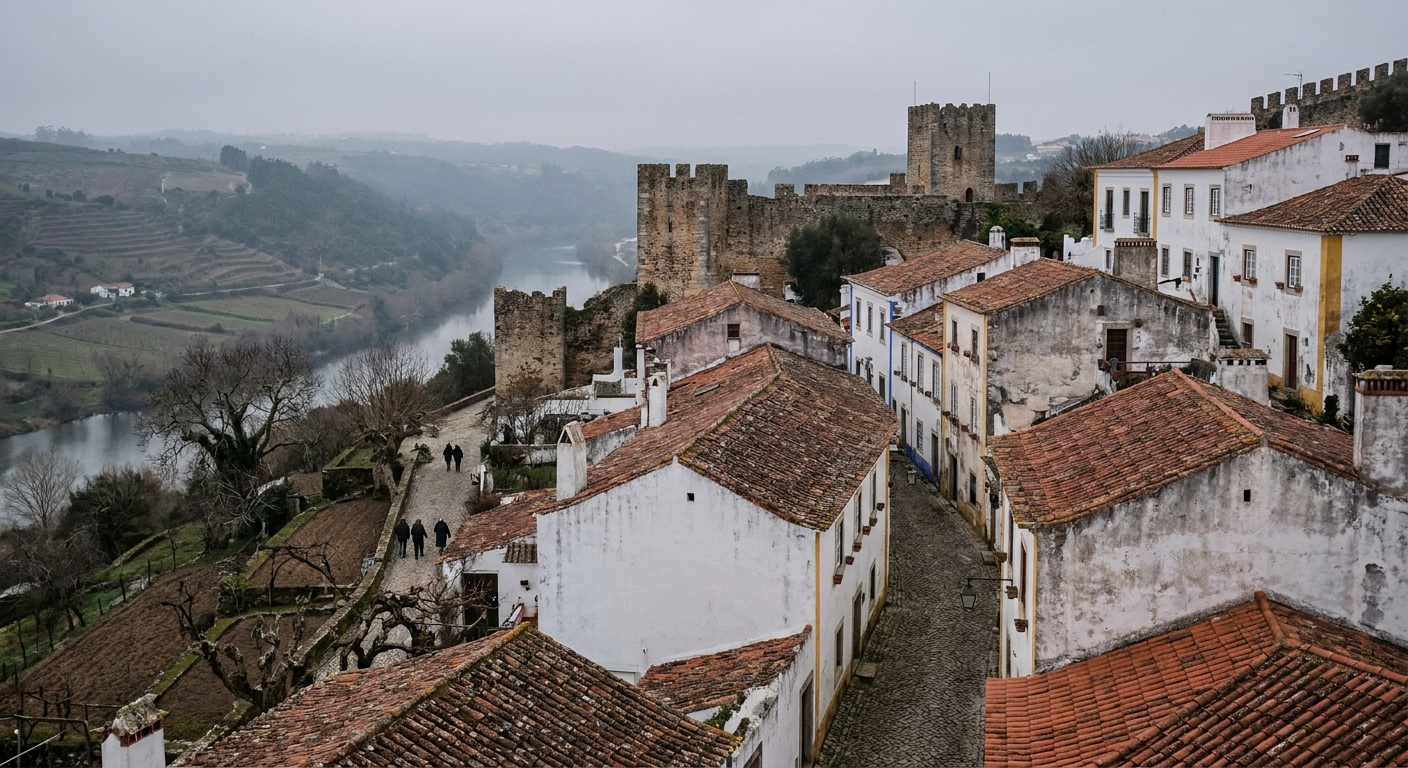
THE MONTH AT A GLANCE · ÓBIDOS · FEBRUARY
February gives you mild days, roughly one wet day in four and short afternoons, so plan the walls for midday and sleep inside the gates rather than day-tripping from Lisbon.
LOW SEASON BY THE CALENDAR · 10H 46M OF DAYLIGHT ON FEB 15 · SWEATER AND RAIN SHELL
Go for: the full wall circuit walked at noon instead of at dawn, empty lanes between the gate and Igreja de Santa Maria, and a long lunch that nobody is waiting on.
Think twice before: building the trip around water or evenings. Daylight ends at 6:14 pm, and we found no verified sea-temperature series for this coast.
Normals: IPMA 1991-2020, station 531 Cabo Carvoeiro · Daylight: sunrise-sunset.org · full sources at the end
On this page
- Average highs, lows and rain daysÓbidos weather in February
- How cold do the nights get?58.5°F days, 50.5°F nights, frost risk
- When to book a February roomCrowds, prices and the lodging tax
- Things to do in Óbidos in FebruaryThe walls, Rua Direita and the Lagoa de Óbidos
- A two-day plan built on 10h 46m of lightThe February itinerary, hour by hour
- January or March instead?How the three months compare
- Is February a good time to visit Óbidos?Our verdict, and who should shift
The town itself, where to sleep and how to get up from Lisbon belong to our Óbidos guide, and the twelve-month view of the country sits in the best-time verdict. Below, the date and nothing else.
Óbidos weather in February: average highs, lows and rain days
| February in Óbidos | Normal, 1991-2020 |
|---|---|
| Average high | 58.5°F (14.7°C) |
| Average low | 50.5°F (10.3°C) |
| Monthly rainfall | 2.17 in |
| Days with 0.04 in (1 mm) or more | 7.6 |
| Days with 0.39 in (10 mm) or more | 1.7 |
| Daylight on February 15 | 10h 46m · 7:28 am to 6:14 pm |
Every figure here comes from one instrument. IPMA, Portugal’s national weather service, publishes 1991-2020 normals for station 531 at Cabo Carvoeiro, 32.0 meters above the sea on the Peniche headland: February averages a high of 58.5°F (14.7°C), a low of 50.5°F (10.3°C) and 2.17 inches of rain. That is a real thermometer rather than a model grid cell. It also sits out on the open coast while Óbidos stands a short way inland behind its walls, and IPMA flags the limit itself. High ground nearby runs colder and considerably wetter, so nobody should pack for a hill trail on a coastal reading.
Rain falls on 7.6 days in an average February, counting every day that records at least 0.04 inch (1 mm). That works out to something wet roughly one day in four, and most of those days are not washouts: a gray morning, a bright lane by three o’clock. Watch one trap when you compare tables. US summaries usually count days above 0.10 inch, so a smaller number published elsewhere can describe exactly the same February sky.
Eight degrees separate the average high from the average low, a narrow Atlantic spread that keeps nights mild and afternoons cool. You wear the same three layers from breakfast to dinner: long sleeves, a fleece or sweater, and a shell that genuinely keeps water out. Shoes with grip matter more than they sound, because 2.17 inches spread over the month leaves the cobbles of Rua Direita slick well after the rain stops. Our packing guide handles the rest of the suitcase.
On February 15 the sun rises at 7:28 am and sets at 6:14 pm local time, Portugal staying on UTC through the winter, for 10 hours 46 minutes of daylight. The last usable light on the ramparts arrives around six, so the wall circuit is an afternoon job and never an evening one. Any drive back toward Lisbon or Nazaré after dinner happens in full dark.
How warm is Óbidos in February? Daytime and night temperatures and frost risk
58.5°F is the daytime figure, 50.5°F the nighttime one, and the eight degrees between them are the whole story of a February day here. There is no midday spike to hide from and no plunge at dusk. The ocean twenty minutes west flattens both ends of the curve, which is why the coast keeps a winter that Lisbon’s inland suburbs do not quite share.
In practice, breakfast happens at around 50 degrees and calls for a jacket that closes. By two in the afternoon, with sun on whitewashed walls inside the gate, the sweater comes off on the sheltered side of the street and goes straight back on in the wind above it. Gloves are a judgment call. A rain shell is not, given how many of those 7.6 wet days arrive as a squall rather than a warning.
On frost, we will not pretend. The IPMA normals we read carry no count of nights at or below 32°F for this station, so we publish none. What they do carry is an average low of 50.5°F, a full 18.5 degrees above freezing at the coast, and IPMA’s own caveat that the headland reading does not describe every spot around it. Óbidos sits inland of that thermometer, and a clear, still night behind the walls can run colder than the number suggests.
How busy is Óbidos in February? Crowds, prices and when to book
February lands between New Year and Easter, the low stretch of the Portuguese calendar. We found no occupancy series and no monthly room-rate series for Óbidos, so we crown no month the cheapest and none the busiest. What the date does guarantee is measurable: 10 hours 46 minutes of light and 7.6 wet days, and those two figures shape a February weekend far more than any rate card would.
The walled center holds a handful of small hotels and guesthouses, and the choice widens once you go outside the gate. Two or three weeks ahead is usually enough for a February Saturday (est.), against something far longer for a spring one. We could not verify booking lead times, so read that as our reading rather than a measurement. If you are collecting a car for the drive up, the rental guide covers tolls and the paperwork, and our where-to-stay page frames the wider region.
We could not verify whether Óbidos levies a municipal lodging tax, or at what rate, so we quote no percentage and you should ask at check-in. Budget the rest of the trip with our Portugal cost guide, which keeps the national picture.
One upgrade genuinely changes the month, and it is sleeping inside the walls. With the light gone at 6:14 pm and back at 7:28 am, a room inside the gates buys two hours nobody else has: the lanes after dinner and the ramparts before breakfast. Second on the list is heat. Ask whether the room has real heating before you book, because 50.5°F nights are felt indoors in old stone houses.
Things to do in Óbidos in February: the walls, Rua Direita and the Lagoa de Óbidos
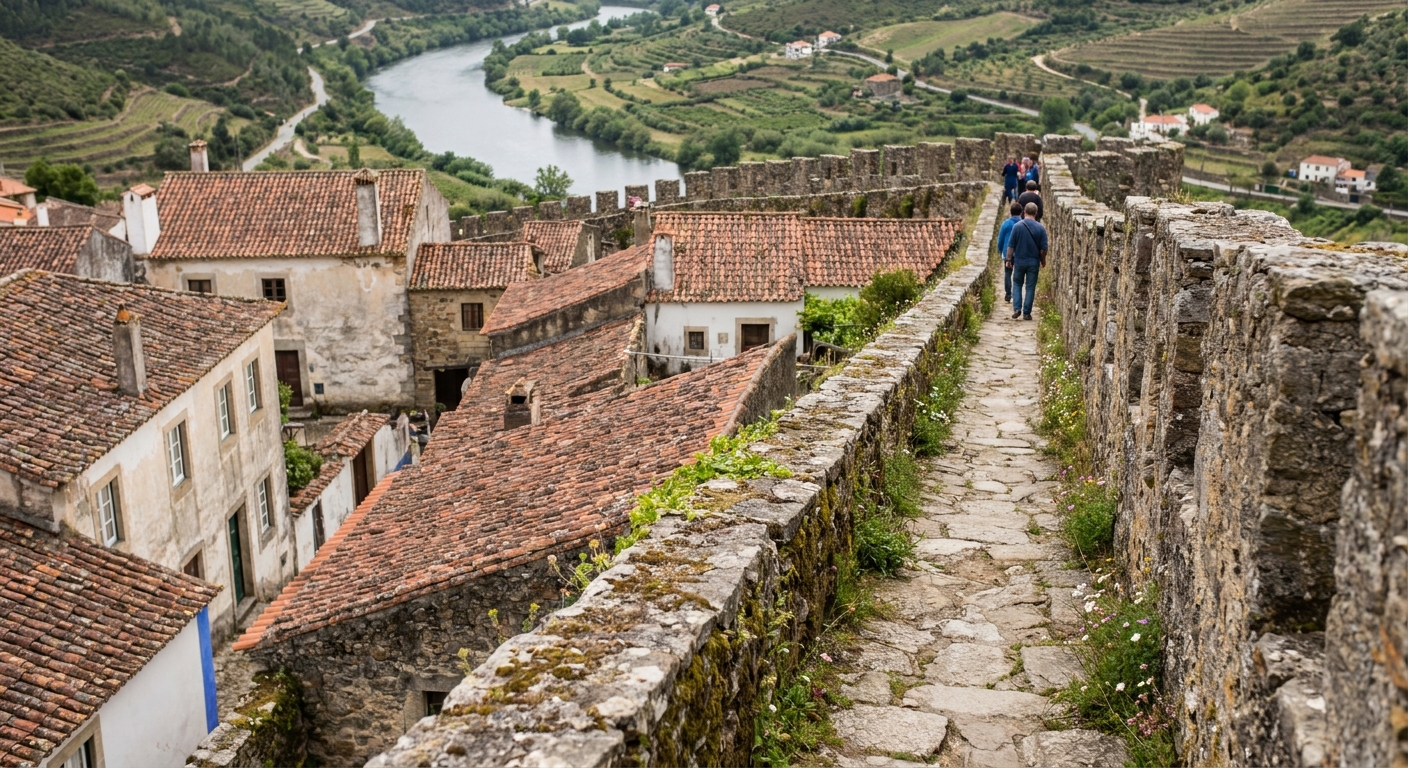
February hands you the wall circuit at noon. At 58.5°F the whole loop is a midday walk in a sweater rather than a dawn raid against the heat, and long stretches of the parapet stay empty between groups. Cool air also makes the hill itself easier: everything in the old town is uphill from the gate, and you climb it without ever needing shade.
Start at Porta da Vila, the double gate with a tiled oratory over your head, and take the steps to the wall walk. The circuit runs above Rua Direita, the single straight street through town, and looks down on the Igreja de Santa Maria on its square and the Igreja de São Pedro at the far end. Inside the former Igreja de Santiago, a bookshop fills the nave with shelves. Out on the plain the Aqueduto da Usseira runs toward the walls, and the Lagoa de Óbidos opens to the ocean a short drive west. We could not verify current hours or admission for any of them, so we quote none.
What February changes is the air, not the stone. The gate, the aqueduct and the rampart are exactly what they are in July, but 58.5°F days and 50.5°F nights turn the long outdoor loop into the comfortable part of the trip and a two-hour lunch into the sensible part. Wind off the Atlantic is the variable nobody packs for: the same ocean that keeps the nights at 50 degrees also strips the warmth off a bright afternoon on the parapet.
Walking costs nothing, and in February that covers most of the day: Rua Direita end to end, the square in front of Santa Maria, the back lanes that no one photographs, the view down onto the aqueduct from the walls. Which sites charge, what they charge and when their doors open in winter we could not verify, so check before you count on any of them. A ginja de Óbidos poured into a small chocolate cup is the local ritual and a fair answer to a cold afternoon.
Óbidos in February: a two-day itinerary
Day one starts early because the light does. Sunrise at 7:28 am gives you an hour with nobody in it, so take coffee at eight and the wall circuit from nine, while the low sun is still raking across the whitewash. Igreja de Santa Maria before noon, lunch at one and no hurry about it, the bookshop in the old Igreja de Santiago mid-afternoon, then a ginja around five. By 6:14 the light is gone and dinner inside the walls is the whole evening plan.
Day two goes downhill: the Aqueduto da Usseira on foot from the gate, then the short drive west to the Lagoa de Óbidos for an hour of flat water and wind. If the sky turns, and 7.6 days in an average February do turn, swap the lagoon for the church interiors, the bookshop you rushed the day before and a table by a window. Rain here arrives in bands rather than a single gray lid, so a wet eleven o’clock often means a dry three.
Óbidos in February vs January and March
| Normal, 1991-2020 | January | February | March |
|---|---|---|---|
| Average high | 58.1°F (14.5°C) | 58.5°F (14.7°C) | 60.6°F (15.9°C) |
| Average low | 49.8°F (9.9°C) | 50.5°F (10.3°C) | 52.7°F (11.5°C) |
| Rainfall | 2.98 in | 2.17 in | 1.92 in |
| Days with 0.04 in or more | 10.4 | 7.6 | 7.6 |
| Sea temperature | Not verified | Not verified | Not verified |
All three months come from the same IPMA station and the same 1991-2020 period, so the comparison is apples to apples. February runs 0.4°F warmer than January by day and 2.1°F cooler than March. Rainfall is where the three separate: 2.98 inches in January, 2.17 in February, 1.92 in March. On water temperature we found no verified series for this stretch of coast, so no figure appears anywhere here. Where we do publish one, it is an average of daily maxima, a touch warmer than a true 24-hour mean, and worth knowing before you compare our tables with anyone else’s.
Shift four weeks forward and March pays you 2.1°F on the high, 2.2°F on the low and a quarter inch less rain, for an identical 7.6 wet days. Shift four weeks back and January charges 0.81 inch more rain spread across 2.8 extra wet days, for a high that is 0.4°F lower. Our January page makes the case for the quieter end of that trade.
Is February a good time to visit Óbidos?
Yes, if you came to walk. Mild afternoons, roughly three dry days in four and a village you can have largely to yourself between coach arrivals make a strong two-day trip. No, if the plan depends on water or on evenings: daylight ends at 6:14 pm mid-month, and we have no verified sea temperature to encourage anyone toward the lagoon in a swimsuit.
If the answer is no, take March. Two more degrees by day, two more at night, a quarter inch less rain and the same 7.6 wet days, plus a later sunset every week. The only thing you trade is the winter quiet, and that trade gets steeper the closer the calendar creeps to Easter.
Between the three, February is the month that keeps January’s emptiness while the rain bill drops by 0.81 inch and 2.8 wet days.
The last word
Book the night, not the day trip. Óbidos in February belongs to whoever is still inside the walls at 6:14 pm and out on the ramparts again at 7:28 the next morning, and a coach from Lisbon owns neither hour. Then plan for the 1.7 days in an average February that dump 0.39 inch or more: keep one church interior and one long lunch in reserve for them, and give every other afternoon to the wall circuit.
Sources & data for this guide
- February normals, rainfall and wet-day counts · IPMA, Normais Climatológicas 1991-2020, station 531 Cabo Carvoeiro (Peniche), altitude 32.0 m · checked Sep 23, 2026
- January and March normals, same station and same 1991-2020 period · IPMA · checked Sep 23, 2026
- Daylight, sunrise 7:28 am and sunset 6:14 pm on February 15, local time · sunrise-sunset.org · checked Sep 23, 2026
- Rain-day thresholds: IPMA counts days at 1 mm (0.04 in) and 10 mm (0.39 in), not the 0.10 in threshold common in US tables · counts are not interchangeable
- Sea temperature: we found no verified series for this stretch of coast, so no water figure appears
- Occupancy, room rates and any municipal lodging tax: we could not verify them, so we publish no rate, no ranking and no percentage
- Admission prices, winter opening hours and February event dates in Óbidos: we could not verify any, so we quote none · check with operators before you go