
ÓBIDOS · MARCH · THE WALLED TOWN
March is the month the Silver Coast gets its light back before it gets its buses. Óbidos still fits inside its ring of walls, the whitewash is bright rather than glaring, and a ginja in its little chocolate cup tastes considerably better under a cool sky than it does in an August queue.
The trade is plain arithmetic. Afternoons average 60.6°F instead of April’s 61.9°F, measurable rain lands on about one day in four, and the sun sets at 6:46 p.m. on March 15. Pack a layer you can shed at one o’clock and pull back on at five, and the month does the rest.
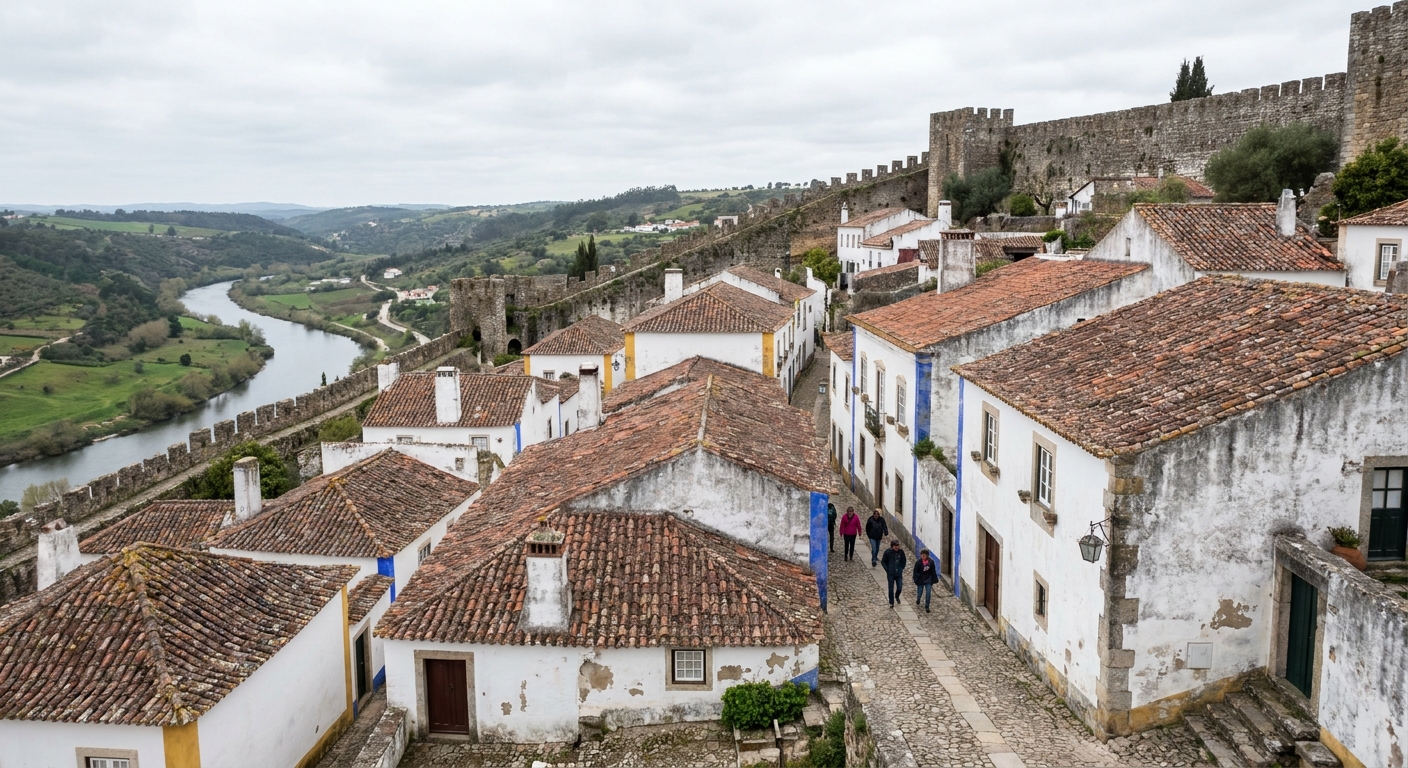
THE MONTH AT A GLANCE · ÓBIDOS · MARCH
Come for 60.6°F afternoons and near-empty ramparts, accept 7.6 days of measurable rain, and book a room inside the gate so the quiet hours are yours.
IPMA 1991-2020 NORMALS · STATION 531 CABO CARVOEIRO · COASTAL READING, INLAND RUNS COLDER
Go for: the wall circuit at 60.6°F, streets that empty once the day-trip coaches leave, and almost twelve hours of daylight to spend on foot.
Think twice before: planning beach days. We could not verify a sea temperature for this stretch of coast, and 7.6 wet days is a real share of a short trip.
Normals: IPMA station 531, Cabo Carvoeiro · Daylight: sunrise-sunset.org · full sources at the end
On this page
- Óbidos weather in MarchHighs of 60.6°F and 7.6 wet days
- How cold it gets at nightLows of 52.7°F, and the sea question
- Crowds, prices and when to bookWhat we verified and what we could not
- Things to do in Óbidos in MarchThe walls, Rua Direita, Lagoa de Óbidos
- A two-day plan for MarchTwo days built on 12 hours of light
- March, February or April?How the three months compare
- Is March a good month to go?Our verdict, and who should shift
Óbidos is small, and in a small town the date changes the visit more than the plan does. The normals below come from a single coastal station north of Lisbon, and we say exactly where that station stands before anyone packs a bag for the hills. The main Óbidos guide handles what the town is; this is what the month does to it.
Óbidos weather in March: average highs, lows and rain days
| Measure | March normal (1991-2020) |
|---|---|
| Average high | 60.6°F (15.9°C) |
| Average low | 52.7°F (11.5°C) |
| Rainfall for the month | 1.92 in |
| Days with 0.04 in or more | 7.6 |
| Days with 0.39 in or more | 1.6 |
| Daylight, March 15 | 11 h 59 min (sunrise 6:46 a.m., sunset 6:46 p.m.) |
Every figure here comes from IPMA, the Portuguese national weather service, and from one instrument in particular: station 531 at Cabo Carvoeiro, 32.0 m above the sea on the Peniche headland. Across the 1991-2020 normals, March runs an average high of 60.6°F, an average low of 52.7°F and 1.92 inches of rain. That is a real thermometer rather than a model grid cell, and it stands on the open coast while Óbidos sits slightly inland behind its walls. Higher ground away from the water is colder and a good deal wetter, so do not pack for a hill walk on a coastal reading.
Measurable rain falls on 7.6 days in an average March, roughly one day in four, and 1.6 of those days deliver 0.39 inch or more. IPMA counts at its own thresholds, 1 mm and 10 mm, not at the 0.10-inch line most American tables use, so the two sets of rain-day counts are not interchangeable. On the ground that usually reads as a bright hour on the ramparts, a squall that passes in the time it takes to drink a galão, and cobbles shining afterward.
Only 7.9°F separates the average afternoon from the average night. That narrow gap is not permission to travel light on top: 52.7°F with Atlantic air moving through reads colder than the figure suggests, and the stone lanes hold the morning chill well past breakfast. A fleece, a shell that stuffs into a daypack and shoes that grip wet calçada cover the month, and our packing guide has the rest.
On March 15 the sun clears the horizon at 6:46 a.m. and drops at 6:46 p.m. local time, for 11 hours 59 minutes of daylight, near enough the even split of the equinox. A five o’clock start on the wall circuit still finishes in light. Leave at eight for the coast and you are back on the ramparts before sunset, with dinner inside the gate beginning under lamps.
How warm is Óbidos in March, day and night?
March averages 60.6°F by day and 52.7°F by night, 7.9°F apart. Set against February, the daytime gain is 2.1°F, and April adds only another 1.3°F on top, so the climb through the coastal spring is gradual rather than sudden. Nights move a little faster than days: 50.5°F in February, 52.7°F now, 54.5°F in April.
Mornings want a jacket and many afternoons do not. By one o’clock a sunny 60.6°F on a sheltered terrace on Rua Direita reads like shirtsleeves, and stepping into the shadow of the wall puts the layer straight back on. Wind is the variable nobody packs for: the shore between Peniche and Nazaré is exposed, and the lagoon beach at Foz do Arelho has nothing standing between it and the ocean.
The normals we read carry no frost-day count for station 531, so we give no number. With an average low of 52.7°F, nights sit some 20°F above freezing and the coastal air rarely does anything dramatic in March. We could not verify a sea-surface temperature for this stretch of shore either, so we quote no water figure. If you find one elsewhere, check what it averages: most published sea temperatures are means of daily maxima, and they therefore read a shade warmer than a true 24-hour average.
How busy is Óbidos in March? Crowds, prices and the demand peak
We found no occupancy series and no monthly room-rate data for Óbidos, so we crown no month cheap and no month expensive. The pattern you can rely on is hourly rather than seasonal. Óbidos is a standard stop on the Lisbon day-trip circuit, and in March the lanes fill late in the morning and thin out again by mid-afternoon. Stay the night and the two best stretches of the day, before ten and after five, belong to residents, a few guests and you.
Booking lead time here is our judgment rather than measured data. A month ahead is comfortable for a March weekday, and a Saturday inside the gate deserves longer, because the walled town holds guesthouses rather than hotels and the castle pousada is one building. If your dates hang off a flight, our getting-around guide covers how the trip north from Lisbon fits into a morning.
We could not verify whether Óbidos levies a municipal tourist tax, or at what rate, so we give no percentage. Ask the property when you book whether the quoted total is the figure you pay on departure, and ask the same question about heating while you have them: a March night of 52.7°F inside thick stone is a different proposition from the same night in a modern room, and few listings say which one you are buying.
Spend the extra on the bed and almost nothing else. A heated room inside the walls buys the empty ramparts before ten and a warm evening once the outside air settles toward 52.7°F. Upgrades to meals, tours and rental cars will not shift a March day in a town you cross on foot in ten minutes.
Things to do in Óbidos in March: the walls, Rua Direita and Lagoa de Óbidos
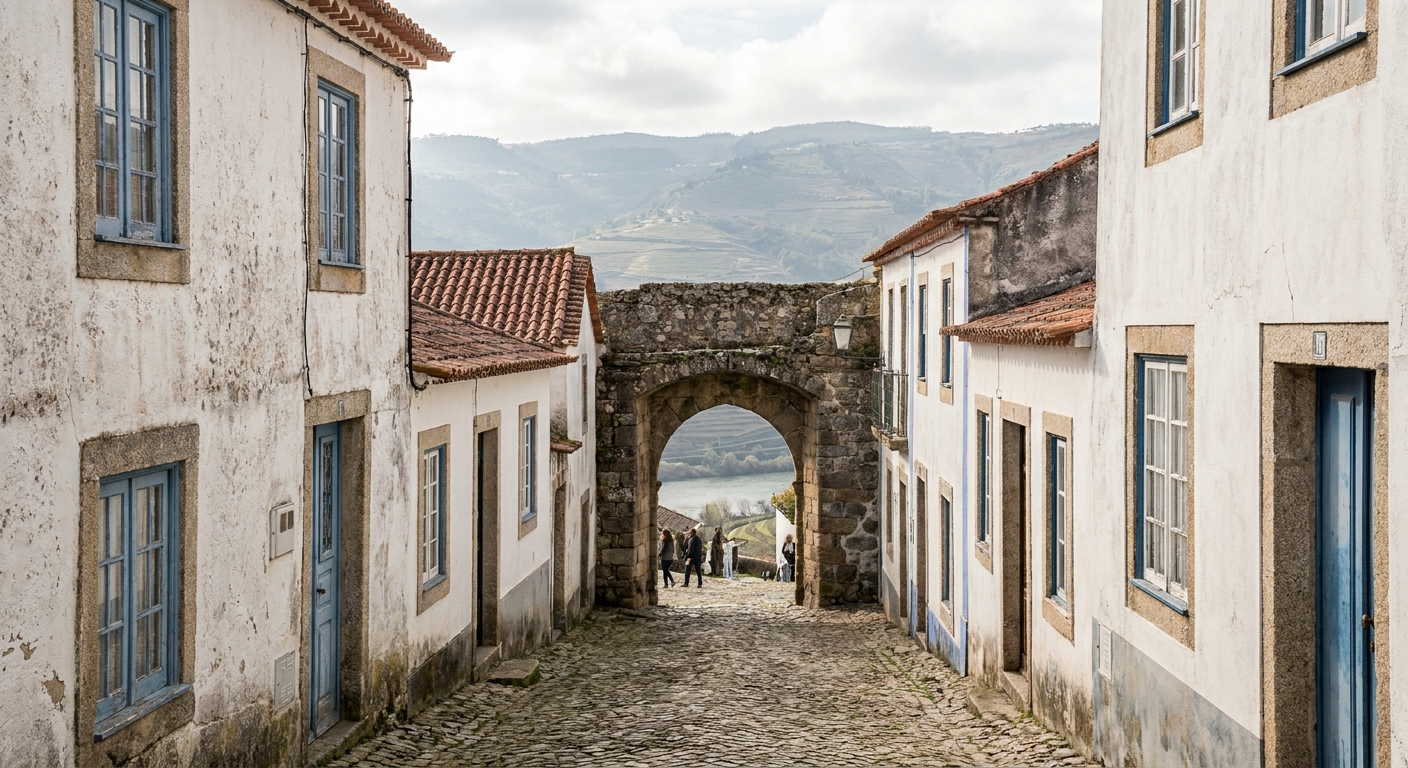
March hands you the middle of the afternoon, which July takes away. The wall path is uneven stone, open to the sky and without a scrap of shade, and 60.6°F is the temperature it walks best at. Photographers get the second dividend: the sun stays low for most of a twelve-hour day, so the whitewash reads white instead of blowing out.
Inside the gate, the spine is Rua Direita, running from the tiled Porta da Vila to the castle at the far end, now a pousada. Igreja de Santa Maria holds the town’s blue-and-white tilework, and the bookshops tucked into a church, a market hall and a cellar are an Óbidos particularity worth an unhurried hour. Outside, the aqueduct strides off toward the fields, Lagoa de Óbidos opens at Foz do Arelho, and Cabo Carvoeiro at Peniche is where the thermometer behind these figures stands. We could not verify 2026 hours or ticket prices for any of them, so we quote none.
What March changes at those places is the air around them rather than the places themselves. The lagoon shore at Foz do Arelho is a walk under a 60.6°F sky and an unbroken wind, where the same sand in August is a swimming beach. Up on the circuit the change is grip: with 7.6 wet days in the month, worn stone is often damp at nine and dry by two on a clear day.
Walking the wall circuit, the length of Rua Direita and the lane out to the aqueduct costs nothing, and in March nothing is queuing ahead of you. We could not verify which paid sites keep reduced winter hours in March, and we found no confirmed event dates for the month, so we name none. Ask at breakfast: your guesthouse knows what opened that week.
Óbidos in March: a two-day itinerary
Day one stays inside the walls. Be up on the ramparts by half past eight, while the light is low and the coaches are still on the road from Lisbon, and take the full lap first. Drop into Rua Direita afterward for a ginja in a chocolate cup, see Santa Maria’s tiles before noon, then eat indoors through the fullest part of the day. From four the lanes thin again, and at 6:46 p.m. the light goes for good.
Day two goes to the water: Foz do Arelho for the lagoon shore, or Peniche and Cabo Carvoeiro for cliffs and the headland where station 531 sits. Leave at eight and you are back with daylight in hand. If one of the month’s 1.6 heavy days lands instead, keep it indoors: the church tiles, the bookshops, a long lunch, and the wall walk pushed to the break in the weather. Our getting-around guide covers the options for both days.
Óbidos in March vs February and April
| Measure | February | March | April |
|---|---|---|---|
| Average high | 58.5°F | 60.6°F | 61.9°F |
| Average low | 50.5°F | 52.7°F | 54.5°F |
| Rainfall | 2.17 in | 1.92 in | 1.88 in |
| Days with 0.04 in or more | 7.6 | 7.6 | 7.7 |
These three months run closer together than the calendar implies. Daytime normals climb 58.5°F, 60.6°F, 61.9°F, and nights 50.5°F, 52.7°F, 54.5°F, so the whole swing from February to April is 3.4°F by day. Rainfall falls steadily across the same stretch, 2.17 inches to 1.92 to 1.88, while the count of wet days barely twitches: 7.6, 7.6, 7.7. The rain thins out, it does not go away.
Moving four weeks forward buys 1.3°F on the afternoon, 1.8°F on the night and 0.04 inch less rain over the month, a difference you feel at breakfast and almost nowhere else. Moving back to February costs 2.1°F by day and adds a quarter inch of rain inside the same 7.6 wet days, so February’s days are heavier rather than more frequent. Crowds are the one variable we cannot price: no occupancy series was available to us for any of the three, and we rank them on weather alone.
Is March a good time to visit Óbidos?
Yes if the trip runs on walking, looking and eating. Afternoons at 60.6°F, a town you can photograph without waiting for a gap in the crowd, and rain on roughly a quarter of the days make a solid two or three days. No if the plan involves the sea. We could not verify a water temperature, and 52.7°F nights on an exposed Atlantic shore answer the swimming question without one.
If the answer is no, April is the smallest useful step: 61.9°F by day, 54.5°F at night, 1.88 inches of rain and the same number of wet days. Anything beyond that is a different trip, and our best-time-to-visit guide sets March against the rest of the Portuguese year, coast by coast.
No other month puts 11 hours 59 minutes of daylight, with sunrise and sunset both at 6:46, on a wall circuit you can have largely to yourself before ten in the morning.
The last word
Book the room inside the gate and let the coaches have the middle of the day. The arithmetic is kinder than the wet-day count sounds: 1.92 inches spread over 7.6 rainy days works out to about a quarter inch on the days it rains at all, which is a coffee’s worth of shelter rather than a lost afternoon. February is colder and wetter, April is 1.3°F warmer, and March asks only one thing of you. Take the first morning on the ramparts, before ten.
Sources & data for this guide
- March normals (60.6°F high, 52.7°F low, 1.92 in) and rain-day counts at 1 mm and 10 mm · IPMA, 1991-2020 climate normals, station 531 Cabo Carvoeiro, 32.0 m · checked Sep 24, 2026
- February and April normals used in the comparison · same IPMA series, same station · checked Sep 24, 2026
- Daylight, sunrise 6:46 a.m. and sunset 6:46 p.m. on March 15 · sunrise-sunset.org · checked Sep 24, 2026
- Scope caveat: the station stands on the coast at Peniche, and Óbidos sits slightly inland behind its walls · ground away from the water runs colder and wetter
- We could not verify sea-surface temperatures, ticket prices, winter opening hours, event dates, occupancy or a municipal tourist tax for Óbidos · ask when you book and call ahead the week you travel
- Booking lead times and packing advice are our editorial judgment, not measured data