
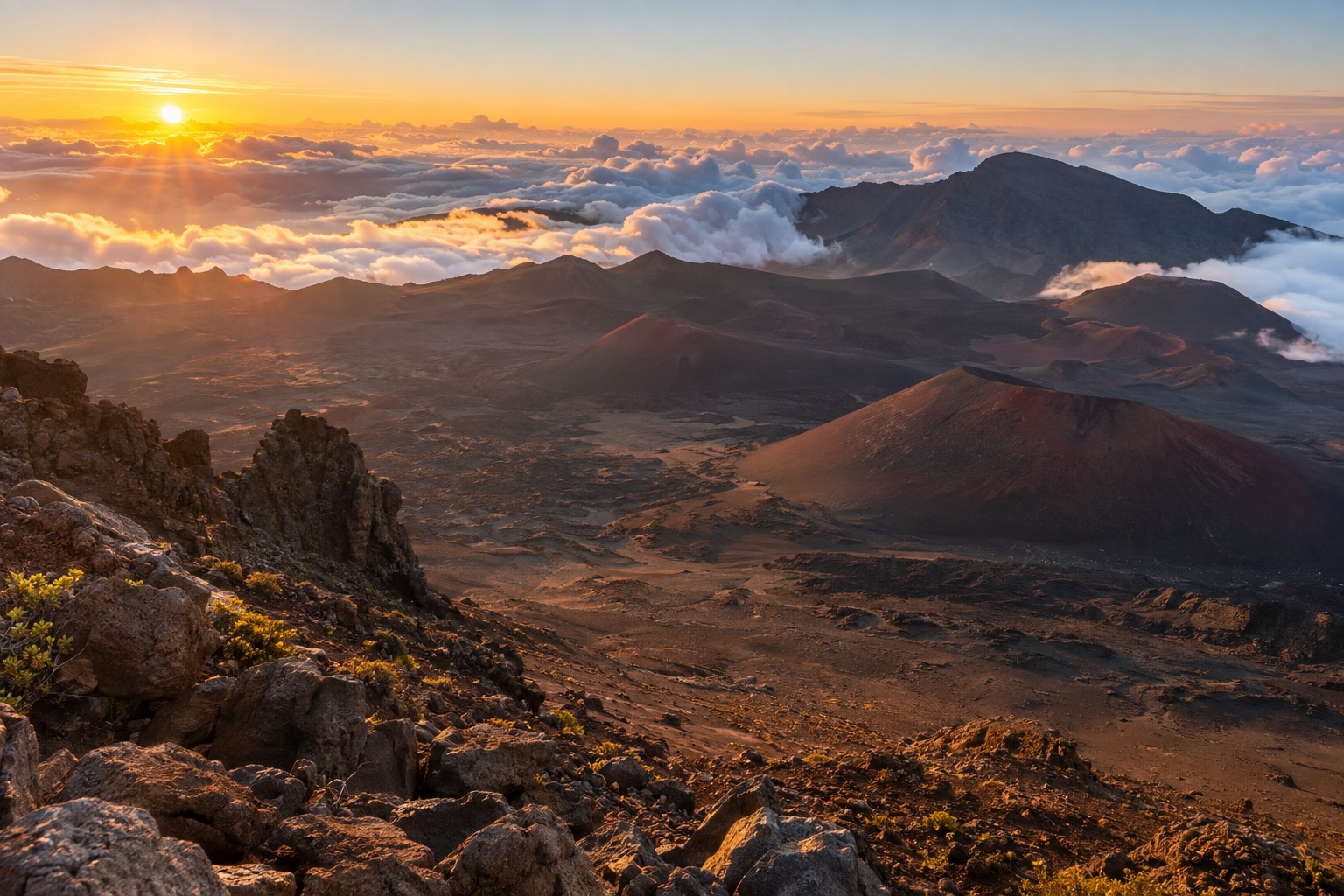
On a clear morning at the rim of Haleakala, the sky goes from ink to orange while clouds pool below like a second sea, and the red and black cinder cones slowly take shape in the crater. The year here is gentler than the beaches below suggest: a drier, brighter stretch from late spring into early fall, a wetter and moodier one from November through March, and the busiest weeks when the mainland is on vacation. Maui’s great volcano rewards almost any month, but each one gives a different mountain.
When is the best time to visit Haleakala?
May through September is the best time for most visitors, with April and October close behind, because the mountain has its fewest rainy days and the clouds are more likely to leave the crater open to view.
For sightseeing and photography, the drier months give the best odds of a clear crater floor and a long view down the slopes. Silversword plants and the red cinder desert look striking in any light, but the summer sun lingers nicely on the crater walls in the afternoon. Winter can still deliver an unforgettable sunrise, it just asks for more patience and a bigger margin for clouds.
For the beach and sea portion of a Maui trip, the summit is a long outing from the resorts, so the real choice is about the coast. Summer is when south and west shores tend to be gentler, while winter brings big surf to north-facing beaches. Pair the mountain with the shore season you prefer and let the volcano fit around it.
For budget and quiet, the stretches after the summer rush and just before the winter holidays tend to feel easier, with more space at the overlooks and rooms that are simpler to find. Families should know that spring break in March is loud and full, and that the cold before dawn is hard on small children in any season.
Haleakala weather by month
The table gives conditions at about 7,000 feet, and the summit, 3,000 feet higher, is colder still.
| Month | Average high (°F) | Average low (°F) | Rain (in) | Rain days |
|---|---|---|---|---|
| January | 61.0 | 43.9 | 5.14 | 5.9 |
| February | 59.7 | 42.7 | 4.08 | 5.4 |
| March | 59.7 | 43.1 | 5.70 | 7.6 |
| April | 60.7 | 43.8 | 2.75 | 6.0 |
| May | 63.2 | 45.9 | 2.44 | 4.4 |
| June | 65.6 | 47.7 | 1.62 | 3.3 |
| July | 65.5 | 48.9 | 2.70 | 5.0 |
| August | 66.1 | 49.4 | 2.17 | 4.4 |
| September | 64.7 | 47.9 | 2.53 | 5.2 |
| October | 64.0 | 47.8 | 3.25 | 5.5 |
| November | 63.1 | 47.0 | 4.59 | 6.9 |
| December | 61.1 | 45.1 | 5.28 | 6.6 |
The year runs cool to cold and never truly hot. Summer is the brighter half, with June the calmest month for rain, while the stretch from November through March brings the most wet days, March being the wettest of all.
Rain on the mountain comes as passing showers and drifting cloud rather than long storms, and the temperatures between winter and summer differ by only a few degrees. What changes more is the light and the odds of a clear view.
When is Haleakala cheapest and least crowded?
The quietest months are usually late April through May, and then September into early November, when the mainland is back at school and work and the overlooks feel roomier.
The busiest weeks follow the U.S. calendar: spring break in March, Easter week, the long summer family weeks from June through August, and Christmas and New Year, when Maui fills and everything from rooms to rental cars gets tight. Sunrise is popular all year, so the crowd at the summit is thick even in off-peak months.
In the shoulder months, hotels along the Maui coast are easier to find at gentler rates, beaches feel less packed, and the road up the mountain is calmer. If your dates are flexible, a midweek visit outside school vacations gives the best chance at a relaxed morning.
Which months should you avoid in Haleakala?
No month is off limits, but December through March is the stretch most likely to disappoint, with the most rain days and a summit that can sit inside cloud.
The Central Pacific hurricane season runs from June 1 to November 30. Hawaii is rarely hit, but a passing system can bring heavy rain and wind to the slopes, so keep an eye on the forecast if you travel in those months. Hurricane Lowell passed just west of Kauai in September 2026 and damaged roads, trails and parks, a reminder to watch the state parks notices.
Winter also means the coldest mornings up high, with the summit frequently dipping to freezing. Dress for it in layers if you come between December and March. The driest months are the most reliable, but even then clouds sometimes fill the crater, so treat a clear view as a gift and not a guarantee.
Festivals and events in Haleakala through the year
Winter: whales and holidays
From about December into spring, humpback whales gather in the warm waters off Maui, and on a clear day you can sometimes spot spouts from the overlooks and the coast road far below. Whale watching boats leave from Lahaina and Maalaea, and the season peaks in the middle of winter.
Christmas and New Year fill the island with visitors, and sunrise reservations are in demand. The holiday weeks are festive in the towns, with lights in Paia and Makawao, but plan the mountain early in the trip so a cloudy morning leaves you a second chance.
Spring and summer: lei, silverswords and long days
Lei Day on May 1 is celebrated across Maui with flower garlands, hula and music in town squares and schools. It is a gentle, local holiday and a good reason to visit in early May, when the weather is also turning drier.
Summer brings the silversword toward its bloom on the crater slopes in some years, a spiky plant found nowhere else, and Kamehameha Day on June 11 adds parades and lei draping on the island. Long days make the afternoon drive down the mountain a pleasure.
Fall: quieter roads and Hawaiian seasons
September and October feel like a pause between the summer families and the winter crowds. Farm stands in the upcountry towns are full, small festivals pop up in Kula and Makawao, and the nene, the Hawaiian goose, is easier to spot along quiet park roads. This is a good moment to pair the summit with the upcountry, then continue to Hosmer Grove for native forest birds, where early morning is the best time to listen and look.
Sources
- NOAA NCEI, monthly normals 1991-2020, station USC00511004, checked September 8, 2026
- sunrise-sunset.org, sunrise and sunset calculated for the 15th of the month, checked September 8, 2026
- NPS, pages Puuulaula (nps.gov/places/puuulaula.htm) and Plan Like a Park Ranger: Top 10 Tips, checked September 25, 2026
- NPS, Haleakala, pages Summit District and Sunrise, checked September 25, 2026
- NPS, Haleakala National Park, pages Sunrise (nps.gov/hale/planyourvisit/sunrise.htm) and Fees & Passes, checked September 25, 2026
- NPS, Haleakala National Park, Fees & Passes, checked September 25, 2026
- NPS, Sunrise ; HVCB, map Driving Times from Kahului Airport (2010), checked September 25, 2026
- NPS, Haleakala, Summit District, checked September 25, 2026
- NPS, Haleakala, pages Sunrise and Summit District, checked September 25, 2026
- NPS, Haleakala, Kipahulu District, checked September 25, 2026
- NOAA NCEI, normals 1991-2020, station USC00511004, via PLAN-HAWAII.md §1
- NWS Honolulu / Central Pacific Hurricane Center, « 2026 Central Pacific Hurricane Season Outlook », weather.gov/hfo/hurricaneOutlook2026, checked September 24, 2026