
PONTA DA PIEDADE · LAGOS, ALGARVE · THE SIGNATURE HEADLAND
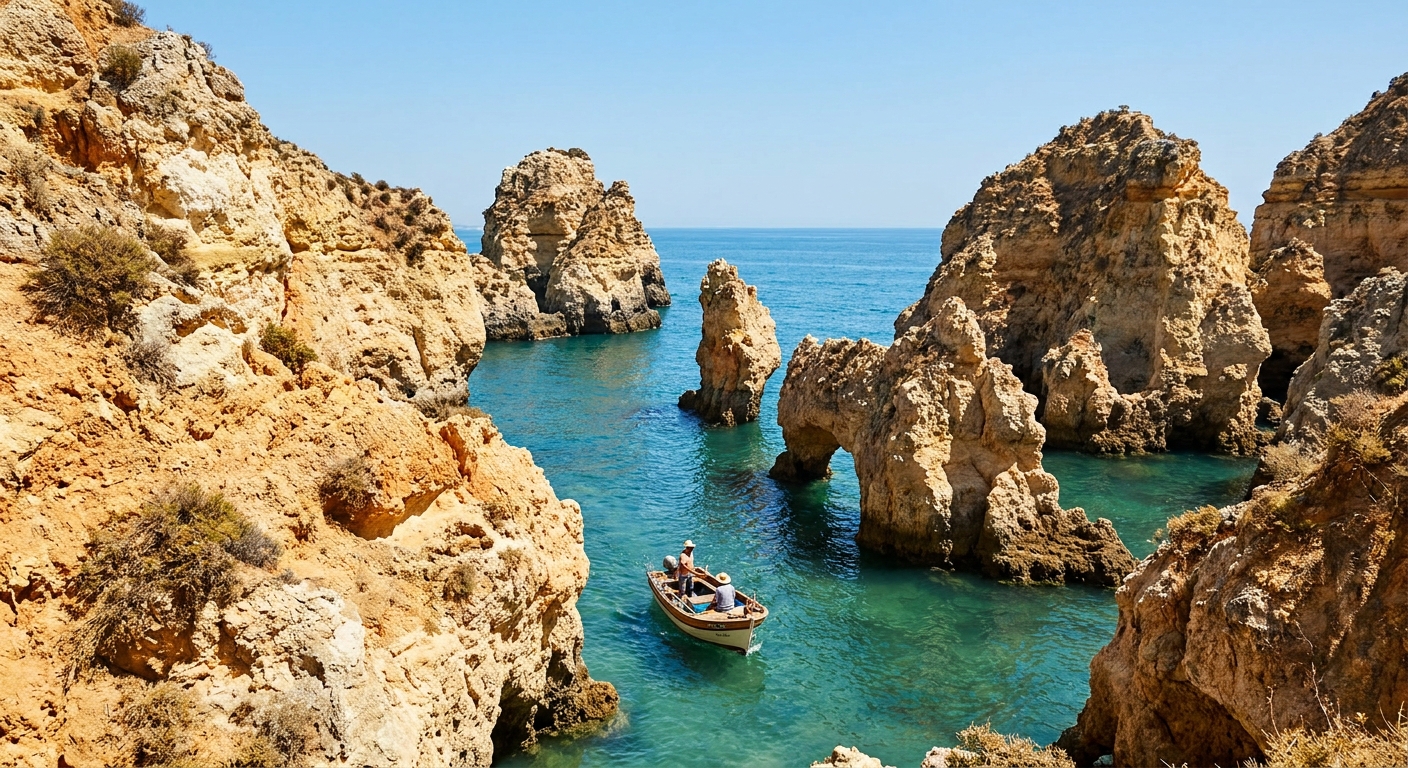
Come down the staircase cut into the headland and the Algarve changes scale. What reads from the top as a field of gold-ochre pillars turns, at water level, into a set of doorways: openings in the rock wide enough for a wooden boat, a skipper and four passengers deciding whether to duck. Up top costs nothing and works at any hour. Down below depends on the sea, on the size of the boat, and on a man reading the swell that morning. Most visitors do one of the two. The place is built for both.
THE HEADLAND AT A GLANCE · LAGOS
Walk the clifftop first because it does not depend on the sea, then take a small boat from the cove below if the operator says the water allows it that day.
CLIFFTOP FREE, ANY HOUR · BOATS CANCEL WITH WIND AND SWELL · CAMILO FOOT ACCESS CLOSED
Go for: the built viewpoints along the headland, the little lighthouse on the point, and a short run under the arches when the sea allows it.
Think twice before: planning the whole day around the water. Wind and swell cancel boats and paddles at short notice, while the walkway up top generally stays open.
Camilo closure: Câmara Municipal de Lagos / APA via regional press, August 2026 · full sources at the end of this guide
On this page
- The three ways in, and what each costsClifftop, small boat, kayak
- What the walk up top gives youLighthouse, boardwalks, the staircase down
- Getting under the archesWhat the cove boats reach, and when they cancel
- Which hour to bookMorning water, late-day rock
- The cove next doorPraia do Camilo: foot access closed, and why
- Stairs, edges and a rolling boatWith kids and with vertigo
Three ways to see Ponta da Piedade: clifftop, small boat, kayak
Each way in shows a different site. From the clifftop you get the composition: stacks in a row, coves opening one after another, a boat crossing far below to give the rock its scale. From a small boat you get the interiors, arches seen from underneath and grottoes when the swell inside is low enough for a skipper to commit. From a kayak or a paddleboard you get closeness and quiet, at the price of being the first thing conditions cancel.
| Way in | What you see | What you miss | The constraint | Best for |
|---|---|---|---|---|
| Clifftop walk | The whole headland, stacks in sequence, the lighthouse point, coves from above | Arch interiors, grottoes, the color of the water at eye level | Sun exposure, and unfenced dirt paths if you leave the boardwalk | A first visit, any hour, any budget |
| Small boat from the cove | Passages between the stacks, arches from below, grottoes when the sea allows | The overview that makes sense of the geography | Sea state, tide, boat size, the skipper’s call. Short outings | Photographers and anyone who wants to be under the rock |
| Kayak or SUP | The slowest, closest version, and quiet inlets between hulls | The top, and whatever the conditions rule out that day | Wind and swell cancel it first, and you supply the engine | Confident paddlers on a settled morning |
One caveat before you choose. Wind and swell can shut down boats and paddles with little notice, while the built route along the top generally stays walkable, and even on a calm day the passages that are reachable depend on sea state, tide, the size of the craft and the skipper’s judgement. Nobody sells a guaranteed grotto here.
For a first visit the efficient order is top then bottom: walk the headland, see where the openings are, then decide whether the water looks like a boat day. If the sea says no all week, the cliff walking east of Carvoeiro is the consolation prize, the wider coast sits on our Algarve guide, and the country-level frame lives on the Portugal hub.
Ponta da Piedade clifftop walk: the lighthouse, the boardwalks and the staircase down
A small lighthouse marks the point, and the ground around it is the free grandstand: a low, sun-bleached plateau with sea on three sides and the stacks arranged below like a broken colonnade. The view rearranges itself every few steps, because each cove cuts into the cliff at its own angle and hides the next one until you are level with it.
From the lighthouse sector, the municipal boardwalk network continues toward Praia Dona Ana and Praia do Pinhão, with built viewpoints spaced along the way, so the walk back to town happens on a proper surface. Informal dirt paths still branch off toward the cliff edge. Those are optional, some carry no rail at all, and undercut limestone is the last material you want to stand on the lip of. Our Portugal safety guide handles the coastal rules in full.
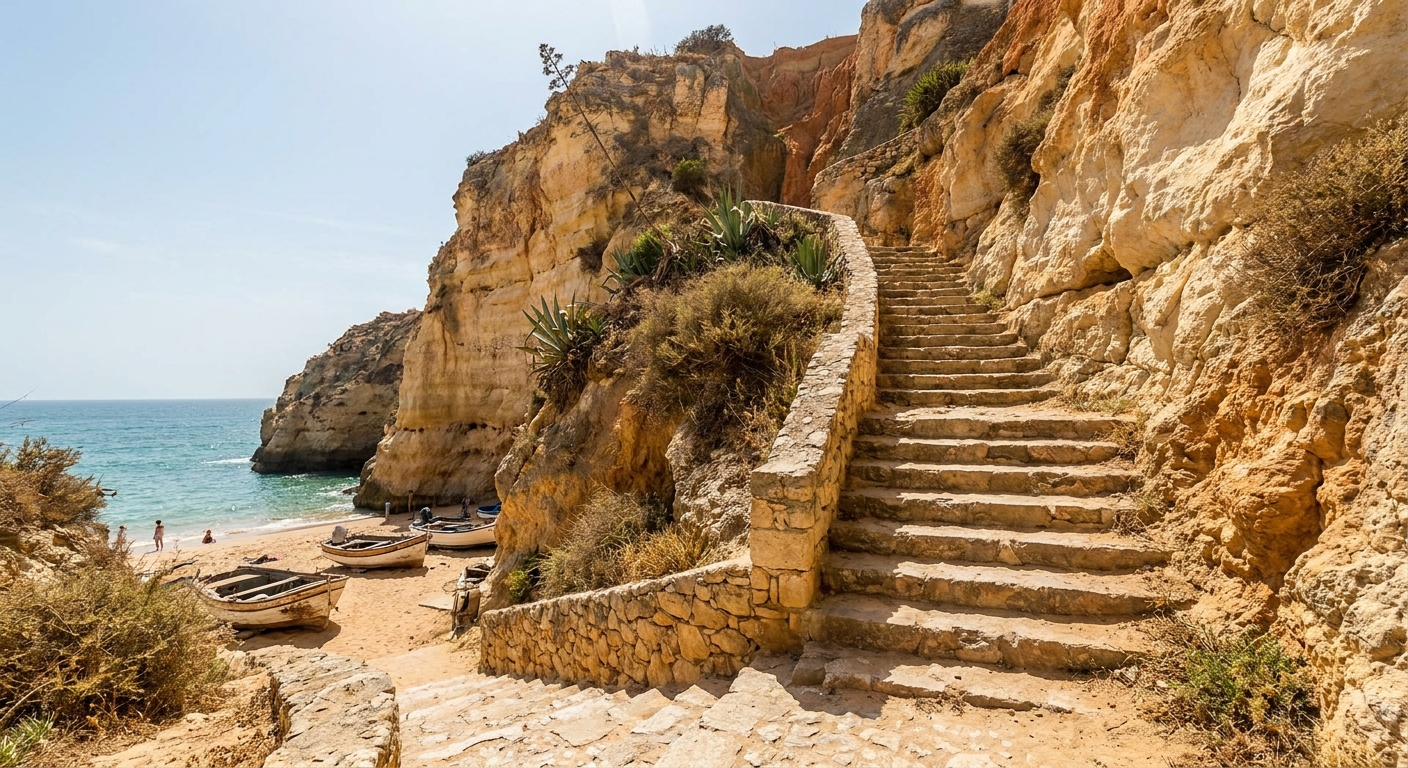
The staircase down to the boats is the part photographs flatten. Cut into the rock, long and steep, it lands at a small cove where local boatmen wait. Published step counts disagree with each other, so we quote none. What matters is the return trip, which faces open sky with no shade at any point, and which people who went down at midday in August still talk about. Carry water down, not just sunscreen.
Ponta da Piedade boat trips: what the cove boats reach under the arches
The craft that matter for the arches are the small ones waiting at the foot of the stairs, traditional open boats with an outboard and a skipper who has worked this rock for years. Their job is the close work: threading the passages between stacks, sliding under arches, nosing into grottoes when the water inside is settled enough to allow it. The outings are short by design, because the scenery at that scale covers only so much coastline.
That is a different product from the day trips leaving the Lagos marina, which cover far more coast, move faster, and, being larger, cannot follow a small boat into the tight openings. Both have their place. If the caves are the point, you want the cove boat; if hours on the water and a wider stretch of coast are the point, the marina fleet does that better. Our Lagos guide covers what leaves from where.
The sea has the last vote, and it exercises it often. Departures get cancelled at short notice, sometimes on a morning that looks perfectly benign from a café table, and how far anyone goes in comes down to the skipper’s read of the water. Similar logic, with stricter rules on entry, governs the region’s other famous chamber at Benagil.
Best time of day: morning water, late-day rock
Mornings are usually the better half for anything afloat. Local wind tends to be lighter before the afternoon fills in, and there are fewer hulls working the same passages. What a morning does not guarantee is a smaller sea: swell arrives from weather systems far offshore and pays no attention to the clock. The operator reading conditions on the day, rather than the hour printed on a booking, decides whether the arches are in play.
Late in the day belongs to the top. The rock is oriented so that low sun rakes across its west-facing faces, and the ochre that looks pale and washed under noon glare comes back warm, with the shadows of the stacks lengthening over the water. That version needs no reservation and no sea state. Which suggests an obvious shape for the day: boat early, lunch in Lagos, walkway last.
Getting there from Lagos, and the Praia do Camilo closure
Three approaches, all from Lagos. On foot, the coastal walkway leaves town past Praia do Pinhão and Praia Dona Ana and climbs to the headland, which is the most rewarding version because it shows you the coves in order. By car, there is parking near the lighthouse, and it behaves like every small coastal lot in this region in summer: arrive early or circle. By sea, a boat delivers you to the rock and back without a single step.
One planning note, because plenty of guidebooks still say otherwise. Pedestrian access to Praia do Camilo, the cove just along the coast, is closed. Winter storms destabilised the slope and the wooden staircase down to the sand, the municipality and the environment agency are still studying a fix, and the closure holds until the site can be made safe. The familiar routine of cliffs followed by a swim at Camilo does not work right now. The Lagos guide carries the detail and the beach alternatives.
Ponta da Piedade with kids, and with a fear of heights
With children, the top is straightforward and the staircase is the real decision. Going down is quick and easy. Coming up is long, steep and unshaded, and short legs plus a high sun make a memorable argument halfway. Families who want the boat often take it early for exactly that reason, then do the boardwalk section afterwards, when there is shade in town waiting at the end.
The edges deserve a plain sentence rather than a scare. On the boardwalk you are on a built structure, at viewpoints designed for standing on. Step off it onto the dirt paths and you are on unprotected clifftop, sometimes with no rail and always with a sheer drop below undercut rock. Hold small hands out there, or simply stay on the timber.
Vertigo and seasickness are two different problems with two different answers. Most people who dislike heights manage the clifftop comfortably, since the built viewpoints keep you back from the lip. The cove boat is another matter: it rolls at the boarding step, it rolls more in the passages, and a closed grotto is a poor place to discover you hate that motion. Our Portugal with kids guide handles the wider family logistics.
When to go. The month-by-month case for Ponta Da Piedade — what the normals say, when the sea is warm enough to swim and which weeks fill up — sits on the best time to visit Ponta Da Piedade.
The last word
Portugal has better swimming than this, and warmer. The lagoon beaches of the east around Tavira beat it on water temperature and calm on any day you care to pick. So it says something that the image the country sells is not a beach at all, but a short stretch of collapsing limestone below Lagos. Sand photographs as sand. This rock photographs as architecture, with a boat dropped in to prove the size of it.
Which is why the place rewards both halves when the sea cooperates: the top for the arrangement of stacks and coves, the water for the sound swell makes inside a chamber with a roof on it. Go up in the late light. Go down early, if the boatmen are going out. And take water with you for the climb back, because those stairs are the one part nobody photographs, and the one part everybody remembers.
Sources & data for this guide
- Praia do Camilo · pedestrian access closed after winter storms destabilised the slope and the wooden staircase to the sand, municipality and environment agency studying a fix, closure holds until safety is restored · Câmara Municipal de Lagos / APA, reported by Postal, Jornal do Algarve and Beachcam, August 2026 · checked Sep 3, 2026
- Headland layout · small lighthouse on the point, long steep staircase down to a cove where local boatmen wait · Algarve guide sources, medium confidence. Published step counts for the staircase disagree with one another, so we deliberately quote none.
- Clifftop boardwalk network from the lighthouse sector toward Praia Dona Ana and Praia do Pinhão, with built viewpoints along the route · Câmara Municipal de Lagos walkway network · checked Sep 3, 2026
- Boat and paddle operations · editorial notes from the Lagos coast. Departures, and how far into the passages anyone goes, depend on wind, swell, tide, craft size and the skipper’s decision on the day. No schedule or price is quoted here for that reason.
- Seasons, sea temperatures and regional context · our Algarve guide · checked Sep 3, 2026