
LAGOS · THE ALGARVE · BARLAVENTO COAST
Cross the little bridge over the creek after breakfast and the whole shape of the place reads in ten minutes: masts and boat kiosks on one bank, a walled center of cobbled lanes on the other, cliffs beginning a short walk south. That geography is the argument for staying here. On this coast, Lagos is the one base where a morning under the cliffs and an afternoon in an old town do not require getting back in a car, and where the town keeps working after the beach towels go home.
LAGOS AT A GLANCE
Book a room you can walk home to, do the cliffs early, and plan the coves around one hard fact: the path down to Praia do Camilo is closed and Dona Ana now has rules about what you may carry down its stairs.
WALLED OLD TOWN · MEIA PRAIA ON FOOT · CAMILO STAIRWAY CLOSED
Go for: the clifftop path at first light, the museum on Praça Infante Dom Henrique when the sun turns unkind, and the long flat sand of Meia Praia in the last hours of the afternoon.
Think twice before: planning a day around Praia do Camilo because a listicle told you to. The way down is shut, people still climb the barriers, and that is a bad idea on a slope the engineers are still assessing.
Camilo closure: Camara Municipal de Lagos, August 2026 · gear rule: Regulamento n.816/2024 · full sources at the end
On this page
- Is Praia do Camilo open?The closed stairway, and what the rule at Dona Ana says
- A beach you can walk toMeia Praia, flat and long, east of town
- Kayak, SUP or dive gearWhere you can still launch, and the boats
- Which part of town to bookInside the walls, Meia Praia, or the heights
- Faro, Lisbon, and the car questionArriving, and moving on east
What to see in Lagos: the walled center, the Mercado de Escravos building and the marina
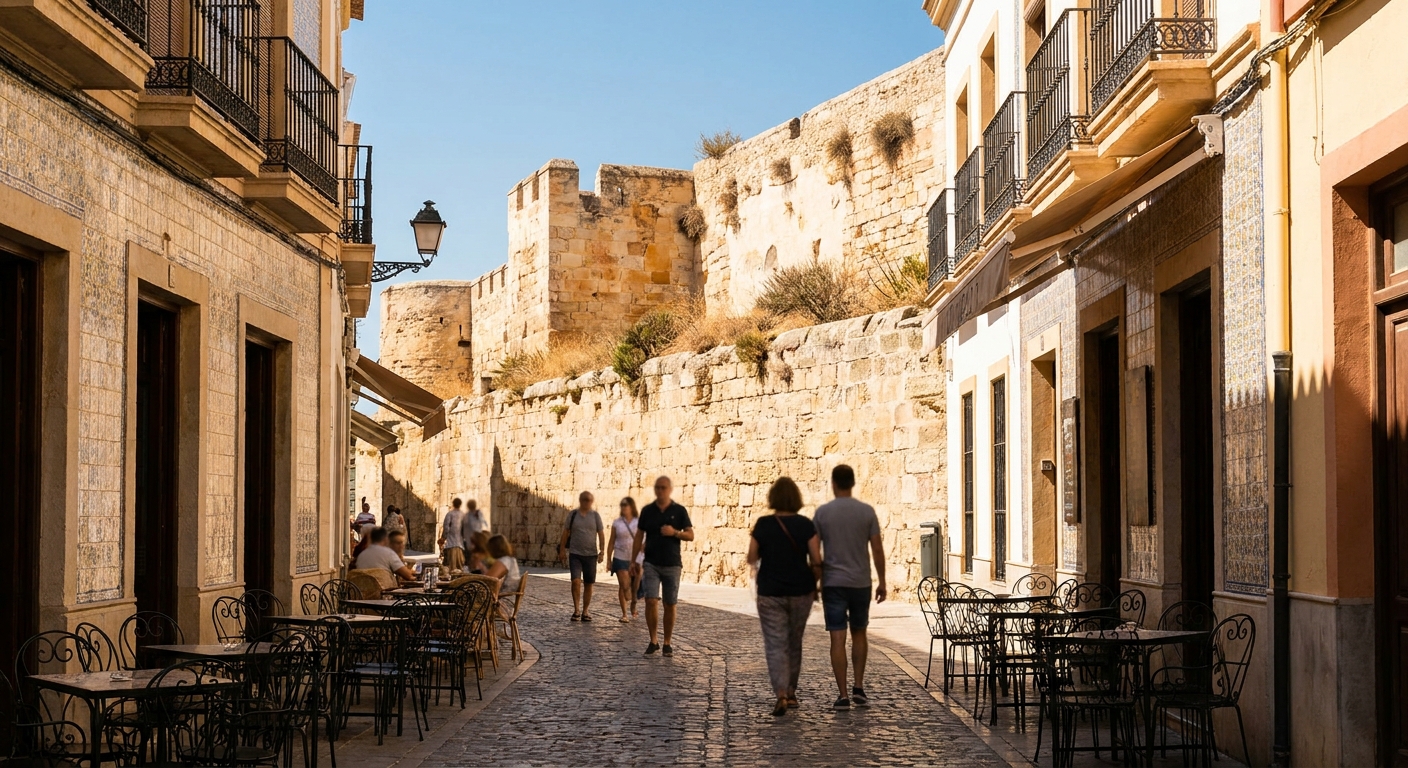
The old town sits inside surviving stretches of wall, small enough to cross on foot in a few minutes and laid out in lanes that mostly keep cars out. Under the arcades on Praça Infante Dom Henrique stands the 17th-century building known as the Mercado de Escravos, today a small municipal museum on Lagos and the Atlantic slave trade. It stands near one of the possible sites associated with the sale of captives in 1444, and the building itself is later than that event. It belongs to the town, and it is worth an hour of a hot afternoon.
The rest of the center is ordinary in the best sense: a fortress on the waterfront, churches on small squares, a food market, and streets where the tourist economy and the town economy share the same block. Across the footbridge lies the marina, a different register entirely, with pontoons, chandlers, boat kiosks and a longer strip of restaurants. Sleeping on one side and eating on the other is the standard local geometry, and the bridge takes minutes.
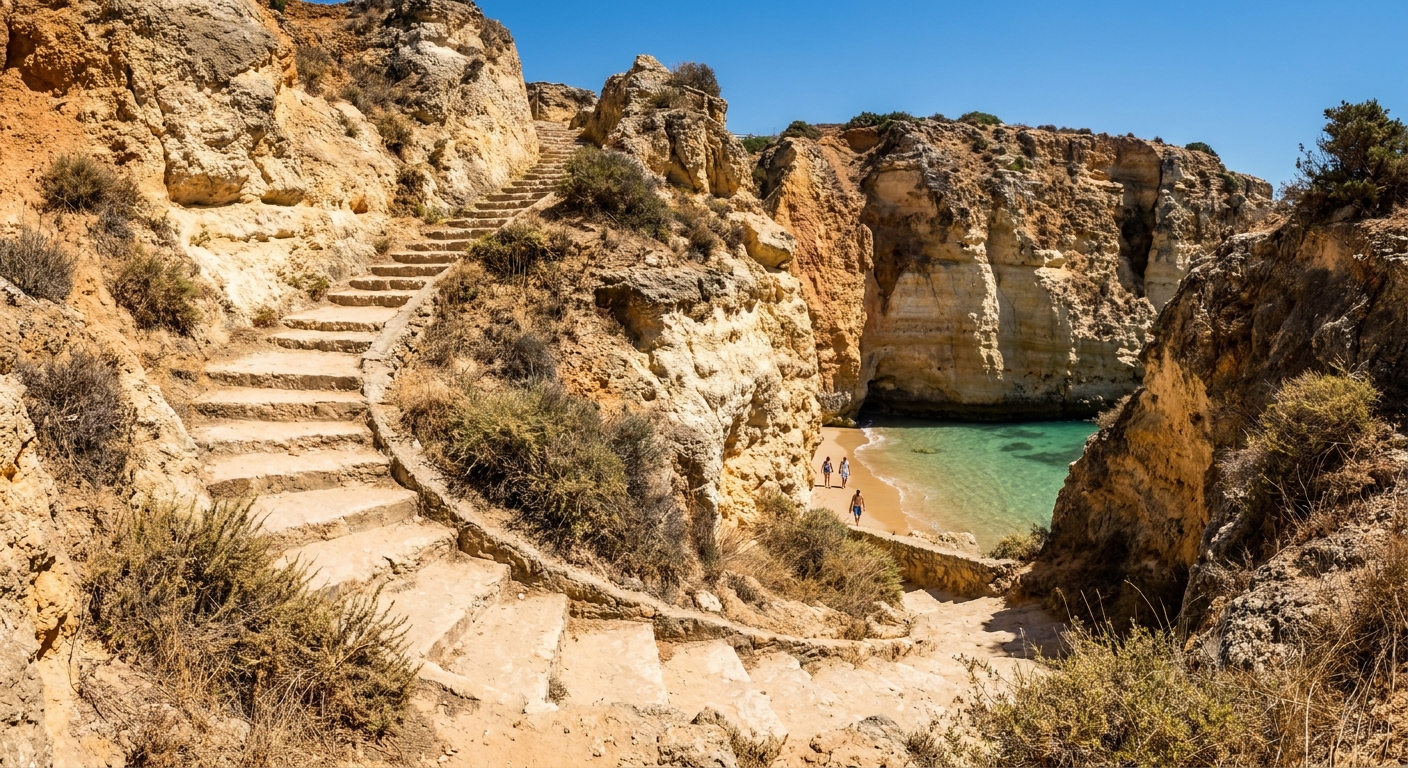
Lagos beaches: Meia Praia, Dona Ana, and the closed path down to Praia do Camilo
Start with the fact most guides still ignore. Pedestrian access to Praia do Camilo is closed. Winter storms destabilised the slope and wrecked the wooden staircase down to the sand, the municipality and the environment agency are still studying a fix, and the closure holds until the descent can be made safe. No reopening date has been announced. Visitors do climb the barriers, and it is the one thing on this page we will ask you not to do: this is an unstable cliff, not a bureaucratic formality.
Praia Dona Ana, next door, is open by its stairway, with a second rule attached. Since 16 August 2024, under a municipal regulation, carrying surf, SUP, windsurf, kitesurf, kayak or canoe equipment, or bulky scuba gear, down the stairs to Dona Ana or Camilo is an offence during the bathing season between 9am and 7pm, because both stairways are narrow and winding. Skimboards and bodyboards are exempt. Fines for an individual run from 55 to 550 euros. Meia Praia, the long flat sweep east of the marina, has none of these constraints and takes an easy walk from town.
So the cove coast is best met from the water. Boats leave from the marina and from the town beach, from small grotto runs to longer trips, and the arches, stacks and sea caves of Ponta da Piedade get their own treatment on the Ponta da Piedade page, including how the clifftop path and the lighthouse fit in. Paddlers and divers should plan to launch from the marina side or from Meia Praia rather than hauling anything down a cove stairway in daylight hours.
Where to stay in Lagos: inside the walls, around Meia Praia, or up toward the point
Inside the walls is the choice that makes a car unnecessary. You wake in the middle of the thing, walk to the market, the museum and the town beach, and eat wherever you feel like at eight o’clock. The cost is noise: the lanes carry sound, terraces run late in summer, and a room over a restaurant street is a room over a restaurant street. Ask about the window before booking.
Around Meia Praia the ground is flat, the buildings are lower and newer, and the sand is at the end of the street. Families and anyone travelling with a stroller tend to land here. Up toward the point, on the heights south of town, you buy the view and the quiet and give back the walk: it is a climb home, and most people staying there end up using a car or taxis. Our country-level guidance sits in where to stay in Portugal.
One local caution that applies to all three: high summer books out early here, and the rooms that go first are the walkable ones. If the trip is built around not driving, the room is the decision that enforces it.
Getting to Lagos from Faro or Lisbon, and moving on east
Faro is the airport, and the region’s regional train line and the airport coach both reach Lagos at the western end. If the flight search is still open, our guide to flying in from the US covers the routings, and Faro itself is worth a night at the start or the end rather than a taxi rank you pass through. From Lisbon, trains and long-distance coaches run south daily. Check the current operator timetable for the season you are travelling in rather than trusting a schedule copied into a blog.
A car is optional in Lagos and useful beyond it. The tolls, the parking and the whole calculation live in the car rental guide and getting around Portugal, and we are not reopening them here. If your next base is Tavira in the east, note that the Algarve line now runs some regional services through between Lagos and the eastern Algarve: check the current CP timetable rather than assuming a change at Faro. For how many nights Lagos deserves against the other bases, the table on the region page already answers it.
A day in Lagos: where to be at each hour, and what goes wrong
| Time of day | Where | Why then | The trap |
|---|---|---|---|
| First light to mid-morning | The clifftop path south of town | Low sun on the ochre, empty paths, flat water below | No shade and no water fountains once you are out on the headland |
| Late morning | On the water, from the marina or the town beach | The sea is usually calmest before the afternoon breeze | Popular departures fill first in summer, and the last slot of the day is not the best light |
| Midday to mid-afternoon | Inside the walls: lanes, museum, lunch | The old town is the shaded half of Lagos | The marina side is glare and open asphalt at exactly this hour |
| Late afternoon | Meia Praia | Long light, room to spread out, easy entry into the water | The beach runs a long way east; remember which access you came in by |
| Evening | The squares and the bridge | Both sides of town come alive, ten minutes apart | If you sleep inside the walls, the street noise is part of the deal |
When to go. The month-by-month case for Lagos — what the normals say, when the sea is warm enough to swim and which weeks fill up — sits on the best time to visit Lagos.
The last word
Two habits make a week here work. Do the cliffs before the town is awake, and take Camilo off the plan until the municipality says the way down is safe again. What remains is generous: a grotto trip out of the marina, an hour in the museum on Praça Infante Dom Henrique, a swim off Meia Praia when the shadows finally reach the sand, dinner on whichever bank you feel like crossing to.
What no other base on this coast offers is the ordinary version of the Algarve at the same address as the famous one: a town with a market, a bus station and school kids on the walls, five minutes from cliffs people fly across an ocean to photograph. Carvoeiro is prettier at postcard scale, Tavira is calmer, and you can reach either from here. The regret we hear most from readers who came for three nights is that they worked out the town’s shortcuts on the morning they left.
Sources & data for this guide
- Pedestrian access to Praia do Camilo closed after winter storms destabilised the slope and the wooden staircase; no reopening date announced · Camara Municipal de Lagos and APA, as reported by Postal, Jornal do Algarve and Beachcam, August 2026 · checked Sep 3, 2026
- Ban on carrying surf, SUP, windsurf, kitesurf, kayak, canoe or bulky scuba equipment down the Dona Ana and Camilo stairways during the bathing season, 9am to 7pm; skimboards and bodyboards exempt; fines 55 to 550 euros for an individual · Regulamento n.816/2024, Diario da Republica 2.a serie n.147 of 31 July 2024, in force 16 August 2024, articles 3(c) and 7 · checked Sep 3, 2026
- The Mercado de Escravos building on Praça Infante Dom Henrique: a 17th-century structure, today a municipal museum, standing near one of the possible sites associated with the 1444 sale of captives. Editorial note: the link between the surviving building and that event is a question of siting, not a documented address, and we word it that way deliberately.
- Train and coach services between Lisbon, Faro and Lagos, and through services along the Algarve line, change by timetable season · verify with CP and the coach operators before booking; we quote no journey times or fares on this page on purpose · checked Sep 3, 2026
- Zone character, walking distances and the order of the day are editorial observation from the ground, not measured data.