
LAGOS · SEPTEMBER · 37.1° N
September hands Lagos an odd pair of numbers. The air comes off its August peak, 76.8°F against 78.6°F, while the sea below the cliffs climbs from 62.1°F to 64.2°F. Cooler days, warmer water, and 0.73 inches of rain spread over about two and a half days in an average month.
For a first trip that means the beach days still work and the walking days work better. It also means the light is on its way out: 12 hours 27 minutes on September 15, sunset at 7:44 p.m., and October waiting with 6.7 rain days. Everything below is dated to this month. The rest of the town, and the rest of the coast, live on the Lagos guide and in the Algarve.
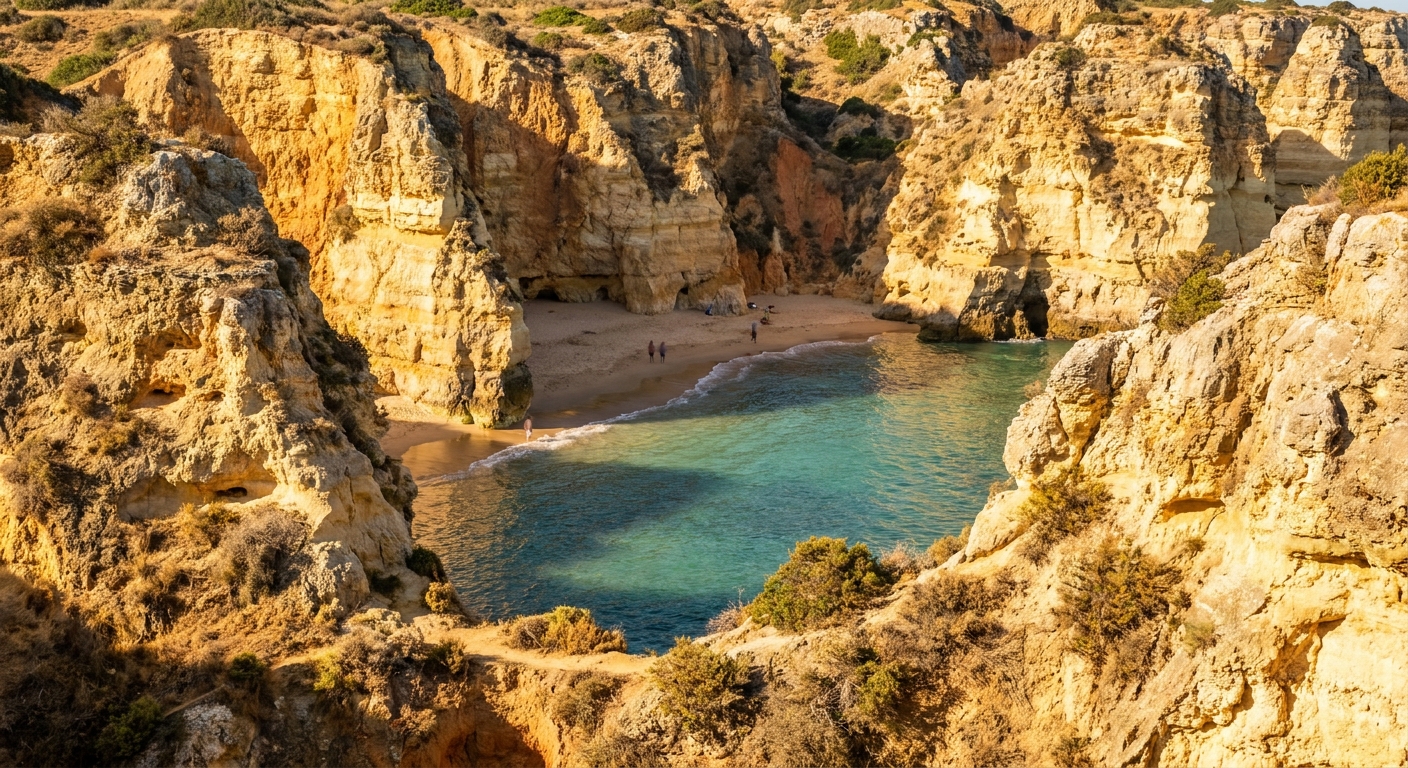
THE MONTH AT A GLANCE · LAGOS · SEPTEMBER
Warmer water than August at 64.2°F, highs 1.8°F lower, and rain on about one day in twelve: go if you want to swim and walk on the same day.
HIGH 76.8°F · SEA 64.2°F · 2.5 RAIN DAYS · SUNSET 7:44 P.M. ON THE 15TH
Go for: water at 64.2°F, two and a half rain days in an average month, and enough evening left after a cliff walk to reach a dinner table in daylight.
Think twice before: planning 62.1°F evenings in beachwear, or building a day around the Forte Ponta da Bandeira, listed as temporarily closed by the Museu de Lagos on July 16, 2026.
Air and rain: IPMA station 533, Sagres, 1991-2020 · Sea: Open-Meteo Marine, 2015-2024 · Hours: Museu de Lagos · full sources at the end
On this page
- Lagos weather in September76.8°F highs, 2.5 rain days, and where the thermometer sits
- Sea temperature in September64.2°F, and what that is like on entry
- How busy Lagos is in SeptemberBooking lead time and the tourist tax we could not verify
- Things to do in Lagos in SeptemberThe Rota da Escravatura, Ponta da Piedade and Praia da Luz
- A two-day plan for LagosTwo days built around a 7:44 p.m. sunset
- September vs August and OctoberHow the three months compare, line by line
- Is September a good time to visit Lagos?Who should go, and who should move a month
Two things this month cannot tell you on its own: what a week in the country costs, which sits in the cost guide, and how the twelve months rank across Portugal, which is the 12-month verdict.
Lagos weather in September: average highs, lows and rain days
| Measure | September normal | Reading |
|---|---|---|
| Average high | 76.8°F (24.9°C) | Shorts from mid-morning on |
| Average low | 62.1°F (16.7°C) | A layer after dark |
| Precipitation | 0.73 in | Most Septembers stay dry |
| Days with 0.04 in or more | 2.5 | Rain on roughly one day in twelve |
| Days with 0.39 in or more | 0.6 | A real soaking about three Septembers in five |
| Daylight, Sept 15 | 12 h 27 min | Sunrise 7:17 a.m., sunset 7:44 p.m. |
| Sea surface | 64.2°F (17.9°C) | Mean of daily maxima, 2015-2024 |
Every figure here comes from one real thermometer. IPMA, Portugal’s national weather service, publishes 1991-2020 normals for station 533 at Sagres, 22.9 meters (75 feet) up, the nearest station to Lagos with a published series: September averages a high of 76.8°F, a low of 62.1°F and 0.73 inches of rain. Two caveats travel with those numbers. Sagres is the windiest headland in the Algarve, and the ground inland runs colder and a good deal wetter, so nobody should pack for a hill walk on a coastal reading.
In an average September, 2.5 days record at least 0.04 inch of rain and 0.6 day reaches 0.39 inch or more. Those are IPMA’s own thresholds, lower than the 0.10 inch most US tables count, so the counts are not interchangeable with an American rain-day figure. On the ground it works out at rain roughly one day in twelve, usually a band that passes rather than a day lost, and one genuine soaking about three Septembers in five. On a week-long trip, budget one wet afternoon and keep an indoor site in reserve for it.
The gap between 76.8°F by day and 62.1°F at night is 14.7°F, which is the whole packing argument. Beach clothes cover mid-morning to late afternoon and nothing else. Dinner outdoors at 62°F asks for a sweater or a windbreaker, more so near the water, where those readings were taken. The full kit sits in our Portugal packing list. For this month in Lagos the short version runs to two layers, swimwear that dries fast, and shoes that cope with cobbles.
On September 15 the sun rises at 7:17 a.m. and sets at 7:44 p.m. local time, 12 hours 27 minutes of daylight. That leaves a usable evening: finish a cliff walk at 7 p.m. and you reach a table before dark. The margin shrinks through the month, so late-afternoon beach plans want moving earlier as the weeks go by, and by October the coast loses light noticeably sooner.
Can you swim in Lagos in September? Sea temperature and what it feels like
The sea off Lagos averages 64.2°F in September in the Open-Meteo Marine record for 2015-2024. One thing to hold onto about that number: it is the mean of daily maximum readings, so it sits a shade above a true 24-hour average, and a 7 a.m. swim will feel colder than the figure promises. The same series puts August at 62.1°F, which is the part that catches people out. On this coast the water keeps warming after the air has already peaked.
At 64.2°F you get a swim rather than a soak. It is sharp on entry, fine after a minute of moving, and short for most adults without a wetsuit. Children last less time in it than their parents do. The sheltered coves under the cliffs at Ponta da Piedade are the classic swim from town, and the number above is a sea-surface average for the area, not a cove-by-cove reading.
We found no wind or wave series for Lagos in our sources, so we publish no figure for either. What we can say comes from the station’s own address: IPMA measures at the Sagres headland, the windiest point of the Algarve, and air recorded there is not the air in a sheltered bay. Sagres is worth a drive for exactly that exposure. Before committing a morning to open water, check the conditions on the beach itself.
How busy is Lagos in September? Crowds, booking lead time and the tourist tax
We found no occupancy series and no monthly room rates for Lagos, so we crown no month cheap and none busy. What we can date is the weather curve, and September sits on its far side: 1.8°F below August by day, with the sea 2.1°F warmer than it was four weeks earlier. Season on this coast runs on school calendars and charter schedules rather than thermometers, and neither of those reached our sources.
Lead time, then, is a judgment rather than a measurement, and ours goes like this: lock the room six to eight weeks out (est.) for the first half of the month, less for the last week, and book the car in the same sitting. Our car guide covers the toll system before you sign anything. Most trips down here arrive through Faro, and the transfer west is the line travelers forget to price. Flight timing sits in flights from the US.
We could not verify a tourist-tax rate for Lagos, so we quote no per-night amount and no percentage. Tickets are the same story: the Museu de Lagos publishes hours and closure dates, not a price list we could read, so no admission figure comes from us. Ask at the desk, and budget the rest from the Portugal cost page.
The line worth paying up on is location. With sunset at 7:44 p.m. on the 15th and the low at 62.1°F, a bed in the old town turns the evening into a walk to Praça do Infante and back, while a room out along the coast road turns it into a drive and a parking hunt. Second line: a refundable rate, for the two and a half days a month that arrive wet.
Things to do in Lagos in September: the Rota da Escravatura, Ponta da Piedade and Praia da Luz
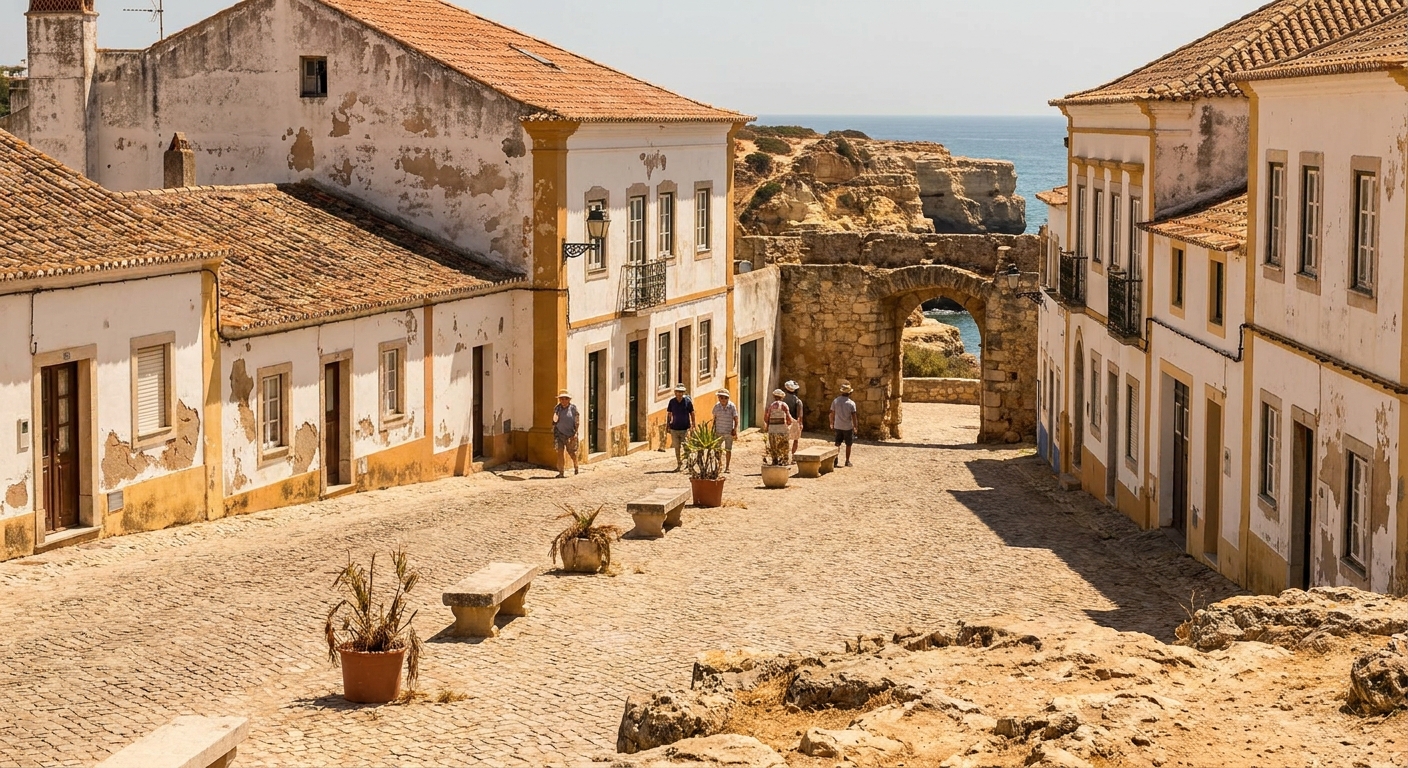
Of the three months around it, September is the one where the swim and the long walk fit into the same day. The air reads 76.8°F instead of August’s 78.6°F, so a midday hour on the cliffs is no punishment, and the water has gained 2.1°F since August. The 2.5 rain days weigh less than they look on paper: with 12 hours 27 minutes of daylight on the 15th, one wet hour rarely costs the whole plan.
Start at the Rota da Escravatura, also signed as the Mercado de Escravos, on Praça do Infante: Tuesday to Sunday, 10:00 to 13:00 and 14:00 to 18:00, last admission half an hour before closing. It tells Lagos’s part in the fifteenth-century slave trade. Behind it sits a 2009 dig at Vale da Gafaria, outside the walls, where a refuse tip found under a new underground car park held more than 150 human skeletons, confirmed as African people brought here as merchandise. The Museu de Lagos runs seven sites in all, one of them the Roman bath house at Praia da Luz.
Those hours hold all year. What changes with the season is the air outside them. In September the 13:00 to 14:00 break falls in the hottest stretch of the day, which makes it a lunch rather than a loss, and the 18:00 close still leaves nearly two hours of daylight on the 15th. One correction to fold in early: the Forte Ponta da Bandeira, built between 1680 and 1690 to cover the quay, was listed as temporarily closed on the museum’s own page, updated July 16, 2026.
We found no published admission price for any of the seven museum sites, and nothing on entry to Ponta da Piedade or the beaches, so we name no free ticket. The free part of September is daylight: sunrise 7:17 a.m., sunset 7:44 p.m., and the clifftop path between the two.
Lagos in September: a two-day itinerary
Day one. Out by 8 a.m., an hour after sunrise, for the clifftop path toward Ponta da Piedade while the air still sits nearer the 62.1°F low than the 76.8°F high. Down to the water around 10:30, when a 64.2°F swim is easiest to talk yourself into. Lunch at 13:00, exactly when the Rota da Escravatura shuts for its hour. Back inside at 14:00, out by 16:00, and keep the last stretch until 7:44 p.m. for the sand.
Day two goes west to Praia da Luz for a morning swim and the Balneário Romano, the museum’s Roman bath house, then back into town for dinner. If the day turns out to be one of the 2.5 wet ones, invert it: museum at 10:00, a long lunch, beach in the afternoon once the band has passed. Leave the Forte Ponta da Bandeira off both versions while the closure stands. Only 0.6 day a month reaches 0.39 inch of rain, so a washout of both days is unlikely.
Lagos in September vs August and October
| Measure | August | September | October |
|---|---|---|---|
| Average high | 78.6°F | 76.8°F | 72.3°F |
| Average low | 63.3°F | 62.1°F | 59.0°F |
| Precipitation | 0.06 in | 0.73 in | 2.42 in |
| Days with 0.04 in or more | 0.4 | 2.5 | 6.7 |
| Sea surface (daily maxima) | 62.1°F | 64.2°F | 66.3°F |
Read the columns across and the trade is plain. August is the dry one, 0.06 inches over 0.4 days against September’s 0.73 inches over 2.5. October is the wet one, 2.42 inches over 6.7 days, more than three times September’s rainfall. Air falls steadily through the set, 78.6°F to 76.8°F to 72.3°F. The sea does the opposite, 62.1°F to 64.2°F to 66.3°F, which is why the warmest water of the three arrives with the most rain. Air and rain come from IPMA at Sagres, the sea figures from the marine API.
Move four weeks back to August and you buy 1.8°F more daytime heat and near-certain dry weather, paying 2.1°F off the water. Move four weeks forward to October and you gain those 2.1°F back in the sea, lose 4.5°F of air, and take on four more rain days plus a shorter afternoon.
Is September a good time to visit Lagos?
Yes, on one condition: you have to be fine with 64.2°F water. If that reads as a swim to you, this is a strong month in Lagos, with walking easier than August’s and rain still slight at 0.73 inches. If you want the sea in the high seventies, no month in this set delivers it, and September is no exception at 64.2°F.
When the answer is no, the month to prefer depends on which number broke it. Heat and dry ground point to August, 78.6°F and 0.06 inches, covered in Lagos in August. Water points to October, 66.3°F, paid for with 6.7 rain days. For the country as a whole rather than this one town, the 12-month verdict takes it from the top.
One thing only September manages among the three: the sea clears 64°F while rainfall stays under an inch, so a swim morning and a dry cliff afternoon can sit in the same forecast.
The last word
Decide on the water first, because everything else in September follows it. If 64.2°F sounds like a swim, book the room in the old town and let the 7:44 p.m. sunset on the 15th do the rest. Check one thing before you build a morning around it: the Forte Ponta da Bandeira, ringed by a moat and crossed by a drawbridge, with a small seventeenth-century chapel lined in azulejos inside and sentry boxes added by restorers around 1960, was listed as temporarily closed in July 2026. Plan lunch for the Rota da Escravatura’s 13:00 to 14:00 break.
Sources & data for this guide
- September air and precipitation normals, 1991-2020, station 533 Sagres at 22.9 m · IPMA · checked Sep 23, 2026
- Rain-day counts at the 1 mm (0.04 in) and 10 mm (0.39 in) thresholds · IPMA, same series · checked Sep 23, 2026
- Sea surface 64.2°F, mean of daily maxima 2015-2024 · Open-Meteo Marine API · checked Sep 23, 2026
- Sunrise 06:17 UTC and sunset 18:44 UTC on September 15, converted to local time · sunrise-sunset.org · checked Sep 23, 2026
- August and October figures in the comparison table, same two sources, same periods · checked Sep 23, 2026
- Rota da Escravatura hours, Forte Ponta da Bandeira closure, the 2009 Vale da Gafaria dig and the museum’s seven sites · Museu de Lagos, page updated Jul 16, 2026 · read Sep 22, 2026
- We found no occupancy series, no monthly room rates and no verified tourist-tax rate for Lagos, and the museum publishes no price list we could read, so we quote none. Hours and closures change · confirm before you travel.