
PORTUGAL · LAGOS · JANUARY
January is the month Lagos gets its own streets back. The national weather service puts the average January high at 61.0°F and the average low at 47.3°F, the sea off the point averages 61.4°F, and the sun stays up for 9 hours 57 minutes on the 15th. Those figures make a walking, eating and museum trip with a coastline attached.
The month takes away warm water, long afternoons and the waterfront fort, listed as temporarily closed on the museum’s own page since July 2026. It hands back 2.10 inches of rain where December carries 2.96, a town center you can cross at your own pace, and museum sessions running Tuesday through Sunday. Where to sleep and what a week costs sit with the lodging guide and our week-in-Portugal budget.
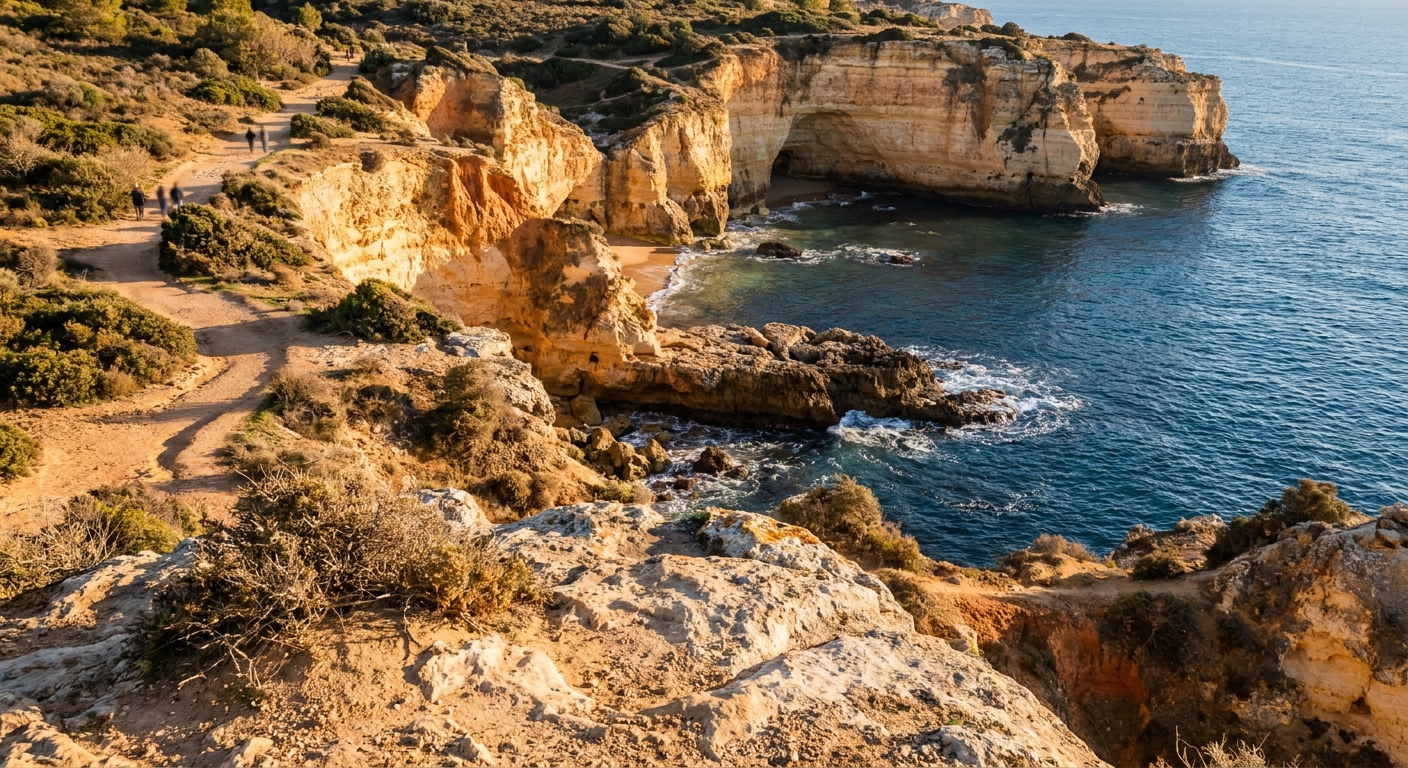
THE MONTH AT A GLANCE · LAGOS IN JANUARY
January buys you a quiet town, 7.4 wet days and a 61.4°F sea: book it for cliff walking and museum hours, and book another month if the trip hangs on swimming.
LOW SEASON · AIR 61.0°F / 47.3°F · SEA 61.4°F · 7.4 RAIN DAYS · 9H 57M OF LIGHT
Go for: cliff walking on short days, the Rota da Escravatura on Praça do Infante, and a three-night town stay in the low season.
Think twice before: booking January for the beach, or building a day around Forte Ponta da Bandeira, temporarily closed as of the museum’s July 16, 2026 page.
Normals: IPMA station 533, Sagres, 1991-2020 · Sea: Open-Meteo Marine API, 2015-2024 · Hours: Museu de Lagos · full sources at the end
On this page
- Average highs, lows and rain daysJanuary weather, from the IPMA station at Sagres
- Can you swim in Lagos in January?A 61.4°F sea, and what that reading really is
- How busy the town is, and when to bookCrowds, prices and the figures we could not verify
- Things to do when the water is coldThe Rota da Escravatura, Praia da Luz and the cliffs
- A two-day plan built on 9h 57m of lightTwo days, hour by hour
- Lagos in January vs December and FebruaryHow the three months compare, in one table
- Is January a good time to visit Lagos?The verdict, and who should shift four weeks
Every figure here comes from IPMA’s station 533 at Sagres, 22.9 m above sea level, the nearest published station to Lagos and the windiest point of the Algarve. The rest of the region does not read the same: high ground is colder and far wetter, and the far end of a coast keeps its own weather. Pack for an inland trail from an inland forecast.
Lagos weather in January: average highs, lows and rain days
| January at Sagres station (1991-2020) | Value |
|---|---|
| Average high | 61.0°F (16.1°C) |
| Average low | 47.3°F (8.5°C) |
| Precipitation | 2.10 inches |
| Days with 0.04 in or more | 7.4 |
| Days with 0.39 in or more | 1.5 |
| Daylight on January 15 | 9 hours 57 minutes |
| Sea surface (mean of daily maxima) | 61.4°F |
IPMA, the Portuguese institute for the sea and the atmosphere, publishes the 1991-2020 normals this page uses: an average high of 61.0°F, an average low of 47.3°F and 2.10 inches of precipitation for the month. A real thermometer produced them, at 22.9 m, not a reanalysis grid cell, and the two methods do not always agree on the same coast. When another table gives you a warmer Lagos night, check which of the two it is reading.
Rain reaches 0.04 inch on 7.4 days in an average January, roughly one day in four, and only 1.5 days bring 0.39 inch or more. Those thresholds belong to IPMA, not to the 0.10-inch line American climate tables use, so the two counts do not swap. On the ground the split matters more than the total: a gray morning that clears by two is the common January day, and a full washout is the exception rather than the rule.
Between that high and that low sits a 13.7°F spread, and you feel all of it because the day is short. Dawn at 47.3°F asks for a fleece and a wind layer, one o’clock at 61.0°F asks you to take both off, and a cliff path after rain asks for shoes with grip. Our packing guide handles the full list; for January, layers plus one waterproof shell cover the month.
On January 15 the sun rises at 7:46 a.m. and sets at 5:43 p.m. local time, mainland Portugal running on UTC in winter, for 9 hours 57 minutes of daylight. Light that short reorders a day: the museum slot goes in the morning, the coast path goes between lunch and four, and dinner happens after dark whatever you had planned. Nobody photographs Ponta da Piedade at seven in the evening in January.
Can you swim in Lagos in January? Sea temperature and what it feels like
The sea surface off Lagos averages 61.4°F in January in the Open-Meteo Marine API record for 2015-2024. Read the small print with it: that number is the mean of daily maxima, so it runs a shade warmer than a 24-hour average of the same water. Tables that publish a cooler January figure for this coast are not contradicting it, they are averaging differently.
Set the water next to the air and the month gets clear: 61.4°F of sea against a 61.0°F average air high, four tenths of a degree apart. Swimmers in neoprene treat that as ordinary winter water and stay in. Without a wetsuit it is a fast dip measured in minutes, with a towel and a hot drink waiting, and it is not an afternoon on a beach towel. Families booking for water should read the month-by-month verdict first.
We could not verify a wave-height or wind series for Lagos itself, so we give no swell figure. What our sources do say bears on it: the station feeding this page stands at Sagres, described as the windiest point of the Algarve, and a cove tucked under the cliffs east of Ponta da Piedade does not sit in that exposure. Check a marine forecast on the morning, not a monthly average.
How busy is Lagos in January? Crowds, prices and booking lead time
We found no occupancy series and no monthly room-rate series for Lagos, so we crown no month cheapest and none dearest. The calendar is firmer ground. January sits outside the beach season by its own numbers, 61.4°F of water and under ten hours of light, and the only dated closure our sources carry for the month is 1 January. A town built around summer sand is doing something else in winter.
On lead time we give you our working rule rather than a data series: three to four weeks (est.) is usually enough for a January stay here, with the New Year week the obvious exception. Flights decide more of the budget than the room does at this time of year, and our routes page covers how Americans reach the Algarve. Fix the car before the restaurant if you plan to leave town.
We could not verify a lodging-tax rate for Lagos, so no percentage appears anywhere here. Ask at check-in and expect it as a line on the final bill. The same reserve applies to sightseeing: our sources carry no admission price for any Museu de Lagos site, because the museum publishes hours and closure dates rather than a stable price list we could read and date.
One upgrade genuinely changes the month, and this is our editorial call, not a measurement: pay for a place you can heat. The average low is 47.3°F, holiday apartments on this coast are built for August, and a January evening indoors at the wrong end of that is the single thing travelers complain about. A car is the second, since a rental turns short daylight into two coastal stops instead of one.
Things to do in Lagos in January: the Rota da Escravatura, Praia da Luz and the cliffs
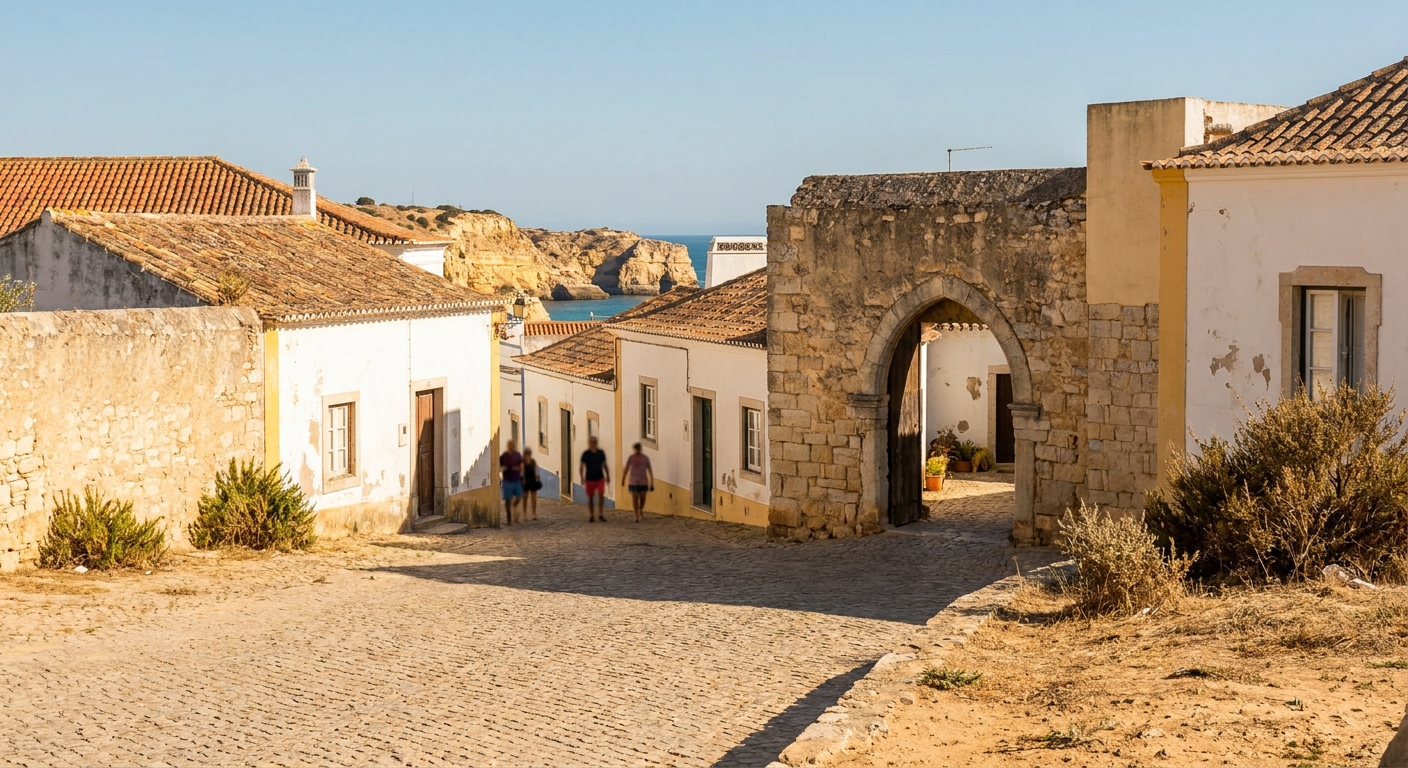
January makes the indoor half of Lagos the point of the trip rather than the rainy-day reserve. The Museu de Lagos is not one building but seven, from the main museum and the Dr. José Formosinho collection to the documentation center, the Armazém do Espingardeiro and a Roman bath house out at Praia da Luz. In August nobody spends a morning on any of them. In January they hold the hours when the light is worst anyway.
Start on Praça do Infante at the Rota da Escravatura, the Mercado de Escravos, open Tuesday to Sunday, 10:00 to 13:00 and 14:00 to 18:00, last admission half an hour before closing. Skip Forte Ponta da Bandeira: built between 1680 and 1690 to cross fire with the Porta da Vila, moat, drawbridge, azulejo chapel and all, it is listed as temporarily closed on the museum’s page updated July 16, 2026. We have no admission price for either.
The month bites on the timetable, not on the exhibits. A 10:00 opening lands more than two hours after the 7:46 sunrise, the 13:00 to 14:00 break falls in the warmest hour of the day, and the doors shut at 18:00, a quarter of an hour after dark. The museum’s own hardest room does not soften with the season either: the 2009 dig at Vale da Gafaria, under a car park site outside the walls, turned up more than 150 African people discarded with the town’s refuse.
For the free half of the day, nothing needs reserving. The clifftop walk toward Ponta da Piedade takes no ticket and no booking, and the bath house at Praia da Luz makes the natural January pairing with it, one indoors, one out. We hold no price and no visitor figure for the cliffs, so we make no claim about how busy the path is on a Tuesday in January.
Lagos in January: a two-day itinerary
Day one runs on the light. Coffee while it is still dark, the old town walls and Praça do Infante from 9:00, then the Rota da Escravatura when it opens at 10:00, giving you the full three-hour session. Lunch during the museum’s 13:00 to 14:00 break, when the thermometer is closest to that 61.0°F high. Out on the clifftop path by 14:30 and back before the 17:43 sunset. Dinner is an indoor event in January, so book a table.
Day two goes west to Praia da Luz for the Balneário Romano, the museum’s Roman bath house, with the afternoon left open for the beach front or a swim if you brought neoprene for 61.4°F water. If the sky turns, and 7.4 days a month it does, drop the coast and spend the afternoon on the other museum sites in town rather than the fort, which is closed. One soaking day of 0.39 inch or more falls in an average January, sometimes two.
Lagos in January vs December and February
| December | January | February | |
|---|---|---|---|
| Average high | 62.6°F | 61.0°F | 61.3°F |
| Average low | 49.8°F | 47.3°F | 47.8°F |
| Precipitation | 2.96 in | 2.10 in | 1.91 in |
| Days with 0.04 in or more | 8.0 | 7.4 | 6.3 |
| Sea surface (daily maxima) | 63.2°F | 61.4°F | 61.1°F |
Across the three winter months the air barely moves: 1.6°F separates December’s high from January’s, and February comes back up by 0.3°F. Rain does the separating. December carries 2.96 inches over 8.0 wet days, January 2.10 over 7.4, February 1.91 over 6.3. The water runs the other way, warmest in December at 63.2°F and coldest in February at 61.1°F, all three readings taken from the marine API as means of daily maxima.
Shift four weeks forward and you gain the driest of the three months and one fewer wet day, and you pay for it with the coldest sea of the winter. Shift four weeks back and December hands you the warmest water and the warmest air of the trio, then charges nearly an inch more rain, plus Christmas and New Year on the calendar, when the Rota da Escravatura closes on the 1st, the 24th and the 25th.
Is January a good time to visit Lagos?
Yes for walkers, for anyone who wants the old town at its own speed, and for a three-night winter break where the sea is scenery. No for swimmers, sunbathers and families whose children measure a vacation in hours in the water, because 61.4°F does not negotiate. Surfers and wetsuit swimmers sit in the yes column and know it already.
If the answer is no, February is the obvious shift among the months we have numbers for: 1.91 inches of rain, 6.3 wet days, a hair warmer by day. It will not fix the water, which reads 61.1°F. For actual swimming weather, the decision belongs to the twelve-month verdict and to our Algarve guide, not to a winter page.
What January holds that its two neighbors do not: December’s rain has already dropped away, 2.10 inches against 2.96, and February’s colder water has not arrived yet, 61.4°F against 61.1.
The last word
Book the room you can heat, keep the mornings for the museum sessions and the 14:30 to 17:00 window for the cliffs, and let the beach go until another trip. One thing not to plan around: Forte Ponta da Bandeira stays shut, and the cylindrical sentry boxes people photograph from the quay are not even seventeenth-century, having been added by restoration work around 1960.
Sources & data for this guide
- January normals, highs, lows and precipitation · IPMA, climate normals 1991-2020, station 533 Sagres, 22.9 m · checked Sep 23, 2026
- Rain-day counts and their 1 mm / 10 mm thresholds · IPMA, same station and period · checked Sep 23, 2026
- December and February normals (air and rain) · IPMA, same station and period, not estimates · checked Sep 23, 2026
- Sea surface, 61.4°F in January and the December/February figures, taken as means of daily maxima 2015-2024 · Open-Meteo Marine API · checked Sep 23, 2026
- Sunrise 07:46, sunset 17:43 and 9h 57m of daylight on January 15 · sunrise-sunset.org · checked Sep 23, 2026
- Museum hours, closure dates, the seven museum sites, the fort’s construction and closure, the Vale da Gafaria dig · Museu de Lagos, Câmara Municipal de Lagos, page updated July 16, 2026 · checked Sep 23, 2026
- Our reserves: we could not verify an admission price for any Lagos museum site, any lodging-tax rate, or any occupancy or room-rate series. Where we have no figure, we give none, and the lead time in the crowds section is marked (est.) because it is our call.