
LAGOS · BEST TIME TO VISIT · 37.1° N
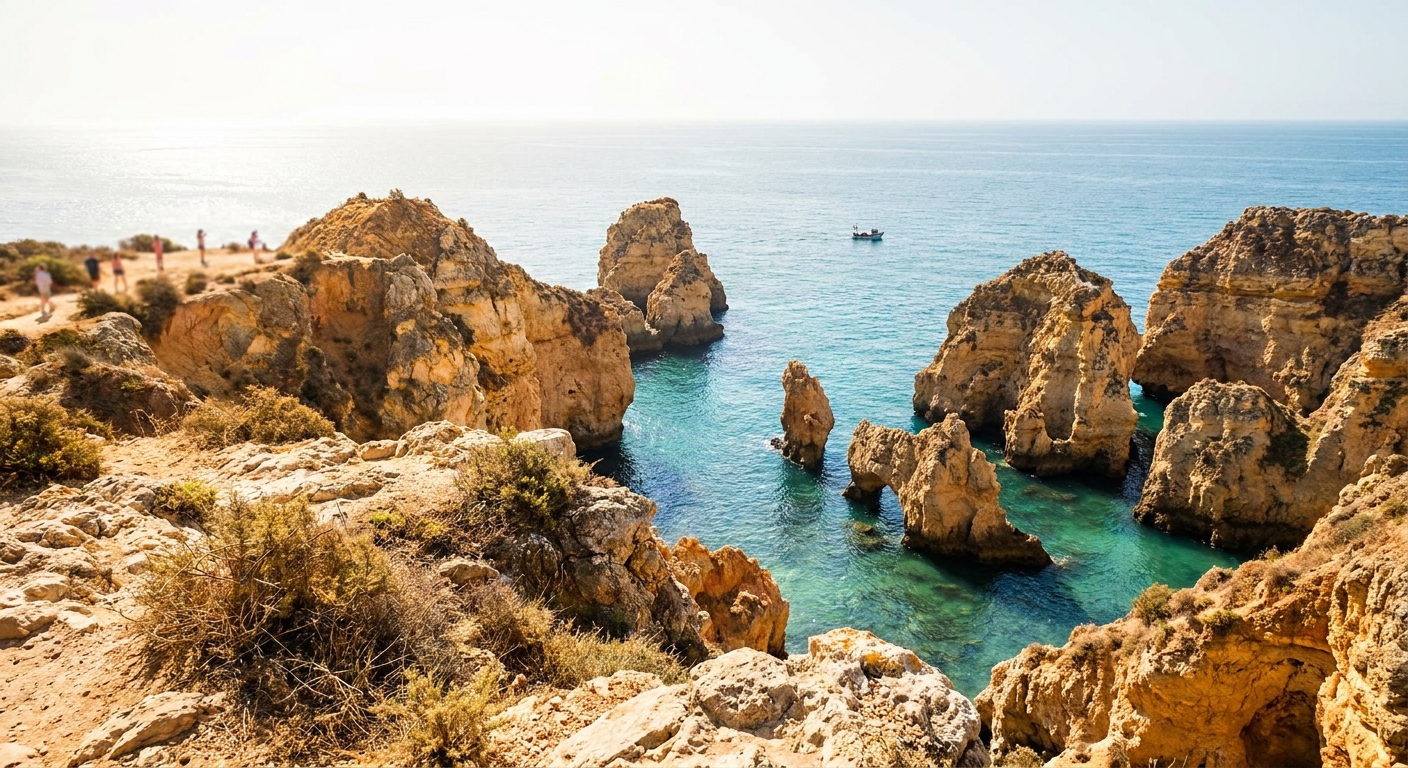
Lagos makes its case at the cliff edge above Ponta da Piedade: gold stacks, green water, a stairway down to a boatman. The calendar behind that view surprises most American visitors. Air temperatures peak at 78.6°F in August, the sea peaks two months later at 66.3°F in October, so the hottest week of the year is not the best week to get in the water.
Most trips here turn on a single decision: how many of your days are meant to be spent in the water rather than beside it. Answer that and the month follows, and with it the flights, the nights and how early you book them. The normals below come from a real thermometer, and they disagree with the brochure in two useful places.
THE YEAR AT A GLANCE · LAGOS
Go in September: highs of 76.8°F, 0.73 inches of rain over 2.5 wet days, and a sea at 64.2°F that August, for all its heat, cannot match.
BEST MONTH: SEPTEMBER · WARMEST SEA: OCTOBER, 66.3°F · QUIET SEASON: NOVEMBER TO FEBRUARY
Go for: September and October, when the water sits at 64.2°F and 66.3°F, its annual best, and the August school holidays are over.
Think twice before: booking November for a beach week: 3.23 inches of rain across 8.4 days at 1 mm or more, the wettest of the twelve months.
Air and rain: IPMA normals 1991-2020, station 533 Sagres · Sea: Open-Meteo Marine, 2015-2024 · full sources at the end
On this page
- Month by month: highs, rain, sea and daylightThe twelve-month table
- Best month for a beach tripSeptember, and the numbers behind it
- When the sea is warm enough to swimFour months above 64°F
- Quiet months for a low-season tripNovember through February
- The month to skip for a beach vacationNovember, 3.23 inches of rain
- May, June, September and OctoberThe shoulder months against August
Peak in Lagos is July and August, when Portuguese and northern European school holidays land on the same sand and rooms book earliest. The low season runs November through February, with the Christmas and New Year weeks as the exception. We hold no monthly price series for this town, so treat those quiet months as a fact of the calendar and check rates yourself once you have flights into Faro or Lisbon.
Lagos weather month by month: highs, lows, rain and sea
| Month | High | Low | Rain | Days ≥ 1 mm | Sea | Daylight (15th) |
|---|---|---|---|---|---|---|
| January | 61.0°F | 47.3°F | 2.10 in | 7.4 | 61.4°F | 9h57 |
| February | 61.3°F | 47.8°F | 1.91 in | 6.3 | 61.1°F | 10h53 |
| March | 64.0°F | 51.1°F | 1.92 in | 6.3 | 60.2°F | 12h00 |
| April | 66.4°F | 53.6°F | 1.37 in | 5.7 | 61.8°F | 13h13 |
| May | 70.7°F | 57.0°F | 0.87 in | 3.9 | 62.2°F | 14h13 |
| June | 75.0°F | 61.2°F | 0.15 in | 0.7 | 65.3°F | 14h45 |
| July | 77.4°F | 62.6°F | 0.04 in | 0.2 | 63.3°F | 14h30 |
| August | 78.6°F | 63.3°F | 0.06 in | 0.4 | 62.1°F | 13h37 |
| September | 76.8°F | 62.1°F | 0.73 in | 2.5 | 64.2°F | 12h27 |
| October | 72.3°F | 59.0°F | 2.42 in | 6.7 | 66.3°F | 11h18 |
| November | 66.2°F | 53.1°F | 3.23 in | 8.4 | 64.4°F | 10h14 |
| December | 62.6°F | 49.8°F | 2.96 in | 8.0 | 63.2°F | 9h41 |
Summer here is not merely drier than winter, it is close to rainless: June through September bring 0.98 inches between them, more than three times less than November alone at 3.23 inches. Temperature travels a narrow road by American standards, 61.0°F in January to 78.6°F in August, a spread of 17.6 degrees across the whole year.
Two months do the swinging. April into May is the first, rain dropping from 1.37 to 0.87 inches and wet days from 5.7 to 3.9 while highs climb 4.3 degrees to 70.7°F. September into October is the second, running the other way: 0.73 inches becomes 2.42, and 2.5 days at 1 mm or more become 6.7. Everything between those two hinges is the dry half of the year.
November is the hardest of the twelve months for a beach-and-boat trip, with 3.23 inches of rain spread over 8.4 days at 1 mm or more and 2.6 days at 10 mm or more, tied with December for the year’s most. Daylight is down to 10 hours 14 minutes by the 15th. For a walking trip the same month reads differently: highs of 66.2°F sit within half a degree of April’s 66.4°F, and the cliff paths are empty.
Every figure here for air and rain is measured at IPMA station 533, Sagres, 22.9 meters above sea level, the windiest point of the Algarve and the nearest published station to Lagos. Readings a few miles east along the coast differ, and the hills behind the shore are colder and far wetter. The wet-day counts use the Portuguese service’s own thresholds, 1 mm and 10 mm, not the 0.10-inch line American tables draw, so the two sets of counts are not interchangeable.
When is the best time to visit Lagos?
Go in September. Highs of 76.8°F, 0.73 inches of rain across 2.5 days at 1 mm or more, 12 hours 27 minutes of daylight on the 15th, and a sea at 64.2°F against August’s 62.1°F. That is the rare month where the water is warmer than the peak of summer and the school holidays are over, and it is the one to build an itinerary around if you can travel outside the family calendar.
October takes the water further, to 66.3°F, the warmest reading of the twelve months, and charges for it in weather: 2.42 inches of rain over 6.7 wet days against September’s 0.73 inches over 2.5, and 11 hours 18 minutes of daylight against 12 hours 27. Four degrees of sea for six inches more rain and an hour less light is the trade, and for most trips September wins it.
The same weeks work across the country, and the national picture sits in our 12-month verdict for Portugal. For what fills the days, the Algarve guide covers the coast from Sagres to Tavira, with the two boat runs detailed at Ponta da Piedade and Benagil. Airport and schedule questions go to flights from the US, and the wardrobe call for a 64°F sea is in what to pack.
When can you swim in Lagos? Sea temperature month by month
Four months average above 64°F at the surface: October at 66.3°F, June at 65.3°F, November at 64.4°F and September at 64.2°F. None of the twelve reaches 68°F. March is the floor at 60.2°F, and the two hottest months in the air are not the two warmest in the water, July sitting at 63.3°F and August at 62.1°F. Swimmers who book August for the heat get the coolest sea of the second half of the year.
Read those figures with one caveat attached. Each is a mean of DAILY MAXIMA over 2015-2024, taken from a marine series off Lagos rather than from the Sagres thermometer, so it runs a shade above a true 24-hour average. An early-morning swim, before the sun has worked on the surface, comes in under the table value. This is the Atlantic, not the Gulf of Mexico: 66.3°F is a brisk pleasure for twenty minutes and a wetsuit question for an hour.
When is Lagos quietest?
The town runs on a European school calendar. August is the continent’s holiday month and fills the beaches from both ends of Portugal and from northern Europe, with July close behind and Easter week producing a short spring bump. The quiet stretch is November through February, broken only by the Christmas and New Year fortnight. That is a statement about the calendar, not about rates: we carry no monthly price data for Lagos.
What those months give is room. The November sea holds 64.4°F, warmer than May’s 62.2°F, highs of 66.2°F suit a long cliff walk better than August heat does, and a rental car finds space near Ponta da Piedade instead of circling. Restaurants seat you without a booking, and a winter weekend in town needs less planning than a summer one.
The bill comes in daylight and rain. December 15 carries 9 hours 41 minutes of light and January 15 carries 9 hours 57, against 14 hours 45 in mid-June. Rain falls on 8.0 December days and 7.4 January days at 1 mm or more, and the water bottoms out at 60.2°F in March. Grotto boats also cancel on Atlantic swell in winter, so a two-day trip can lose both of its mornings on the water.
Which month should you avoid in Lagos?
For anyone coming to swim, sail or lie on a beach, November is the month to skip: 3.23 inches of rain, the most of the twelve, over 8.4 days at 1 mm or more, with 2.6 days at 10 mm or more and only 10 hours 14 minutes of daylight at mid-month. Book that fortnight as a beach vacation and the odds are simply against you.
It redeems itself for a different traveler. November’s water sits at 64.4°F, warmer than every month from December through May, including April at 61.8°F. Highs of 66.2°F are April weather without April’s crowds, the cliff path above Ponta da Piedade is yours, and a long weekend built around walking, market food and one clear afternoon on the water works well in it.
Lagos shoulder season: months, weather and crowds
The shoulder runs May and June on the way up, September and October on the way down. Against August’s 78.6°F, May gives back 7.9 degrees at 70.7°F and October 6.3 degrees at 72.3°F. June closes to within 3.6 degrees at 75.0°F, and September comes within 1.8 degrees at 76.8°F. In air temperature alone, the edges of summer are barely a compromise.
The water is where the shoulder beats the peak outright. October averages 66.3°F, a full 4.2 degrees above August’s 62.1°F, and June’s 65.3°F beats it too. May pays you in light instead: 14 hours 13 minutes on the 15th, just 32 minutes short of the June maximum, with 0.87 inches of rain over 3.9 wet days for walking. Beaches that need a dawn arrival in August take a mid-morning one in either.
What the shoulder removes is reliability and hours. October brings 2.42 inches over 6.7 wet days against August’s 0.06 inches over 0.4, and its 11 hours 18 minutes of daylight run 2 hours 19 minutes short of August’s 13 hours 37. May’s sea, at 62.2°F, is 4.1 degrees cooler than October’s, so a spring trip is a walking trip with swims in it rather than the reverse.
Pick by what your days are for. If the trip is swimming, boats and long lunches, book late September or October and keep one indoor afternoon in reserve. If it is cliff paths, markets and driving the coast, take May and use the extra light. June splits the difference at 75.0°F with 0.7 wet days, and it is the last month before the nights get hard to find.
The last word
September is the booking to make, and October only if warm water outranks dry afternoons. One last figure worth packing around: on June 15 the sun sets at 8:58 p.m. local time, 3 hours 37 minutes later on the clock than the 5:21 p.m. of December 15. A June evening holds a second beach and a late dinner. A December one holds the walk back from the marina, and that is the real difference between the two halves of the Lagos year.
Sources & data for this guide
- Air temperature and rainfall normals 1991-2020, station 533 Sagres (22.9 m) · IPMA, Instituto Português do Mar e da Atmosfera · checked Sep 12, 2026
- Rain-day counts at the 1 mm and 10 mm thresholds, same station and period · IPMA · checked Sep 12, 2026
- Sea surface temperature, mean of daily maxima 2015-2024, marine series off Lagos · Open-Meteo Marine API · checked Sep 12, 2026
- Daylight, sunrise and sunset on the 15th of each month, converted from UTC to local time · sunrise-sunset.org · checked Sep 12, 2026
- Editorial caveat: Sagres is the nearest published station to Lagos and the windiest headland on this coast. We publish what is measured there rather than a model grid cell over the town, and inland or eastern readings differ.
- Crowd and season notes are an editorial reading of the school and holiday calendar. We hold no monthly price series for Lagos, and boat schedules and opening hours change · check operators when you book.