
PONTA DA PIEDADE · MARCH · THE ALGARVE
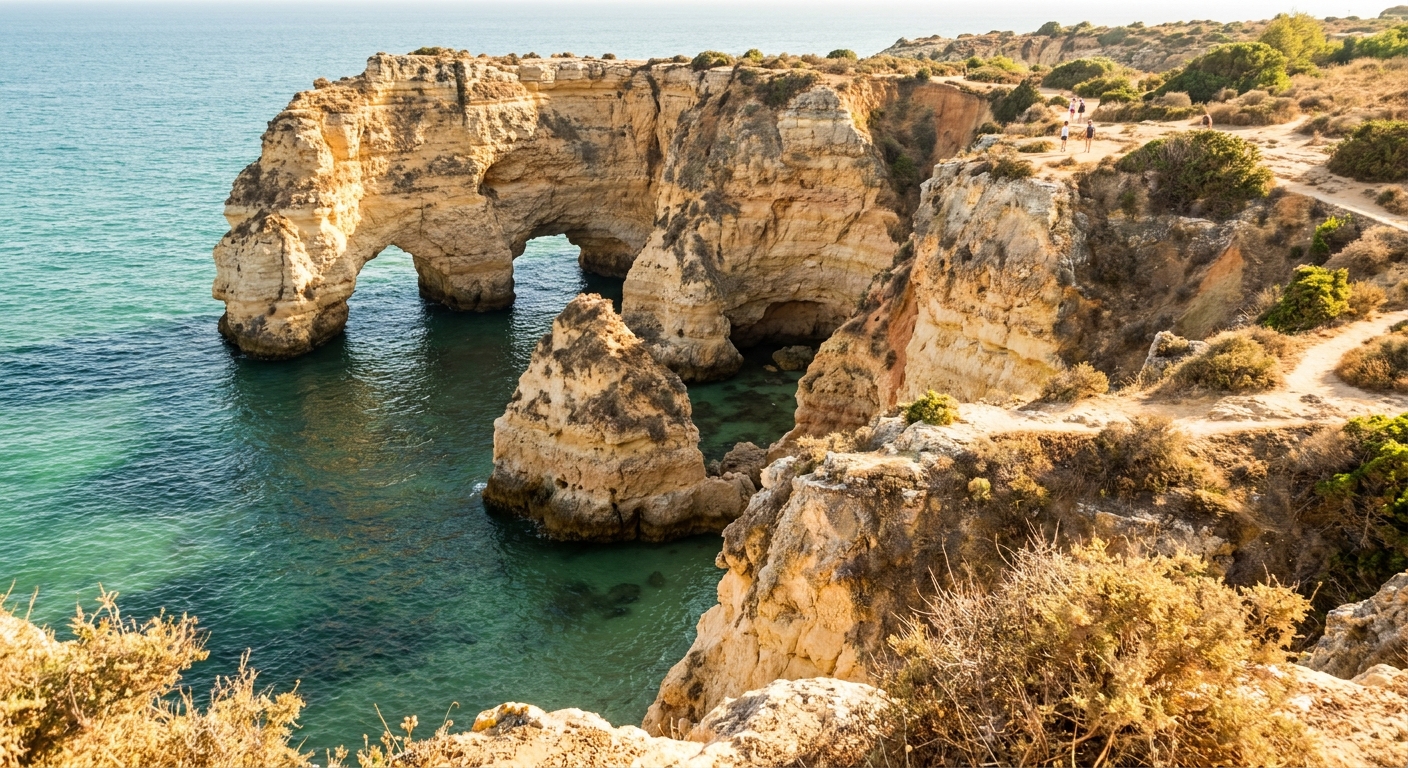
The cliffs at Ponta da Piedade do their best work in cool air and clean light, and March hands you both. Days run to an average high of 64.0°F, the headland is still green from the winter rain, and the sun stays up a full twelve hours by mid-month. Boats leave Lagos for the sea caves whenever the swell drops.
What the month takes back is the swimming. The water off the headland averages 60.2°F, colder than February and colder than April, and that reading is already generous. Pack shoes for the clifftop path, a layer for a 51.1°F dawn, and a plan for the boat that can move by a morning.
THE MONTH AT A GLANCE · MARCH
March gives you the clifftops in walking weather, 64.0°F days and twelve hours of light, and refuses you the swim: the sea sits at 60.2°F, the coldest of the three months around it.
IPMA NORMALS 1991-2020 · STATION 533 SAGRES · SEA FROM OPEN-METEO MARINE
Go for: the clifftop walk from Lagos in air that never gets hot, a grotto boat on a calm morning, and twelve hours of daylight to spend on foot.
Think twice before: booking a fixed boat slot weeks ahead, or planning a swimming trip around a 60.2°F sea.
Air: IPMA station 533, Sagres · Sea: Open-Meteo Marine · Daylight: sunrise-sunset.org · full sources at the end
On this page
- Average highs, lows and rain days in March64.0°F days, 1.92 inches, 6.3 wet days
- Sea temperature: can I get in the water?60.2°F, and what that does to a swim
- Crowds, boat fares and when to bookWhat we can source, and what we cannot
- Things to do around the cliffs in MarchPraia do Camilo, Dona Ana, the Lagos cliff path
- A two-day plan built on March lightTwo days, 6:44 a.m. to 6:44 p.m.
- March vs February and AprilHow the three months compare, figure by figure
- Is March a good month to come?Yes for walkers, no for swimmers
Every air figure here comes from a single thermometer: IPMA’s station 533 at Sagres, 22.9 m above the sea, on the windiest headland of this coast. It reads coastal air well. It does not describe high ground inland, which runs colder and a good deal wetter. The sea number has a different pedigree, Open-Meteo’s marine model, and the daylight comes from a sunrise calculation.
Ponta da Piedade weather in March: average highs, lows and rain days
| Measure | March | Source |
|---|---|---|
| Average high | 64.0°F (17.8°C) | IPMA 1991-2020, station 533 Sagres |
| Average low | 51.1°F (10.6°C) | IPMA 1991-2020, station 533 Sagres |
| Precipitation | 1.92 in | IPMA 1991-2020, station 533 Sagres |
| Days with 0.04 in or more | 6.3 | IPMA 1991-2020, station 533 Sagres |
| Days with 0.39 in or more | 1.7 | IPMA 1991-2020, station 533 Sagres |
| Sea surface | 60.2°F (15.7°C) | Open-Meteo Marine, daily maxima 2015-2024 |
| Daylight on March 15 | 12h 00m | sunrise-sunset.org |
The national weather service, IPMA, gives March at Sagres an average high of 64.0°F and an average low of 51.1°F over the 1991-2020 period, with 1.92 inches of rain. That is a real instrument on a real cliff, not a model grid cell averaged over a hundred square miles, and the difference matters on a coast where the next valley inland behaves differently.
Rain shows up on 6.3 days in an average March, roughly one day in five. Read that threshold carefully: IPMA counts any day with 1 mm, about 0.04 inch, while American tables usually start counting at 0.10 inch. A US-style table for the same coast will therefore print a smaller number for the same weather. In practice, four days out of five are walkable and one wants a hood.
Between the 51.1°F night and the 64.0°F afternoon sits nearly 13°F, and on this headland the wind widens the gap further. A windproof shell, a mid layer you can shed by ten, and grip on the shoes cover the whole day. Our packing guide has the rest of the Portugal list.
Light is the month’s quiet gift. On March 15 the sun rises at 6:44 in the morning and sets at 6:44 in the evening, a clean twelve hours, with the last of it striking the stacks from the west. That is nearly an hour of usable evening more than a January visitor gets, and it is why dinner in Lagos can wait until dark.
Can you swim in Ponta da Piedade in March? Sea temperature and what it feels like
The sea surface off the headland averages 60.2°F in March, from Open-Meteo’s marine series over 2015-2024. One nuance belongs with that figure: it is the mean of daily maxima, the warmest reading of each day, so it sits a shade above a true 24-hour average. The honest range for an early-morning dip is a touch below 60.
Sixty degrees is a gasp, not a swim. Locals and surf schools in Lagos are in full wetsuits through March, and a bare-skinned plunge from Praia do Camilo lasts about as long as your breath does. With the air at 64.0°F and a headland breeze, the getting-out is colder than the getting-in, so carry a towel and something dry for the walk back up.
Sagres, where our thermometer stands, is the windiest point of this coast, and on a grotto trip the sea state decides more than the air does. We could not verify a wave-height or wind series for March off the headland, so we give no swell figures. The practical consequence stands anyway: check the operator’s board or phone the morning of, not the week before.
How busy is Ponta da Piedade in March? Crowds, tour prices and booking ahead
March sits before the Algarve’s summer season, and that is a calendar fact rather than a price reading. We found no monthly occupancy or room-rate series for Lagos, so we crown no month cheap and no month expensive. What the calendar does support: the clifftop parking, the beach staircases and the boat queues belong to July and August, and a March weekend on the headland is a different scale of thing.
Most US trips reach this coast through Faro, an hour east by road, and the flight is the part to lock early. Our flights guide covers the routings and Faro the arrival. The boat is the part to keep loose: with 6.3 wet days in the month and departures ruled by the swell, a slot booked four weeks out is a coin toss, while a morning call from your hotel almost always finds space.
We could not verify March fares or sailing times for the grotto boats that run to the headland, and we could not verify the municipal lodging tax in force in Lagos for this month, so we quote no euro figure for either. Both are answered in thirty seconds, at the marina ticket huts and at hotel check-in.
The one place where paying more genuinely changes March: a small or private departure rather than a fixed shared slot, because it can move to the morning the sea allows instead of the morning your booking says. A room within walking reach of the cliff path buys the same flexibility on land, since a clear window is not worth spending on a drive.
Things to do in Ponta da Piedade in March
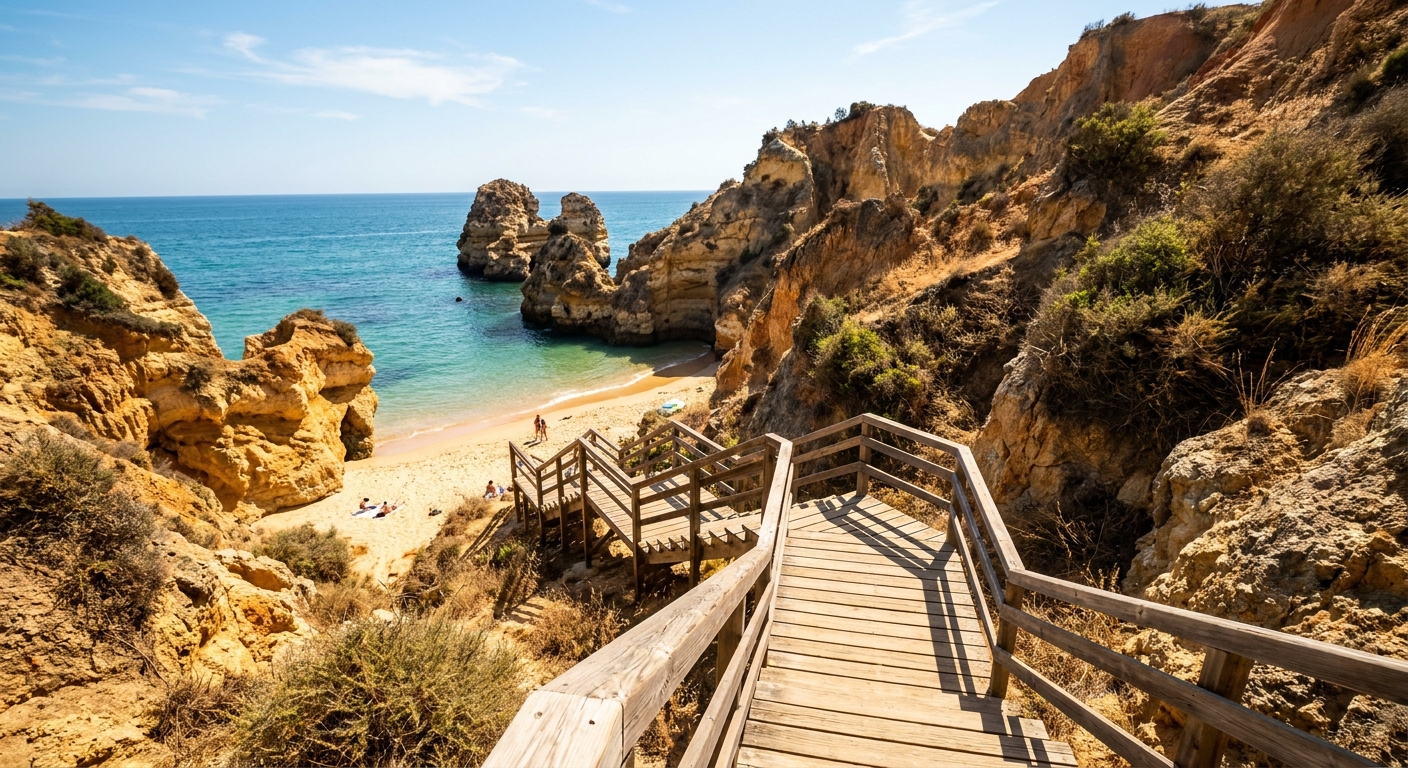
March lets you walk the cliffs in the middle of the day, which July does not. At an average high of 64.0°F the path from Lagos out along the headland is a comfortable two hours in either direction, wildflowers on the scrub, and no shade problem to solve. Add the twelve hours of daylight and the same day holds a walk, a beach and a boat.
The names worth your feet: the headland itself, with its stacks and arches seen from the clifftop and again from the water, the long staircase down to Praia do Camilo, the amphitheater of Praia de Dona Ana, and the flat sweep of Meia Praia when you want to walk without steps. Departures for the caves leave from Lagos marina and from the beaches below. The bigger cave circuit further east is a separate trip, covered in our Benagil guide.
What March changes at those places is the air, not the water. The sea moves less than 2°F across February, March and April, from 61.1 to 60.2 to 61.8, while the daytime air climbs 5.1°F over the same eight weeks. So the coves feel transformed and the swimming does not. Dona Ana in March is a sun trap for a picnic and a cold shock for a paddle.
The free half of the month is the better half. No ticket is needed for the clifftop paths, the viewpoints over the stacks, the staircases down to the coves or the Lagos waterfront, and those are exactly the things summer heat makes hard work. The wider Algarve guide covers the paying attractions inland.
Ponta da Piedade in March: a two-day itinerary
Day one runs on the light. Sunrise is at 6:44 a.m. in mid-March, so an eight o’clock start on the cliff path from Lagos puts you at the headland while the air is still in the low fifties and the stacks are in shadow. Give the middle of the day to Praia do Camilo, when the sun is high enough to reach the water. Keep the afternoon for the boat if the swell has settled, then stay up top: the sun sets at 6:44 p.m.
Day two goes west. A slow morning in the Lagos market and old streets, then the drive out to Sagres, the cape where our thermometer sits and where the sea decides everything. If one of the month’s 6.3 wet days lands on you, swap the order: town first, cape later, boat pushed to a third morning. Two nights in Lagos covers this headland comfortably, and our getting-around guide settles the car question.
Ponta da Piedade in March vs February and April
| Measure | February | March | April |
|---|---|---|---|
| Average high | 61.3°F | 64.0°F | 66.4°F |
| Average low | 47.8°F | 51.1°F | 53.6°F |
| Precipitation | 1.91 in | 1.92 in | 1.37 in |
| Days with 0.04 in or more | 6.3 | 6.3 | 5.7 |
| Sea surface (daily maxima) | 61.1°F | 60.2°F | 61.8°F |
The three months span 5.1°F on the daytime high, from 61.3 in February to 66.4 in April. Rain is where they separate: February and March both land near 1.9 inches across the same 6.3 wet days, while April falls to 1.37 inches over 5.7. And the sea does the opposite of what the air suggests, with March the coldest of the three at 60.2°F, behind February’s 61.1 and April’s 61.8, because water lags the calendar by weeks.
Move your flight four weeks later and April buys 2.4°F on the high, half an inch less rain, one fewer wet day and 1.6°F more sea, against a coast filling up toward its season. Move it four weeks earlier and February costs 2.7°F by day and 3.3°F at night for exactly the same rain days. Our month-by-month verdict for Portugal takes the argument out to twelve months, and February has its own page.
Is March a good time to visit Ponta da Piedade?
Yes, if what you came for is the headland on foot and the caves from a boat. Walking weather at 64.0°F, twelve hours of daylight and coves you can photograph without a queue are a strong hand. No, if your trip is built on swimming, or on a boat departure printed on a non-refundable ticket for a fixed date.
If the answer came out no, take April rather than May. It holds the daytime air at 66.4°F, cuts the rain to 1.37 inches over 5.7 wet days, and warms the sea to 61.8°F, which is the biggest single improvement available for four weeks of patience. A rental car makes the April version easier too, as our car guide explains.
What no other month around it offers: twelve hours of daylight arriving while the air is still cool enough to walk the cliffs all afternoon.
The last word
Book the room in Lagos within walking reach of the cliff path, keep the boat morning unbooked until the forecast firms, and be on the headland at 6:44 in the evening. One figure we held back makes the case: of March’s 6.3 wet days, only 1.7 record 0.39 inch or more, so the genuinely soaking days are a pair at most and the rest is rain you walk through with a hood up and the stacks to yourself.
Sources & data for this guide
- March air normals, high 64.0°F, low 51.1°F, 1.92 in · IPMA climate normals 1991-2020, station 533 Sagres, altitude 22.9 m · checked Sep 23, 2026
- Rain-day counts, 6.3 days at 0.04 in or more and 1.7 at 0.39 in or more · IPMA, same station and period · metric thresholds, not the 0.10-inch threshold used in US tables · checked Sep 23, 2026
- February and April air normals used in the comparison · IPMA 1991-2020, station 533 Sagres · checked Sep 23, 2026
- Sea surface 60.2°F in March, 61.1°F in February, 61.8°F in April · Open-Meteo Marine API, mean of daily maxima 2015-2024 · checked Sep 23, 2026
- Daylight 12h 00m on March 15, sunrise 06:44 and sunset 18:44 UTC · sunrise-sunset.org · checked Sep 23, 2026
- Editorial admission: Sagres is the nearest official thermometer we could read for this headland, and it stands on the windiest point of the coast, so inland and high ground run colder and wetter. We could not verify grotto-boat fares, sailing times or the Lagos municipal lodging tax, so we quote none · check operators when you book.