
FARO · MARCH · IPMA STATION 554
Faro’s March runs a normal high of 66.0°F and a normal low of 51.4°F. That is jacket-at-breakfast, shirt-by-noon weather, and it is the reason the eastern Algarve fills with walkers, cyclists and birdwatchers weeks before anyone unfolds a beach towel.
What the date takes away is the water. The sea off the city averages 60.9°F, rain shows up on 5.6 days of the month, and March 15 brings exactly 12 hours of daylight. Those three numbers decide whether you book now or slide the trip to April.
FARO AT A GLANCE · MARCH
March gives Faro 66.0°F afternoons and twelve hours of light for walking the old town and the lagoon, and a 60.9°F sea that will not carry a swimming holiday.
IPMA STATION 554 · 1991-2020 NORMALS · THERMOMETER AT 5 M
Go for: walking weather at 66.0°F, twelve hours of daylight on March 15, and the Ria Formosa lagoon in cool, clear air.
Think twice before: booking March for the beach. The sea averages 60.9°F, the coldest of February, March and April.
Normals: IPMA station 554 · Sea: Open-Meteo Marine · Light: sunrise-sunset.org · full sources at the end
On this page
- Faro weather in March66.0°F days, 51.4°F nights, 5.6 wet days
- Can I swim in the sea in March?A 60.9°F sea, and what that means in practice
- Crowds, prices and the tourist taxWhat we verified, and what we could not
- Things to do in Faro in MarchRia Formosa, the old town, Ilha Deserta, Tavira
- A two-day plan for FaroHour by hour on twelve hours of light
- Faro in March vs February and AprilHow the three months compare, degree by degree
- Is March a good time to visit Faro?Yes for walkers, no for swimmers
Anything that is not dated by the month sits elsewhere: the city itself, its neighborhoods and its airport links are in our Faro guide, the twelve-month national verdict in the best-time guide, and the coastline either side of town in the Algarve guide.
Faro weather in March: average highs, lows and rain days
| March at Faro, 1991-2020 | Normal |
|---|---|
| Average high | 66.0°F (18.9°C) |
| Average low | 51.4°F (10.8°C) |
| Precipitation | 1.84 in |
| Days with 0.04 in or more | 5.6 |
| Days with 0.39 in or more | 1.6 |
| Daylight, March 15 | 12h 00m |
These normals come from IPMA, the Portuguese national weather service, station 554 at Faro, with the instrument 5.0 m above sea level: a real thermometer on the coast, not a model grid cell. Over 1991-2020 its March average high is 66.0°F, the average low 51.4°F, and the monthly rainfall 1.84 inches. Every figure here is measured at that single coastal spot on the eastern Algarve. Inland and on high ground the same month is colder and a good deal wetter, so nobody should pack for a hill walk on a sea-level reading.
Rain reaches the gauge on 5.6 days of an average March, counting every day with at least 1 mm (0.04 inch), which is roughly one day in five. Heavier weather, 10 mm (0.39 inch) or more, arrives on 1.6 days. Those are IPMA’s own thresholds, not the 0.10-inch cutoff behind most US tables, so the two counts are not interchangeable. Read it as four dry days for every wet one, with the heavy days doing a large share of the monthly total.
Between the 66.0°F afternoon and the 51.4°F dawn sits a spread of 14.6°F, and it lands inside a single day rather than across the month. Pack a fleece for 8 am and again after sunset, a shirt for the middle of the day, and rain cover you can carry for those 5.6 days. Our Portugal packing guide goes further, but the March answer is layers and a hood rather than a heavy coat.
On March 15 the city gets 12 hours 00 minutes of daylight, with sunrise at 6:40 am and sunset at 6:40 pm local time, which is still UTC at that point in the month. The practical effect: a boat back at 6 pm lands in daylight, and an 8 pm dinner is a night meal. Sunrise-sunset.org supplies those two clock times.
Can you swim in Faro in March? Sea temperature and what the water feels like
Sea surface off Faro averages 60.9°F in March in the Open-Meteo Marine record for 2015-2024, and the way that number is built matters. It is the mean of daily maxima, so it runs a shade warmer than a full 24-hour average would. Take it as the top of the day’s water, not what waits for you at 8 am.
At 60.9°F the water is swimmable in the technical sense and unpleasant in every other one. Expect the gasp, a few minutes of bravado and a quick exit, unless you own a wetsuit, in which case the eastern Algarve is a perfectly good March surf coast. Families with small children should plan on a heated pool and treat the ocean as scenery.
We found no wind or wave series for Faro in March, so we make no claim about swell or blown-out days. The geography still tells you something: the Ria Formosa lies behind a chain of barrier islands, so its channels and flats stay sheltered when the open water is not, while the exposed sand west of the city takes the Atlantic straight on. Our Algarve guide covers which stretch faces where.
How busy is Faro in March? Crowds, prices and the tourist tax
March sits between the winter lull and the Easter run, ahead of the coast’s summer season. We could not verify an occupancy series or a month-by-month room-rate series for Faro, so we crown no month the cheapest. For what a week really costs, our Portugal cost breakdown and the guide to flights from the US carry the money side.
Easter moves between March and April from one year to the next, and we did not verify the date, so check it against your own dates before anything goes non-refundable. Settle the car before the room if driving is part of the plan, because Faro’s airport supplies rentals to the whole coast and not just to the city. Our car guide handles tolls, insurance and the pickup queue.
We could not verify a municipal tourist tax rate for Faro, so we give no per-night figure. Ask at check-in, and treat any city levy as a line added on arrival rather than something folded into the rate you booked. Know before you go gathers the rest of that practical layer.
One upgrade changes March more than any other: heating that works. Nights average 51.4°F, and plenty of Algarve rentals are built for July, with tile floors, thin glass and a reversible air-conditioning unit as the only warmth. Paying for a room that states central heating, or choosing a hotel over an apartment, buys back the evening. The view matters less in March than the radiator does.
Things to do in Faro in March
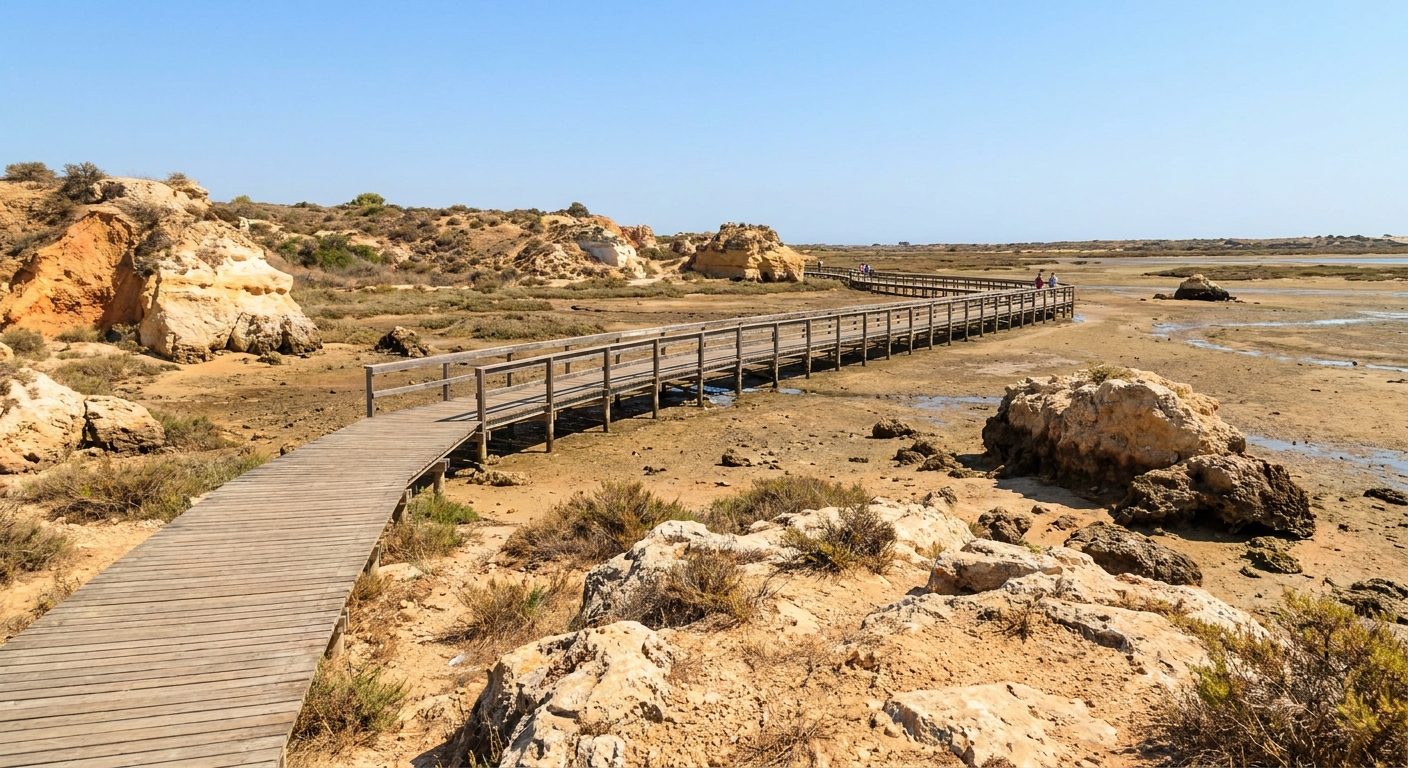
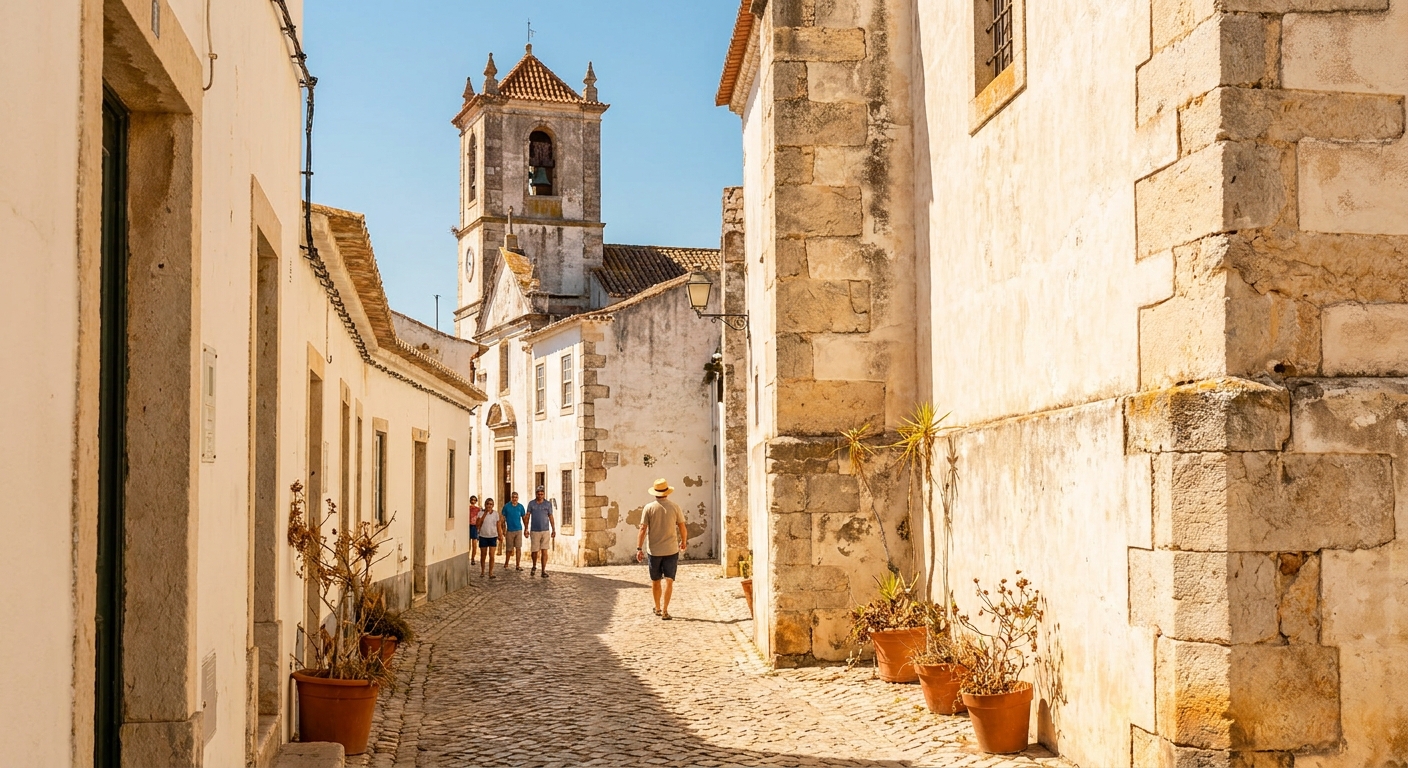
March opens the walking that July shuts down. At 66.0°F you can cross the walled old town, the Vila Adentro, and the lagoon boardwalks in mid-afternoon without hunting for shade, and the Ria Formosa is in its spring bird season, with waders and flamingos working the flats at low tide. A day outdoors here needs no early start and no siesta built into it.
Named targets: the Sé cathedral and the bone chapel at Igreja do Carmo inside the walls, the marina and the city piers for boats into the lagoon, the barrier islands of Ilha Deserta and Ilha do Farol, the long sandspit of Praia de Faro out past the airport, and Tavira up the coast by train. We could not verify current ferry fares, sailing times or opening hours for any of them, so we quote none: check the operators and the ticket office the week you travel.
The month works on those places through the gap between air and water. An island at 66.0°F in the air and 60.9°F in the sea is a walking and lunching destination with a theoretical swim attached. Four weeks later the air reads 69.3°F and the water 63.5°F, the same sand doing a different job. The lagoon behaves identically in any month, filling and emptying with the tide twice a day.
Free in March as in any month: the lanes inside the old walls, the waterfront promenade along the marina, the sand at Praia de Faro and the shoreline paths on the lagoon side. We could not verify free-admission days or reduced hours for Faro’s museums, so we name none. Our Portugal things-to-do guide carries the national picks.
Faro in March: a two-day itinerary
Day one. Light arrives at 6:40 am, so a 9 am start is already generous. Old town first, the cathedral and the bone chapel while the air is still near that 51.4°F mark, then coffee on the marina front. Give the middle of the day to the outdoors, since that is where the 66.0°F sits: a boat into the Ria Formosa, or the bus out to Praia de Faro and a long walk on the spit. Head back toward town by 5:30 pm, with sunset at 6:40 pm, and eat late.
Day two goes east on the train to Tavira for the salt pans, the old bridge and lunch by the river. If your day turns out to be one of the 1.6 heavy-rain days, spend it on the municipal market, the museum in the old convent and a slow meal, then move the island crossing to the next morning.
Faro in March vs February and April
| Faro normals | February | March | April |
|---|---|---|---|
| Average high | 62.6°F | 66.0°F | 69.3°F |
| Average low | 47.8°F | 51.4°F | 54.3°F |
| Precipitation | 1.65 in | 1.84 in | 1.54 in |
| Days with 0.04 in or more | 5.4 | 5.6 | 5.3 |
| Sea, daily maxima | 61.3°F | 60.9°F | 63.5°F |
February runs 62.6°F by day and 47.8°F at night, March 66.0 and 51.4, April 69.3 and 54.3: a gain of 3.4°F on the daytime figure into March, then 3.3°F more into April. Rainfall does not rise with the temperature. March is the wettest of the three at 1.84 inches over 5.6 wet days, against 1.65 inches in February and 1.54 in April. The sea reads stranger yet: 61.3°F in February, 60.9°F in March, 63.5°F in April, all as means of daily maxima from the same marine record.
Shifting four weeks later buys 3.3°F of afternoon air, 2.6°F of sea, a third of an inch less rain and 0.3 fewer wet days, and it puts Easter and the opening of the coast’s season into play. Coming four weeks earlier costs 3.4°F by day and 3.6°F at night, and hands back 0.4°F of water, the one figure February wins. Both neighbors get the full treatment in Faro in February and Faro in April.
Is March a good time to visit Faro?
Yes if your Faro is a walking, eating, bird-and-boat city. Afternoons at 66.0°F, twelve hours of light and four dry days for every wet one make a strong case, and the old town is a pleasure to cross at 2 pm rather than a test. No if the trip is built on swimming: a 60.9°F sea, the coldest of the three months around it, will not carry a beach week for anyone without a wetsuit.
If the water is the point, wait for April: 63.5°F sea, 69.3°F air and 1.54 inches of rain, the driest of the three. The trade is the calendar, since Easter can fall either side of the month boundary, so pin the year’s date before you choose. Our twelve-month verdict for Portugal puts the whole country’s season in order.
Only March pairs a 66.0°F afternoon with exactly twelve hours of daylight and a sea cold enough that the barrier islands stay a walking destination.
The last word
Decide on the water, not the air. If 60.9°F rules out the trip you had in mind, move it to April and stop refreshing the forecast; if it does not, book March and treat Faro as a walking city with a coast attached. One more figure out of the IPMA record: spread 1.84 inches across 5.6 wet days and the average wet day here delivers about a third of an inch, which is an afternoon in the municipal market rather than a day written off.
Sources & data for this guide
- March normals, highs, lows and precipitation · IPMA climatological normals 1991-2020, station 554 Faro, altitude 5.0 m · checked Sep 23, 2026
- Rain-day counts at the 1 mm and 10 mm thresholds · IPMA, same station and period · checked Sep 23, 2026
- February and April normals used in the comparison · IPMA, same station and period · checked Sep 23, 2026
- Sea surface 60.9°F as a mean of daily maxima, 2015-2024 · Open-Meteo Marine API · checked Sep 23, 2026
- Daylight, sunrise and sunset for March 15 · sunrise-sunset.org, converted to Europe/Lisbon · checked Sep 23, 2026
- Editorial note: we could not verify ferry fares, sailing times, museum hours or a municipal tourist tax rate for Faro, and we found no occupancy or monthly room-rate series, so this guide quotes none of them. Check operators and your property when you book.