
ÓBIDOS · PORTUGAL · THE 12-MONTH VERDICT
Óbidos is a walled town you can walk the top of, and that one fact sets its calendar. The ramparts are open stone with no shade and no shelter, so the year here sorts itself by rain rather than by heat. Heat barely moves at all: from the coolest month to the warmest, the average daytime high travels 12.1°F, January’s 58.1°F to August’s 70.2°F. Rain travels a great deal further.
So the question is not whether you will be warm on the walls. It is whether the cobbles of Rua Direita will be dry, how much afternoon you get before the light goes, and how many other day-trippers drove up from Lisbon on the same idea. September answers all three better than the other eleven months. The months that run it close are May and February, for very different reasons.
THE YEAR AT A GLANCE · ÓBIDOS
Come in September: 69.6°F days, 0.99 inches of rain across 4.1 wet days, and 12 hours 29 minutes of daylight on the 15th, the last month of the year that carries all three.
BEST MONTH: SEPTEMBER · DRIEST: JULY, 0.20 IN · WETTEST: NOVEMBER, 3.86 IN
Go for: September and May, when the wall walk is dry underfoot, the evenings run long, and the coach traffic from Lisbon has thinned out.
Think twice before: booking November around an outdoor plan: 3.86 inches of rain over 10.5 wet days, 3.2 of them at 10 mm or more, and the sun down by 5:24 p.m. local on the 15th.
Normals: IPMA station 531, Cabo Carvoeiro at Peniche · Daylight: sunrise-sunset.org · full sources at the end
On this page
- Óbidos weather month by monthThe twelve-month table
- When to visit ÓbidosSeptember, 69.6°F and 4.1 wet days
- How hot Óbidos gets in summerAugust, 70.2°F by day and 63.0°F at night
- The quietest months in ÓbidosJanuary and February
- The month to avoid in ÓbidosNovember, 3.86 inches of rain
- May or September for a shoulder tripHow the two months compare
Most travelers meet Óbidos as a day trip or a single night out of Lisbon, so the month you pick decides more than the packing. Wider planning sits in the twelve-month verdict for Portugal.
Óbidos weather month by month: highs, lows and rainfall
| Month | Avg high | Avg low | Rain | Days ≥ 1 mm |
|---|---|---|---|---|
| January | 58.1°F | 49.8°F | 2.98 in | 10.4 |
| February | 58.5°F | 50.5°F | 2.17 in | 7.6 |
| March | 60.6°F | 52.7°F | 1.92 in | 7.6 |
| April | 61.9°F | 54.5°F | 1.88 in | 7.7 |
| May | 64.8°F | 57.7°F | 1.41 in | 5.4 |
| June | 67.6°F | 61.2°F | 0.48 in | 2.2 |
| July | 68.9°F | 62.4°F | 0.20 in | 0.9 |
| August | 70.2°F | 63.0°F | 0.42 in | 1.8 |
| September | 69.6°F | 62.1°F | 0.99 in | 4.1 |
| October | 67.3°F | 59.5°F | 3.33 in | 9.2 |
| November | 62.6°F | 55.0°F | 3.86 in | 10.5 |
| December | 59.5°F | 51.4°F | 2.70 in | 9.4 |
Read the two temperature columns and almost nothing happens across a whole year: 58.1°F in January, 70.2°F in August, a swing of 12.1°F. The rain column is where the seasons actually live, 0.20 inches in July against 3.86 inches in November, a factor of nineteen between the two ends.
Two hinges do most of the work. Between May and June the rain nearly disappears, 1.41 inches falling to 0.48, with wet days dropping from 5.4 to 2.2. Between September and October it returns harder than it left: 0.99 inches becomes 3.33, and 4.1 wet days become 9.2. Late September is still dry Óbidos. The same fortnight a month later often is not, which is why the last week of September books out before the first week of October does.
November is the wettest of the twelve, 3.86 inches of it, and the heaviest with it: 3.2 days record 10 mm or more, against 0.1 day in July. For anyone whose plan is the wall circuit and a long lunch outside, that is the month that goes wrong. Sunset at 5:24 p.m. local on November 15 shortens the argument further, because a late arrival from Lisbon leaves you an hour of usable light.
Every figure here is a 1991-2020 normal from IPMA, the Portuguese weather service, measured at station 531, Cabo Carvoeiro at Peniche, 32 m above sea level. That thermometer stands on the coast while Óbidos sits slightly inland behind its walls, so read the numbers as the coastal signal for this corner of Estremadura, not as a reading taken at the Porta da Vila. The wet-day counts use the Portuguese thresholds, 1 mm and 10 mm, not the 0.10-inch threshold American tables use. The two counts do not swap.
When is the best time to visit Óbidos?
September. Days average 69.6°F, nights 62.1°F, and rain totals 0.99 inches spread over 4.1 days at 1 mm or more. On September 15 there are 12 hours 29 minutes of daylight and the sun is up until 7:47 p.m. local, which is enough evening to arrive after lunch, do the ramparts, and still be outside when the lamps come on.
October looks like the same trip and is not. The daytime high falls only 2.3°F, to 67.3, but rain more than triples from 0.99 inches to 3.33, wet days go from 4.1 to 9.2, and daylight drops 1 hour 16 minutes between the 15th of one month and the 15th of the next. August sits on the other side, drier and 0.6°F warmer, and it is also the month Europe takes its vacation, which shows up on the one street everybody walks.
For the detail around that date, the national calendar sets September against the rest of the country, the packing guide settles the rain-shell question, and getting around plus the car guide matter here because Óbidos is a day trip or a one-night stop for most itineraries rather than a base. It also drops neatly into the seven-day route between Lisbon and Nazaré.
How hot does Óbidos get in summer?
August is the warmest month of the twelve, and warm by a gentle standard: 70.2°F by day, 63.0°F at night, a spread of just 7.2°F. July runs 68.9°F and 62.4°F on the same measure. Those nights are the part that surprises Americans booking a room without air conditioning, because the thermometer holds above 62°F right through July, August and September. Rain, meanwhile, is a rounding error, 0.20 inches over 0.9 days in July.
What the published normals do not carry is the muggy part. The IPMA set for this station gives highs, lows, precipitation and wet-day counts, and we could not read humidity, wind or sea-surface temperature for it, so no figure for those appears above. It matters twice over. The Atlantic breeze at Peniche is doing work that a walled town a few miles inland does not receive, and a stone lane inside the ramparts at 3 p.m. can feel a good deal warmer than 70.2°F suggests.
When is Óbidos quietest?
The quiet stretch is a matter of the calendar, not of a price list: the weeks from mid-January to the start of Easter, once the Christmas visitors have gone and before the spring coach season starts running up from Lisbon. Those weeks come with short days, 9 hours 45 minutes of daylight on January 15 and 10 hours 46 minutes a month later on February 15.
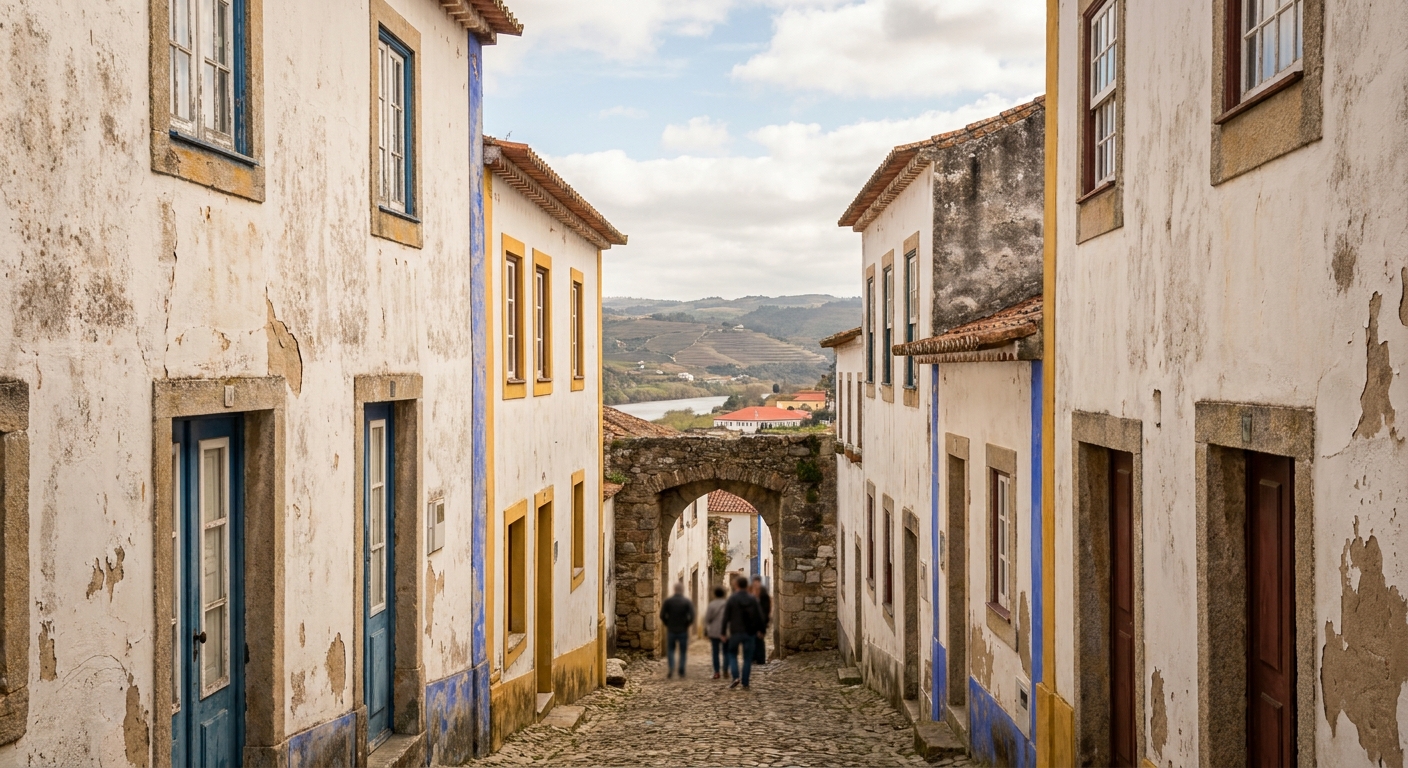
February pays you back in dry ground. It records 2.17 inches against January’s 2.98 and December’s 2.70, and 7.6 wet days against January’s 10.4, making it the driest month of the cold half apart from March and April. Daytime highs of 58.5°F are jacket weather rather than winter, and Rua Direita with no coach group on it is a different street from the one in the photographs.
What you give up is light and the heavy rain that comes with these months. January records 2.4 days at 10 mm or more and February 1.7. On January 15 the sun has gone by 5:39 p.m. local, which ends the walking day in what still feels like mid-afternoon to a visitor on East Coast habits. The wall walk is unrailed stone, and wet stone at that, so a winter trip is planned around the morning.
Which month should you avoid in Óbidos?
November, and specifically for walkers. It is the wettest month of the twelve at 3.86 inches, with 10.5 days at 1 mm or more and 3.2 days at 10 mm or more, the highest heavy-rain count of the year. Daylight on November 15 runs 10 hours 04 minutes. October is nearly as wet, 3.33 inches over 9.2 days, but it keeps 67.3°F afternoons against November’s 62.6°F, so the same shower feels like a different trip.
Against all that, 10.5 wet days still leave roughly 19 days in a 30-day November recording less than 1 mm, and a 62.6°F afternoon beats most Novembers between Boston and Chicago. The town is at its emptiest in that stretch, and after a front clears the low sun catches the whitewash and the blue and yellow trim at an angle no July noon gives. Bring the boots, keep the plan flexible by half a day, and November repays a driver more than it repays a coach passenger.
Is the shoulder season worth it in Óbidos?
May and September are the shoulders here. May runs 64.8°F by day against August’s 70.2°F, a gap of 5.4°F, with 1.41 inches of rain over 5.4 wet days against August’s 0.42 inches over 1.8. September gives up almost nothing in temperature, 0.6°F, and takes on 0.57 inches more rain than August for it.
Daylight is the May argument. On May 15 there are 14 hours 24 minutes of it, nearly two hours more than September 15 offers, and the sun stays up until 8:46 p.m. local, which turns a day trip into a long, unhurried evening. The countryside below the walls is also still green in May, before the summer takes it to straw, and that is the version of the approach road the postcards use.
The cost shows up in wet days and cool nights. May records three times August’s wet days, 5.4 against 1.8, and its nights average 57.7°F, a full 5.3°F below August’s 63.0°F. September’s cost is smaller and different: 4.1 wet days, 0.7 of them at 10 mm or more, which is the first hint of the October turn arriving early in a bad year.
Take September if the trip is about the town, warm evenings and eating outside. Take May if it is about daylight, the hills below the walls and 5.4 wet days you can plan around. Both beat July and August on company, and neither costs you more than 5.4°F of afternoon warmth to get there.
The last word
Book September, and if the dates are already fixed, fix the hour instead of the month: the ramparts have no shade and no shelter, so a wet November morning and a bright August noon fail for opposite reasons and share the same cure, an early start. One figure not yet served: April is the driest month of the cool half at 1.88 inches, just under March’s 1.92, and it carries 13 hours 19 minutes of daylight on the 15th with sunset at 8:16 p.m. local. That makes it the sleeper month for anyone who cannot travel in September.
Sources & data for this guide
- Monthly normals 1991-2020, highs, lows, precipitation and wet-day counts at the 1 mm and 10 mm thresholds · IPMA (Instituto Português do Mar e da Atmosfera), station 531, Cabo Carvoeiro at Peniche, 32 m · checked Sep 12, 2026
- Station siting: the thermometer is coastal at Peniche while Óbidos sits slightly inland behind its walls, so the readings are a regional coastal signal, not a town measurement · IPMA station metadata · checked Sep 12, 2026
- Sunrise, sunset and daylight length on the 15th of each month, published in UTC and converted to local time (UTC in winter, UTC+1 from late March to late October) · sunrise-sunset.org · checked Sep 12, 2026
- Humidity, wind and sea-surface temperature: we could not read a published series for this station, so no figure for them appears above.
- Season labels (holiday peak, the quiet weeks between Christmas and Easter), trip length and the description of the town and its walls are editorial, not measured · check opening hours and tickets with operators when you book.