
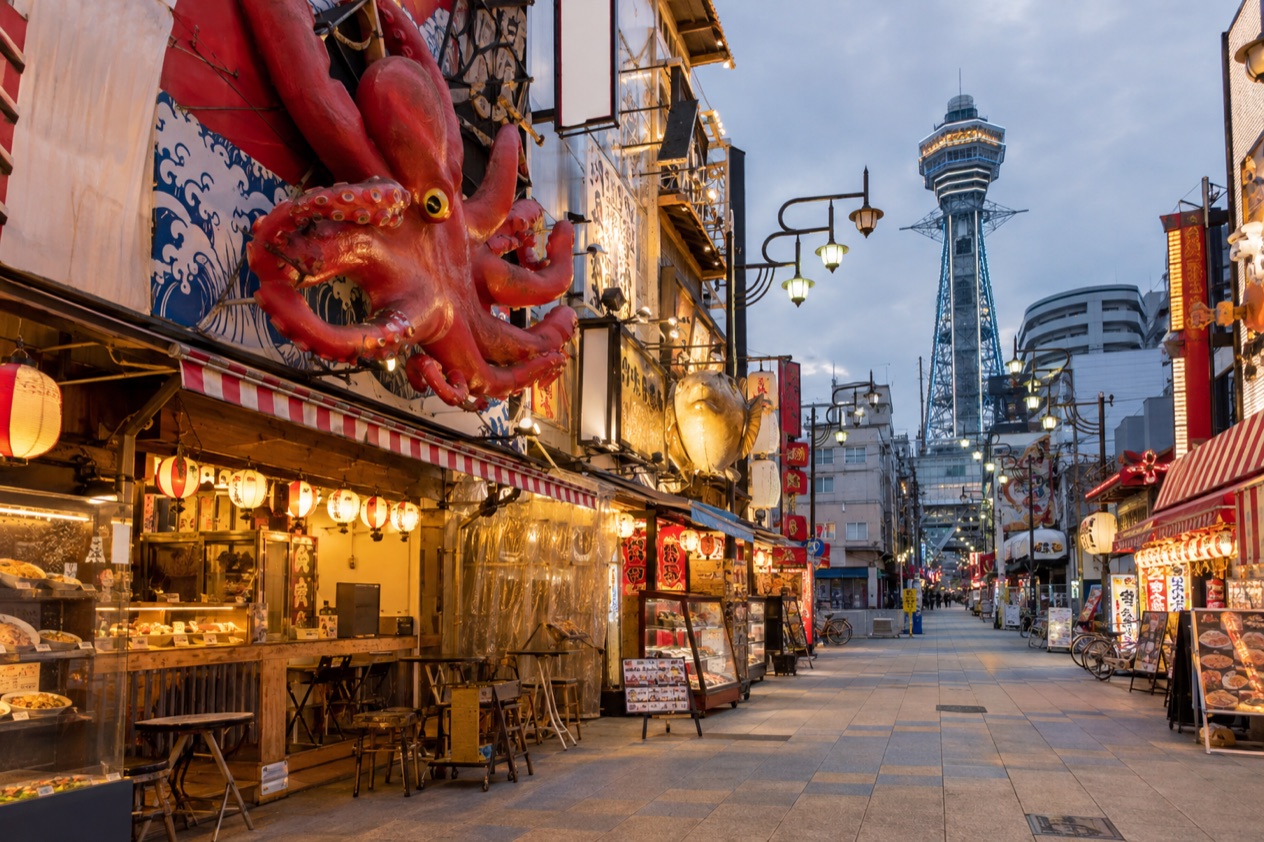
Steam rises from a griddle of round iron molds, a cook flicks batter with two thin picks, and the smell of sweet sauce and toasted bonito drifts down the street. In Osaka, eating on your feet is part of the evening, and the lights of Dotonbori turn the canal into a long, glowing dining room.
Is visiting Osaka street food worth it?
It suits couples, friends and families who prefer grazing to sitting through a long dinner, and anyone who enjoys a street that is part meal, part show.
What sets it apart from other food cities in the region is the way eating becomes the main activity rather than a break between sights.
Osaka is also relaxed in manner. Vendors chat, cooks perform, and nobody expects you to know the rules before you line.
A food walk also pairs well with the rest of the city. Between bites you can look up at Osaka Castle, wander to the Shinsekai district with its Tsutenkaku tower, or visit the Shinto and Buddhist sites that give the city some history to balance the snacking.
What to see at Osaka street food
Dotonbori, the canal-side food street
Dotonbori is the district visitors picture when they think of Osaka eating. Neon signs hang over the canal, restaurant fronts compete with giant mechanical displays, and the smell of grilling follows you along the water. It is the place to start, because a slow walk shows you what is on offer before you commit to a plate.
Look for the stalls selling takoyaki, the golf-ball-sized dumplings of batter with a piece of octopus inside, cooked in rows on a hot griddle, turned by hand until crisp outside and soft within. They come topped with a brown sauce, mayonnaise, green seaweed flakes and bonito shavings that seem to wave in the steam. Eat them slowly, since the centers hold heat for a long time.
Beyond takoyaki, the street offers skewers, grilled seafood, dumplings and sweets. A good habit is to share one portion among two or three people and keep moving, so you taste more.
Okonomiyaki and the griddle tradition
Okonomiyaki is the other great Osaka griddle dish, a savory pancake of cabbage and batter mixed with pork, seafood or other fillings, then brushed with sauce and mayonnaise. The name roughly means cooked as you like it, and that spirit runs through the dish. At many counters you watch the cook shape and flip it on an iron plate in front of you.
Its cousin, yakisoba, adds fried noodles to the same sauce-and-griddle idea, and some places combine the two. Both are the sort of comfort food that locals eat casually, standing or at a small counter, rather than as a formal meal. If takoyaki is a snack, okonomiyaki is the one that fills you up.
Shinsaibashi, covered arcades and snack stops
Shinsaibashi sits right beside Dotonbori and works as its shopping partner. The covered arcades give you a place to browse for clothes, sweets and souvenirs before circling back to the food stalls. For an eater, it is the district for in-between stops: a skewer, a cream-filled pastry, a drink, a bag of something to nibble as you walk.
The two districts blend into one another, so a food walk rarely needs a plan. Follow the crowds that gather outside a single stall, then follow your nose toward the next one. The mix of shoppers and snackers is part of the pleasure.
Shinsekai and its fried skewers
Shinsekai is the district around Tsutenkaku tower, and it has a retro, slightly rowdy character that suits cheap, hearty food. The tower rises above lanes of small eateries, and the area is the one people mention when they talk about kushikatsu, skewers of meat and vegetables coated in breadcrumbs and deep-fried until golden.
Kushikatsu is served with a shared pot of dipping sauce, and the well-known habit is to dip each skewer once only, never twice. It is a good second stop after Dotonbori, with a different mood: less neon spectacle, more local counter life.
How to get to Osaka street food
The street food districts are reached by subway from the main stations. From Osaka Station or Umeda Station, take the Midosuji Line to Shinsaibashi Station, which puts you at both Shinsaibashi and Dotonbori. You can also stay on the Midosuji Line until Namba Station and reach Dotonbori from there.
If you arrive in Osaka by bullet train, all Shinkansen trains, including the Nozomi, stop at Shin-Osaka Station. From Tokyo, the Tokaido-Sanyo shinkansen takes about two and a half hours to Shin-Osaka. From there, take the JR local line to Osaka Station, then transfer to the Midosuji Line as described above. The same Shinkansen stop connects Osaka with Kobe, Kyoto, Nagoya and Yokohama.
Travelers flying in from abroad often land at Kansai International Airport, which handles primarily international passenger flights. The city’s metro system is among the busiest in the world, serving over 912 million people annually, and it is the backbone of getting around town once you are in the center.
The food is concentrated along the canal and the nearby lanes, so you walk from stall to stall rather than ride between them.
When to visit Osaka street food
Street food is a seasonal pleasure here, because you eat outside and the weather shapes the mood. October is a comfortable moment for it: afternoons reach the mid-70s and evenings cool to the low 60s, which is pleasant for standing at a stall with a hot tray in your hands. Rain falls on about eight days in the month, usually as passing showers, so an umbrella is worth having.
April is the other easy month, with highs in the high 60s and lows in the low 50s, and a little more sunshine than October. The evenings are cool enough that the warmth of a fresh takoyaki feels welcome. About nine days in the month see some rain.
Summer is a different experience. August is the hottest month, with an average high of 93°F, and July is humid, with highs near 89°F and rain on about ten days.
Hot fried food at a crowded counter is still eaten, but you will want cold drinks and shaded breaks. The rainy season, called tsuyu, runs from early June to late July. On July 24 and 25, the Tenjin Matsuri festival takes place at Osaka Tenmangu, which adds a festive mood to the city.
Hot street food suits the weather well, and a steaming bowl or a fresh skewer is a good way to warm your hands. Evenings are the natural time for Dotonbori, when the signs are lit and the canal reflects the colors.
| Month | Average high (°F) | Average low (°F) | Precipitation (in) | Days with rain |
|---|---|---|---|---|
| January | 49.5 | 37.4 | 1.85 | 5.6 |
| April | 67.8 | 51.6 | 4.01 | 9.2 |
| July | 89.2 | 76.3 | 6.87 | 10.0 |
| October | 74.7 | 60.8 | 5.35 | 8.3 |
Tips for your visit
Come hungry and plan to share. The pleasure of Osaka street food is variety, and a single portion split among a group lets you taste several dishes without getting full on the first. Napkins and a small bag for your trash are useful, since eating while walking leaves you with sticks, trays and sauce on your fingers.
Walk the canal, loop through the Shinsaibashi arcades, then decide whether you want a second round. A light jacket is handy in spring and autumn, and a small umbrella covers the showers that appear in October and April.
Combine the food walk with the city’s landmarks. Osaka Castle and the Osaka Aquarium Kaiyukan are both landmarks in the city, and the Shinsekai district and its Tsutenkaku tower make a natural food-and-sightseeing pairing with kushikatsu. For history, Sumiyoshi Taisha Grand Shrine is a Shinto shrine in Osaka, and Shitennoji is one of the oldest Buddhist temples in Japan.
If you are traveling with children, a food street can be fun because they can pick their own snacks, but the lanes fill with people in the evening, so keep a hand close. Universal Studios Japan, which opened in 2001 and features attractions like the Wizarding World of Harry Potter, is in the Osaka Bay area, reached from Osaka or Umeda stations via the JR Loop Line and the Chuo subway line, and it can be a separate day for families.
Good to know before you go
Osaka is a city of nearly three million people, and the busiest food streets feel it in the evening, so keep your bag zipped and your belongings close in the crowds. Eating while walking is part of the street food habit in these districts, but it helps to finish a bite before moving on and to put trash in a bag until you find a bin. Outside the official rainy season of June and July, showers still pass through, so a compact umbrella earns its place.
Sources
- Wikipedia, Osaka (https://en.wikipedia.org/wiki/Osaka), checked October 11, 2026
- Japan National Tourism Organization, Osaka (https://www.japan.travel/en/destinations/kansai/osaka/), checked October 11, 2026
- Japan Meteorological Agency (JMA), Normal values 1991-2020, monthly (https://www.data.jma.go.jp/stats/etrn/view/nml_sfc_ym.php?prec_no=62&block_no=47772), station Osaka, elevation 23 m, checked October 11, 2026
To plan your stay
- Best Time to Visit Osaka: Cherry Blossoms, Autumn Color, Weather and Festivals
- Where to Stay in Osaka: Kita, Minami, Tennoji, the Castle Area and the Bay
- Osaka from Tokyo: Shinkansen Services, Shin-Osaka Station and Where to Go on Arrival
- Know Before You Go to Osaka: Entry, Money, Getting Around, Weather and Etiquette