
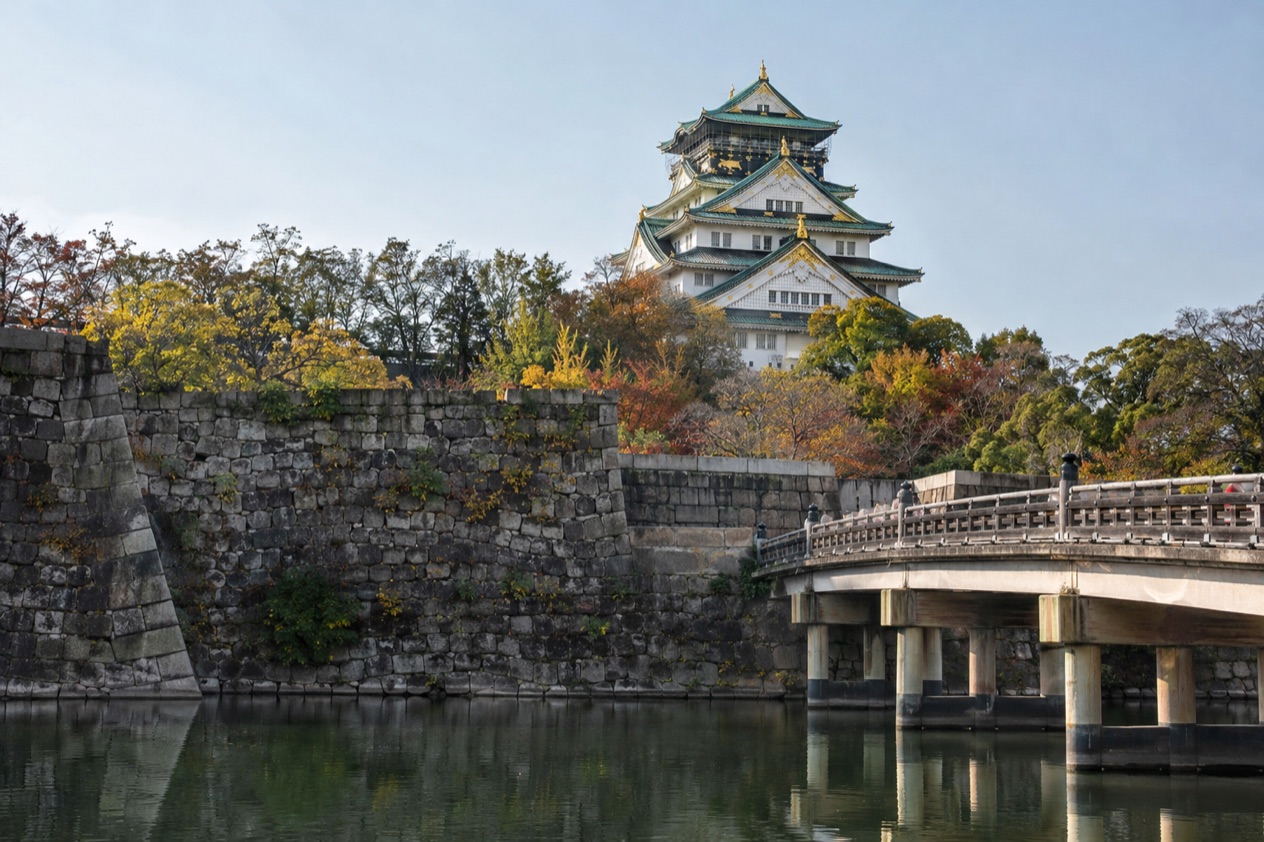
Coming out of Osakajōkōen Station, you walk toward a keep that rises above the trees, its green-tiled roofs and gold ornaments catching the light over wide stone ramparts. Water sits at the foot of the walls, and the grounds spread out around you like a park in the middle of the city. It is a visit built on open air, stone and a big piece of Japanese history, and it fits easily into a day of exploring Osaka.
Is visiting Osaka Castle worth it?
Yes, especially if you want one place in Osaka that ties the city to the story of Japan, and you enjoy wandering outdoors as much as going inside. The castle is one of Japan’s most famous landmarks, and it played a major role in the unification of the country during the sixteenth century. That history is the reason to come, and the setting is the reason to stay a while.
What sets it apart from the other sights in the city is the mix of scales. Much of Osaka is about food, neon and nightlife, a charming and relaxed city that people explore by its appetites. The castle offers the opposite rhythm: a large green space, moats, long stone walls and a keep you can see from far across the grounds.
The main keep is a concrete reproduction of the original, with elevators, and its interior works as a modern museum, so you get the silhouette of a feudal fortress together with a comfortable, functioning exhibition space. Travelers who want a wooden, untouched original should know that going in, and those who like a landmark with views, history and room to walk will find it a good fit.
What to see at Osaka Castle
The grounds cover about 15 acres, and the castle is less a single building than a sequence of things to look at: the keep, the water, the walls and the park that fills the spaces between them.
The main keep
The keep is the image everyone carries away: a tall, tiered tower with decorative gold on the upper levels, set on a massive stone base. It is a concrete reproduction of the original, and the interior is intended as a modern, functioning museum. Elevators are built in, which changes how a visit feels, since you are not climbing steep wooden stairs as in a surviving old castle.
Inside, the museum tells the story of the castle and of the warlords whose ambitions shaped the late sixteenth century, the period when the castle helped bring the country together under one rule. Look for the way the exhibits link the building to the city around it. From the upper floors you look back over the grounds and the surrounding city, which gives a sense of how the fortress was meant to command its surroundings.
The inner moat and the Gozabune boat
Water is part of the castle’s character, and the inner moat is where you meet it up close. A Gozabune boat ferries tourists around the moat, giving you a view of the walls from below, where the size of the stonework is easiest to feel. The boat is styled after the kind of vessel a lord might have used, which suits the setting.
Even if you stay on land, the moat is worth following on foot. The ramparts rise straight from the water, and the reflections of the stone and the keep make it one of the places on the grounds to pause with a camera. It suits anyone who likes to see a fortress from its defensive side, not only from its front gate.
The grounds and cherry blossom season
The sprawling grounds are the heart of a visit in spring. Osaka Castle is a popular spot during festival seasons, and especially during the cherry blossom bloom, the hanami tradition of gathering under the trees to look at the flowers. During the bloom the grounds are covered with food vendors and taiko drummers, so the walk becomes part picnic, part street fair, part concert.
Outside the blossoms, the same grounds work as a place to stroll between the keep, the moat and the park paths. Come for the blossoms if the timing works, and treat the rest of the year as a quieter version of the same walk.
Osaka-jo Hall
A large indoor arena, Osaka-jo Hall, sits within the grounds of Osaka Castle Park. It is not a historic building but part of the modern life of the park, a reminder that the castle grounds are a living part of the city and not only a monument. Its presence explains why the park feels like a public space as much as a heritage site.
For a traveler, the hall is mostly a landmark you pass as you move around the park, and a hint that events may be going on around the grounds. It adds to the sense that you are in a place where the past and the present share the same lawns.
Hours, tickets and rules
Osaka Castle is open to the public, and the grounds, the keep and the moat are all part of what a visit holds. The park is a wide open space where you can follow the paths at your own pace, and the museum in the keep is the part of the visit that works as an indoor stop, with elevators included.
The scale of the site shapes how you spend your time. With roughly 15 acres of grounds, a visit can be as brief as a look at the keep from the park or as full as a loop around the moat, a ride on the Gozabune boat and a visit through the museum. The cherry blossom bloom adds food vendors and taiko drummers across the grounds, which turns the visit into a festival.
The keep is a reproduction in concrete, built as a museum, and that frames what the visit is: a modern exhibition space inside a building shaped like the historic castle. The park around it holds Osaka-jo Hall, the large indoor arena, and the moat where the Gozabune boat runs.
How to get to Osaka Castle
The castle is easily accessible from Osakajoen Station on the JR West Osaka Loop Line, and that station is the main reference point for anyone building a route. , which means many of the city’s other districts connect to it.
If you are coming from Tokyo, the Tokaido-Sanyo shinkansen runs to Shin-Osaka Station, and the journey takes about two and a half hours. From Shin-Osaka Station, take the JR local line to Osaka Station. From there you are in the center of the city, and the Loop Line is the link toward the castle’s own station.
Other parts of Osaka connect the same way. Dotonbori and Shinsaibashi are reached from Osaka or Umeda Station on the Midosuji Line to Shinsaibashi Station, and you can reach Dotonbori by staying on the Midosuji Line until Namba Station.
Osaka Bay is accessible from Osaka or Umeda stations via the JR Loop Line and the Chuo subway line. Those routes make it straightforward to pair the castle with a different part of the city on the same day.
When to visit Osaka Castle
Spring, during the cherry blossom bloom, is the season when the castle is most talked about. The grounds fill with food vendors and taiko drummers, and the whole park becomes a gathering place. If you want to see the castle in festival mood, aim for the weeks when the trees flower, a time that shifts from one spring to the next.
Outside the blossoms, the choice comes down to weather. April, as the numbers show, is mild with a fair number of showers. October is warm and gentle, with some rain, which suits long walks around the moat and the park. January is cold and sometimes brings snow or sleet. July is hot and humid, and the long walk around the grounds is a warm one.
| Month | Average high (°F) | Average low (°F) | Rain days | Sunshine (hours) |
|---|---|---|---|---|
| January | 49.5 | 37.4 | 5.6 | 146 |
| April | 67.8 | 51.6 | 9.2 | 193 |
| July | 89.2 | 76.3 | 10.0 | 184 |
| October | 74.7 | 60.8 | 8.3 | 166 |
In January the air stays cool and dry, with some days of snow or sleet, so a coat is part of the plan. April brings milder afternoons, along with showers on roughly one day in three.
July is the heaviest month, with warm nights and humid air, and it is better suited to a shorter visit with stops for shade and a cold drink.
Tips for your visit
Think of the castle as an outdoor visit with an indoor stop. Comfortable shoes matter because the grounds are large, and the weather decides the rest: a light layer in April and October, a warm coat in January, and something for the heat and humidity in July. A small umbrella is useful in any month with rain.
Families will find the grounds roomy, and a ride on the Gozabune boat around the inner moat gives children something to do besides looking at walls. The keep has elevators, which helps anyone who prefers not to climb stairs, and the museum inside is built as a modern, functioning space.
For combining the castle with the rest of Osaka, the Loop Line is the thread. Dotonbori and Shinsaibashi, with their food and entertainment, are on the Midosuji Line, and Osaka Bay is reached via the Loop Line and the Chuo subway line.
Universal Studios Japan, which features attractions like the Wizarding World of Harry Potter, is part of the bay area. A day that starts with history at the castle can end with the city’s famous appetite for street food and nightlife.
Good to know before you go
Osaka is a charming and relaxed city known for its food, entertainment and nightlife, and the castle is its main step into history. Plan your visit around the weather of the month, since most of the experience is outdoors, and in spring the cherry blossom bloom brings crowds of picnickers, vendors and drummers to the grounds. Rain falls in every month of the year, so a light rain layer is a reasonable companion.
Sources
- Wikipedia, Osaka Castle (https://en.wikipedia.org/wiki/Osaka_Castle), checked October 11, 2026
- Japan National Tourism Organization, Osaka (https://www.japan.travel/en/destinations/kansai/osaka/), checked October 11, 2026
- Japan Meteorological Agency (JMA), Normal values 1991-2020, monthly (https://www.data.jma.go.jp/stats/etrn/view/nml_sfc_ym.php?prec_no=62&block_no=47772), station Osaka, elevation 23 m, checked October 11, 2026
To plan your stay
- Best Time to Visit Osaka: Cherry Blossoms, Autumn Color, Weather and Festivals
- Where to Stay in Osaka: Kita, Minami, Tennoji, the Castle Area and the Bay
- Osaka from Tokyo: Shinkansen Services, Shin-Osaka Station and Where to Go on Arrival
- Know Before You Go to Osaka: Entry, Money, Getting Around, Weather and Etiquette