
In August the cedars around the shrines of Nikko drip with moisture, and the air smells of wet bark and stone. Cicadas drone from the trees, mist slides across the mountains, and lanterns are lit in family homes during Obon, when ancestors are welcomed back. It is a green, humid month for temple courtyards, lakeside walks and a hot bath after a damp day outdoors.
What is the weather like in Nikko in August?
August in the Nikko mountains is mild and wet: pleasantly warm in the daytime, cool at night, and rainy on more than half the days. At Oku-Nikko, near Lake Chuzenji, the air is a notch warmer than in July and clearly warmer than in September.
| Month | Average high (°F) | Average low (°F) | Precipitation (in) | Days with 1 mm or more of precipitation | Hours of sunshine | Daylight on the 15th |
|---|---|---|---|---|---|---|
| July | 71.8 | 58.8 | 11.04 | 16.4 | 110 | 14 h 27 min |
| August | 73.2 | 60.1 | 13.09 | 15.3 | 128 | 13 h 37 min |
| September | 66.0 | 53.4 | 16.10 | 14.4 | 105 | 12 h 28 min |
Humidity is the constant of the month. Honshu summers are described as hot and sultry, and in the mountains that shows up as damp air, mist and clouds rather than blazing heat. Of the three months, August gives the most sunshine, so there are real gaps of blue sky between the showers.
Rain comes in spells and often leaves the ground wet for the next outing, so a waterproof jacket or a compact umbrella matters more than sunscreen. Stone steps and wooden walkways around the shrines turn slick, and shoes with grip earn their place in the bag.
Evenings by the lake feel cool enough for a light sweater over a T-shirt. Daylight stretches well into the evening, which leaves time for a long dinner after a day outside.
What to do in Nikko in August
August in Nikko is about shrine courtyards under dripping cedars, cool lakeside air and slow meals built around yuba, the delicate skin that forms on heated soy milk. Obon, the Buddhist custom of honoring ancestors, runs for three days in the month. Families return to ancestral places and visit and clean the graves of their dead. In the towns around Nikko you may notice incense, freshly swept cemeteries and lanterns outside homes.
Shops in rural areas often close earlier, sometimes as early as 6:00 p.m., so plan dinner and souvenir buying with that in mind. In a mountain town with this much rain, the rhythm is simple: outdoor sights in the dry spells, then a bath or a long lunch when the clouds close in.
Toshogu, Taiyuin and the shrine district
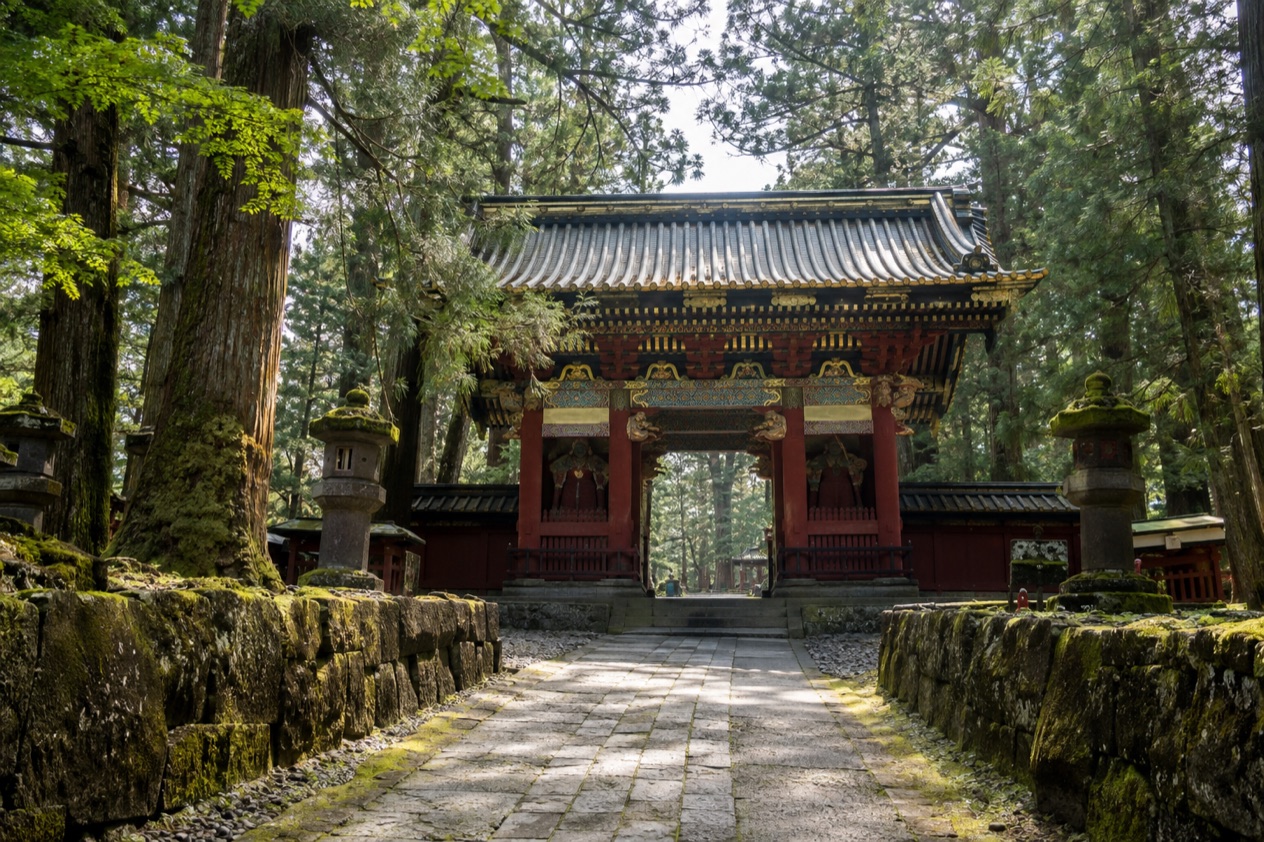
The shrine district is the reason people come to Nikko, and August suits it well. Toshogu is a complex of gates, carved panels and lacquered halls set among tall cedars. Rain makes the red and gold stand out against dark wet bark, and the moss on the stone lanterns turns a deep green.
Taiyuin is the mausoleum of a later shogun, smaller and more inward-looking than Toshogu, with its own gates and guardian figures. Travelers pair the two on one walk, with Rinno-ji and Futarasan Shrine among the trees nearby. Both open at eight in the morning, which gives you the start of the day for the courtyards before you move on to lunch.
| Site | Open |
|---|---|
| Toshogu Shrine | 8:00 a.m. to 4:30 p.m. (April to October) |
| Taiyuin | 8:00 a.m. to 4:30 p.m. (April to October) |
Lake Chuzenji and Oku-Nikko
Up in the mountains lies Lake Chuzenji, the heart of the Oku-Nikko area, and it is the part of a Nikko trip where August weather pays off most. The lakeshore holds a mild, cool air at the height of summer, and forest and water give the outing a different feel from the shrine courtyards. Mist hangs on the slopes after a shower, which can give the far shore a soft, layered look.
Beyond it lie marsh and forest trails and the onsen village of Yumoto. Walking shoes with grip help on wet ground, and a jacket is worth keeping at hand because the air feels cooler up here than in town.
Yuba, shaved ice and a hot bath
Food in Nikko is shaped by the mountains and the temples that grew up here. Yuba appears in many forms: fresh and silky as sashimi, simmered in broth, rolled around vegetables or tucked into a lunch set. Soba noodles served cold with a dipping sauce suit a humid afternoon, and shaved ice with syrup is a seasonal treat in summer.
After a damp day, an onsen, a hot spring bath, does what no umbrella can. Ryokan, the traditional inns, often set dinner out in small courses, and guests slip into a yukata, a light cotton robe, for the evening. In August, with cool nights, that bath and a seated dinner become the best part of the day.
A two-day itinerary for Nikko in August
Day 1 belongs to the shrines. Tobu-Nikko Station is about two hours from Asakusa and from Shinjuku in Tokyo, so an early train means you can reach the courtyards shortly after the gates open. Start with Toshogu, take your time over the carved gates and the covered halls, then continue to Taiyuin, where the setting is more intimate.
Lunch is a good moment to sit down in a restaurant serving yuba or soba, and it doubles as a rain break if a shower arrives. In the afternoon, add Rinno-ji and Futarasan Shrine, then walk back toward the town through the cedars. Dinner suits a small local restaurant or a ryokan, followed by an onsen if you are staying at one.
Day 2 goes up to the lake. Spend the morning at Lake Chuzenji, along the shore and at Kegon Falls, and go on to the marsh trails or the Yumoto onsen village if the weather holds.
Lunch fits a café or a noodle shop near the lake. If rain sets in, linger over a hot meal and an onsen soak rather than pushing on, and let the long daylight finish the day with a slow walk back.
Is Nikko busy in August?
August is one of the main summer months in Nikko, with Obon adding a stretch of travel across Japan as families return to their home towns and visit graves. The month brings green forests, long daylight and mild mountain air, which suits a trip that mixes shrines with lakeside walks.
Rain shapes the pace as much as the calendar. Wet spells keep some visitors indoors, then thin or thicken the courtyards as the weather opens and closes. The shrine gates open at eight, and rural shops can close as early as six in the evening, so the day has a clear start and a clear end.
Holidays can reshape the calendar. When a national holiday falls on a Sunday, the next working day becomes a public holiday, and a day between two holidays also becomes one. In practice, a long weekend can bring a different mood to the streets and the trains, and the shrine district and the road to the lake are where you would notice it.
What to pack for Nikko in August
Pack for damp, mild mountain days with cool evenings, plus a hot bath at the end of many of them.
- A light waterproof jacket, because rain falls on more than half the days.
- Shoes with good grip for wet stone steps and forest paths.
- A sweater or thin fleece for evenings by the lake.
- Breathable T-shirts, since humidity makes cotton feel heavy.
- A compact umbrella for the courtyards between showers.
- A small towel, handy after a shower or a visit to an onsen.
Good to know before you go
August falls within the humid Japanese summer, and downpours can arrive in the mountains, so keep a flexible plan and a rain card for each day. Japan’s Meteorological Agency issues Emergency Warnings for natural phenomena of extraordinary magnitude, and the national tourism organization has a Japan Safe Travel Information page with government safety information for travelers.
Shops in rural areas often close earlier, sometimes as early as 6:00 p.m., so buy snacks and gifts before the evening. The shrine gates open in the morning, and the lakeside and onsen areas are where you can fill the end of the day.
Nikko in August vs July and September
A month earlier, July is a little cooler and a little rainier, with slightly longer days and less sunshine. The forests are lush, and the mist is heavier. If you prefer the longest light and do not mind dampness, July works, though August gives more bright hours between showers.
A month later, September brings the coolest air of the three, the heaviest rain and shorter days, with a sweater becoming a daytime need. The mountains cool toward autumn, which suits travelers who dislike humidity and want lake walks in cooler air, but umbrellas stay essential.
Choose August for the warmest, brightest of the three months, with Obon in the calendar and the green forests at full growth. Shift to July for a slightly cooler start to summer, or to September if cooler air matters more to you than sunshine.
Is August a good time to visit Nikko?
Yes, for travelers who like green mountains, shrine courtyards and lakeside air more than dry, sunny days. August suits people who enjoy a hot bath after a damp walk and are happy to carry a rain jacket. It is a poorer fit for anyone who wants a guaranteed clear sky or dislikes humidity.
On arrival, begin with the shrine district while the gates are open, then keep the lake and the mountain roads for the next day. If a downpour comes, switch to a yuba lunch and an onsen soak and go back out when the clouds open. What stays with you from Nikko in August is the combination of dripping cedars, red-and-gold gates and a hot spring bath at the end of a damp day.
Sources
- Japan Meteorological Agency (JMA), Normal values 1991-2020, monthly (https://www.data.jma.go.jp/stats/etrn/view/nml_sfc_ym.php?prec_no=41&block_no=47690), station Okunikko, elevation 1292 m, checked October 11, 2026
- Computed from the date and the latitude of the place (sunrise equation, solar elevation -0.833 degrees), October 11, 2026
- Japan National Tourism Organization, shop and attraction hours, national holidays (https://www.japan.travel/en/plan/business-hours-and-holidays/), checked October 11, 2026
- Wikipedia, Obon (https://en.wikipedia.org/wiki/Obon), checked October 11, 2026
- Wikipedia, Public holidays in Japan (https://en.wikipedia.org/wiki/Public_holidays_in_Japan), checked October 11, 2026
- Japan National Tourism Organization, summer in Japan (https://www.japan.travel/en/guide/summer-guide/), checked October 11, 2026
- Japan National Tourism Organization, festivals and events (https://www.japan.travel/en/see-and-do/festivals-and-events/), checked October 11, 2026
- Wikipedia, Hanabi (https://en.wikipedia.org/wiki/Hanabi), checked October 11, 2026
- Japan Meteorological Agency, Emergency Warnings (https://www.jma.go.jp/jma/en/Emergency_Warning/ew_index.html), checked October 11, 2026
- Japan National Tourism Organization, safety information (https://www.japan.travel/en/japan-safe-travel-information/), checked October 11, 2026
- Japan National Tourism Organization, weather and seasons in Japan (https://www.japan.travel/en/plan/weather/), checked October 11, 2026
- Wikipedia, Awa Odori (https://en.wikipedia.org/wiki/Awa_Odori), checked October 11, 2026
- Wikipedia, Climate of Japan (https://en.wikipedia.org/wiki/Climate_of_Japan), checked October 11, 2026
- Japan National Tourism Organization, Mount Fuji guide (https://www.japan.travel/en/fuji-guide/), checked October 11, 2026
- Official website for Mt. Fuji climbing, about the climb (https://www.fujisan-climb.jp/en/about/), checked October 11, 2026
- Wikipedia, Nebuta (https://en.wikipedia.org/wiki/Nebuta), checked October 11, 2026
- Wikivoyage, Nikko (https://en.wikivoyage.org/wiki/Nikko), checked October 11, 2026
- Japan National Tourism Organization, Nikko (https://www.japan.travel/en/destinations/kanto/tochigi/nikko-area/), checked October 11, 2026
- Wikipedia, Nikkō, Tochigi (https://en.wikipedia.org/wiki/Nikk%C5%8D,_Tochigi), checked October 11, 2026
To plan your stay
- Things to Do in Nikko: Toshogu Shrine, Lake Chuzenji, Kegon Falls and Kinugawa Onsen
- Where to Stay in Nikko: Station Side, Shrine Precinct, Ryokan Stays and Heritage Stays
- Nikko from Tokyo: Tobu Railway Trains, Limited Express Names and a Day in Nikko
- Know Before You Go to Nikko: Entry, Getting There, Weather and Etiquette