
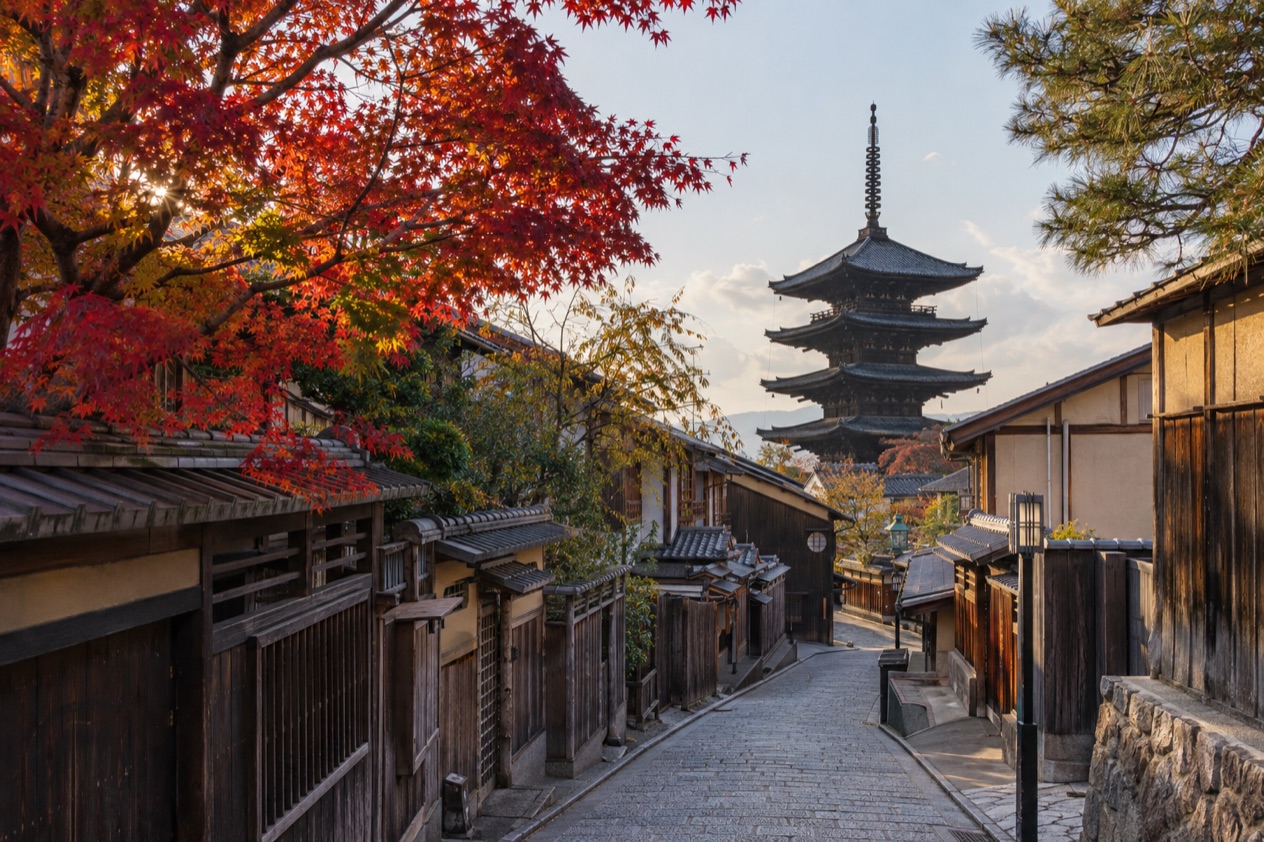
In November, Kyoto’s maples start to burn at the edges, and the first red leaves show up against dark temple roofs and stone lanterns. On shrine grounds, small children in formal kimono walk carefully beside parents for the Shichi-go-san blessings.
The air has turned cool enough for a bowl of hot tofu at lunch, and the days are made for walking between temples. This is a month for leaf-watching, seasonal food and long afternoons among the city’s sights.
What is the weather like in Kyoto in November?
November in Kyoto is cool and fairly dry, with crisp days for sightseeing and chilly nights.
| Month | Average high (°F) | Average low (°F) | Precipitation (in) | Days with 1 mm or more of precipitation | Hours of sunshine | Daylight on the 15th |
|---|---|---|---|---|---|---|
| October | 74.1 | 57.9 | 5.64 | 8.2 | 156 | 11 h 22 min |
| November | 63.1 | 47.1 | 2.91 | 6.3 | 141 | 10 h 22 min |
| December | 52.9 | 38.3 | 2.26 | 6.6 | 134 | 9 h 49 min |
Afternoons sit in the low 60s, a sweater and light coat temperature that suits hours of walking up temple steps and along stone lanes. Mornings and evenings are noticeably colder, in the high 40s, so a scarf comes out as the light fades. The sun still shows up for a good share of the month, and when it slants low through red maples, the leaves glow.
Rain arrives on a handful of days rather than settling in for weeks. A gray, drizzly day is the likeliest kind, and it pairs well with wet stone, dripping moss and the warm interior of a tea house. Daylight is short by now, so the sights are best planned with the early dusk in mind, and lantern-lit streets come on soon after the afternoon closes.
Layers work better than one heavy coat. A light jacket over a sweater handles the midday walk, and a warmer layer or a scarf covers the evening meal. Because the city’s temples involve a lot of outdoor stairs and gravel paths, shoes that stay dry are worth more than extra clothes.
What to do in Kyoto in November
The big draw of the month is the turn of the maples, called kōyō in Japanese. The Japan National Tourism Organization places the brightest colors, from red to yellow and orange, between mid-November and early December.
Early in the month you see the first blush at the edges, and by the last week many trees are well along. The date moves from one autumn to the next, so the timing of any single temple is a matter of luck.
November 15 is Shichi-go-san, the day families bring children of three, five and seven to shrines to give thanks for their growth. Girls and boys wear kimono and hakama, often with a bag of long, thin red-and-white candy called chitose-ame.
You may spot them at larger shrines in the days around the date, posing for photographs on the gravel under the trees. Late in the month, November 23 is a public holiday, Labor Thanksgiving.
Food leans toward warm and seasonal. Yudofu, tofu simmered in a pot of kelp broth, is a classic Kyoto lunch when the weather cools, and it is often served with dipping sauces and small vegetable dishes.
Kaiseki, the multi-course meal built around the season, brings chestnuts, mushrooms, persimmon and ginkgo nuts onto the plate. Sake brewed in the Fushimi district goes well with the evening.
Kyoto’s center follows a grid pattern modeled on Chang’an, the capital of China’s Tang dynasty, and the city is divided into five main areas: Central, Eastern, Northern, Southern and Western Kyoto. City buses and the subway reach Kiyomizu-dera, Gion and Ginkaku-ji, and the city runs a Sightseeing Limited Express Bus for visitors.
JR-WEST RAIL PASS holders can use the Subway & Bus 1-Day Pass. Kyoto City holds 14 UNESCO World Cultural Heritage sites, so the days fill up quickly.
Kiyomizu-dera and the lanes of Gion
Kiyomizu-dera, founded over 1,250 years ago, is part of the Historic Monuments of Ancient Kyoto UNESCO World Heritage Site. Its wooden main hall stands on a platform over a hillside of trees, and in November those trees are where the colors gather. You walk through the gate, past the pagoda and out onto the terrace, looking down into a sea of maple and zelkova crowns.
Gion is reached by the same city buses and subway. Its lanes of wooden teahouses, lantern-lit entrances and small restaurants are best enjoyed on foot. The two make a natural pairing for a day built around the Eastern hills, with the temple first and the lanes as the light fades. If it rains, Gion’s tea rooms and the temple’s covered halls give you somewhere to wait.
Fushimi Inari Taisha
Fushimi Inari Taisha, established in 711, sits in Fushimi-ku at the base of Mount Inari. Its trails pass beneath thousands of vermilion torii gates, and in November the dark green slopes around them pick up spots of red and gold. The gates close in overhead as you climb, and stone foxes, the messengers of the rice deity Inari, watch from small shrines along the way.
Stone steps and uneven ground mean shoes with grip matter, especially after rain. Street stalls near the entrance sell grilled skewers and inari-zushi, rice stuffed into sweet fried tofu pouches, a snack named for the shrine. With the cool air, a walk up among the gates and a warm bite on the way down fit November well.
Kinkaku-ji and Ginkaku-ji
Kinkaku-ji, officially Rokuon-ji, is a World Heritage Site and one of the 17 Historic Monuments of Ancient Kyoto. Its gold-leaf pavilion stands over a pond, and in autumn the reflection shares the water with red and orange leaves. A circuit path takes you around the garden past the pavilion’s mirror image.
Ginkaku-ji, the Silver Pavilion, is reached by city bus and subway. Its moss garden and raked sand are reached by a path that winds up through trees, and in November the moss is dotted with fallen maple leaves. Seeing the two pavilions on different days lets each garden have its own mood: one bright and gilded, the other muted and spare.
A two-day itinerary for Kyoto in November
Day 1 belongs to the Eastern hills. Start at Kiyomizu-dera in the morning, with the terrace and the maples below it, then wander down through the lanes toward Gion.
Stop for a lunch of yudofu or a set meal in one of the small restaurants, then continue to Ginkaku-ji by city bus, since the garden is reached that way. Daylight is short in November, so putting the outdoor gardens in the afternoon keeps them in the light.
As the lamps come on, return to Gion for dinner. A kaiseki meal built around chestnuts, mushrooms and other autumn ingredients suits the evening, and so does an izakaya, a casual pub where small plates arrive one after another.
After dinner, a stroll along the lantern-lit lanes in the cool air finishes the day. If rain sets in, linger in a tea house over matcha and a seasonal sweet, or browse the covered arcades of Nishiki Market.
Day 2 starts at Fushimi Inari Taisha. Walk up through the vermilion gates as far as you like, then come back down to the stalls for grilled skewers or inari-zushi for lunch. The torii paths are outdoors and the steps can get slick in a shower, so on a wet morning the plan can be turned around.
In the afternoon, head to Kinkaku-ji for the gold pavilion and its pond, where fallen leaves collect at the edge. For a rainy day, swap the afternoon for slow time in a tea house or a long meal. Finish with an evening in a sake-focused izakaya, trying the local cups from the Fushimi district.
Is Kyoto busy in November?
November is the start of Kyoto’s autumn leaf season, which gives the month a clear reason to visit and sets the tone for the city’s pace.
From mid-November to early December, the trees take on their red, yellow and orange colors, and that stretch is when people plan their trips around the leaves. Because the maples at the Kyoto station usually turn red around December 5, the early weeks of November are a build-up. The last week of the month is when the city’s temple gardens often look their fullest, though the exact timing shifts with each autumn.
Shichi-go-san on November 15 adds children in kimono at the shrines, and the public holiday on November 23 falls near the end of the month. The pace of the city follows the leaves: gardens that were green in October become places people go to see color. Dinners built around autumn ingredients give the evenings their own rhythm, and the early dusk sends people toward warm restaurants and tea rooms.
What to pack for Kyoto in November
Pack for cool days and chilly evenings, with a plan for showers and a lot of walking on stone and gravel.
- A light jacket and a sweater, because afternoons are mild and evenings are cold.
- A scarf for the walk back after dinner.
- A compact umbrella or rain jacket for the gray days that bring rain.
- Shoes with grip that dry quickly, for stone steps at Fushimi Inari and temple grounds.
- Socks without holes, since shoes come off at the entrance of many halls and tea rooms.
- A camera or phone with room for the maples.
Good to know before you go
Rain falls on about six days of the month, usually as showers or a gray day, and daylight is short, so sights are best lined up before dusk. The color of the leaves moves from one autumn to the next, so a specific week is never guaranteed.
Two public holidays fall in the month, Culture Day on November 3 and Labor Thanksgiving on November 23. Many restaurants and attractions close during the New Year holidays, which comes a little over a month later.
Kyoto in November vs October and December
Moving the trip to October brings warmer, longer days and more rain. The leaves are still green in the city, and the Jidai Matsuri parade, with roughly 2,000 people in period dress, takes place on October 22. That suits travelers who want to walk in lighter clothes and see a festival, and who are happy to skip the color.
December is colder, with highs in the low 50s and a bit of snow or sleet on some days. The maples in the city usually reach their color by early in the month, so the first days are the best chance for leaves, and the New Year closures follow later. It suits people who want the last of the foliage and cold air with seasonal food.
November sits in the middle. Choose October for warmth and a festival, December for cold and late color, and November if you want the leaves arriving, mild afternoons and Shichi-go-san.
Is November a good time to visit Kyoto?
Yes, November is a good time for travelers who like to walk, eat seasonal food and see temples with the first colors of autumn. It suits people who prefer cool air to heat, and it works for anyone who wants a day of gardens, a lantern-lit dinner and a warm bowl of tofu.
It is a weaker fit for anyone set on seeing every maple at full red in the city center, since the usual date there falls in early December. It also asks for layers and a rain plan, and the early dusk means long evenings. If you arrive in the middle of the day, begin with a temple or garden while there is still light, then settle into a warm dinner.
What stays with you from Kyoto in November is the sight of the first red leaves against old wooden halls, with children in kimono crossing the gravel and a pot of tofu steaming on the table.
Sources
- Japan Meteorological Agency (JMA), Normal values 1991-2020, monthly (https://www.data.jma.go.jp/stats/etrn/view/nml_sfc_ym.php?prec_no=61&block_no=47759), station Kyoto, elevation 41 m, checked October 11, 2026
- Computed from the date and the latitude of the place (sunrise equation, solar elevation -0.833 degrees), October 11, 2026
- Japan Meteorological Agency, maple color-change dates 2025-2026 with difference from the 1991-2020 normal (https://www.data.jma.go.jp/sakura/data/phn_014.html), checked October 11, 2026
- Japan Meteorological Agency, kaede2020.pdf (https://www.data.jma.go.jp/sakura/data/kaede2020.pdf), checked October 11, 2026
- Japan National Tourism Organization, winter in Japan (https://www.japan.travel/en/guide/winter-guide/), checked October 11, 2026
- Japan National Tourism Organization, autumn in Japan (https://www.japan.travel/en/guide/autumn-guide/), checked October 11, 2026
- Japan National Tourism Organization, spring in Japan (https://www.japan.travel/en/guide/spring-guide/), checked October 11, 2026
- Japan National Tourism Organization, summer in Japan (https://www.japan.travel/en/guide/summer-guide/), checked October 11, 2026
- Kyoto City Official Travel Guide, areas (https://kyoto.travel/en/areas), checked October 11, 2026
- Kyoto City Transportation Bureau, bus and subway guide (https://www2.city.kyoto.lg.jp/kotsu/webguide/en/), checked October 11, 2026
- Kyoto City Official Travel Guide, discover Kyoto (https://kyoto.travel/en/discover), checked October 11, 2026
- Kyoto City Official Travel Guide, festivals and events (https://kyoto.travel/en/events), checked October 11, 2026
- Kyoto City Official Travel Guide, history and religion (https://kyoto.travel/en/history-and-religion), checked October 11, 2026
- Fushimi Inari Taisha, official site (https://inari.jp/en/), checked October 11, 2026
- Wikipedia, Fushimi Inari-taisha (https://en.wikipedia.org/wiki/Fushimi_Inari-taisha), checked October 11, 2026
- Wikipedia, Kinkaku-ji (https://en.wikipedia.org/wiki/Kinkaku-ji), checked October 11, 2026
- Kiyomizu-dera Temple, official site (https://www.kiyomizudera.or.jp/en/), checked October 11, 2026
- Wikipedia, Kiyomizu-dera (https://en.wikipedia.org/wiki/Kiyomizu-dera), checked October 11, 2026
To plan your stay
- Things to Do in Kyoto: Temples, Gardens, Food and Day Trips
- Where to Stay in Kyoto: Kyoto Station, Central and Eastern Districts, and Ryokan Stays
- Kyoto from Tokyo: Shinkansen Trains, Nozomi vs. Hikari and Kodama, and a First Day in Kyoto
- Know Before You Go to Kyoto: Entry, Money, Getting Around and Local Etiquette