
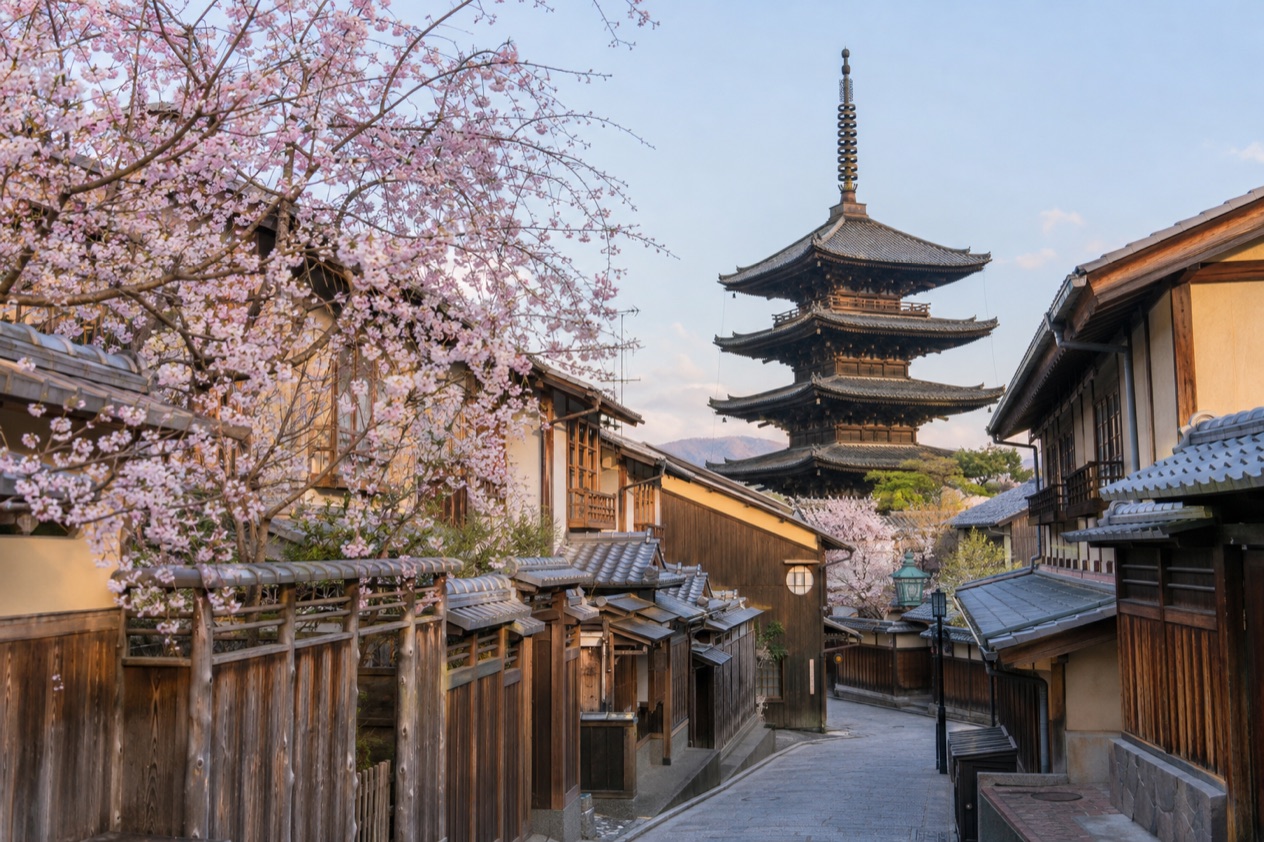
In March, Kyoto’s winter coats start to come off one layer at a time. Shop windows fill with pink sakura sweets, girls’ dolls in court dress sit on display for the Doll Festival, and people begin glancing at the branches along the Kamo River to see whether the buds have loosened yet. The cherry season is only beginning, the air is cool but kind, and the temples and shrines are ready for long days on foot.
What is the weather like in Kyoto in March?
March in Kyoto is cool and changeable, with chilly mornings, mild afternoons and a steady lean toward spring as the weeks pass.
| Month | Average high (°F) | Average low (°F) | Precipitation (in) | Days with 1 mm or more of precipitation | Hours of sunshine | Daylight on the 15th |
|---|---|---|---|---|---|---|
| February | 50.0 | 34.9 | 2.56 | 7.3 | 122 | 10 h 54 min |
| March | 57.4 | 39.7 | 4.18 | 9.5 | 155 | 11 h 54 min |
| April | 68.2 | 48.6 | 4.61 | 9.4 | 177 | 13 h 02 min |
What this means on the ground is a day of two halves. Mornings and evenings call for a real coat, a scarf and closed shoes, while the middle of the day is light-jacket weather, the kind where a sweater is enough once you are walking. Layers that come off and go back on are the whole strategy, because you will be doing both several times between breakfast and dinner.
Rain arrives on about a third of the days, as passing spells rather than a long wet season, and the month is clearly wetter than February. Some days still bring a little snow or sleet, though the total is small and it is nothing like the snowy stretches of midwinter. A compact umbrella and shoes that cope with damp stone steps are worth carrying.
The light is the quiet gift of the month. Day and night are close to equal in length now, so there is time to start at a temple gate, spend the afternoon in a garden and still be out for an evening stroll before dark. Sunshine is more frequent than in February, which makes the wooden halls and gravel gardens look noticeably brighter.
What to do in Kyoto in March
The big event of March in Kyoto is the start of the cherry blossom season. In a typical year the first flowers open on the Somei-Yoshino trees around March 26, and the full bloom usually follows around the beginning of April.
The Japan Meteorological Agency counts the first bloom when several flowers are open on a sample tree. Treat the end of the month as the time the first pink appears, with the fuller show often still ahead.
Before the blossoms, there is a gentler tradition at the start of the month. On March 3, Hina Matsuri, the Doll Festival, puts tiered displays of dolls in imperial court dress into homes, shops and some temples, and the sweets of the season follow the same theme in pastel pinks, whites and greens. Around the spring equinox, families visit graves and temples for the Buddhist observance of Higan, and the sweet shops sell ohagi, rice cakes rolled in sweet bean paste.
Eating in March is a pleasure in itself. Sakura mochi, a pink rice cake wrapped in a salted cherry leaf, shows up in wagashi shops (traditional Japanese confectioners), and matcha sweets pair well with the cool afternoons.
Yudofu, tofu simmered in a pot of hot broth, suits a chilly evening, and the first bamboo shoots of spring begin to appear in kaiseki (multicourse) menus as winter vegetables give way. Warm soba and udon still make sense at lunch.
Fushimi Inari Taisha
Fushimi Inari Taisha sits at the base of Mount Inari in Fushimi-ku, and it was established in 711. Its trademark is the long run of vermilion torii gates that line the paths up the wooded slope, each one carrying the name of the person or company that donated it. Walking beneath them in the cool air of March is one of the most memorable things you can do in the city, and the stone foxes that guard the shrine, messengers of the deity Inari, appear at nearly every turn.
A guided tour of the shrine by DMO Kyoto is among the activities listed in the city. March is a sensible time for the walk, since the cool weather keeps a climb through the gates from turning sweaty. Wear shoes with good grip, because rain makes the steps slick, and bring a layer for the shaded stretches where the trees block the sun.
Kiyomizu-dera and Kinkaku-ji
Kiyomizu-dera was founded over 1250 years ago and belongs to the Historic Monuments of Ancient Kyoto, the UNESCO World Heritage listing that gathers 17 sites in the city. The temple is known for its wide wooden veranda held up by a frame of pillars, and the view across the valley is a draw as spring buds start to open on the hillside trees. In March the first touches of blossom appear around the temple grounds in warm years.
Kinkaku-ji, officially Rokuon-ji, is another of those 17 monuments. Its golden pavilion stands beside a mirror pond, and on a bright March afternoon, when the sky is clear and the gold catches the light, the reflection is the picture everyone has come for. Both temples reward a slow pace and a camera, and both make a good pair with a stop for matcha and sweets nearby.
Nijo Castle
Nijo Castle was built in 1603 by Tokugawa Ieyasu, the first shogun of the Edo period, and it stands in central Kyoto, where the city’s streets follow a grid pattern modeled on Chang’an, the capital of China’s Tang dynasty. Its most talked-about feature is the nightingale floors, boards that chirp like a bird when walked on. They served as an old alarm system to warn guards of intruders.
The castle is a good choice when a March shower rolls in, because much of the visit happens under roofs and along corridors. The painted screens and the long wooden halls give the place a sense of the shogun’s power, and the floors give a quirky sound to every step you take.
Beyond the big sights, Kyoto has hands-on activities that suit a damp day. A samurai experience at Myokakuji Temple includes a sword-fighting lesson taught by a professional actor, and in the central area you can turn your name into kanji and carve it into a stamp. Kyoto is also split into five main areas (Central, Eastern, Northern, Southern and Western Kyoto), and the Keihoku area offers farm stays that put visitors in touch with nature and agriculture.
A two-day itinerary for Kyoto in March
Day 1 belongs to the shrine and the temples on the slopes. Start at Fushimi Inari Taisha with a walk through the torii gates, since the climb can fill a whole morning if you wander. Come down for lunch at one of the noodle shops or tofu restaurants near the shrine, then spend the afternoon at Kiyomizu-dera, where the wooden veranda and the hillside make the best use of the spring light.
Leave the evening for a wagashi shop and a cup of matcha, then a dinner of yudofu or a small izakaya (a casual pub serving small plates) meal. Because March evenings turn cool, keep your coat handy. Daylight lasts nearly as long as the night does, so a stroll after the temples close still has some light to it.
Day 2 moves to the castle and the golden pavilion. Begin at Nijo Castle and listen for the nightingale floors, then break for a bento or a bowl of udon. In the afternoon, go to Kinkaku-ji and look at the pavilion across its pond, and finish with a long dinner of kaiseki or a casual spread of small dishes in a neighborhood restaurant.
If rain sets in, the samurai experience at Myokakuji Temple and the kanji stamp-carving activity are both indoor options. A tea house or a wagashi counter also makes a good shelter, and a pot of hot tea fits the weather.
Is Kyoto busy in March?
March in Kyoto is the opening of the cherry season, and the city, which is described as the cultural capital of Japan and a major tourist destination, sees that start felt in the last weeks of the month.
The early part of the month is the quieter side of the season, with cool days and the first sweets of spring but no blossoms yet. As the end of March approaches, the first flowers appear, and more of the conversation in cafés, on streets and at temples turns to the trees. Because the bloom dates move from one spring to the next, the busy stretch can start earlier or later than a calendar suggests.
What the season changes is the pace and the mood more than any single rule. Garden paths and shrine steps are where people gather to watch the buds, and the city starts to feel like it is waiting for something.
If you want the blossoms in full, aim for the turn of March into April. If you prefer the build-up, the first half of March gives you the temples and the cool air without the cherry talk.
What to pack for Kyoto in March
Pack for cool mornings, mild afternoons and the odd shower, with clothes that layer easily.
- A warm coat or insulated jacket, for mornings and evenings that stay chilly.
- A light sweater or fleece, to wear under the coat or alone once the day warms up.
- A compact umbrella, because showers come on about a third of the days.
- Comfortable shoes with grip, for torii steps and wet stone paths at the temples.
- A scarf and thin gloves, handy on cooler mornings and after dark.
- Shoes that slip off easily, since shoes come off at the entrance of many temple halls and ryokan.
Good to know before you go
March falls well outside Kyoto’s rainy season, which runs from about mid-June to the end of July, and outside its typhoon season in late August and September. The weather instead brings cool air, a little rain and an occasional flurry of snow or sleet. The cherry bloom dates move from year to year, so the blossoms may open earlier or later than the typical date.
Kyoto in March vs February and April
Moving the trip four weeks earlier puts you in February, which is colder and drier, with more days of snow or sleet and noticeably shorter daylight. The plum blossoms of East Asia typically flower from January until late February, and the cherry trees are a long way from opening. It suits people who like a stripped-back, wintry Kyoto with a coat on and the sweets of the season still ahead.
Four weeks later, April is warmer, brighter and longer in daylight, and the cherry bloom reaches its fuller stage. Full bloom in a typical year falls in early April, though some springs it has come at the very end of March. April suits anyone who has come for the blossoms above all else, and who is happy to share the paths with others who have too.
March sits in between. It suits travelers who want mild days for walking, the first sakura, and a city that is easing out of winter, with the cherries still to come. Anyone who has their heart set on full blossoms should lean toward April, and anyone who wants cold, clear winter days should look at February.
Is March a good time to visit Kyoto?
Yes, March is a good time to visit Kyoto, especially for walkers, temple lovers and anyone who wants to see spring arrive without committing to peak cherry season.
It suits people who enjoy cool weather and don’t mind a shower, and who like a trip built around shrines, gardens, tea and slow dinners. On arrival, begin with a walk through a nearby temple or shrine to get your bearings and adjust to the layers.
What marks March in Kyoto is the sense of waiting. The dolls are out, the sweets are pink, and the trees along the river are one mild week away from changing the whole city.
Sources
- Japan Meteorological Agency (JMA), Normal values 1991-2020, monthly (https://www.data.jma.go.jp/stats/etrn/view/nml_sfc_ym.php?prec_no=61&block_no=47759), station Kyoto, elevation 41 m, checked October 11, 2026
- Computed from the date and the latitude of the place (sunrise equation, solar elevation -0.833 degrees), October 11, 2026
- Japan Meteorological Agency, cherry blossom first-bloom dates 2021-2026 and 1991-2020 normal (https://www.data.jma.go.jp/sakura/data/sakura003_07.html), checked October 11, 2026
- Japan Meteorological Agency, cherry blossom full-bloom dates 2021-2026 and 1991-2020 normal (https://www.data.jma.go.jp/sakura/data/sakura004_07.html), checked October 11, 2026
- Japan Meteorological Agency, sakura2020.pdf (https://www.data.jma.go.jp/sakura/data/sakura2020.pdf), checked October 11, 2026
- Japan National Tourism Organization, flowers by season: cherry blossom, plum, wisteria, hydrangea, where and when (https://www.japan.travel/en/see-and-do/flowers/), checked October 11, 2026
- Wikipedia, Prunus mume (https://en.wikipedia.org/wiki/Prunus_mume), checked October 11, 2026
- Japan National Tourism Organization, spring in Japan (https://www.japan.travel/en/guide/spring-guide/), checked October 11, 2026
- Japan National Tourism Organization, autumn in Japan (https://www.japan.travel/en/guide/autumn-guide/), checked October 11, 2026
- Japan National Tourism Organization, summer in Japan (https://www.japan.travel/en/guide/summer-guide/), checked October 11, 2026
- Wikipedia, Kyoto (https://en.wikipedia.org/wiki/Kyoto), checked October 11, 2026
- Wikivoyage, Kyoto (https://en.wikivoyage.org/wiki/Kyoto), checked October 11, 2026
- Japan National Tourism Organization, Kyoto (https://www.japan.travel/en/destinations/kansai/kyoto/central-kyoto/), checked October 11, 2026
- Kyoto City Official Travel Guide, activities (https://kyoto.travel/en/activities), checked October 11, 2026
- Kyoto City Official Travel Guide, areas (https://kyoto.travel/en/areas), checked October 11, 2026
- Fushimi Inari Taisha, official site (https://inari.jp/en/), checked October 11, 2026
- Wikipedia, Fushimi Inari-taisha (https://en.wikipedia.org/wiki/Fushimi_Inari-taisha), checked October 11, 2026
- Wikipedia, Kinkaku-ji (https://en.wikipedia.org/wiki/Kinkaku-ji), checked October 11, 2026
- Kiyomizu-dera Temple, official site (https://www.kiyomizudera.or.jp/en/), checked October 11, 2026
- Wikipedia, Kiyomizu-dera (https://en.wikipedia.org/wiki/Kiyomizu-dera), checked October 11, 2026
To plan your stay
- Things to Do in Kyoto: Temples, Gardens, Food and Day Trips
- Where to Stay in Kyoto: Kyoto Station, Central and Eastern Districts, and Ryokan Stays
- Kyoto from Tokyo: Shinkansen Trains, Nozomi vs. Hikari and Kodama, and a First Day in Kyoto
- Know Before You Go to Kyoto: Entry, Money, Getting Around and Local Etiquette