
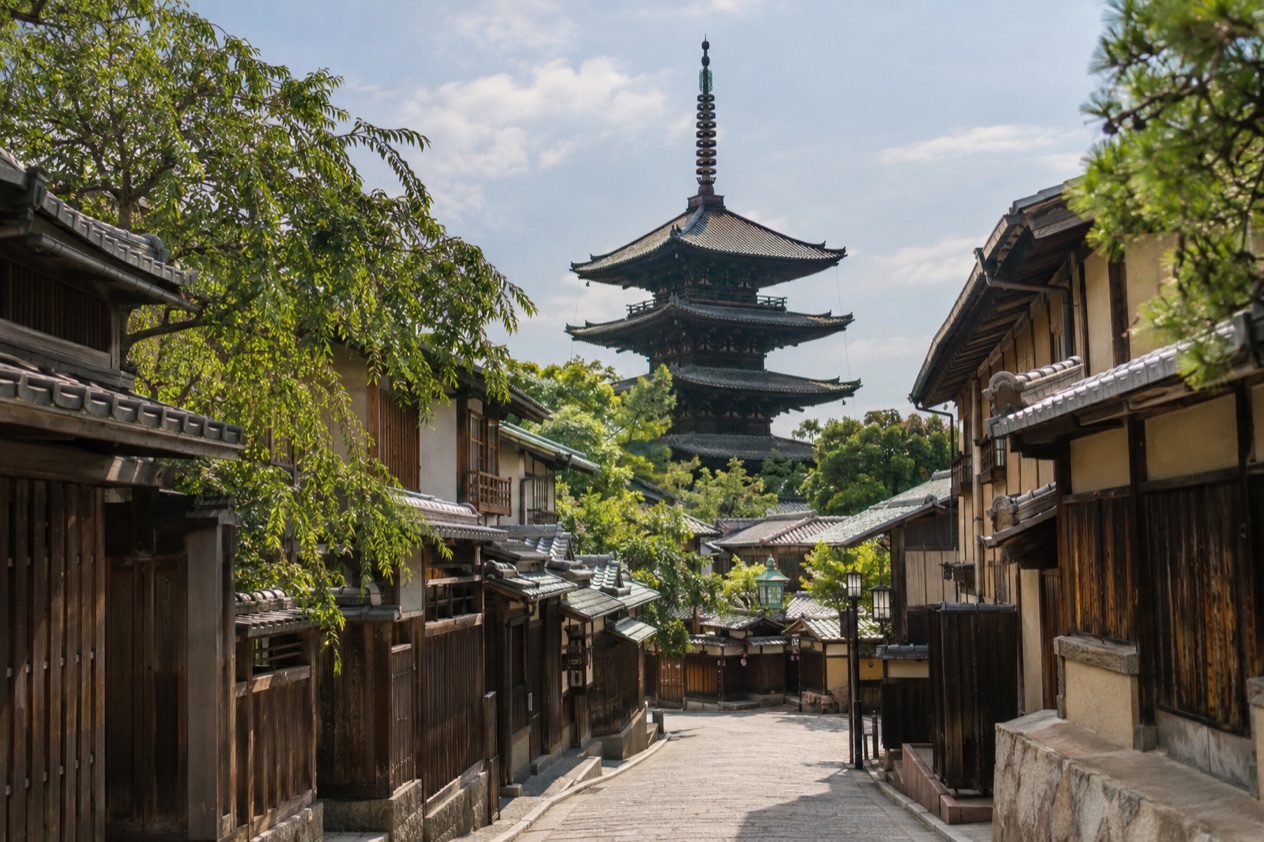
In July, Kyoto sounds like flutes and gongs drifting down the streets as huge wooden floats are readied for the Gion Matsuri. Lanterns glow along the lanes, cicadas fill the temple groves, and cold noodles and shaved ice appear on menus all over town.
What is the weather like in Kyoto in July?
Kyoto in July is hot, humid and often wet, a clear step up from June and just short of the full heat of August.
| Month | Average high (°F) | Average low (°F) | Precipitation (in) | Days with 1 mm or more of precipitation | Hours of sunshine | Daylight on the 15th |
|---|---|---|---|---|---|---|
| June | 82.6 | 66.6 | 7.86 | 11.5 | 133 | 14 h 30 min |
| July | 89.6 | 74.5 | 8.80 | 11.6 | 143 | 14 h 18 min |
| August | 92.7 | 76.5 | 6.06 | 8.3 | 183 | 13 h 31 min |
Honshu summers are very humid and sultry, and Kyoto sits in a basin where that feeling is easy to recognize. Afternoons climb to nearly 90°F, and nights hold in the mid-70s, so the evening brings little relief. Sightseeing in the open air is a matter of pacing yourself, with pauses in shaded temple halls, tea rooms and cafés.
July is the wettest of the three months in the table, and rain comes on more than a third of the days. Expect showers that can turn heavy, with gray stretches between the sunnier spells, so a compact umbrella earns its place in your bag. Sunshine totals still leave plenty of bright hours, and the days are long, giving you room to start slowly and finish with a lantern-lit stroll.
Clothing is simple: breathable fabrics, a hat and something dry to change into. Light cotton and linen dry fastest after a downpour, and a thin layer is useful for air-conditioned trains, museums and restaurants that run noticeably colder than the street.
What to do in Kyoto in July
July in Kyoto belongs to the Gion Matsuri, one of the largest and most famous festivals in Japan, which runs through the whole month. Towering wooden floats, some carrying musicians, roll through the city streets pulled by teams of men in matching festival dress, while the neighborhoods that own them open their doors to the public.
In the days leading up to the processions, the festival fills the old merchant districts with a gentle bustle. Flutes and drums rehearse in the open fronts of town houses, lanterns are lit in the evening, and many families show heirlooms inside their homes. Even if you miss the procession dates, the weeks around them give Kyoto a festive mood that is hard to find in any other month.
Gion and the festival streets
The Gion district, with its wooden teahouses and narrow lanes, is the emotional center of the festival. Walk it in the evening and you will see lanterns, women in yukata (light cotton summer kimono) and the occasional geiko or maiko on her way to an appointment. Kyoto asks visitors not to stop, touch, follow or take unauthorized photos or video of them, and photography is prohibited in many Gion areas.
If you want to watch geiko and maiko perform, public Kyomai shows are held throughout the year, and your hotel or a licensed tour guide can tell you how to attend. It is a better way to see the dances than a chance meeting on a lane, and it fits well with a hot day when you want an hour indoors.
Temples and shrines in the summer heat
Fushimi Inari Taisha, established in 711 AD at the base of Mount Inari in Fushimi-ku, is a forest walk beneath thousands of red torii gates. The shade of the trees matters in July, and the vermilion against the deep green is striking after a rain shower. Bring water and take the path in stages.
Kinkaku-ji, officially Rokuon-ji, and Kiyomizu-dera are both part of the Historic Monuments of Ancient Kyoto World Heritage Site. Kiyomizu-dera, founded over 1250 years ago, has a wide wooden terrace that opens onto the city and the green hills. Kinkaku-ji’s gold pavilion is reflected in its pond, and summer light on the leaves gives the whole garden a lush look.
Eating and drinking Kyoto’s summer
Summer cooking in Kyoto leans toward cold and light dishes. Hamo, a pike conger prepared with careful knife work, is the fish most associated with Kyoto summers and the Gion Matsuri. Chilled somen noodles, cold soba, pickles with a crunch and silky tofu dishes keep lunch light when the heat has taken your appetite.
For something sweet, look for kakigori, shaved ice with syrup, and for matcha served over ice or in parfaits with red bean and rice-flour dumplings. A cold barley tea (mugicha) is a common companion to a meal. In the evening, izakaya (casual pubs) serve cold beer with grilled skewers and small dishes, a good way to end a humid day.
Kyoto has been the cultural capital of Japan for centuries, and it holds about 20 percent of the country’s National Treasures. On rainy days, that heritage shifts indoors, with temple halls, museums and tea houses offering dry corners to wait out the showers.
A two-day itinerary for Kyoto in July
Day 1 is for the temples and the red gates, with the heat in mind. Start with Fushimi Inari Taisha at the base of Mount Inari, walking up through the torii while the shade is thickest and turning back whenever the humidity wins. Return to town for a cold noodle lunch, then spend the afternoon at Kiyomizu-dera and the lanes around it, looking out over the city from the wooden terrace.
As the long July daylight fades, cross to Gion for dinner at a kind of place that suits the month, an izakaya or a restaurant serving hamo. Walk the lanes under the lanterns and, during the festival weeks, listen for the rehearsals of flutes and drums. Keep your camera down where photography is not allowed, and leave any geiko or maiko you see to go about her evening.
Day 2 begins at Kinkaku-ji, the golden pavilion mirrored in its pond, where the green of the garden is deep in summer. Stop afterward for kakigori or iced matcha at a café, and use midday for a long, cool lunch indoors. If the processions fall on this day, July 17 or July 24, plan to spend the central hours watching the floats move through the streets.
The rain card is easy in Kyoto. Switch to a museum, a tea house, a covered shopping arcade or a Kyomai performance, the public geiko and maiko shows that your hotel or a licensed guide can point you to. Finish the evening with a drink or a bowl of noodles, and let the showers pass before one last walk past the lanterns.
Is Kyoto busy in July?
July is a festival month in Kyoto, and the Gion Matsuri gives the city a lively pace, especially around its two procession days.
The festival is one of the largest and most famous in Japan, and it runs through the month in Kyoto. Streets near the procession routes are given over to floats, musicians and onlookers on July 17 and July 24, while the days between are more relaxed, with preparations and neighborhood events. Away from the festival, temples and gardens carry on at their usual rhythm.
The heat sets its own tempo. Visitors drift toward shaded gardens, cafés and indoor attractions in the middle of the day, and the city comes alive again as the light softens and the lanterns come on. Kyoto is a major destination for travelers, so it makes sense to plan your festival days with that in mind.
What to pack for Kyoto in July
Pack for hot, humid days with a chance of heavy showers, and for walking a lot between temples, shrines and festival streets.
- Breathable cotton or linen clothes, which handle sticky afternoons and dry quickly after rain.
- A compact umbrella, because July is the wettest of the summer months here.
- A hat and sunscreen for temple courtyards and the open terraces.
- A refillable water bottle for the climb through the torii gates at Fushimi Inari.
- Comfortable shoes that slip off easily, since shoes come off at the entrance of many temple halls and tea houses.
- A light layer for air-conditioned trains and restaurants.
- A small towel or handkerchief for the humidity.
Good to know before you go
July in Kyoto is hot, damp and festive, and the weather shapes the days more than anything else. Showers can arrive on many days, so keep your plans flexible and have an indoor option for each outing.
The hottest part of the summer stretches from July through September, so build in breaks for shade and cold drinks. The Kyoto Online Tourist Information Center offers disaster preparedness guides and maps of evacuation sites, and its staff speak English.
Kyoto in July vs June and August
Moving the trip four weeks earlier gives you a cooler Kyoto, with highs in the low 80s and slightly longer days. Rain is still frequent, so you gain comfort but not dryness. You also miss the Gion Matsuri, which belongs to July, and with it the processions of floats and the lantern-lit lanes of the festival weeks.
Going four weeks later brings the strongest heat and the sunniest weather of the three months, with fewer rainy days. Nights stay warm, and midday sightseeing asks even more of you. The festival is over by then, so August suits travelers who want long bright days and are happy to plan around the heat.
Choose July if the Gion Matsuri is the reason you are going, or if you like a city in celebration. Shift to June if you want gentler temperatures for walking, and to August if you prefer more sunshine and fewer showers and can live without the festival.
Is July a good time to visit Kyoto?
Yes, for travelers who come for the Gion Matsuri and can handle heat and humidity with a slow pace and plenty of cold drinks.
People who enjoy festivals, evening strolls and seasonal food will love July here, from hamo and cold noodles to kakigori and iced matcha. Those who struggle with sticky weather or want a dry, crisp trip should look at another month. If you arrive in the festival weeks, start by working out which procession date you want to see, then fit the temples around it.
What makes July in Kyoto its own is the sound of flutes and gongs in the old merchant streets, floats towering over the roofs and lanterns lighting the lanes of Gion as the humid evening settles in.
Sources
- Japan Meteorological Agency (JMA), Normal values 1991-2020, monthly (https://www.data.jma.go.jp/stats/etrn/view/nml_sfc_ym.php?prec_no=61&block_no=47759), station Kyoto, elevation 41 m, checked October 11, 2026
- Computed from the date and the latitude of the place (sunrise equation, solar elevation -0.833 degrees), October 11, 2026
- Japan National Tourism Organization, weather and seasons in Japan (https://www.japan.travel/en/plan/weather/), checked October 11, 2026
- Wikipedia, Climate of Japan (https://en.wikipedia.org/wiki/Climate_of_Japan), checked October 11, 2026
- Japan National Tourism Organization, summer in Japan (https://www.japan.travel/en/guide/summer-guide/), checked October 11, 2026
- Japan National Tourism Organization, festivals and events (https://www.japan.travel/en/see-and-do/festivals-and-events/), checked October 11, 2026
- Wikipedia, Hanabi (https://en.wikipedia.org/wiki/Hanabi), checked October 11, 2026
- Wikipedia, Gion Matsuri (https://en.wikipedia.org/wiki/Gion_Matsuri), checked October 11, 2026
- Japan National Tourism Organization, Mount Fuji guide (https://www.japan.travel/en/fuji-guide/), checked October 11, 2026
- Official website for Mt. Fuji climbing, about the climb (https://www.fujisan-climb.jp/en/about/), checked October 11, 2026
- Wikipedia, Tanabata (https://en.wikipedia.org/wiki/Tanabata), checked October 11, 2026
- Kyoto City Official Travel Guide, history and religion (https://kyoto.travel/en/history-and-religion), checked October 11, 2026
- Kyoto City Official Travel Guide, responsible travel (https://kyoto.travel/en/responsible-travel), checked October 11, 2026
- Kyoto City Official Travel Guide, safety information (https://kyoto.travel/en/safety-info/), checked October 11, 2026
- Kyoto City Official Travel Guide, seasonal information (https://kyoto.travel/en/seasonal-info), checked October 11, 2026
- Wikipedia, Kyoto (https://en.wikipedia.org/wiki/Kyoto), checked October 11, 2026
- Fushimi Inari Taisha, official site (https://inari.jp/en/), checked October 11, 2026
- Wikipedia, Fushimi Inari-taisha (https://en.wikipedia.org/wiki/Fushimi_Inari-taisha), checked October 11, 2026
- Wikipedia, Kinkaku-ji (https://en.wikipedia.org/wiki/Kinkaku-ji), checked October 11, 2026
- Kiyomizu-dera Temple, official site (https://www.kiyomizudera.or.jp/en/), checked October 11, 2026
- Wikipedia, Kiyomizu-dera (https://en.wikipedia.org/wiki/Kiyomizu-dera), checked October 11, 2026
To plan your stay
- Things to Do in Kyoto: Temples, Gardens, Food and Day Trips
- Where to Stay in Kyoto: Kyoto Station, Central and Eastern Districts, and Ryokan Stays
- Kyoto from Tokyo: Shinkansen Trains, Nozomi vs. Hikari and Kodama, and a First Day in Kyoto
- Know Before You Go to Kyoto: Entry, Money, Getting Around and Local Etiquette