
In early February, shouts of “Oni wa soto! Fuku wa uchi!” carry out of Kyoto’s shrines as roasted soybeans fly through the cold air, thrown at paper-masked demons. Steam rises from bowls of simmering tofu, and the first plum buds open on bare branches beside temple walls. February is the last stretch of winter in the old capital, a month of woolen scarves, hot food and the first hint of spring for travelers who want Kyoto’s temples and gardens in their cold-weather mood.
What is the weather like in Kyoto in February?
February in Kyoto is cold but not harsh: afternoons stay cool rather than freezing, nights drop to the edge of frost, and a little snow is part of the picture.
| Month | Average high (°F) | Average low (°F) | Precipitation (in) | Days with 1 mm or more of precipitation | Hours of sunshine | Daylight on the 15th | Snowfall (in) |
|---|---|---|---|---|---|---|---|
| January | 48.4 | 34.7 | 2.10 | 6.4 | 124 | 10 h 02 min | 2.0 |
| February | 50.0 | 34.9 | 2.56 | 7.3 | 122 | 10 h 54 min | 2.8 |
| March | 57.4 | 39.7 | 4.18 | 9.5 | 155 | 11 h 54 min | 0.4 |
What this means on the ground is simple. Days are cool enough that you want a real coat, a scarf and gloves, yet mild enough to walk from temple to temple without feeling you are racing the cold. Evenings bring the chill back, so a warm layer you can keep on through dinner is the sensible choice.
Precipitation is modest and arrives on a handful of days rather than every day. Some of it falls as snow or sleet, in small amounts that melt quickly in the city, though a dusting on tile roofs and garden stones is one of the pictures people travel for. A compact umbrella or a hooded waterproof jacket covers both rain and wet snow, and shoes with decent grip help on damp stone steps.
Daylight is growing noticeably. The month ends with a clearly longer day than January, which gives you more room for sightseeing before dark. Sunshine is about the same as in January, so expect a mix of bright spells and gray skies rather than a steady run of blue.
What to do in Kyoto in February
The month belongs to Setsubun, to the first plum blossoms and to a winter table that is at its warmest and richest. Between those, the great temples and gardens look different in the cold, with bare maples, dark wood and stone lanterns edged in frost or snow.
Setsubun and the bean-throwing
Setsubun, the day before spring begins on the old calendar, falls in early February. The main ritual is mamemaki, in which roasted soybeans called fukumame are thrown out the front door or at a family member wearing an oni (demon) mask, while everyone shouts “Oni wa soto!
Fuku wa uchi!” (Devils out! Fortune in!). In Kyoto, shrines and temples hold their own versions, with priests and invited guests tossing beans to the crowd from a stage.
Afterward comes the eating. Custom says you swallow one bean for each year of your life plus one extra for luck in the coming year, counting age the traditional way known as kazoedoshi.
Shops and supermarkets sell little bags of beans with a paper oni mask tucked in, and bakeries and convenience stores fill with ehomaki, thick sushi rolls eaten in silence by many families on the day. Watching a ceremony, or simply hearing the shouting from a courtyard as you pass, makes this one of the liveliest days of Kyoto’s winter.
Plum blossoms and winter gardens
Plum trees (Prunus mume) typically flower from January until late February in East Asia, so February is when their pale pink and white petals show up on shrine grounds and in temple gardens. They come before the cherry blossoms, and in Kyoto the sequence runs from plum to cherry, then azaleas, wisteria and irises. The scent is faint and sweet, and the flowers look striking against dark branches and gray roofs.
Shrines known for their plum trees, such as Kitano Tenmangu, draw people who like to walk slowly under the branches with a hot drink. Gardens such as Kenrokuen are in Kanazawa, not here, but Kyoto’s own garden temples and moss gardens take on a hushed, graphic look in winter, with snow on a pine or a few buds on a branch giving the whole scene its focus. If the weather turns damp, a covered veranda at a temple is a good place to sit and look out.
The winter table
February is the month for food that warms you from the inside. Yudofu, tofu simmered gently in a pot of kombu broth, is a Kyoto winter classic, and so are bowls of noodles, hot pots, and oden, the stewed daikon, eggs and fish cakes served in a clear broth. Kaiseki, the multicourse meal built around the season, leans on root vegetables, tofu, and Kyoto’s pickles at this time of year.
Warm drinks are part of the day. Hot green tea, sweet amazake made from rice, and sake served warm suit the cold, and many izakaya (casual Japanese pubs) feel especially welcoming when the evening air bites.
Temples, shrines and the old streets
Kyoto was the capital of Japan for over a thousand years, starting in 794, and it is home to about 20 percent of the country’s National Treasures. February is a good month to spend on that heritage, since the cold keeps you moving from one wooden hall to the next. Fushimi Inari, with its tunnels of red torii gates, Kinkaku-ji, the golden pavilion, and Kiyomizu-dera, with its wide wooden terrace, each look different against a winter sky.
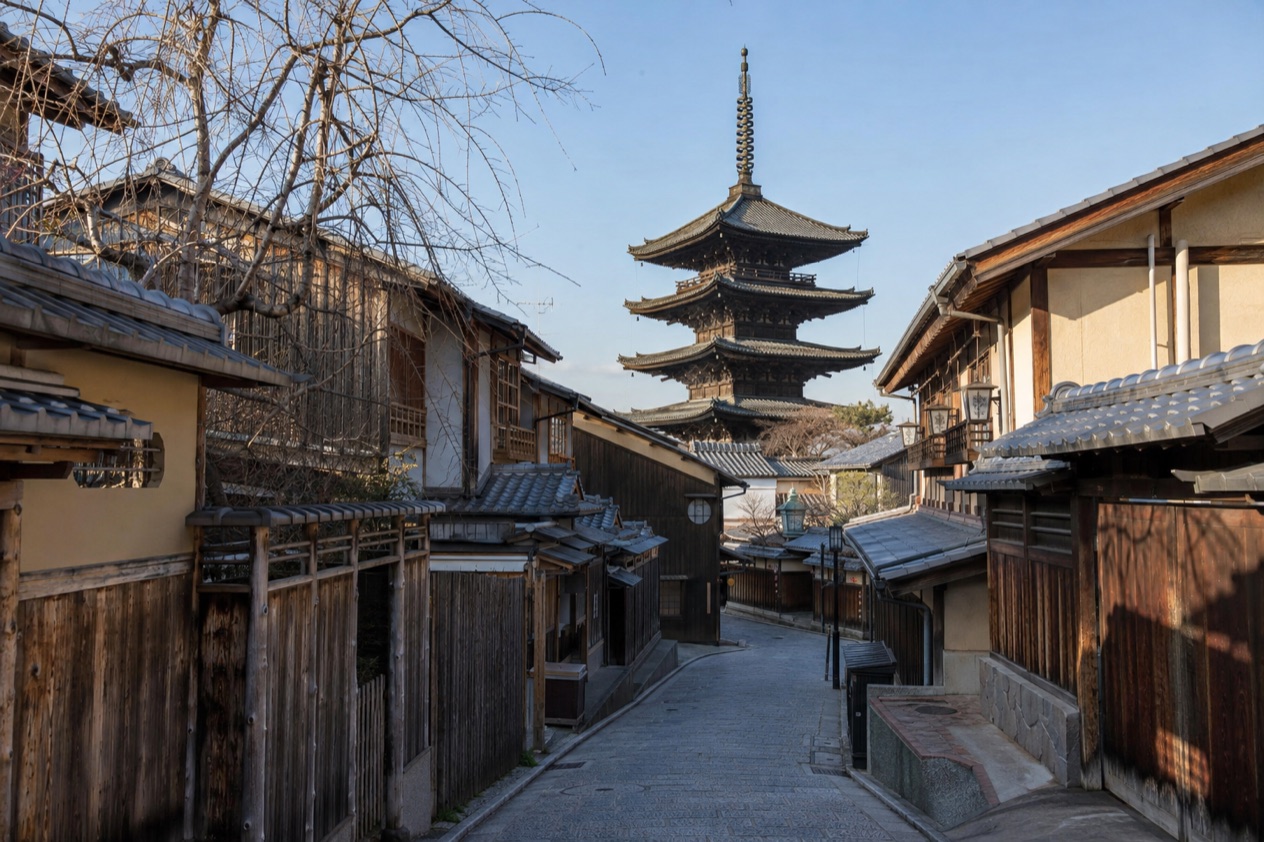
In the old quarter of Gion, the streets of wooden teahouses are a draw in themselves. Visitors must not stop, touch, follow or take unauthorized photos or videos of geiko or maiko walking around, and photography is prohibited in many Gion areas, parts of shrines and temples, and some restaurants. To see them perform, travelers can attend public Kyomai shows held throughout the year by inquiring at their hotel or with a licensed tour guide.
A two-day itinerary for Kyoto in February
Day 1 is for the eastern temples and the old streets of Gion. Start the morning at Kiyomizu-dera, with its wooden terrace looking out over the city, and follow the lanes of shops and teahouses down from the temple.
In the afternoon, wander through the streets of Gion, remembering that maiko and geiko are not to be stopped or photographed without permission. A cup of matcha and a sweet in a tearoom breaks up the cold.
Evening can be a kaiseki dinner or an izakaya meal with warm sake, and winter’s long nights make that a pleasant way to finish the day. If rain or snow arrives, museums, covered shopping arcades and tearooms are good indoor choices.
Day 2 turns to the other great sights. Begin at Fushimi Inari, walking among the red torii gates as far as you like, then move on to Kinkaku-ji, whose gold leaf stands out against a gray winter sky. Make a stop at a shrine known for plum blossoms such as Kitano Tenmangu, where the flowering branches are the draw in February.
Lunch can be soba or a set meal near the shrine, and the afternoon can go to a garden temple where you sit on a veranda and watch the light change. For the evening, an oden counter or a hot pot dinner closes the trip, and if the weather turns wet, a covered market for pickles, tofu and sweets keeps the day going.
Is Kyoto busy in February?
February is a winter month in Kyoto, set before the cherry blossom season that arrives toward the end of March, and the pace is that of a city in between its better-known seasons.
The big seasonal draws come later. The first cherry blossoms in Kyoto usually open around the end of March, with full bloom around the start of April, and Kyoto’s large festivals are in May, August and October, including the Aoi Matsuri on May 15, the Gozan Okuribi bonfires on August 16 and the Jidai Matsuri on October 22. February has none of those, so the month’s own events are smaller and more local, such as the Setsubun ceremonies and the plum blossoms.
What you feel in the city is a rhythm set by the weather. People linger over hot drinks and long meals, temple grounds feel bare and open, and the plum blossoms give a reason to look closely at a branch or a garden corner. Tourist Information Centers in Kyoto have staff who speak English and many other foreign languages, a help if you want to ask about the month’s ceremonies.
What to pack for Kyoto in February
Pack for cool days, cold evenings and a bit of wet weather, with layers you can add or remove as you move between outdoor temples and heated rooms.
- A warm coat, for afternoons that stay cool and nights near frost.
- A scarf, gloves and a hat, since temple grounds and shrine stairs are open to the air.
- A hooded waterproof jacket or compact umbrella, for rain and wet snow.
- Shoes with good grip, for damp stone steps and gravel paths.
- Warm socks, because shoes come off at many temple halls and ryokan entrances.
- A sweater to keep on at dinner, for evenings that turn cold.
Good to know before you go
February sits in the cold part of the year, so snow or sleet can appear on some days and the temperature falls close to frost at night. The New Year closures of many restaurants and attractions belong to the start of January, not to this month.
The Kyoto Online Tourist Information Center provides disaster preparedness guides and maps of evacuation sites, and the Kyoto City Official Travel Guide lists the most important emergency numbers. Respect the rules around Gion, where photography is prohibited in many areas.
Kyoto in February vs January and March
Moving the trip four weeks earlier brings you to January, which is a touch colder and slightly drier, with a bit less snow than February and a shorter day. The plum blossoms are just beginning at that point, and the Setsubun ceremonies are still ahead. February adds a little more daylight and the first flowering branches.
Four weeks later, March is clearly milder, with warmer afternoons, longer days, more sunshine and more rain. Snow becomes rare, and the first cherry blossoms usually come near the end of the month, so March carries the feeling of spring that February only hints at. Plum season is winding down by then, since the blossoms typically last until late February.
Choose February if you want the Setsubun ceremonies, plum blossoms and the winter table, with cool air on temple grounds. Shift to March if you prefer milder afternoons and the approach of the cherry trees. Stay with January only if a colder, shorter-day winter is what you are after.
Is February a good time to visit Kyoto?
Yes, for travelers who like winter travel and want temples, gardens and food at a cold-weather pace. February suits people who enjoy warming up over a bowl of tofu, a cup of tea or a glass of warm sake, and who are happy to wear a coat while walking between sights.
It is a weaker fit for anyone who wants spring warmth or cherry blossoms, which arrive later, or who dislikes cold evenings. On arrival, start with the plum blossoms and a Setsubun ceremony if the date lines up with your stay, then spend the rest of the days among the temples and old streets, stepping indoors for hot food whenever the cold sets in.
What is special about February here is the small-scale spring in the middle of winter: soybeans thrown at paper demons, a plum branch in flower beside a frosty wall, and a pot of tofu bubbling gently on the table.
Sources
- Japan Meteorological Agency (JMA), Normal values 1991-2020, monthly (https://www.data.jma.go.jp/stats/etrn/view/nml_sfc_ym.php?prec_no=61&block_no=47759), station Kyoto, elevation 41 m, checked October 11, 2026
- Computed from the date and the latitude of the place (sunrise equation, solar elevation -0.833 degrees), October 11, 2026
- Wikipedia, Setsubun (https://en.wikipedia.org/wiki/Setsubun), checked October 11, 2026
- Japan National Tourism Organization, festivals and events (https://www.japan.travel/en/see-and-do/festivals-and-events/), checked October 11, 2026
- Sapporo Snow Festival official website (https://www.snowfes.com/english/), checked October 11, 2026
- Wikipedia, Sapporo Snow Festival (https://en.wikipedia.org/wiki/Sapporo_Snow_Festival), checked October 11, 2026
- Japan National Tourism Organization, winter in Japan (https://www.japan.travel/en/guide/winter-guide/), checked October 11, 2026
- Japan National Tourism Organization, skiing and snowboarding in Japan: regions, resorts, seasons (https://www.japan.travel/en/sports/snow/), checked October 11, 2026
- Wikipedia, Climate of Japan (https://en.wikipedia.org/wiki/Climate_of_Japan), checked October 11, 2026
- Japan National Tourism Organization, flowers by season: cherry blossom, plum, wisteria, hydrangea, where and when (https://www.japan.travel/en/see-and-do/flowers/), checked October 11, 2026
- Wikipedia, Prunus mume (https://en.wikipedia.org/wiki/Prunus_mume), checked October 11, 2026
- Japan National Tourism Organization, skiing guide (https://www.japan.travel/en/guide/skiing/), checked October 11, 2026
- Wikipedia, List of ski areas and resorts in Japan (https://en.wikipedia.org/wiki/List_of_ski_areas_and_resorts_in_Japan), checked October 11, 2026
- Japan National Tourism Organization, weather and seasons in Japan (https://www.japan.travel/en/plan/weather/), checked October 11, 2026
- Japan Meteorological Agency, cherry blossom first-bloom dates 2021-2026 and 1991-2020 normal (https://www.data.jma.go.jp/sakura/data/sakura003_07.html), checked October 11, 2026
- Japan Meteorological Agency, cherry blossom full-bloom dates 2021-2026 and 1991-2020 normal (https://www.data.jma.go.jp/sakura/data/sakura004_07.html), checked October 11, 2026
- Kyoto City Official Travel Guide, festivals and events (https://kyoto.travel/en/events), checked October 11, 2026
- Kyoto City Official Travel Guide, history and religion (https://kyoto.travel/en/history-and-religion), checked October 11, 2026
- Kyoto City Official Travel Guide, responsible travel (https://kyoto.travel/en/responsible-travel), checked October 11, 2026
- Kyoto City Official Travel Guide, safety information (https://kyoto.travel/en/safety-info/), checked October 11, 2026
- Kyoto City Official Travel Guide, seasonal information (https://kyoto.travel/en/seasonal-info), checked October 11, 2026
To plan your stay
- Things to Do in Kyoto: Temples, Gardens, Food and Day Trips
- Where to Stay in Kyoto: Kyoto Station, Central and Eastern Districts, and Ryokan Stays
- Kyoto from Tokyo: Shinkansen Trains, Nozomi vs. Hikari and Kodama, and a First Day in Kyoto
- Know Before You Go to Kyoto: Entry, Money, Getting Around and Local Etiquette