
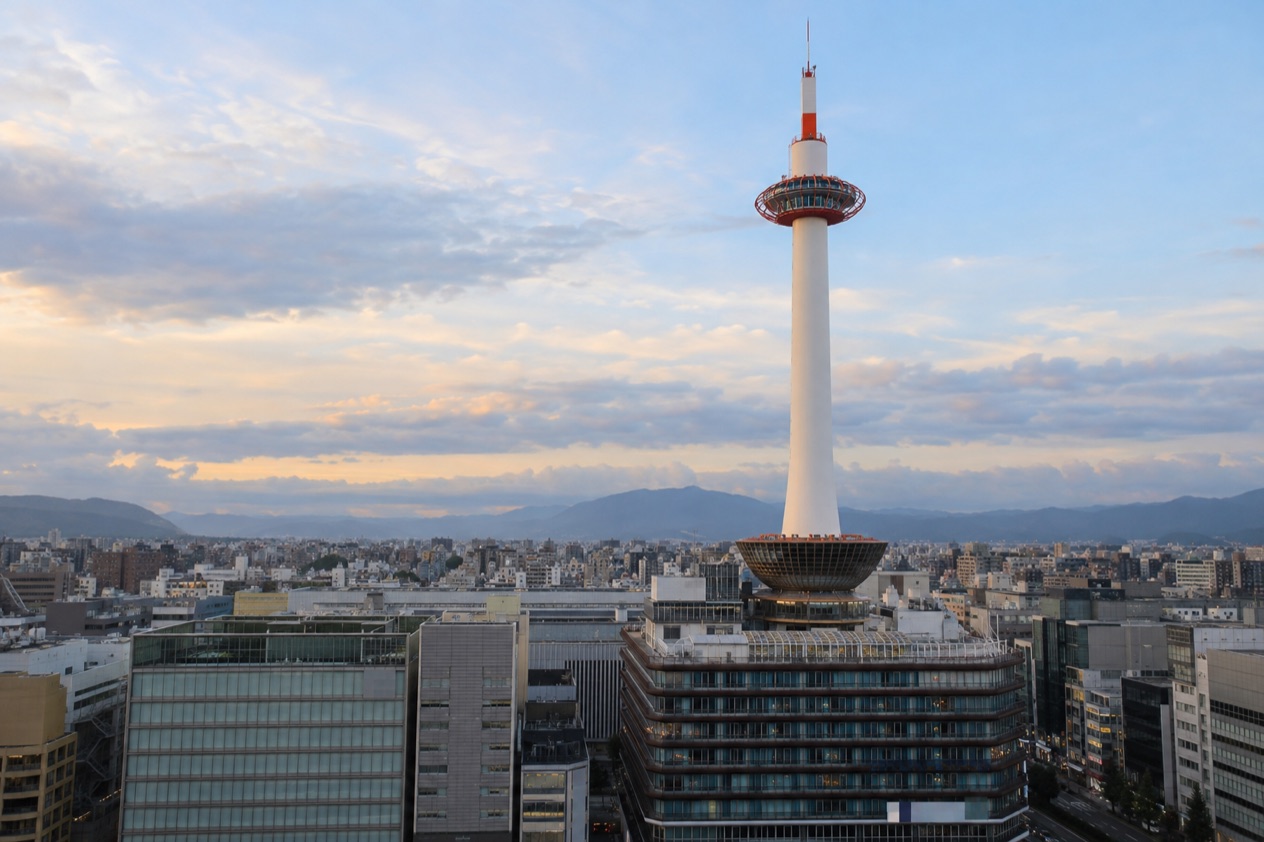
Step out of Kyoto Station and the tower is right there across the way, a white slender shape rising over the glass and concrete of the station plaza. At night it glows against the dark sky, and by day it gives the neighborhood a landmark you can find from almost anywhere nearby. A visit here is a short, easy-to-fit stop that puts the whole city spread out in front of you.
Is visiting Kyoto Tower worth it?
Yes, if you like to get your bearings from above before you walk the streets, or if you are passing through Kyoto Station anyway and want a look at the whole basin. It suits first-time visitors who want to see how the city sits among its mountains, and anyone who enjoys a modern landmark as a counterpoint to the temples.
What sets it apart from the temples, shrines and castles that fill most Kyoto itineraries is the vantage point. Kyoto has served as Japan’s capital for over 1000 years, and most of what you visit is seen from ground level, at the scale of a gate or a garden path.
From the observation deck the picture reverses: you see Higashiyama, Arashiyama and Kitayama mountains ringing the city, and on clear days some buildings in Osaka. The tower stands directly opposite the station, so you do not have to plan a separate excursion to reach it.
It also gives you something the old quarters cannot: a sense of the city’s layout. Once you have traced the mountain lines from above, the names you hear later, Higashiyama for the temple district, Arashiyama for the bamboo and river side, start to fall into place on the map in your head.
What to see at Kyoto Tower
The observation deck
The deck is the reason people come. It sits at 100 meters, and the spire above it reaches 131 meters, which is why the tower reads so clearly against the skyline. Walk the full circle and you move through the Kyoto basin one side at a time: the ridges of Higashiyama on one side, Arashiyama and Kitayama on others, and the grid of the city below.
Look for the long, regular lines of the streets, a reminder of how the old capital was laid out, broken here and there by the dark roofs of temple compounds. On clear days, some buildings in Osaka can be made out in the distance, so a look at the horizon is worth the effort. The deck has a capacity of 500 people, and it is wheelchair accessible via a stair lift and ramps.
The tower and its story
Kyoto Tower first opened to the public on December 28, 1964, and it has stood across from the station ever since. Its slim white form was unusual in a city better known for wooden halls and tiled roofs, and it still draws a mix of admiration and debate among locals for that reason. It is now officially renamed Nidec Kyoto Tower, though the older name is the one you will see used in most places.
The structure is designed to withstand winds up to 201 mph (90 m/s) and earthquakes stronger than the Great Hanshin earthquake. Standing at its foot and looking up, you can follow the line of the spire from the building at its base to the tip, a clean vertical in a plaza of horizontals.
The building beneath: hotel and Sky Lounge
The tower rises from a building of its own. Kyoto Tower Hotel occupies floors 5 to 9 beneath the tower and has 160 rooms, so some travelers wake up with the landmark practically overhead. Higher up, atop the building surrounding the tower, is a circular three-floor restaurant named Sky Lounge ‘空’ KUU.
Even if you are not staying or dining, the building is part of the visit, since it anchors the tower to the plaza and the station beyond.
Hours, tickets and rules
The tower stands opposite Kyoto Station in Shimogyo-ku, so it is a stop you can build into a day of arriving, leaving or changing trains.
| Feature | Detail |
|---|---|
| Observation deck height | 100 meters |
| Spire height | 131 meters |
| Deck capacity | 500 people |
| Wheelchair access | Stair lift and ramps |
The deck is wheelchair accessible via a stair lift and ramps, and its capacity is set at 500 people at a time.
How to get to Kyoto Tower
The tower is located opposite Kyoto Station, and it stands a few steps from the main entrance of the station. That makes the station the one base you need to know: arrive there and you have effectively arrived at the tower.
Kyoto Station is served by the Tokaido Shinkansen line, which makes it the ideal starting point to explore all of Kyoto’s attractions and to connect to major cities across Japan. If you come into Kyoto by bullet train, you step off at the station and the tower is in front of you as you leave the main entrance.
The tower is over 130 meters tall and visible across the entire city, so it also works as a landmark when you are finding your way back to the station at the end of a day. If you are staying elsewhere in Kyoto, heading for the station is the way to head for the tower.
When to visit Kyoto Tower
Because the point of the deck is the view, the weather matters more here than at an indoor museum. Kyoto’s seasons change the look of the mountains you are gazing at, and the figures give a sense of what each season feels like at street level in the city.
| Month | Average high (°F) | Average low (°F) | Precipitation (in) | Rain days | Sunshine (hours) |
|---|---|---|---|---|---|
| January | 48.4 | 34.7 | 2.10 | 6.4 | 124 |
| April | 68.2 | 48.6 | 4.61 | 9.4 | 177 |
| July | 89.6 | 74.5 | 8.80 | 11.6 | 143 |
| October | 74.1 | 57.9 | 5.64 | 8.2 | 156 |
April brings mild days and the most sunshine of the four months shown, which suits a look out over the mountains. October is comfortably warm and brings a good amount of sun too, with the hills beyond the city turning toward autumn.
January is cold, with snow or sleet on many days, so a clear winter day is a chance, not a promise. July is hot and humid, with the most rain days of the four.
As for the time of day, nothing in the record pins down a best hour at the deck.
Tips for your visit
Treat the tower as a stop on a bigger day around the station. Because it sits across from Kyoto Station, it pairs naturally with a meal in the station building, where a full floor of ramen restaurants waits, along with an Isetan department store and a theater. A bowl of ramen after the view makes a tidy rhythm for an arrival or departure day.
Bring a layer that suits the season, since the figures run from a cold January to a hot, humid July. If you are hoping to pick out the far-off buildings of Osaka, they appear only on clear days, so a hazy or rainy day may give you less than you hoped for.
For visitors using a wheelchair, the observation deck is accessible via a stair lift and ramps. Families and groups will find the building self-contained, with the hotel and the Sky Lounge restaurant in the same structure.
From the station area, you can also turn toward the rest of Kyoto’s sights. Central Kyoto holds Nijo Castle, built in 1603 by Tokugawa Ieyasu, the first shogun of the Edo period, with its nightingale floors that make a bird-like sound when walked on. Kyoto’s traditions, from machiya townhouses to the Gion Matsuri festival and the hanamachi districts where geishas live and work, are the next chapter after the view.
Good to know before you go
Kyoto has a cultural heritage that has developed over the past 1,200 years, and the tower is a modern way into it: a single look at the whole basin before you go down into the streets. The tower is now officially renamed Nidec Kyoto Tower, so you may see either name on signs and maps.
Sources
- Wikipedia, Kyoto Tower (https://en.wikipedia.org/wiki/Kyoto_Tower), checked October 11, 2026
- Japan National Tourism Organization, Kyoto (https://www.japan.travel/en/destinations/kansai/kyoto/), checked October 11, 2026
- Japan Meteorological Agency (JMA), Normal values 1991-2020, monthly (https://www.data.jma.go.jp/stats/etrn/view/nml_sfc_ym.php?prec_no=61&block_no=47759), station Kyoto, elevation 41 m, checked October 11, 2026
To plan your stay
- Best Time to Visit Kyoto: Cherry Blossoms, Autumn Leaves, Weather by Month and Festivals
- Where to Stay in Kyoto: Kyoto Station, Central and Eastern Districts, and Ryokan Stays
- Kyoto from Tokyo: Shinkansen Trains, Nozomi vs. Hikari and Kodama, and a First Day in Kyoto
- Know Before You Go to Kyoto: Entry, Money, Getting Around and Local Etiquette