
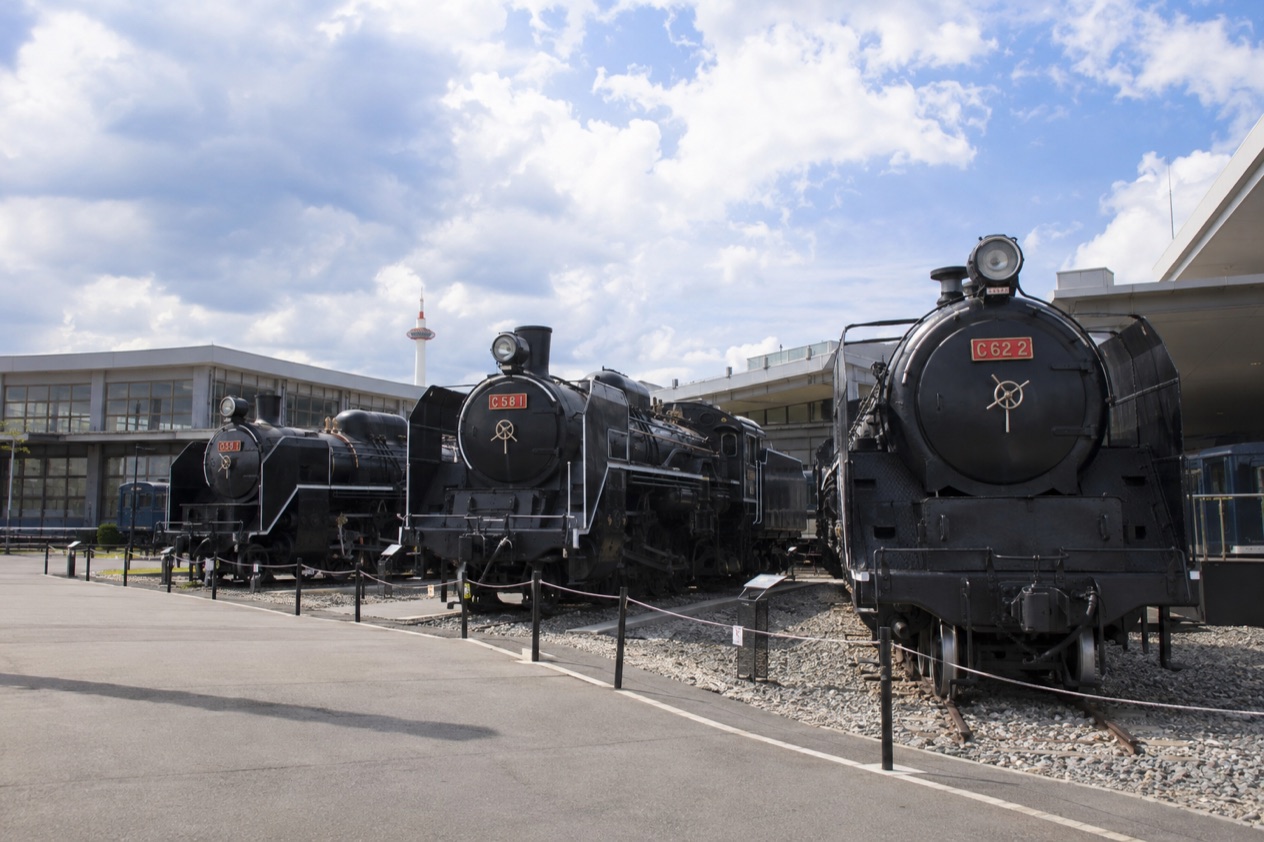
Inside the big halls, full-size locomotives and carriages stand still with their wheels, couplings and driver’s cabs right at eye level. It is a strange pleasure to walk up to machines that once hauled whole regions and see how they were built, rivet by rivet. The Kyoto Railway Museum, in Shimogyō-ku, is a museum for anyone who likes trains, and for travelers who want a day in Kyoto that is not about temples.
Is visiting the Kyoto Railway Museum worth it?
Yes, if trains interest you at all, and especially for families with curious children and for travelers who have already seen a few shrines and want a change of pace. Even if you have never looked twice at a locomotive, the museum has a story worth following: how Japan came to be a country that moves by rail.
It is the largest railway museum in Japan by floor space and number of trains, with 31,000 square meters of exhibit space. That scale matters. You are not looking at a handful of models behind glass but at real engines and cars, arranged so that you can follow the technology from the steam era onward and see how design changed with it.
What sets it apart from the rest of Kyoto is its subject. The city is known for a cultural heritage that has grown over 1,200 years, with machiya townhouses, the Gion Matsuri festival and hanamachi districts where geishas live and work.
The railway museum shows another kind of heritage, the industrial one, and the two fit together well. Kyoto was the capital for over a thousand years, and the rails that now bring visitors to its old streets are part of the city’s later chapters.
The setting adds to the visit. A cultural landmark stands on the grounds, and the building you leave through was once a working station. The museum is as much about buildings as about the vehicles inside them.
What to see at the Kyoto Railway Museum
The roundhouse
The roundhouse is the part of the museum with the most history behind it. It is designated an Important Cultural Property by the Government of Japan as the oldest reinforced-concrete car shed in the country. A roundhouse is a fan-shaped shed where locomotives were stabled and serviced, and the layout still gives you a sense of how a busy steam depot once worked.
Look at the structure itself as well as the engines: the concrete framing, the way the bays radiate out, the proportions built for machines far bigger than a person. Steam locomotives are the natural residents here, and standing beside one gives you a feel for its weight that photographs never do.
Trains from steam to the modern era
Beyond the roundhouse, the main exhibits follow the story of Japanese railways through the vehicles themselves. Expect steam engines with their black boilers and brass fittings, then later generations of electric and high-speed trains with the smooth, streamlined noses that made Japanese trains recognizable around the world.
Take your time with the details. Cab controls, destination boards, seat fabrics and the painted numbers on the sides all tell you about the period each train belonged to. If you are traveling with children, the drivers’ cabs and the sheer size of the wheels tend to start the best questions.
The Umekoji heritage
Today’s museum grew out of an earlier one. It began as the Umekoji Steam Locomotive Museum, devoted to the steam engines that were being retired, and it was reopened and expanded into the Kyoto Railway Museum. That origin explains why steam still has such a strong presence in the collection, and why the roundhouse is at the heart of it.
It also gives the visit an emotional thread. Many of the machines on show were once the daily workhorses of ordinary people’s lives, and the museum treats them with something close to affection.
The former Nijō Station building
The exit has a story of its own. The former Nijō Station building was part of Nijō Station in Kyoto until March 1996, and it now serves as the museum exit and shop. You leave an exhibition about railways through a real piece of railway architecture, a nice final touch that lets you see an old station from the inside.
The shop is where visitors pick up railway souvenirs. Pause before you go in to look at the building itself, since it stood in the middle of daily travel for decades.
Hours, tickets and rules
The museum is a visit with distinct layers, and its dates tell you how they fit together. A roundhouse from the early twentieth century, a station building that served travelers until the 1990s, a steam museum from the 1970s and the larger museum of today all sit within one site. Each of them is described in the table.
| Part of the museum | Date | Role today |
|---|---|---|
| Roundhouse | Built in 1914 | Important Cultural Property, the oldest reinforced-concrete car shed in the country |
| Former Nijō Station building | Part of Nijō Station until March 1996 | Museum exit and shop |
| Umekoji Steam Locomotive Museum | Opened October 10, 1972 | The original museum |
| Kyoto Railway Museum | Opened in its current form April 29, 2016 | The museum today |
The roundhouse’s status as an Important Cultural Property is the main reason to treat the building with care. It is a protected structure as well as a place to walk through.
The museum sits in Shimogyō-ku, in the city of Kyoto itself, so it can be planned as one stop among the city’s other sights. Keep the exit in mind when you plan your route, since you leave through the old station building and its shop.
How to get to the Kyoto Railway Museum
The museum is in Shimogyō-ku, in Kyoto, and the city’s rail hub, Kyoto Station, makes a sensible base for a trip to a railway museum. It is served by the Tokaido Shinkansen line, which links the city to major cities across Japan, so arriving by bullet train sets the mood for the day.
Kyoto Station is also a destination in its own right. The building houses a full floor of ramen restaurants, an Isetan department store, a theater and a Granvia luxury hotel.
Travelers like to arrive in Kyoto, drop their bags and then spend part of a day on a theme that has nothing to do with temples. A railway museum suits that plan well. You can begin the morning with a bowl of ramen on the station’s restaurant floor, then head on to the museum in Shimogyō-ku.
For the exact route from the station to the museum, look at a transit app or a map once you are in Kyoto, since Kyoto’s trains and buses are all part of the same network that the museum celebrates.
When to visit the Kyoto Railway Museum
Kyoto’s seasons change the feel of a day out considerably, and the table gives the figures for four typical months. Autumn is also a pleasant time to be in the city generally.
| Month | Average high (°F) | Average low (°F) | Precipitation (inches) | Days with rain | Sunshine (hours) |
|---|---|---|---|---|---|
| January | 48.4 | 34.7 | 2.10 | 6.4 | 124 |
| April | 68.2 | 48.6 | 4.61 | 9.4 | 177 |
| July | 89.6 | 74.5 | 8.80 | 11.6 | 143 |
| October | 74.1 | 57.9 | 5.64 | 8.2 | 156 |
January is cold, and in an average January snow or sleet falls on many days, though it is a light total. Dress warmly if you come then. April is gentle and bright, with spring warmth and more sunshine. July is the hottest and stickiest of the four, with humid air that makes a long day on foot tiring.
The calendar offers a small bonus in the second week of October. The original Umekoji Steam Locomotive Museum opened on October 10, so this is a good time to think about the museum’s origins as you walk through the roundhouse. The museum itself does not depend on a season, and a day with bad weather can still be a good day for a visit.
Tips for your visit
Go without a tight schedule. With so much floor space, the museum rewards a slow pace, and children in particular will want to stop and look at the machines. Comfortable shoes are the one thing worth thinking about, because a day among large exhibits means a lot of standing and walking.
Combine the museum with the rest of Kyoto’s rail and city life. Kyoto Station, with its ramen floor and its department store, is a natural companion for a meal before or after. Kyoto Tower, close to the station’s main entrance, gives a view over the whole city and a sense of how it is laid out.
If you want to balance steel and cedar, add a historic site from central Kyoto. Nijo Castle was built in 1603 by Tokugawa Ieyasu, the first shogun of the Edo period, and its nightingale floors make a bird-like sound when walked on, an old security system that warned the guards of intruders. Seeing a castle and a railway museum in the same trip shows two very different eras of Japanese engineering.
Read the building before you leave. The old Nijō Station hall is the way out, and a few minutes spent looking at it connects the exhibits to the real stations that brought people to Kyoto.
Good to know before you go
Kyoto rewards a flexible plan, and the museum is the kind of stop that works well on a day when the weather turns. Autumn brings some wet days, so a light rain layer is a sensible companion in a bag, and in winter a warm coat matters more than anything.
The Gion Matsuri and the hanamachi districts show the city’s old traditions, and the railway museum shows the machines that carried people to them.
Sources
- Wikipedia, Kyoto Railway Museum (https://en.wikipedia.org/wiki/Kyoto_Railway_Museum), checked October 11, 2026
- Japan National Tourism Organization, Kyoto (https://www.japan.travel/en/destinations/kansai/kyoto/), checked October 11, 2026
- Japan Meteorological Agency (JMA), Normal values 1991-2020, monthly (https://www.data.jma.go.jp/stats/etrn/view/nml_sfc_ym.php?prec_no=61&block_no=47759), station Kyoto, elevation 41 m, checked October 11, 2026
To plan your stay
- Best Time to Visit Kyoto: Cherry Blossoms, Autumn Leaves, Weather by Month and Festivals
- Where to Stay in Kyoto: Kyoto Station, Central and Eastern Districts, and Ryokan Stays
- Kyoto from Tokyo: Shinkansen Trains, Nozomi vs. Hikari and Kodama, and a First Day in Kyoto
- Know Before You Go to Kyoto: Entry, Money, Getting Around and Local Etiquette