
White gravel crunches underfoot, tall plaster walls with tiled caps line the paths, and pines lean over gates that were never meant for ordinary visitors. Inside the great park at the center of Kyoto, the old home of the emperors appears in low, hushed rooflines rather than towers. This is a visit about history and architecture, for travelers who like to understand what they are looking at.
Is visiting the Kyoto Imperial Palace worth it?
Yes, if you want to see where Japan’s court actually lived and governed rather than another temple, and it suits history-minded travelers, architecture lovers and anyone who enjoys a long walk through open green space in the middle of a city. The palace was the residence of the Emperor of Japan from 1331 to 1869, and the buildings you see today date from 1855.
What sets it apart from the temples and the castle elsewhere in Kyoto is its purpose. Kyoto’s temples are about worship and gardens, and Nijo Castle was built in 1603 by Tokugawa Ieyasu, the first shogun of the Edo period, as a seat of military power.
The Imperial Palace belongs to the other side of Japanese history, the court. Its halls were built for ceremony, enthronements and the quiet rhythms of imperial life, so the mood is of restraint and ritual rather than gold leaf and display.
It also works as an outing in its own right. The palace stands inside the Kyoto Gyoen, a large rectangular enclosure that is now a national park managed by the Ministry of the Environment. The grounds are open to the public, so even a loose walk beneath the trees and along the long walls gives you something. The buildings themselves are seen on public tours hosted by the Imperial Household Agency several times a day.
Travelers who prefer color, crowds and souvenir stalls may find the palace understated. Plain wood, white gravel and deep eaves are the point here. Kyoto has a cultural heritage that has developed over the past 1,200 years, and this is the place where the thread of the court is easiest to follow.
What to see at the Kyoto Imperial Palace
The visit is built around a handful of structures and the open spaces between them. The palace is a set of separate halls, gates and courtyards rather than one great building, so it rewards slow looking at proportions, roof lines and the textures of wood and stone.
The Shishinden, hall of state ceremonies
The Shishinden is the hall used for state ceremonies, and it is the architectural heart of the compound. It faces a broad courtyard of white gravel, an open space that gives the building room to be seen and was designed for gatherings of courtiers in formal dress. The roof is covered in layers of cypress bark rather than tile, which gives it a soft, rounded edge unlike the heavy tiled roofs of Kyoto’s temples.
Inside is the Takamikura, the Imperial throne used in enthronement ceremonies. The enthronements of Emperors Meiji through Showa took place in this hall. You look in from the front of the building and take in a raised, canopied seat in a very plain interior. Look also at the two trees that traditionally stand in the courtyard in front of the hall, one a cherry and one an orange, which are part of the layout of a court hall of this type.
The Kenreimon, a gate for one person only
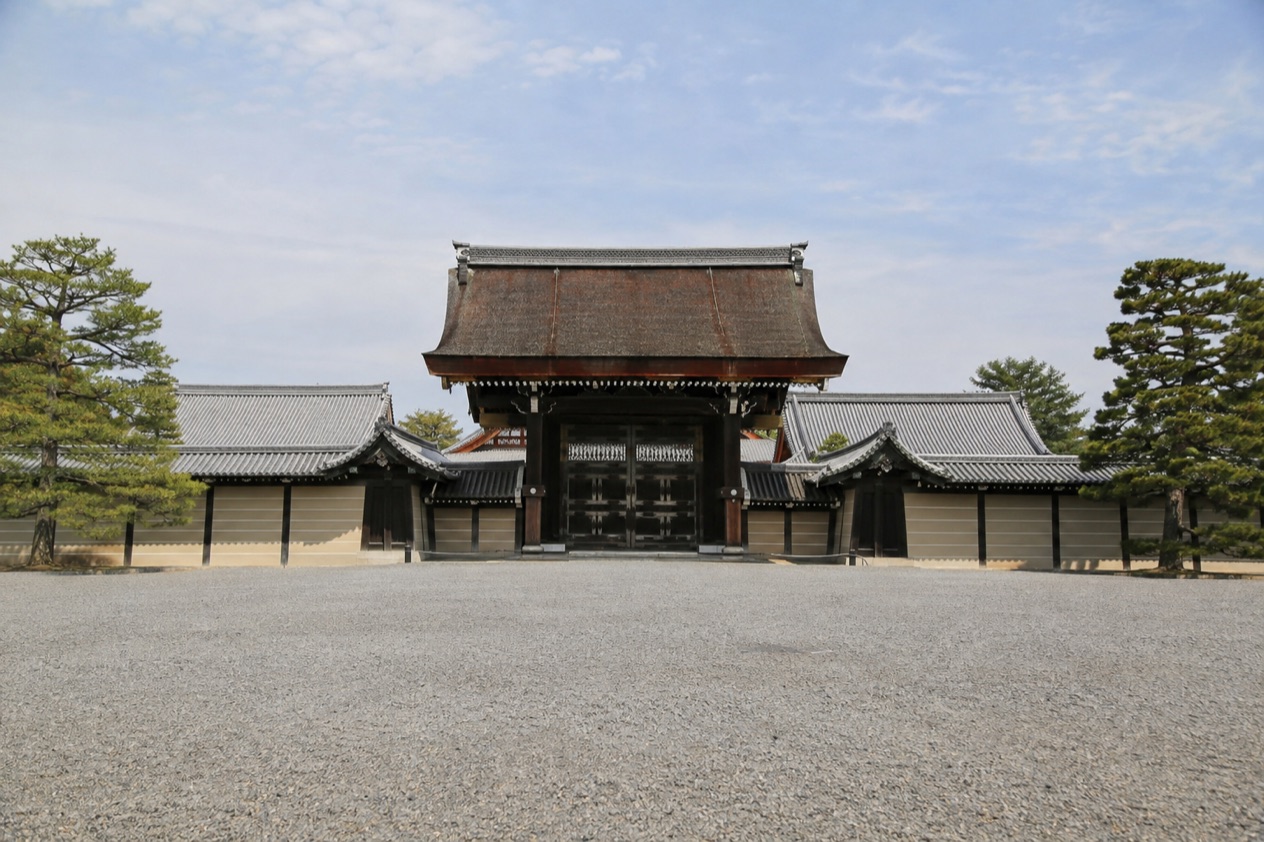
The Kenreimon is the main entrance gate of the palace, and it was used only by the emperor. Stand in front of it and you can read the hierarchy of the court in a single structure: a grand, formal gateway that for people was never an entrance at all. Courtiers and officials used other gates, and the difference in status was built into the walls.
It makes a good place to slow down and imagine the procession scenes the compound was designed for. The gate is more about what it meant than about decoration, so look at its proportions and how it sits within the surrounding wall, and notice how little ornament it carries compared with the great temple gates elsewhere in the city.
The Kogosho and the night of December 9, 1867
The Kogosho is where one of the turning points of modern Japanese history played out. On the night of December 9, 1867, the Kogosho Conference was held here, discussing the treatment of Tokugawa Yoshinobu during the Meiji Restoration. It was a meeting that helped close the era of the shoguns and return power to the emperor.
Seen from the outside, it is a modest-looking building, and that is part of its interest. Great decisions were made in rooms like these, with small groups of men arguing through the night. If you know the story, the building takes on a charge that its quiet appearance does not announce.
The grounds of the Kyoto Gyoen
The palace sits inside a large rectangular enclosure, much longer from north to south than from east to west, and the surrounding park is as much a part of the visit as the buildings. Wide gravel avenues run between lawns and stands of trees, and the park gives the city’s center a long stretch of open air. Because the grounds are open to the public, you can wander the paths, sit under the trees and see the palace walls from the outside.
Locals use it for walks and for the changing seasons, with plum and cherry blossoms in the spring and colored leaves in the fall, though the exact timing varies from one year to the next. Treat the park as the setting that gives the palace its sense of scale.
Hours, tickets and rules
The grounds of the palace are open to the public today, and the buildings are seen on public tours hosted by the Imperial Household Agency several times a day. That split is the main thing to understand: the park is a place you can enter and walk through, while the interior courtyards and halls are visited as part of a guided tour of the buildings.
The park around the palace, the Kyoto Gyoen National Park, is managed by the Ministry of the Environment, while the tours of the buildings are run by the Imperial Household Agency, a separate body. If you plan to see the buildings and not only the park, keep that in mind when you think about your day, since the tours run to their own schedule and not to the rhythm of the park.
The enclosure is large, so even without a tour you can spend a good part of a day inside it, walking the gravel avenues and looking at the palace walls and gates from the outside. A tour of the buildings adds the view into the main courtyard and its halls, including the Shishinden and its throne, which is what people come for.
When to visit the Kyoto Imperial Palace
Spring and fall suit the palace best, because so much of the pleasure is outdoors, in the gravel courtyards and the park. April and October both bring mild air that makes a long walk comfortable, and the open ground of the enclosure means there is little shade from walls to hide behind in the heat or the cold.
| Month | Average high (°F) | Average low (°F) | Rain days | Sunshine (hours) |
|---|---|---|---|---|
| January | 48.4 | 34.7 | 6.4 | 124 |
| April | 68.2 | 48.6 | 9.4 | 177 |
| July | 89.6 | 74.5 | 11.6 | 143 |
| October | 74.1 | 57.9 | 8.2 | 156 |
April is the month for walking comfortably in a light jacket, with a good amount of sunshine and some rain that comes in showers, and spring is when Kyoto’s blossoms draw people into its parks. October is warmer, still pleasant for a long outdoor visit, and the leaves begin to turn as the season moves on.
July is hot and humid, with the most rain days of the four months. A walk across open gravel in that heat and damp is tiring, so it suits those who do not mind sweating. January is cold, with a chance of snow or sleet on many days, and the white gravel and bare trees give the palace a stark look. Bring warm layers if you go then.
As for the time of day, Japan’s national tourist organization suggests visiting Kyoto’s shrines at less crowded times, such as early morning or late evening when they are illuminated. That advice is about shrines. For the palace buildings, the tour times set by the Imperial Household Agency decide when you go inside, so build the rest of your day around them.
Tips for your visit
Plan for a good walk. The enclosure is a large rectangle, and getting from one end to the other on foot takes real time, so wear comfortable shoes that cope with gravel. In the cooler months a warm layer is useful, and in the summer months, with the heat and humidity of July, a hat and something to drink make the walk more pleasant.
Because the park and the building tours are run by different bodies, think of the day in two parts. Walk the grounds and see the outer walls and gates at your own pace, then fit in a tour of the buildings when it suits your timing. If you are fascinated by history, the story of the Kogosho Conference and the enthronements in the Shishinden give the tour a narrative to follow.
The palace pairs naturally with other Kyoto sights that tell a different story. Seeing both gives you the two poles of Japanese power in one visit to the city: the court and the military ruler.
Kyoto’s wider setting adds to the day. If you arrive by train, Kyoto Station is served by the Tokaido Shinkansen line, and its building houses a full floor of ramen restaurants, an Isetan department store, a theater and a Granvia hotel, which makes it a place to eat before or after your day.
For families, the open grounds give children room to move, and the story of the emperor’s private gate or the throne can be a way into the history. For visitors who find long walks hard, keep in mind that the park is big and the surfaces are gravel, so plan your route around the parts that matter most to you.
Good to know before you go
Kyoto’s weather changes the feel of this visit more than anything else. Summer brings heat, humidity and the most rain days of the year’s main travel months, while winter can bring snow or sleet to the white gravel.
Pack for the month, with a light rain layer in spring and summer and warm clothing from late fall through winter. The palace is a place of formality and tradition, so a calm, respectful manner in the grounds suits the setting.
Sources
- Wikipedia, Kyoto Imperial Palace (https://en.wikipedia.org/wiki/Kyoto_Imperial_Palace), checked October 11, 2026
- Japan National Tourism Organization, Kyoto (https://www.japan.travel/en/destinations/kansai/kyoto/), checked October 11, 2026
- Japan Meteorological Agency (JMA), Normal values 1991-2020, monthly (https://www.data.jma.go.jp/stats/etrn/view/nml_sfc_ym.php?prec_no=61&block_no=47759), station Kyoto, elevation 41 m, checked October 11, 2026
To plan your stay
- Best Time to Visit Kyoto: Cherry Blossoms, Autumn Leaves, Weather by Month and Festivals
- Where to Stay in Kyoto: Kyoto Station, Central and Eastern Districts, and Ryokan Stays
- Kyoto from Tokyo: Shinkansen Trains, Nozomi vs. Hikari and Kodama, and a First Day in Kyoto
- Know Before You Go to Kyoto: Entry, Money, Getting Around and Local Etiquette