
The morning crowd at Shin-Kobe Station carries coffee, bento boxes and backpacks, and the bullet trains slide in and out beneath the hills behind the port. From here, a castle that has stood through wars and earthquakes, the neon canals of Osaka and the temples of Kyoto are all within a day’s reach. Kobe makes a comfortable base for people who like to come back at night to a harbor city, and these are the outings that make the most of it.
What are the best day trips from Kobe?
The strongest day trips from Kobe head to the neighboring cities of the Keihanshin region, where a castle, a food district, a theme park and the old imperial capital each fill a day. Kobe sits across the bay from Osaka and belongs to the same agglomeration as Kyoto, so the choices are wide and very different from one another.
- Himeji Castle, a white fortress that has come through war, fire and earthquakes and is both a national treasure and a UNESCO World Heritage site.
- Dotonbori and Shinsaibashi in Osaka, for street food, bright signs and a long evening of eating.
- Osaka Bay and Universal Studios Japan, for a day of rides, shows and the Wizarding World of Harry Potter.
- Kyoto Station and its surroundings, a gateway to a city shaped by more than a thousand years of culture.
- Nijo Castle in central Kyoto, built for the first shogun of the Edo period, with floors that sing under your feet.
Himeji suits anyone who likes a single, striking monument. Osaka suits appetites. The bay is for families and thrill seekers, and Kyoto is for people who want temples, townhouses and slow streets. Each is described in turn, with what you see, how the day runs and what to keep in mind.
The best day trips from Kobe
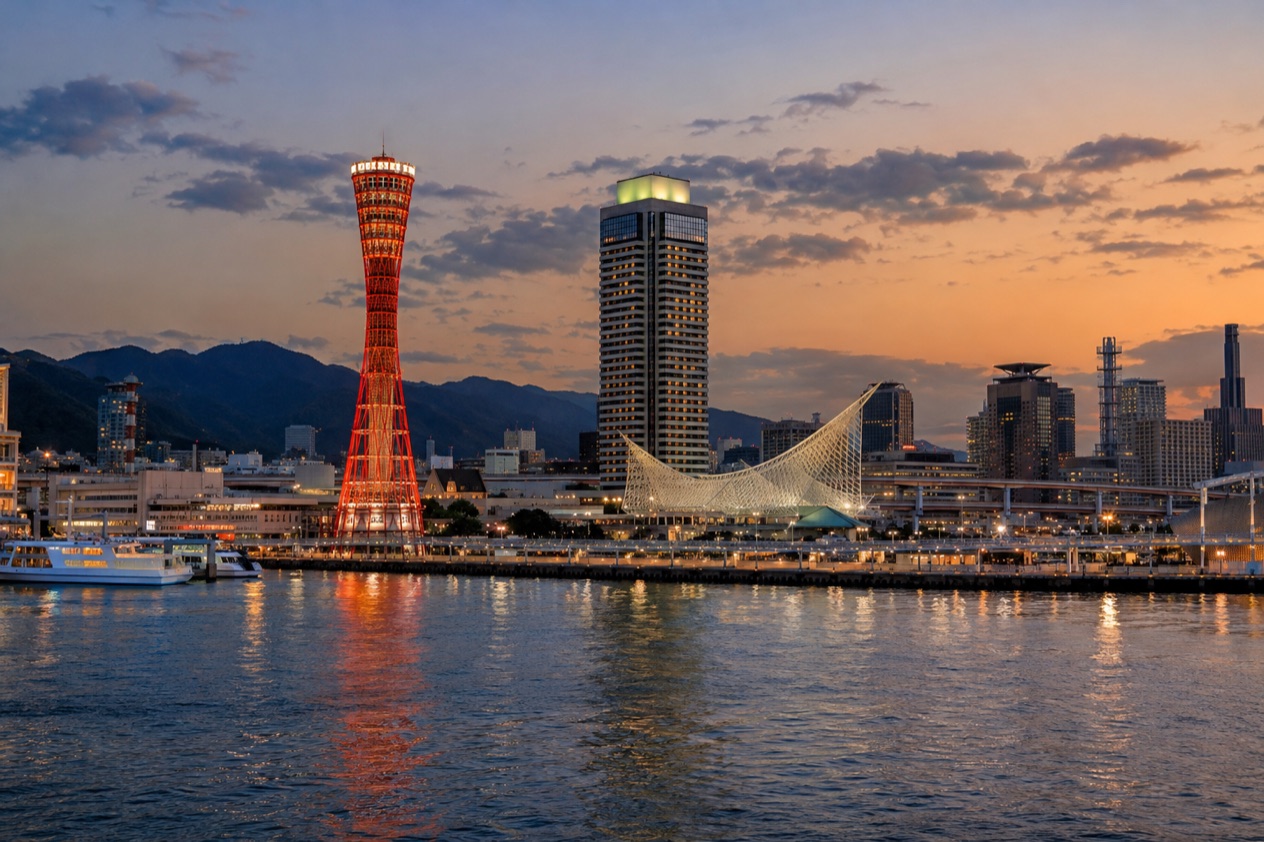
Whichever way you go, the day ends back in Kobe, and the city has a fine place to close it. The observation deck on the 24th floor of Kobe City Hall looks over the lights of the port after dark, a good way to watch the evening settle over the harbor before dinner.
| Site | Open |
|---|---|
| Kobe City Hall observation deck (24th floor) | Monday to Friday 08:15-22:00, Saturdays, Sundays and holidays 10:00-22:00 |
Himeji Castle
Himeji lies about an hour and a half west of Osaka by train, and a visit centers on one thing, the castle. It is both a national treasure and a UNESCO World Heritage site, and it dates back more than 400 years.
It is also one of the 12 original castles in Japan, meaning the keep you climb toward is the real structure rather than a later concrete copy. Its white walls and layered roofs give it a bird-like silhouette that people often compare to a heron in flight.
Inside the grounds you move through a maze of gates, stone walls and winding paths designed to slow an attacker, and every turn gives a new angle on the keep. The castle came through the bombing of World War II and the Great Hanshin earthquake of 1995, which Kobe knows well, so standing here has a particular weight for visitors based in the port city. Allow the better part of a day, and wear shoes you can slip on and off, since the keep is entered in socks or slippers as in most Japanese historic buildings.
Entry to the main keep is limited to the first 15,000 visitors each day, so the keep is something to plan around if you travel on a busy day. The castle is closed at the very end of the year.
| Site | Open |
|---|---|
| Himeji Castle, September to April | Daily 09:00-17:00, last admission 16:00 |
| Himeji Castle, May to August | Daily 09:00-18:00, last admission 17:00 |
| Himeji Castle, closed | December 29-31 |
Dotonbori and Shinsaibashi, Osaka
Osaka is a relaxed city known for its food, its entertainment and its nightlife, and Dotonbori is where all three meet along a canal. Expect the smell of takoyaki (octopus dumplings) being flipped on hot griddles, okonomiyaki (savory pancakes) sizzling at counters, and skewers of kushikatsu dipped once in the shared sauce. Giant mechanical signs, among them a crab with waving claws and the running man of a candy brand, hang over the street and are lit as the evening gets going.
Shinsaibashi is the shopping side of the same district, a long covered arcade of department stores, boutiques, drugstores and snack stands. It makes a fine contrast with the canal, since you can browse by day and eat by night without changing area. From Osaka or Umeda Station, the Midosuji Line takes you to Shinsaibashi Station for both districts. You can also stay on the same line until Namba Station to reach Dotonbori.
This is a trip for people who plan their day around meals. Go hungry, share plates and keep walking, since the best bites often come from a small stand rather than a sit-down restaurant. If rain arrives, the arcades of Shinsaibashi give you somewhere to carry on.
Osaka Bay and Universal Studios Japan
Osaka Bay is a major port area of the Kansai region, and its star is Universal Studios Japan, which opened in 2001. The park includes the Wizarding World of Harry Potter, where you walk through a snow-dusted village, sip butterbeer and watch wands cast spells in shop windows. Beyond that, the park mixes film-themed rides, stage shows and character meet-ups, which makes it a day built around waiting your turn, snacking and moving between zones.
To reach the bay area, take the JR Loop Line or the Chuo subway line from Osaka or Umeda stations. The route passes through the heart of the city, so you can pair the morning ride with a look at Osaka Station’s busy surroundings, then continue toward the water.
Plan on staying until after dark, when the park’s lights come on, and keep Dotonbori for another day, since each deserves its own evening.
Kyoto Station and the old capital
Kyoto’s cultural heritage has developed over the past 1,200 years, and the city served as Japan’s capital and the emperor’s residence for more than a thousand. Its traditions include machiya townhouses with narrow wooden facades, the Gion Matsuri festival and hanamachi districts where geishas live and work. Kyoto Station is served by the Tokaido Shinkansen, which makes it the starting point for exploring the city and for connecting to other cities across Japan.
The station is a destination in its own right. The building houses a full floor of ramen restaurants, an Isetan department store, a theater and a Granvia hotel. Kyoto Tower stands a few steps from the main entrance, over 130 meters tall and visible across the entire city, a handy landmark when you want to find your bearings before heading to the temples.
The national tourism organization suggests visiting shrines early in the morning or late in the evening, when they are less crowded and sometimes illuminated. A day here suits people who like to wander, and a ramen lunch inside the station gives you a break halfway through.
Nijo Castle in central Kyoto
Nijo Castle was built in 1603 by Tokugawa Ieyasu, the first shogun of the Edo period, and it shows the power of the warrior class in a city otherwise known for emperors and temples. Its most memorable feature is the nightingale floors, which make a bird-like chirp when walked on. They were an ancient security system, meant to alert the guards to intruders, and walking the corridors you hear them one board at a time.
It suits readers who enjoy history told through buildings and small details rather than big spectacle, and it makes a sharp contrast with the white fortress of Himeji.
Day trips from Kobe compared
| Trip | Best for | How to go |
|---|---|---|
| Himeji Castle | One great monument and a day around a single site | By train, about an hour and a half west of Osaka |
| Dotonbori and Shinsaibashi | Street food, signs and shopping | Midosuji Line from Osaka or Umeda to Shinsaibashi, or on to Namba |
| Osaka Bay and Universal Studios Japan | Rides, shows and the Wizarding World of Harry Potter | JR Loop Line or Chuo subway line from Osaka or Umeda |
| Kyoto Station area | Temples, townhouses and ramen | Tokaido Shinkansen to Kyoto Station |
| Nijo Castle | History of the Edo period and the nightingale floors | From central Kyoto |
Choosing comes down to what you want the day to feel like. Himeji is the trip for someone who wants one thing done well, a castle and a slow walk around it. Osaka bundles two moods, the street-food evening at Dotonbori and the theme-park day at the bay, so it works for groups with different tastes.
Kyoto asks for the most curiosity, since the city spreads out and rewards wandering. If you have only one day and you like history, pair the station with Nijo Castle. If you have two outings and a hearty appetite, put Himeji in one and Dotonbori in the other, and finish each by returning to Kobe for a last look at the harbor from the City Hall deck.
Spring days in Kobe run cool to mild, and the same layers will do in the neighboring cities. Between May and August, Himeji Castle stays open an hour later than the rest of the year, which gives a long summer day a little more room.
Tour or on your own?
The five outings here are all linked by rail or subway lines named above, so the question is less about transport and more about how you like to experience a place. A guided visit has the most to give where a site has stories behind its details, such as the nightingale floors at Nijo Castle or the defensive layout of the gates and walls at Himeji. A guide can tell you why a corridor squeaks or why a path doubles back, and that turns a walk into something you remember.
On your own, you set the pace. Dotonbori and Shinsaibashi are built for wandering and for stopping when something smells good, and a fixed schedule tends to get in the way.
The same holds for Kyoto Station, where a ramen floor, a department store and a tower are all in one building and the pleasure lies in following your own curiosity. At the theme park, the day is shaped by the rides you choose, so a group of friends can easily split up and meet again later.
Before you commit to either, check what each place sets as its own limits. Himeji Castle caps entry to the main keep at the first 15,000 visitors each day, so ask how a tour or your own plan handles that.
The castle also closes on December 29-31 and ends admission an hour before closing, which matters if you want to see the keep itself. Hours on the observation deck at Kobe City Hall differ between weekdays and weekends, so a late return is worth fitting around.
If you do pick a guided option, look at how long it spends at each stop and whether the stops match what you came for. A long program that passes quickly through the temples of Kyoto may leave less time for the station area, while a day built around Himeji alone leaves room for lunch and a second look at the keep. Think about meals too, since Osaka’s best bites reward a free stomach and a flexible afternoon.
Good to know before you go
Carry some yen for street stalls and small restaurants in Osaka, and keep a light layer in your bag, since Kobe’s spring days run cool to mild and the same goes for the nearby cities. Visit with the usual habits of a careful traveler, keeping an eye on belongings in the busy arcades and around station crowds. Typhoon and rainy seasons can change a plan, so keep the evening flexible and let the covered arcades of Shinsaibashi or the halls of Kyoto Station serve as a fallback when the weather turns.
Sources
- Japan National Tourism Organization, Kobe (https://www.japan.travel/en/destinations/kansai/hyogo/kobe-and-around/), checked October 11, 2026
- Visit Kobe, the official travel guide (https://www.feel-kobe.jp/en/), checked October 11, 2026
- Wikipedia, Kobe (https://en.wikipedia.org/wiki/Kobe), checked October 11, 2026
- Wikivoyage, Kobe (https://en.wikivoyage.org/wiki/Kobe), checked October 11, 2026
- Japan National Tourism Organization, Himeji (https://www.japan.travel/en/destinations/kansai/hyogo/himeji-and-around/), checked October 11, 2026
- Wikipedia, Himeji (https://en.wikipedia.org/wiki/Himeji), checked October 11, 2026
- Wikivoyage, Himeji (https://en.wikivoyage.org/wiki/Himeji), checked October 11, 2026
- Japan National Tourism Organization, Osaka (https://www.japan.travel/en/destinations/kansai/osaka/), checked October 11, 2026
- Japan National Tourism Organization, Kyoto (https://www.japan.travel/en/destinations/kansai/kyoto/), checked October 11, 2026