
In January, the pine trees of Kenrokuen wear cone-shaped skirts of rope, and wet snow settles on the tiled roofs of the old teahouse streets. Kanazawa smells of grilled fish and simmering broth, and a steady drizzle makes the lantern light on the wet stone look brighter. It is a month for gardens in winter dress, warm bowls of seafood stew and long museum afternoons, set on the Sea of Japan side of Honshu.
What is the weather like in Kanazawa in January?
January in Kanazawa is cold, gray and wet, with rain, sleet and snow taking turns on most days and the sun showing itself only now and then.
| Month | Average high (°F) | Average low (°F) | Precipitation (in) | Days with 1 mm or more of precipitation | Hours of sunshine | Daylight on the 15th | Snowfall (in) |
|---|---|---|---|---|---|---|---|
| December | 50.4 | 38.3 | 11.85 | 22.6 | 69 | 9 h 41 min | 9.4 |
| January | 44.8 | 34.2 | 10.08 | 23.4 | 62 | 9 h 55 min | 26.4 |
| February | 46.0 | 33.8 | 6.40 | 18.6 | 86 | 10 h 50 min | 20.9 |
What this means on the ground is simple. The city sits close to sea level, so much of the winter precipitation arrives as a mix of cold rain, slush and wet snow rather than the dry powder of the mountain resorts.
Snow or sleet falls on most days of the month, but it often melts on the pavements while piling up on rooftops, gardens and branches. Expect damp, heavy air, and a chill that gets through thin coats.
Dress in layers you can add and remove as you move between heated museums, tea rooms and the open air. A waterproof outer shell and boots with real grip matter more here than a bulky parka. Umbrellas are a constant companion, though wind can make a hood or a brimmed hat the better choice in the garden.
Daylight is short and the sky is often a flat pearl gray, so plan outdoor sights first and keep the long evenings for lanterns, hot food and indoor visits. The sea is a winter sea, a backdrop to the coast and the fish counters rather than something to swim in.
What to do in Kanazawa in January
The first days of the month belong to the Japanese New Year, celebrated on January 1, and the city keeps its holiday rhythm for a while. Families visit a shrine for the first time of the year (hatsumode), and homes serve osechi, the box of festive dishes eaten at New Year.
Many restaurants and attractions close during the New Year holidays, so the real sightseeing season begins once shutters go back up. Early in the month, Kanazawa also holds a parade of its firefighters, a winter ritual with a long local history.
What defines January here is the look of the city under weather. Kanazawa was one of the most important cultural and artistic centers of Japan in the Edo period, and today it belongs to the UNESCO Creative Cities Network as a City of Crafts and Folk Art. Gold leaf, Kutani porcelain and silk dyeing are the crafts to look for, and winter, when you want to be indoors anyway, suits workshops and galleries well.
Kenrokuen and the castle grounds
Kenrokuen, the Garden of Six Attributes, is a strolling-style garden, and winter gives it a character it lacks in other seasons. Pines are held up by fans of rope called yukitsuri, which protect the branches from the weight of wet snow and make a pattern against the white ground. Ponds go dark and still, stone lanterns wear caps of snow, and bare maples show their shapes.
Kanazawa Castle stands adjacent to the garden, with its pale roofs and white walls against the winter sky, and the two are easy to link in a single outing on foot. Both the castle park and the garden are promoted by the local tourist guide for their illumination at night. Wear boots with traction, since paths in the garden turn to slush and the stones can be slick.
Omicho Market and the winter table
The Sea of Japan makes January a month for seafood, and Omicho Market, the city’s fish and produce market, is where you see it laid out. Look for crab in season, fatty winter yellowtail, sweet shrimp and shellfish, all sold fresh or served as sushi and seafood bowls in the small eateries around the stalls. Kanazawa’s old vegetables, grown for centuries in the region, appear in stews and pickles.
A bowl of Kanazawa-style oden, with simmered radish, fish cakes and local specialties in a clear broth, is a natural answer to the cold. Jibuni, a stew of duck dredged in flour and simmered with vegetables, is a traditional Kaga dish of the area.
A cup of hot sake or a sweet with gold leaf finishes the meal. Shops in cities are generally open from 10:00 a.m. to 8:00 p.m., though in rural areas they often close earlier, sometimes as early as 6:00 p.m.
Higashi Chaya, Nagamachi and the museums
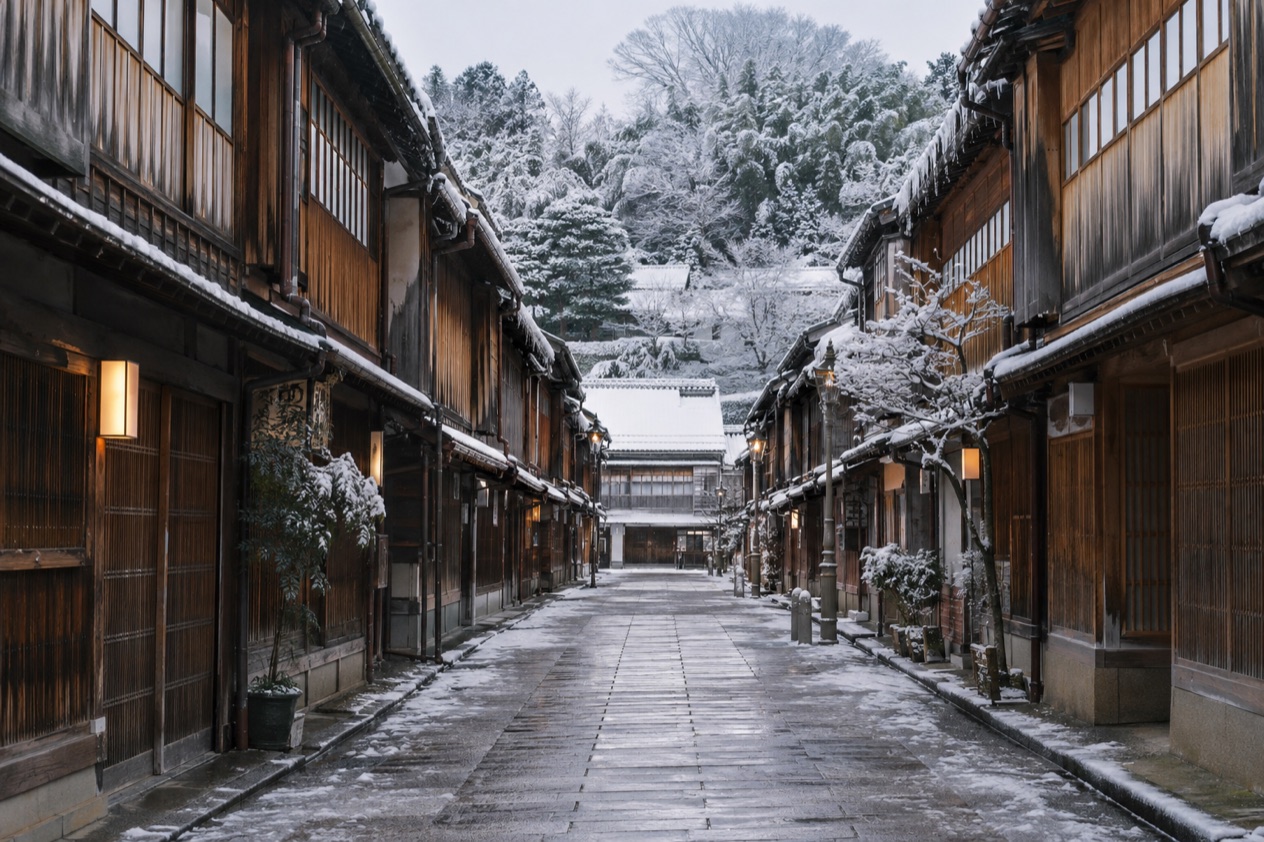
The old teahouse districts, where wooden latticed facades line narrow lanes, look their best in wet weather, when stone paving shines and umbrellas pass under the eaves. Higashi Chaya is the one to wander for tea rooms, small craft shops and sweets, and the samurai quarter of Nagamachi has earthen walls, covered with straw mats against the snow, and quiet lanes with canals running alongside.
When the weather turns heavy, Kanazawa has plenty of indoor space: craft museums, art galleries, tea rooms and traditional houses open to visitors. A cup of matcha with a wagashi sweet in a teahouse is as much part of the winter experience as the garden walk. The city’s role as a center of crafts means a gold leaf workshop or a pottery studio is a good way to use a day when the sky is dark.
Winter sports are not a Kanazawa matter. The country’s ski season generally opens in December and runs until April, with Hokkaido and the high mountains of Nagano having peak season in January and February. In the city, you swap skis for boots and umbrellas, and the pleasure is in the food, the gardens and the crafts.
A two-day itinerary for Kanazawa in January
Day 1 belongs to the open-air sights, while daylight lasts. Start at Kenrokuen and take your time among the roped pines, the frozen-still ponds and the snow-capped lanterns. From there, cross to the castle grounds, which are next door, and walk the white walls and the lawns. Daylight is short in January, so the outdoor part comes first.
For lunch, head to Omicho Market and choose a seafood counter, with a bowl of rice topped with winter fish or a plate of sushi. The afternoon can go to a craft museum or a gold leaf workshop, and in the evening you can return to the castle park and garden for their night illumination, then dine on oden or duck stew in a small restaurant. If the weather is terrible, shift the garden to the end and spend the day indoors among the museums and the market’s covered lanes.
Day 2 is for the old districts. Begin in Nagamachi with the samurai lanes and their earthen walls, then continue to Higashi Chaya for tea and sweets in a latticed teahouse. The streets of the old teahouse quarter look good with a light covering of snow, and the small shops sell crafts to take home.
After lunch, go to the contemporary art museum or to a Kutani ware gallery, both useful on wet afternoons. As the day closes, walk the lantern-lit lanes by the river and settle into a ryokan or an izakaya (a casual pub) for hot sake and grilled fish.
Is Kanazawa busy in January?
January in Kanazawa is a winter month, and the pace depends mostly on the New Year holidays at the start and the weather after that.
During the New Year holidays, many restaurants and attractions are closed, so the first days of the month feel like a pause. Families are at home or at shrines, and the usual rhythm of shops and museums only comes back later. When a national holiday falls on a Sunday, the next working day becomes a public holiday, and a day between two national holidays also becomes one, so closures can stretch a little.
After that, the city settles into a winter routine of damp streets, steaming food stalls and visitors with umbrellas. The snow and sleet shape the pace more than any festival: people walk more slowly on wet stone, duck into tea rooms and spend longer over lunch. Gardens and museums are set up for visitors, and what you meet depends on the weather more than the calendar.
The mountain resorts that draw winter-sports travelers at this time of year, in Hokkaido and Nagano, are a different kind of winter trip. Kanazawa is the city option for people who want crafts, food and gardens on the Sea of Japan coast, and who are happy to take the weather as it comes.
What to pack for Kanazawa in January
Pack for wet and cold, with layers that dry fast and shoes that can handle slush, and leave room for a purchase or two of local crafts.
- Waterproof boots with good grip, for slush and wet stone in the garden and old lanes.
- A waterproof outer shell, since rain, sleet and snow all appear in the same week.
- Warm layers such as a fleece or sweater, easy to remove when you step inside a heated museum.
- A compact umbrella and a brimmed hat or hood, for days when the wind makes umbrellas awkward.
- Gloves, a scarf and warm socks, useful when shoes come off at ryokan and tea rooms.
Good to know before you go
The main thing to plan around in January is the New Year holiday stretch, when many restaurants and attractions are closed. Once it ends, shops in urban areas are generally open from 10:00 a.m. to 8:00 p.m. every day, though places in rural areas often close earlier.
Gardens and old streets are slippery when wet, so take time on stone steps and paths.
Kanazawa in January vs December and February
Moving the trip four weeks earlier, to December, brings a milder chill, with a good deal less snow on the ground and the garden’s ropes freshly set up. Days are at their shortest, and the rain is heavy. The year-end holidays then bring their own closures, and the celebrations of the New Year give the city a seasonal mood.
Moving four weeks later, to February, gives a little more sun, longer days and noticeably less precipitation, though snow still falls on many days. The cold is similar, the garden is still in winter dress, and the New Year closures are behind you, so museums, restaurants and shops are back to their usual hours. Plum trees begin to flower in East Asia from January until late February, which gives the later weeks a first hint of spring in the region.
If you want the New Year atmosphere, shrine visits and the deepest winter look, January is the month. If you would rather have a milder chill, choose December, and if you want more light and fewer wet days while keeping the snow, February is the better pick.
Is January a good time to visit Kanazawa?
Yes, for travelers who like winter cities and are happy to spend their days in gardens, markets and museums, accepting gray skies and damp weather as part of the trip.
It will suit people drawn to food, since the Sea of Japan season brings crab, yellowtail and warming stews, and those who want to see Kenrokuen with its rope-supported pines under snow. It also suits anyone interested in crafts, from gold leaf to ceramics. It is a poor match for travelers who want long, bright days outdoors, since sunshine is scarce and the light fades early.
On arrival, check which restaurants and attractions have reopened after the New Year holidays and start with the outdoor sights while you have daylight. What is special about January here is the contrast of rope-wrapped pines, lantern-lit lanes, steaming bowls and wet stone, all at once in a city that has long made its living from crafts.
Sources
- Japan Meteorological Agency (JMA), Normal values 1991-2020, monthly (https://www.data.jma.go.jp/stats/etrn/view/nml_sfc_ym.php?prec_no=56&block_no=47605), station Kanazawa, elevation 6 m, checked October 11, 2026
- Computed from the date and the latitude of the place (sunrise equation, solar elevation -0.833 degrees), October 11, 2026
- Japan National Tourism Organization, shop and attraction hours, national holidays (https://www.japan.travel/en/plan/business-hours-and-holidays/), checked October 11, 2026
- Wikipedia, Japanese New Year (https://en.wikipedia.org/wiki/Japanese_New_Year), checked October 11, 2026
- Wikipedia, Public holidays in Japan (https://en.wikipedia.org/wiki/Public_holidays_in_Japan), checked October 11, 2026
- Japan National Tourism Organization, winter in Japan (https://www.japan.travel/en/guide/winter-guide/), checked October 11, 2026
- Japan National Tourism Organization, skiing and snowboarding in Japan: regions, resorts, seasons (https://www.japan.travel/en/sports/snow/), checked October 11, 2026
- Wikipedia, Climate of Japan (https://en.wikipedia.org/wiki/Climate_of_Japan), checked October 11, 2026
- Japan National Tourism Organization, weather and seasons in Japan (https://www.japan.travel/en/plan/weather/), checked October 11, 2026
- Japan National Tourism Organization, skiing guide (https://www.japan.travel/en/guide/skiing/), checked October 11, 2026
- Wikipedia, List of ski areas and resorts in Japan (https://en.wikipedia.org/wiki/List_of_ski_areas_and_resorts_in_Japan), checked October 11, 2026
- Japan National Tourism Organization, flowers by season: cherry blossom, plum, wisteria, hydrangea, where and when (https://www.japan.travel/en/see-and-do/flowers/), checked October 11, 2026
- Wikipedia, Prunus mume (https://en.wikipedia.org/wiki/Prunus_mume), checked October 11, 2026
- Japan National Tourism Organization, Kanazawa (https://www.japan.travel/en/destinations/hokuriku-shinetsu/ishikawa/kanazawa-and-around/), checked October 11, 2026
- Kanazawa Tourist Information Guide (https://www.kanazawa-tourism.com/), checked October 11, 2026
- Wikipedia, Kanazawa, Ishikawa (https://en.wikipedia.org/wiki/Kanazawa,_Ishikawa), checked October 11, 2026
- Wikivoyage, Kanazawa (https://en.wikivoyage.org/wiki/Kanazawa), checked October 11, 2026
- Japan National Tourism Organization, Japanese gardens (https://www.japan.travel/en/see-and-do/japanese-garden/), checked October 11, 2026
- Wikipedia, Kenroku-en (https://en.wikipedia.org/wiki/Kenroku-en), checked October 11, 2026
- Wikipedia, Kanazawa Castle (https://en.wikipedia.org/wiki/Kanazawa_Castle), checked October 11, 2026
To plan your stay
- Things to Do in Kanazawa: Kenrokuen, Samurai Streets, Gold Leaf and Day Trips
- Where to Stay in Kanazawa: Station Area, Tea House Streets, Downtown and Ryokan Choices
- Kanazawa from Tokyo: Hokuriku Shinkansen, Komatsu Airport and a Day in the Gardens
- Know Before You Go to Kanazawa: Entry, Money, Getting Around and Local Etiquette