
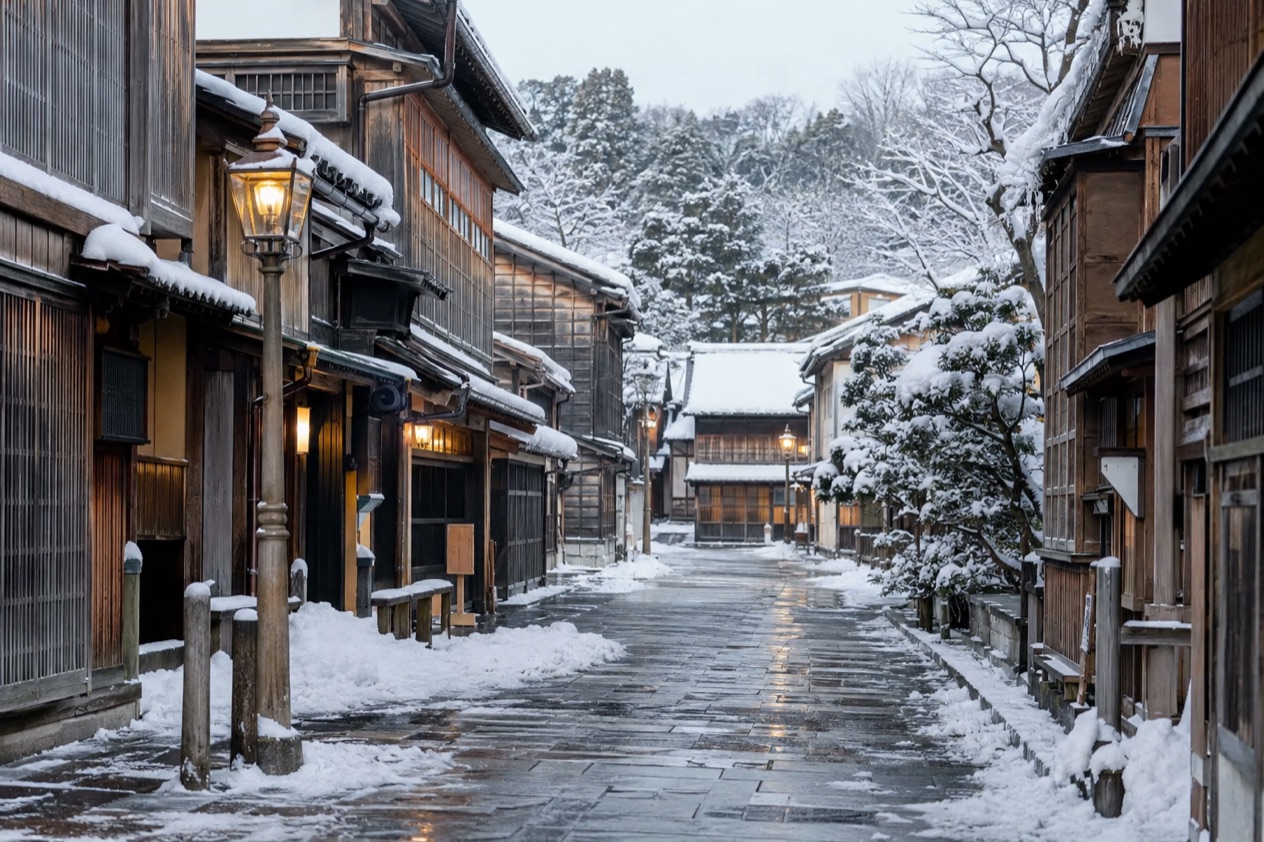
In February, snow settles on the pine boughs of Kenrokuen while ropes fan out from the treetops like the ribs of an umbrella, and the wooden lattice fronts of the old tea-house streets darken in the sleet. Indoors, steaming stews and cups of hot tea fill the afternoons. Kanazawa in February is a winter city on the Sea of Japan, a month for gardens under snow, craft museums, market lunches and the bean-throwing of Setsubun.
What is the weather like in Kanazawa in February?
February in Kanazawa is cold, gray and often wet with snow, though the days are clearly longer and a little brighter than in January.
| Month | Average high (°F) | Average low (°F) | Precipitation (in) | Days with 1 mm or more of precipitation | Hours of sunshine | Daylight on the 15th | Snowfall (in) |
|---|---|---|---|---|---|---|---|
| January | 44.8 | 34.2 | 10.08 | 23.4 | 62 | 9 h 55 min | 26.4 |
| February | 46.0 | 33.8 | 6.40 | 18.6 | 86 | 10 h 50 min | 20.9 |
| March | 52.9 | 38.1 | 6.19 | 15.7 | 145 | 11 h 54 min | 5.1 |
Highs in the mid-40s call for a wool coat, a hat and gloves, and lows just above freezing mean that wet pavements and the stone steps of old districts can turn slick. Humidity stays high, around 70 percent, so the cold feels damp and settles into your sleeves. Layers that you can peel off matter, because tea houses, museums and restaurants are warm inside.
Precipitation here falls largely as snow or sleet, on nearly twenty days of the month, and cold rain fills in between. Kanazawa sits on a narrow strip of land along the Sea of Japan, and that is the side of Honshu where winter arrives gray and wet. An umbrella and waterproof boots are more useful than sunglasses, though the sun does break through for a while on some days and then the snow on rooftops glitters.
The light in February is soft and flat, which flatters gardens, black-tiled roofs and the gold leaf of craft shops. Evenings are dark and cold, a good moment for a bowl of something hot.
What to do in Kanazawa in February
The date that gives the month its character is Setsubun, around the start of February, the eve of the traditional beginning of spring. The main ritual is mamemaki, in which roasted soybeans called fukumame are thrown out the front door, or at someone wearing an oni (demon) mask, with the cry of ‘Oni wa soto!
Fuku wa uchi!’, meaning devils out, fortune in. Afterward people eat the beans, one for each year of their age plus one more for luck in the coming year. Shrines hold their own bean-throwing, and supermarkets and shops fill with bags of beans and paper oni masks.
Plum blossoms in East Asia flower from January until late February, so a branch in bud or in flower is possible in a garden or a shrine courtyard, a pale and scented sign that spring is on its way. Cherry blossoms are still weeks off, so February in Kanazawa is about snow, steam and craftsmanship. Kanazawa is also a member of the UNESCO Creative Cities Network as a City of Crafts and Folk Art, and a winter day spent indoors among lacquer, ceramics and gold leaf suits the month well.
Kenrokuen Garden and Kanazawa Castle Park
Kenrokuen is one of Japan’s most iconic landscape gardens, and winter gives it a look the other seasons do not. The pines are wrapped in rope supports called yukitsuri, which hold their branches up under the weight of wet snow.
Ponds are edged in white, stone lanterns wear caps of snow, and bare branches stand out against a gray sky. Paths can be slick with ice or slush, so waterproof shoes with a good grip matter more than a camera lens.
Kanazawa Castle Park and Kenrokuen are both illuminated at night, as the city’s tourist guide promotes, which gives an evening visit its own mood after the day’s gray light. Free admission is offered to Kenrokuen. A walk here pairs well with a hot drink at a tea house afterward, and a rainy or snowy morning is a fine moment to be among the trees with an umbrella.
| Site | Admission |
|---|---|
| Kenrokuen Garden | Free admission offered |
Higashi Chaya, Nagamachi and the craft museums
Kanazawa was one of the most important cultural and artistic centers of Japan during the Edo period, and the old districts still show it. In the tea-house quarter, Higashi Chaya, wooden lattice facades line the lanes, and in February they glisten with sleet and melting snow. Some of the old houses hold shops selling gold-leaf goods, from small boxes to the gold leaf that tops soft-serve ice cream, a Kanazawa specialty.
Nagamachi, the old samurai district, has earthen walls and narrow lanes that look their best under a dusting of snow. In many parts of Japan, straw mats are laid at the base of earthen walls in winter to protect them from frost and snow, a sight you may see on a cold morning.
Winter food: seafood, stews and oden
Winter is when Kanazawa’s position on the Sea of Japan shows on the plate. Market stalls and sushi counters serve the catch of the cold months, with snow crab (kani) and yellowtail (buri) among the names you may see on menus. Sushi counters in Kanazawa are a pleasure in their own right, and a lunch built around local seafood suits a gray day.
Warmer dishes fit the weather. Oden, a pot of daikon radish, eggs, fish cakes and tofu simmered in a light broth, is a winter staple of izakaya (Japanese pubs), and Kanazawa has its own regional touches.
Jibuni, a stew of duck or chicken with wheat gluten dumplings, belongs to the local Kaga cuisine. Sweets served with matcha at tea houses also suit the season, since the whisked green tea is warming and the sweets are often shaped like winter or early spring motifs such as plum blossoms.
Setsubun week has its own foods in some homes and shops. Eating roasted soybeans is customary, and many shops sell small packets to mark the day. Kanazawa’s calm streets in winter also leave room for a long tea-house stop, with hot tea and a seasonal sweet while the sleet falls on the lattice windows.
A two-day itinerary for Kanazawa in February
Day 1 starts in the market. In the morning, head to the seafood stalls for a hot breakfast or an early lunch of whatever the winter catch offers, since the cold weather is a good reason to eat first and walk later.
Late morning, move to Higashi Chaya and its tea houses, ducking into craft shops whenever the sleet picks up. Save a tea-house stop for midday, where hot tea and a seasonal sweet will warm you up.
In the afternoon, cross to Nagamachi, where the earthen walls and lanes of the samurai district suit the soft winter light. If the sky turns heavy, switch to a craft museum or a gallery and stay inside until the weather eases.
Daylight is still short, so keep the outdoor walking for the middle of the day. In the evening, find an izakaya for oden and a cup of warm sake, a fitting way to end a cold day.
Day 2 belongs to the garden. Start at Kenrokuen to see the pines in their rope supports and the ponds edged in white, taking your time on the slick paths. After that, continue to Kanazawa Castle Park, whose lawns and walls are also lit at night. Between the two, a hot drink in a tea house gives your hands a rest and a reason to stay out longer.
At midday, take lunch at a small restaurant serving Kaga cuisine, such as jibuni or a set meal built on local fish. The afternoon is for the contemporary art museum or a craft workshop, a good plan for a day when the snow keeps coming.
For the evening, return to the castle grounds if the sky has cleared, or settle at a sushi counter for yellowtail and crab. If the weather turns bad at any point, the museums and tea houses of both days make a good indoor reserve.
Is Kanazawa busy in February?
February is a winter month in Kanazawa, with the cherry blossom season still weeks away, so the city keeps a slower, colder pace.
February sits well before that, in the weeks of snow, bare branches and plum buds. The festival that marks the month is Setsubun, a family and neighborhood tradition more than a spectacle, held in homes and at shrines.
The New Year holidays, when many restaurants and attractions close according to the national tourism organization, are already behind you by February. The city is open and running at its winter rhythm. Kenrokuen’s free admission keeps a visit to the garden simple, and its evening illumination is one of the things the city promotes.
The mood in the streets is of people in coats and boots, umbrellas at the ready, ducking into tea houses and noodle shops. Ski areas elsewhere in Japan reach their peak in January and February, but Kanazawa itself is a city of museums, gardens and markets, not a snow-sports base. Its own season in February is one of cold-weather food and indoor crafts, with the garden as the outdoor highlight.
What to pack for Kanazawa in February
Pack for snow, sleet and damp cold, with warmth that you can adjust once you step indoors.
- A warm, water-resistant coat, because snow and sleet are likely on most days.
- Waterproof boots with a grippy sole, for icy paths in Kenrokuen and wet stone in the old districts.
- A hat and gloves for the damp cold of the gardens.
- An umbrella or a hooded waterproof layer for sleet and rain.
- Thin layers underneath, since tea houses, museums and restaurants are warm.
- Socks without holes, as shoes come off at tea houses and many restaurants.
Good to know before you go
Winter weather is the thing that shapes a February visit. Snow and sleet fall on nearly twenty days, and wet pavements can be slick, so allow yourself slower walking and keep museums and tea houses in reserve.
The New Year closures are over by February, and Setsubun arrives at the start of the month. For getting here, the Hokuriku Shinkansen has served Kanazawa since March 14, 2015, and brought the trip from Tokyo to around two and a half hours.
Kanazawa in February vs January and March
Moving the trip four weeks earlier brings you to January, which is wetter and snowier in Kanazawa and has shorter, grayer days. The garden is most wintry then, but the sun is scarce. Waiting until March changes the picture more. Snowfall thins out, sunshine rises sharply and the plum blossoms are mostly done. The cherry blossoms are still some weeks off, with the usual first bloom in early April.
Setsubun belongs to the start of February, so a trip in January or March misses it. The same goes for the particular mood of Kanazawa’s snow gardens, which February keeps in a lighter form than January. Seafood and stews are winter dishes, so they fit all three months, but the hearty food tastes best when the weather is at its coldest.
If you want the deepest winter, with the most snow and the gloomiest light, January is the month. If you would like a little more daylight, a bit less snow and the festival of Setsubun, February is the balance. For milder walks and the first hints of spring, March is the one to pick.
Is February a good time to visit Kanazawa?
Yes, February is a good time for travelers who enjoy winter, indoor crafts and hot food more than blue skies and blossoms.
It suits people who like gardens under snow, long tea-house stops, seafood counters and museums, and who do not mind damp cold. It is a weaker choice for those who want blossoms, long sunny days or time outdoors without a coat. Sunshine is limited, and snow and sleet fall on most days.
On arrival, go to Kenrokuen first, since the garden under snow is the thing the month offers that no other month does. Then let the weather decide the rest, moving between tea houses, craft shops and the market. What stays with you from February in Kanazawa is the sound of Setsubun, the cry of ‘Oni wa soto! Fuku wa uchi!’ and a bowl of oden after a day in the sleet.
Sources
- Japan Meteorological Agency (JMA), Normal values 1991-2020, monthly (https://www.data.jma.go.jp/stats/etrn/view/nml_sfc_ym.php?prec_no=56&block_no=47605), station Kanazawa, elevation 6 m, checked October 11, 2026
- Computed from the date and the latitude of the place (sunrise equation, solar elevation -0.833 degrees), October 11, 2026
- Wikipedia, Setsubun (https://en.wikipedia.org/wiki/Setsubun), checked October 11, 2026
- Japan National Tourism Organization, festivals and events (https://www.japan.travel/en/see-and-do/festivals-and-events/), checked October 11, 2026
- Sapporo Snow Festival official website (https://www.snowfes.com/english/), checked October 11, 2026
- Wikipedia, Sapporo Snow Festival (https://en.wikipedia.org/wiki/Sapporo_Snow_Festival), checked October 11, 2026
- Japan National Tourism Organization, winter in Japan (https://www.japan.travel/en/guide/winter-guide/), checked October 11, 2026
- Japan National Tourism Organization, skiing and snowboarding in Japan: regions, resorts, seasons (https://www.japan.travel/en/sports/snow/), checked October 11, 2026
- Wikipedia, Climate of Japan (https://en.wikipedia.org/wiki/Climate_of_Japan), checked October 11, 2026
- Japan National Tourism Organization, flowers by season: cherry blossom, plum, wisteria, hydrangea, where and when (https://www.japan.travel/en/see-and-do/flowers/), checked October 11, 2026
- Wikipedia, Prunus mume (https://en.wikipedia.org/wiki/Prunus_mume), checked October 11, 2026
- Japan National Tourism Organization, skiing guide (https://www.japan.travel/en/guide/skiing/), checked October 11, 2026
- Wikipedia, List of ski areas and resorts in Japan (https://en.wikipedia.org/wiki/List_of_ski_areas_and_resorts_in_Japan), checked October 11, 2026
- Japan National Tourism Organization, weather and seasons in Japan (https://www.japan.travel/en/plan/weather/), checked October 11, 2026
- Japan Meteorological Agency, cherry blossom first-bloom dates 2021-2026 and 1991-2020 normal (https://www.data.jma.go.jp/sakura/data/sakura003_07.html), checked October 11, 2026
- Japan Meteorological Agency, cherry blossom full-bloom dates 2021-2026 and 1991-2020 normal (https://www.data.jma.go.jp/sakura/data/sakura004_07.html), checked October 11, 2026
- Kanazawa Tourist Information Guide (https://www.kanazawa-tourism.com/), checked October 11, 2026
- Wikipedia, Kanazawa, Ishikawa (https://en.wikipedia.org/wiki/Kanazawa,_Ishikawa), checked October 11, 2026
- Wikivoyage, Kanazawa (https://en.wikivoyage.org/wiki/Kanazawa), checked October 11, 2026
- Japan National Tourism Organization, Kanazawa (https://www.japan.travel/en/destinations/hokuriku-shinetsu/ishikawa/kanazawa-and-around/), checked October 11, 2026
To plan your stay
- Things to Do in Kanazawa: Kenrokuen, Samurai Streets, Gold Leaf and Day Trips
- Where to Stay in Kanazawa: Station Area, Tea House Streets, Downtown and Ryokan Choices
- Kanazawa from Tokyo: Hokuriku Shinkansen, Komatsu Airport and a Day in the Gardens
- Know Before You Go to Kanazawa: Entry, Money, Getting Around and Local Etiquette