
The little Enoden train rattles between houses and then swings out beside the sea, and the people with beach bags sit next to visitors carrying temple guidebooks. Kamakura works that way: a seaside town that was once the seat of a warrior government, with giant bronze and old wooden halls tucked into wooded hills. It suits travelers who like temples, shrines, coastal air and slow wandering.
Where is Kamakura and what is it like?
Kamakura is a city in Kanagawa Prefecture, in the Kanto region on the island of Honshu, with Tokyo and Yokohama as its big-city neighbors. It is a small city of temples, shrines and shops that opens onto the sea, and its character comes from the mix of the two: sacred ground in the hills, a beach town along the shore.
For a stretch of Japanese history, Kamakura was the political capital. From 1185 to 1333 it was the seat of the Kamakura shogunate, founded by Minamoto no Yoritomo, and the warrior culture of those years still shapes how the town presents itself. The city was designated as a city in 1939, and the old buildings, statues and shrines that visitors come for are scattered among ordinary neighborhoods where people live, shop and commute.
The pace is slower than in the capital, and the scale is human. You walk under tall trees to a temple gate, pass a small bakery or a stall selling grilled rice crackers, climb a flight of stone steps and find a hall with incense drifting out of it. Then you head back down to a street where surfers carry boards past a shrine lantern.
Kamakura rewards people who like to wander with no tight schedule and who enjoy a little history with their scenery. The pleasure is in the layering: a Buddhist temple here, a Shinto shrine there, a bakery, a café and a sea breeze in between.
Next to the city lies Enoshima, a small island with some of the closest sandy beaches to Tokyo and Yokohama. Together the two places give a trip two moods, the contemplative one of the temples and the loose, holiday one of the shore.
What is there to do in Kamakura?
Kamakura gives you temples and shrines first, then the coast, then food and small shops. What sets it apart from its big neighbors is that all of this sits within one compact-feeling mix of hills and shoreline, so a single day can go from a sacred hall to a beach town without a change of region.
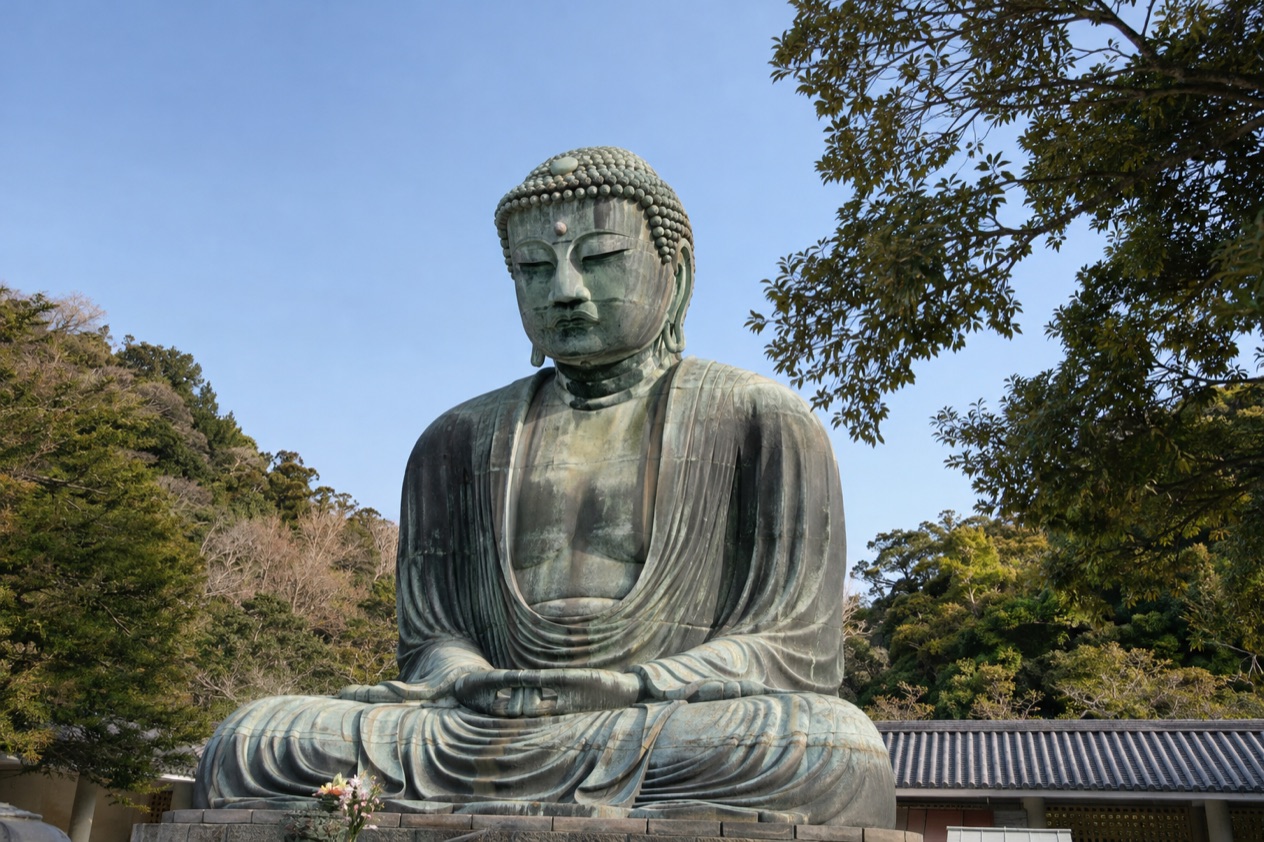
The Great Buddha at Kotoku-in
The figure sits in the open air, a seated bronze with half-closed eyes and a calm, centered face that photographs show only partly. In person, what strikes you is the scale against the trees and sky behind it.
Visitors pause at the gate, walk the grounds in a loop and look at the statue from several angles, then step to the side to see how it sits against the hills. It suits anyone with an interest in Buddhist art, in sculpture, or simply in standing before something made with great patience. Hours and admission are not given here, so look them up when you plan your day.
Hase-dera, the temple of Hase-kannon
Hase-dera, also called Hase-kannon, is a Buddhist temple of the Jodo-shu sect, set on a hillside in Kamakura. Temples of this kind are built in tiers: you climb past small statues, stone lanterns and gardens, and the view opens out as you rise. Hall interiors are dim and fragrant with incense, and the outdoor spaces are planted with seasonal flowers that change the look of the grounds through the year.
Because the temple is built on the slope, it asks you to go slowly and look at details: carved wood, rows of small figures, moss on stone. It pairs naturally with the Great Buddha in a single outing, since the two sit within the same part of the city, and it suits travelers who like gardens as much as architecture.
Tsurugaoka Hachimangu
Tsurugaoka Hachimangu is the most important Shinto shrine in Kamakura, and it anchors the old warrior city. You approach it along a broad tree-lined path, pass beneath torii gates, cross a bridge over a pond and climb steps to the main hall. The mood shifts from street to sanctuary in a few minutes, and the shrine’s rhythm of ritual gives the walk a sense of direction.
Shrines of this type are living places. You may see families bringing children for blessings, couples in formal dress, people bowing before the hall and clapping their hands as they pray. Watching these small rituals is part of the visit, and doing it quietly and from a respectful distance fits the setting well.
Enoshima and the shore
Enoshima is the seaside side of the trip. Its beaches are among the closest sandy beaches to Tokyo and Yokohama, which gives the island the feel of a city escape. Beyond the sand there are paths around the island, small shops, seafood stalls and the kind of shoreline food that goes with salty air.
The Enoden line links the area to Kamakura, so the coast can be added to a temple day or kept for a day of its own. It suits anyone who wants a break from history, a bit of seaside fun, or a different light on the same trip.
Streets, snacks and small shops
Between the big sights, Kamakura’s lanes are full of small pleasures: sweet shops, tea rooms, bakeries, and stalls grilling rice crackers and dumplings. Seafood from the nearby coast turns up on menus, often as a bowl of rice topped with tiny whitebait, a local specialty known as shirasu-don. Souvenir shops sell sweets, crafts and small gifts that make good reminders of the day.
A break at a tea house, with a bowl of matcha and a seasonal sweet, is a good way to let the temple visits settle. It also gives you a reason to sit and watch the street, which is much of what the town offers.
How many days do you need in Kamakura?
Travelers see Kamakura as a day out from Tokyo, and that is enough to see the Great Buddha, Hase-dera and Tsurugaoka Hachimangu if you set out early and keep a steady rhythm. It will feel like a brisk tour rather than a stay, but you will leave with the essentials.
With a day and a half, the pace relaxes. You can spend one stretch with the temples and the shrine, another with the shore, and still have time for a long lunch and a slow walk through the lanes. The Enoden train itself becomes part of the experience when you are not hurrying, because it passes the sea and goes through narrow streets in a way that suits a gentle afternoon.
With two or three days, you can add the smaller temples and shrines tucked into the hills and give Enoshima its own time. Beach hours, a seafood meal on the island and an evening by the water balance the cultural days. Staying overnight also means seeing the town after the day trippers have gone home, when streets are calmer and the light on the water changes.
For a longer trip, Kamakura fits well as one stop in a wider route through Kanagawa and the Kanto region. Yokohama is a natural pairing for a city day with a harbor feel, and Tokyo sits at the other end of the same rail corridor. Pairing a temple town with big-city energy gives a trip two very different faces.
Where to stay in Kamakura
The main choice is between sleeping in Kamakura itself, sleeping by the shore around Enoshima, or staying in Tokyo or Yokohama and visiting for the day. Each suits a different kind of trip, and the right one depends on how much of the town’s atmosphere you want after the sights close.
Staying in Kamakura puts you close to the temples and the shrine, which means you can start your day in the quiet before the paths fill and end it with dinner nearby.
The Enoshima side suits people who want a beach holiday feel, with sea air, island paths and seafood close at hand. It works well for travelers who want the coast as the center of the trip and the temples as an excursion, rather than the other way around.
Basing yourself in Tokyo or Yokohama and visiting Kamakura on a day out keeps you near big-city dining, nightlife and transport links. The route runs by rail, and the Odakyu and Enoden option from Shinjuku is one way to do it. That choice suits anyone who is combining Kamakura with a longer city stay and does not want to move luggage between hotels.
Whichever area you pick, think about the kind of evening you want. A night in the town means dinner among the lanes and a quiet morning at the temples, while a night in a big city means more choice and less of the local mood. Both are good, and both are very different.
How do you get to Kamakura and get around?
From Shinjuku in Tokyo, one way in is to take the private Odakyu line to Fujisawa and change there onto the Enoden line to Kamakura, a trip of about 90 minutes. The Enoden is the small, charming train that links the towns of this coast, and riding it is part of the pleasure of arriving.
A pass exists for this route. The Enoshima-Kamakura Free Pass offers a roundtrip from Shinjuku and unlimited use of the Enoden line for one day, but it does not include fares on local buses. That detail matters if you plan to use buses to reach temples away from the rail line, because those rides are paid separately.
Once in town, much of the sightseeing is done on foot, moving between temples, the shrine and the shopping lanes. The Enoden carries you along the coast and to Enoshima, and local buses link places that sit apart from the tracks. Taxis are another option for reaching a hillside temple, though routes, fares and timings are not given here.
Think of the day as a loop. You arrive by train, go out to the Great Buddha and Hase-dera, return toward the shrine and the lanes, and finish with the coast or a final tea. Keeping that loop in mind helps you avoid backtracking, and it lets the town reveal itself in a natural order.
When is the best time to visit Kamakura?
Kamakura is a town of temple gardens and seashore, so the seasons shape what you see more than any single date. Spring and autumn are the times when the gardens around the temples are most talked about, with blossoms and turning leaves framing the old halls. Those are the stretches travelers aim for, and the town is likely to draw more visitors then.
Summer turns attention to the shore. Enoshima and its beaches become the center of the trip, and the temples work best as shorter visits between swims and seaside meals. Early summer brings a rainy spell, when temple gardens with hydrangeas are a favorite for photographers, and a damp, green light settles on the stone and moss.
Winter is quieter in mood, with cool air that suits long walks and the clear light that sometimes makes the hills look sharp. New Year is a time when Japanese families visit shrines for their first prayers of the year, and Tsurugaoka Hachimangu is among the places where that tradition is observed, so the grounds can feel busy then.
Weekends and holiday periods tend to bring more people to any popular temple town, so a weekday visit gives you a different feel from a Saturday.
Good to know before you go
Temple and shrine visits come with small habits that make the day smoother: shoes come off before stepping into certain halls, voices drop near places of worship, and photography is sometimes limited inside buildings, so watch for signs. Carry some cash and a light bag for the stairs and slopes, and wear shoes you are happy to take on and off.
Rain can arrive in the wetter part of the year and a typhoon can sometimes affect travel on the coast, so keep your plans flexible and let the weather decide whether the day leans toward temples or toward a café. The shoreline and the hills are both part of the town, and a change of plan rarely costs you the visit.
Sources
- Wikipedia, Kamakura (https://en.wikipedia.org/wiki/Kamakura), checked October 11, 2026
- Wikivoyage, Kamakura (https://en.wikivoyage.org/wiki/Kamakura), checked October 11, 2026
- Wikipedia, Kōtoku-in (https://en.wikipedia.org/wiki/K%C5%8Dtoku-in), checked October 11, 2026
- Wikipedia, Enoshima (https://en.wikipedia.org/wiki/Enoshima), checked October 11, 2026
- Wikipedia, Hase-dera (Kamakura) (https://en.wikipedia.org/wiki/Hase-dera_(Kamakura)), checked October 11, 2026
- Wikipedia, Tsurugaoka Hachiman-gū (https://en.wikipedia.org/wiki/Tsurugaoka_Hachiman-g%C5%AB), checked October 11, 2026
All our pages
Things to do
- Things to Do in Kamakura: The Great Buddha, Hase-dera, Hill Trails and Shirasu Seafood
- Kamakura Great Buddha: The Bronze Statue, Its Hollow Interior, Getting There and When to Go