
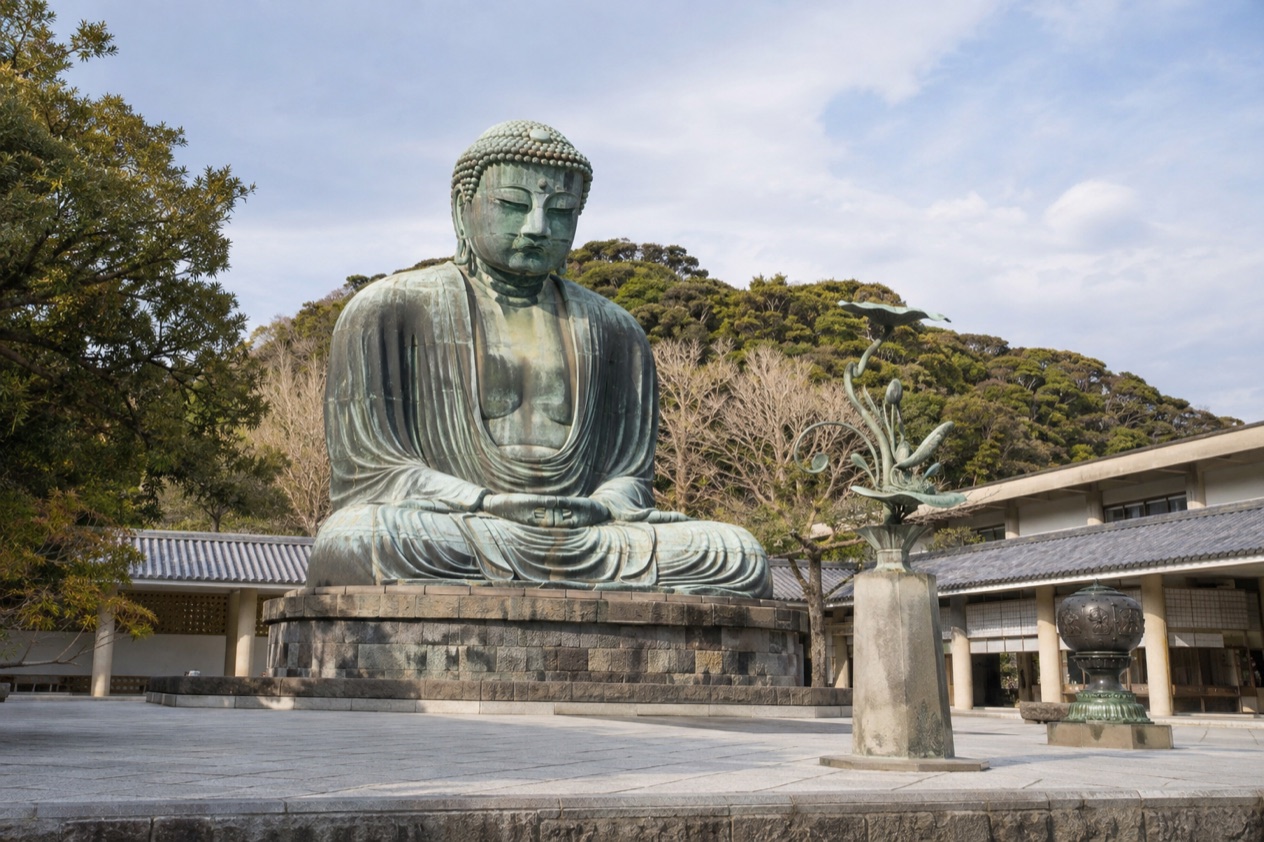
You pass through the temple gate and there he is, a vast bronze figure seated in the open air, with the sky as his only roof and the hills of Kamakura behind him. The metal has darkened over the centuries to a soft green-brown, and the half-closed eyes seem to look just past you. This is the Great Buddha of Kamakura at Kotoku-in, and the visit is a contemplative stop in a seaside temple town, one that suits anyone curious about Japan’s Buddhist heritage.
Is visiting the Great Buddha of Kamakura worth it?
Yes, for anyone who wants to stand in front of one of the great Buddhist statues of Japan and who likes a sight that is as much about presence as about detail. The Great Buddha is a monumental outdoor bronze figure of Amitabha, a National Treasure of Japan and described as one of the most famous icons of the country. If you have seen it only in photographs, the real thing has a weight that pictures do not carry.
It also suits travelers who like their sightseeing to have a clear center. There is one great statue, one temple precinct and a visit built around looking, walking around the figure and, if you wish, stepping inside it. Photographers, history lovers, families curious about how a giant bronze is built, and people interested in Pure Land Buddhism all find a reason to come.
What sets it apart from the other temples and shrines of the area is that the Buddha sits outdoors, with no hall around him. At many Japanese temples the main image is kept in a dim interior and glimpsed through an opening. Here the figure is lit by whatever the day brings, whether bright sun, thin cloud or rain running down the bronze, and you can walk around it, look at it from the side and see the folds of the robe from several angles.
The second difference is that you can enter the hollow interior of the statue. That turns a sight you look at into one you step into, and it makes the Great Buddha a very different stop from a temple where the main image stays out of reach. Kamakura itself adds to the interest, since it was the political capital of Japan during the Kamakura shogunate, and a visit here puts a face on that chapter of history.
Kotoku-in is a Buddhist temple of the Jodo-shu sect, a school devoted to Amitabha, the Buddha of the Pure Land. Knowing that changes how the statue reads.
This is not a portrait of a historical teacher but an image meant to inspire devotion, and the calm of the face, the hands resting in the lap and the steady seated pose all come from that purpose. Even for a visitor with no religious background, understanding it makes the figure more than a large piece of metal.
What to see at the Great Buddha of Kamakura
The bronze figure itself
The statue is a seated Amitabha in bronze, and the first thing to do is simply stand back and take in its size. Including its base, it is among the largest bronze statues you will see in Japan, and the table in the story section below gives the exact figures. The head has the small tight curls of hair typical of Buddhist images, the eyes are lowered, and the shoulders sweep into a robe that falls in broad folds over the knees.
Walk slowly around it. From the front the face has a composed, inward look, while from the side you notice how the head leans forward very slightly, which is why the figure seems to regard you rather than the horizon. The bronze surface shows its age in streaks and patches of green and brown, and up close you can pick out the seams where the casting was joined.
Look for the hands too. They rest in the lap with the fingers arranged in a meditative gesture, and the contrast between this stillness and the sheer mass of metal is the heart of the sight. Because it stands in the open, the Buddha looks different in sun, cloud and light rain, so a gray day is not a wasted one.
Stepping inside the statue
Visitors to Kotoku-in can enter the hollow interior of the Great Buddha, and it is the detail that travelers remember. Inside, the bronze shell closes around you like the inside of an enormous bell. You see the underside of the casting, the way the metal was built up in sections, and the dark ceiling of the head far above.
It is also a reminder that a statue like this is a piece of engineering as well as an object of worship. The walls carry marks of the casting, and visitors over the years have left graffiti scratched into the surface, a human layer added to the metal that is part of the story of the place, even if not a flattering one. Treat the interior as a curiosity and a way to understand the structure, rather than a place to linger for photographs.
The temple grounds and the entrance
Kotoku-in sits on Hase, in the city of Kamakura in Kanagawa Prefecture, and the approach to the grounds sets the tone for the visit. A notice at the entrance asks all visitors, whatever their creed, to enter with reverence. It is a simple request, and a fair summary of how to behave here: quiet voices, no climbing on the base and attention to the fact that people are also praying.
Inside the precinct, the grounds are laid out so that the statue is the obvious focus, with space around it for visitors to gather and for the photographs that everyone takes. Notice the incense and the small offerings that devout visitors bring, which are a useful reminder that for people this is a place of worship before it is a sight.
From wooden Buddha to bronze: the story
The bronze figure had a predecessor. A giant wooden Buddha was completed at the site before the present statue, and the bronze followed it. According to temple records, the Great Buddha dates from around the middle of the thirteenth century, in the Kamakura period, when the city was the seat of the shogunate and a center of new religious energy.
| Detail | Figure |
|---|---|
| Height including base (meters) | 13.35 |
| Weight (tonnes) | About 93 |
| Date of the bronze statue, per temple records | Around 1252 |
| Earlier wooden Buddha completed | 1243 |
| Kamakura shogunate, when the city was the political capital | 1185 to 1333 |
When to visit the Great Buddha of Kamakura
The Great Buddha can be seen in any season, because it stands outdoors and the visit is built around the statue rather than a bloom or a festival. What changes is the light and the mood.
A visit on a bright day gives clear detail on the face and robe, a gray day softens the bronze, and light rain makes the metal darker and glossier. None of these is a bad time, so the choice depends more on what else you want from the day than on the statue.
One date-related detail is worth planning around. The Great Buddha is usually illuminated at night in summer, which gives the statue a very different look from the daytime one, with the bronze standing out against a dark sky. Because the lighting is usual rather than guaranteed, treat it as a possibility when you plan a summer visit and not as a promise.
Since the statue is in the open air, you are exposed to the weather, so match your day to the forecast. On a hot day, you will feel the sun on the open ground around the figure, and in the rain you will want a waterproof layer, since there is no hall to shelter in. The interior of the statue is a useful change of scene if you want a break from the open space.
Kamakura is also a city of many temples and walks, so travelers fit the Great Buddha into a longer day. Think about the whole itinerary when you choose a season. Spring and autumn invite longer walks between sights, summer brings the evening lighting, and the cooler months suit a slower visit with warm layers. The statue is the same in each, but what surrounds it changes with the weather and the calendar.
If you are building a trip around Kamakura’s history, remember that the city was the political capital of Japan during the Kamakura shogunate. The best moment to visit is whenever you can give the statue unhurried attention, with enough time to walk around it, step inside and sit with the view before moving on to the next stop.
Tips for your visit
Dress for the weather and for a temple. Comfortable shoes suit a day of walking in Kamakura, and a hat, sunglasses or a light rain jacket makes sense because the statue stands in the open. Behave as you would at any active Buddhist temple, with a respectful tone, since the notice at the entrance asks every visitor to enter with reverence.
Kamakura is a city in Kanagawa Prefecture on the island of Honshu, and getting there from Tokyo is part of the plan. From Shinjuku, one option is to take the private Odakyu line to Fujisawa and then change to the Enoden line to Kamakura, a journey of about 90 minutes. The Enoshima-Kamakura Free Pass offers a roundtrip from Shinjuku and unlimited use of the Enoden line for one day, though it does not include fares on local buses.
Pair it with other temples and shrines in the city, and with time just walking the streets of this old shogunate capital. A relaxed rhythm suits the place better than trying to see everything.
What to combine with the Great Buddha
Because Kamakura was the seat of the shogunate, the city holds many other temples and shrines, and the Great Buddha makes a natural centerpiece for a day of exploring them. Add a stroll through the streets of Kamakura, a lunch of local specialties and a view of the water if the day allows. You can also use the Enoden line, which the Free Pass covers, to see more of the area.
If you are traveling from Tokyo, think of Kamakura as a full outing with the statue as its main stop. That keeps the pace unhurried and leaves room to sit, look and let the place settle in, which is exactly what the figure invites.
Families and mobility
Children are often drawn to the idea of going inside a giant statue, and the hollow interior gives them something to look at and ask about. Explain beforehand that this is a place of worship, so that the quiet and respect the entrance notice asks for come naturally. The open grounds give younger travelers room to look at the figure from different angles.
For anyone with limited mobility, the temple’s layout, steps and surfaces are things to confirm before you go, since the details are not set out here. Consider how much walking your day in Kamakura will involve as a whole, and plan the sights around your own pace.
Good to know before you go
Kotoku-in is an active Buddhist temple at 4 Chome-2-28 Hase in Kamakura, so keep your voice low and your manner respectful, and remember the request on the notice at the gate. Carry some yen, since small purchases at temples and in town are often made that way, and dress for the weather because you will spend your time outdoors. Late summer and autumn bring Japan’s typhoon season, and a wet, windy day will change what the visit feels like, so keep your plans flexible.
Sources
- Wikipedia, Kōtoku-in (https://en.wikipedia.org/wiki/K%C5%8Dtoku-in), checked October 11, 2026
- Wikipedia, Kamakura (https://en.wikipedia.org/wiki/Kamakura), checked October 11, 2026
- Wikivoyage, Kamakura (https://en.wikivoyage.org/wiki/Kamakura), checked October 11, 2026