
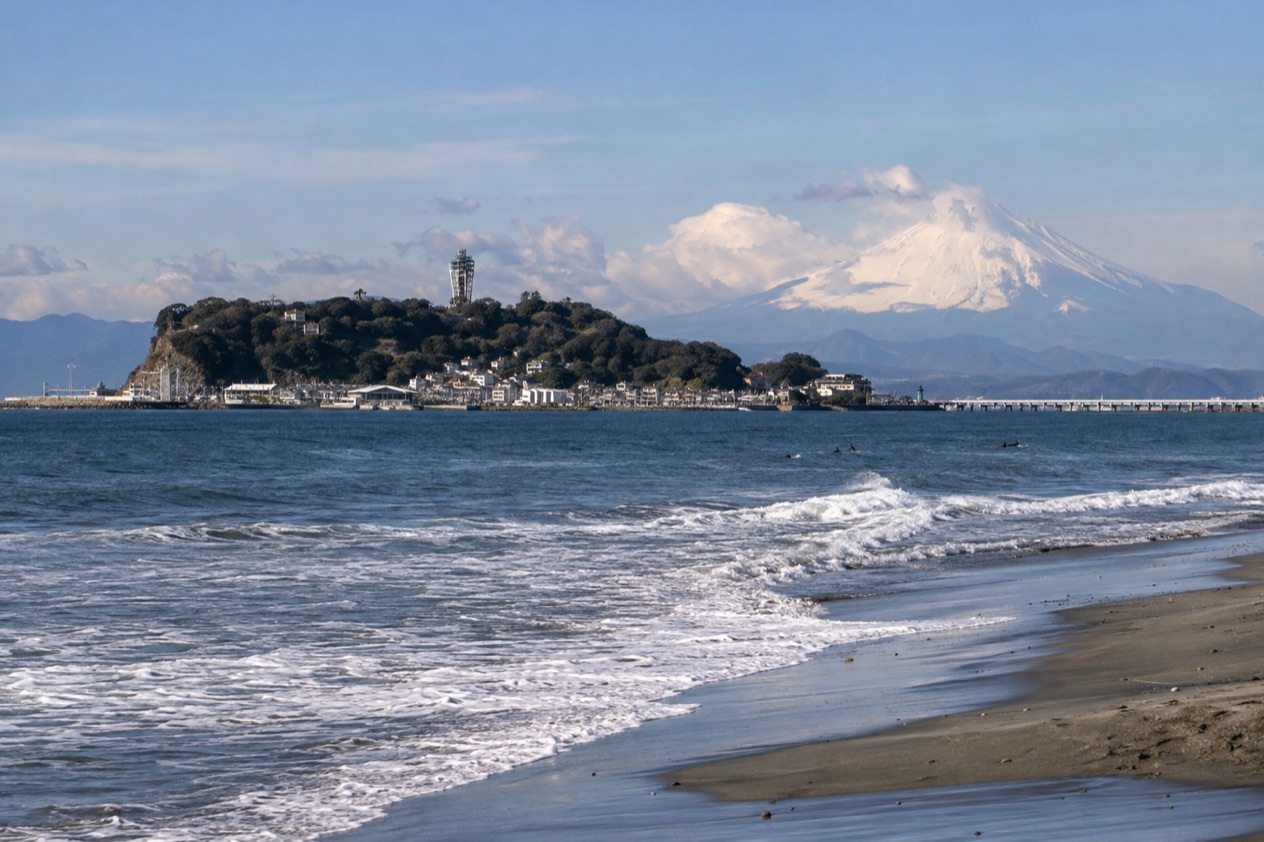
You cross the bridge to Enoshima with the town’s shop fronts ahead of you, the smell of grilled seafood drifting out of doorways and the island rising green behind the roofs. Gulls turn over the water, and a shrine gate waits at the foot of the climb. Enoshima is a small island off the Kanagawa coast, and a visit to it combines a goddess’s shrine, caves, a garden and sandy beaches near Tokyo and Yokohama.
Is visiting Enoshima worth it?
Yes, for travelers who like their sightseeing to have a mix of shrine, garden, cave and shoreline in one outing, and who would rather wander than tick off a single monument. It suits people staying in Tokyo or Yokohama who want a coastal change of pace, and it pairs well with a day in nearby Kamakura.
What sets Enoshima apart from other seaside outings is that the whole island is a sacred place. It is dedicated to Benzaiten, the goddess of music and entertainment, Enoshima Shrine’s buildings and the island’s dedication to Benzaiten give the visit a strong religious thread.
The beaches nearby are among the sandy stretches closest to Tokyo and Yokohama, which gives the day a lighter, holiday-by-the-sea side that the temples of Kamakura do not have. Add a winter light show and a set of illuminated escalators, and the island has a reason to be visited in more than one season.
It also helps to know the limits. The bridge and the town area are wheelchair accessible, but the climb beyond the shrine’s main gate is a different matter, and that shapes who can see what.
What to see at Enoshima
The island works as a sequence: the bridge and town at the bottom, the shrine buildings on the way up, the garden and its views at the summit, and the caves on the far side. Each part has its own character, and together they fill a day without feeling like a checklist.
Enoshima Shrine and the island of Benzaiten
Enoshima Shrine is dedicated to Benzaiten, the goddess of music and entertainment, and the entire island is dedicated to her. She is often pictured with a biwa, the Japanese lute, and her name turns up on the island in carvings, charms and the names of shops. Local legend ties the island’s origin to a dragon that terrorized the coast until the goddess descended and won it over, which is why dragons appear in the shrine imagery as well.
Look for the way the shrine is spread out rather than gathered in one compound, with separate halls along the route up the island. Musicians, students and performers come to ask for her blessing, so you may see small votive tablets with wishes tied to their themes. Anything past the shrine’s main gate is not wheelchair accessible, which includes the observation tower and the caves.
Samuel Cocking Garden and the Luminous Way
At the island’s summit sits Samuel Cocking Garden, a botanical garden named for the British merchant who once built a garden here. It draws over half a million visitors a year. Paths wind among plantings and open onto views over the water, and at the top you also reach the observation tower, which is part of the stretch that is inaccessible to visitors with mobility difficulties.
Getting there does not require climbing every step. The Luminous Way is a set of three illuminated escalators that carry visitors from the base of Enoshima Shrine up to the garden, bypassing the stairs, and fees are required. It is a pleasant way to see the island lit up, and the escalators are part of the island’s look after dark when the winter lights are on.
Iwaya Caves
The Iwaya Caves are the part of the visit that feels most like an expedition. The First Cave is 502 feet long. The Second Cave is 184 feet long. Both can be entered by purchasing a ticket, and walking through them you move from daylight into cool, dim passages cut by the sea into the rock.
The caves have long been linked to the island’s devotion to Benzaiten, and they feel like a quieter chapter of the shrine’s story after the stairs, gardens and views above. Like the observation tower, they are in the area that is inaccessible to those with mobility difficulties, so plan around that if anyone in your group needs level ground.
The beaches and the town at the bridge
Back at the water, Enoshima has some of the closest sandy beaches to Tokyo and Yokohama, and they are a reason people come at all. The town at the foot of the bridge is where you eat. Shirasu, the tiny whitebait of this coast, turns up over rice in bowls, and shops sell tako-senbei, crisp crackers pressed from whole octopus, along with skewers and sweets for eating as you walk.
The bridge and the town area are wheelchair accessible, so this is the part of the island that works for everyone. Take your time on the lanes, because the shops, the grilled smells and the sea views make this side of the island a pleasure on its own.
Hours, tickets and rules
The caves require a ticket, the garden requires admission, the escalators charge a fee, and the winter light show is free to watch. Opening hours are set by each site.
Admission to Samuel Cocking Garden is required even during the Enoshima Illuminations, which means the show is free to enjoy but the garden within it is not. The Luminous Way charges fees for the escalator ride. The area beyond the main gate of the shrine, including the observation tower and the caves, is inaccessible to visitors with mobility difficulties, while the bridge and town area are wheelchair accessible.
How to get to Enoshima
Enoshima is reached by rail, and three separate stations serve it, each on a different line. Katase-Enoshima is on the Odakyu Enoshima Line. Enoshima Station is on the Enoshima Electric Railway, known as the Enoden. Shonan-Enoshima Station is on the Shonan Monorail. Which one suits you depends on the line you are coming from.
By Odakyu, Enoden or monorail
The Odakyu Enoshima Line brings you to Katase-Enoshima, the Enoden to Enoshima Station and the Shonan Monorail to Shonan-Enoshima. The Enoden is the little railway that also runs to Kamakura, and the monorail is the one that hangs from its track above the streets. Choose among the three stations according to the line you are traveling on.
That journey ends in Kamakura rather than at Enoshima, but it shows how the Odakyu and Enoden lines connect, and Enoshima Station is also on the Enoden.
The Enoshima-Kamakura Free Pass
The Enoshima-Kamakura Free Pass offers a roundtrip from Shinjuku and unlimited use of the Enoden line for one day. It does not include fares on local buses. For a day that links the island with Kamakura, the Enoden portion is what the pass covers on the coast.
Kamakura is a city in Kanagawa Prefecture, in the Kanto region on the island of Honshu. It was the political capital of Japan during the Kamakura shogunate, from 1185 to 1333, which is why the two places are so often paired in a single trip.
When to visit Enoshima
The one dated event on the island is the Enoshima Illuminations, a large-scale light show that runs from December through the end of February. It is free to watch, though admission to Samuel Cocking Garden is required, and it gives the island a reason to be visited in the dark months when many beach towns are at rest.
The light show also changes the character of the climb. The Luminous Way escalators, lit as they carry visitors from the base of the shrine to the garden, are part of the island’s winter look, so a visit in these months can combine the shrine, the garden and the illuminations in one outing. The garden’s own plantings and the sea views from the summit are there whatever the month.
Outside the winter lights, the island is a place for the beaches, the shrine, the caves and the town’s food stalls. The sandy beaches close to Tokyo and Yokohama are the draw for a seaside day, and the shrine and garden give the visit a cultural side in any month. Match the season to what you want from the island: lights and a cool-weather walk in winter, a coastal day in the warmer part of the year.
Tips for your visit
Think of Enoshima as a place where the route matters as much as the sights. Wear shoes you are happy to walk in, since the shrine buildings, the garden and the caves are spread along the island and a good part of the day is spent on foot. The Luminous Way escalators can carry you from the shrine’s base up to the garden if you prefer to bypass the stairs.
Plan to let the day unfold in order. Start in the town beside the bridge for a bowl of shirasu or a cracker, climb through the shrine, reach the garden at the summit, then go on to the Iwaya Caves, where the First Cave stretches 502 feet. Finish back among the shops and the beach, where you can sit and watch the water.
For families and anyone with mobility needs, the split on the island is clear. The bridge and the town area are wheelchair accessible, while anything past the main gate of the shrine, including the observation tower and the caves, is not. A group with mixed mobility needs can spend time in the wheelchair-accessible bridge and town area while others continue beyond the shrine’s main gate.
Enoshima combines well with Kamakura, and the Enoden line links the two. Local buses are not included in that pass.
Good to know before you go
Several of the island’s attractions charge separately, so expect to pay at the caves, the garden and the Luminous Way escalators rather than once at the gate. The light show itself costs nothing to watch.
Take the bridge and the shrine stairs at your own pace, and let the island’s sense of being a place devoted to a goddess of music set the mood for the day. The Free Pass does not cover local buses.
Sources
- Wikipedia, Enoshima (https://en.wikipedia.org/wiki/Enoshima), checked October 11, 2026
- Wikipedia, Kamakura (https://en.wikipedia.org/wiki/Kamakura), checked October 11, 2026
- Wikivoyage, Kamakura (https://en.wikivoyage.org/wiki/Kamakura), checked October 11, 2026
To plan your stay
- Best Time to Visit Japan: Cherry Blossoms, Autumn Colors, Weather and Festivals
- Where to Stay in Japan: Ryokan, Temple Stays, Capsule Hotels and the Best Cities to Base In
- Sending Luggage from the Airport in Japan: Hands-Free Travel, Hotel Delivery and Coin Lockers
- Know Before You Go to Japan: Entry, Money, Etiquette and Getting Around