
ÉVORA · WHEN TO GO · 247.6 M ABOVE SEA LEVEL
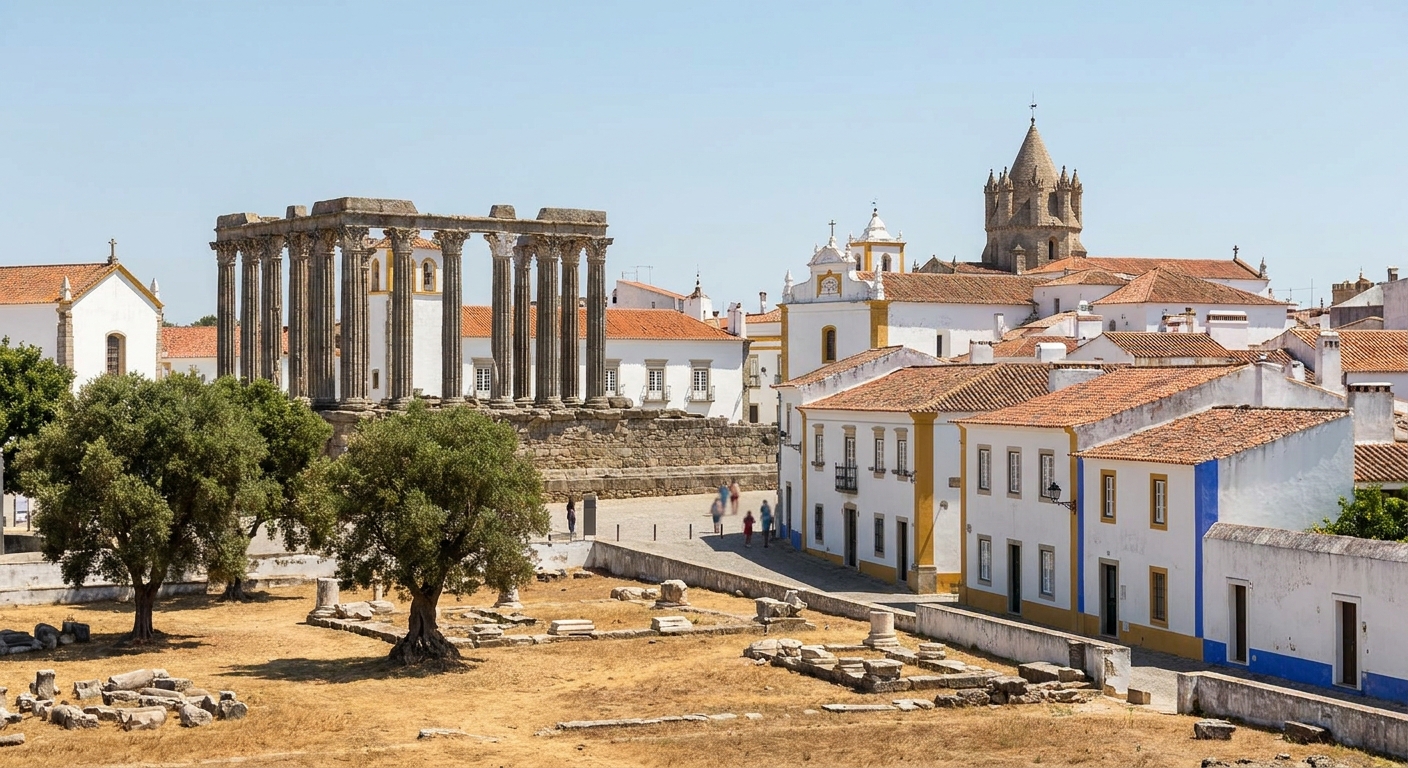
Évora sits inland, up on a low rise in the Alentejo wheat country, and it runs on an inland calendar. The old town is walled granite and whitewash: a Roman temple, an aqueduct that walks straight into people’s houses, a chapel lined with bones. None of it has an ocean breeze behind it. The town’s own thermometer, 247.6 m above sea level, averages 92.3°F in August and 57.4°F in January.
The short answer is May, and the figures back it: 77.0°F afternoons, 6.0 days of rain, daylight running to 14 hours 20 minutes by mid-month. April is cooler and wetter. June has already climbed above 86°F. Everything after that is a question of what you are willing to trade, and how much of the plain you plan to walk at midday.
THE YEAR AT A GLANCE · ÉVORA
May is the answer for most travelers: 77.0°F afternoons, 6.0 rain days and 14 hours 20 minutes of daylight, taken before the Alentejo heat arrives.
BEST: MAY · SHOULDER: APRIL, SEPTEMBER, OCTOBER · HOTTEST: AUGUST AT 92.3°F
Go for: a walled town you cross on foot in an afternoon, spring plains between April and May, and long evenings that hold past 8 p.m. from May through August.
Think twice before: booking July or August around midday walking: highs average 91.9°F and 92.3°F, with 0.6 and 0.7 rain days to break the run.
Normals: IPMA station 558, 1991-2020 · Daylight: sunrise-sunset.org · full sources at the end
On this page
- The best month to visit ÉvoraMay: 77.0°F and 6.0 rain days
- Évora weather month by monthThe twelve-month table, with daylight
- Swimming near ÉvoraNo coast at 247.6 m: what the water tables measure
- The quietest months in ÉvoraDecember to February, 9h49 of light in January
- The month to avoid in ÉvoraAugust, at 92.3°F
- Évora in April, May, September or OctoberThe shoulder gap to August, in degrees
Two things separate Évora from the coastal month tables Americans usually land on. The rain arrives compressed into autumn and winter, 3.39 inches in November against 0.11 inches in July. And the daylight swing is wide: 9 hours 32 minutes on December 15, 14 hours 54 minutes on June 15. A town of white lime and granite reads very differently under each.
Évora weather month by month: highs, lows, rain days and daylight
| Month | Avg high | Avg low | Rain | Days ≥1 mm | Days ≥10 mm | Daylight (15th) |
|---|---|---|---|---|---|---|
| January | 57.4°F | 40.1°F | 2.70 in | 8.6 | 2.4 | 9h49 |
| February | 60.3°F | 41.0°F | 2.06 in | 7.0 | 1.7 | 10h49 |
| March | 65.7°F | 44.4°F | 2.39 in | 7.5 | 2.0 | 12h00 |
| April | 69.3°F | 47.3°F | 2.44 in | 8.0 | 1.9 | 13h17 |
| May | 77.0°F | 51.6°F | 1.83 in | 6.0 | 1.4 | 14h20 |
| June | 86.4°F | 56.8°F | 0.42 in | 1.7 | 0.3 | 14h54 |
| July | 91.9°F | 60.1°F | 0.11 in | 0.6 | 0.1 | 14h38 |
| August | 92.3°F | 60.8°F | 0.24 in | 0.7 | 0.2 | 13h42 |
| September | 85.1°F | 58.3°F | 1.33 in | 3.6 | 1.1 | 12h29 |
| October | 75.4°F | 54.1°F | 3.21 in | 7.7 | 2.8 | 11h15 |
| November | 63.7°F | 46.2°F | 3.39 in | 8.8 | 3.1 | 10h07 |
| December | 58.3°F | 41.5°F | 3.35 in | 8.7 | 3.2 | 9h32 |
The year has one long dry season and one compressed wet one. May through September add up to 3.93 inches of rain between them, barely more than November delivers on its own at 3.39. Temperature follows the same curve, 57.4°F in January to 92.3°F in August, a spread of 34.9 degrees.
Two hinges do the work. Between May and June the rain effectively stops: 6.0 days at 1 mm or more drop to 1.7, and the average high jumps 9.4 degrees, from 77.0°F to 86.4°F. Between September and October it comes back just as fast, highs falling 9.7 degrees to 75.4°F and the monthly total going from 1.33 inches to 3.21. Neither direction is gradual.
August is the hardest month of the year, and it is hardest for a specific traveler: anyone who wants to be on foot in the old town between noon and five. Average highs reach 92.3°F, the top figure of the year by 0.4 degrees over July, and rain falls on 0.7 days. Families with small children and anyone whose room lacks air conditioning feel it first.
The figures come from one instrument. IPMA, the Portuguese weather service, publishes 1991-2020 normals for station 558, in Évora itself at 247.6 m: a real thermometer, not a model grid cell. It describes this town. The Alentejo coast to the west reads differently, and so does higher ground. The rain-day counts also use Portuguese thresholds, 1 mm (0.04 inch) and 10 mm (0.39 inch), which are not the 0.10-inch counts American tables print.
When is the best time to visit Évora?
Go in May. Average highs of 77.0°F let you cross the main square at two in the afternoon without planning around it, nights hold at 51.6°F, and the month records 6.0 days with at least 1 mm of rain and 1.4 with 10 mm or more. On May 15 the sun is up at 6:17 a.m. and down at 8:38 p.m. local, 14 hours 20 minutes of light. That reaches the megalithic circles out on the plain after an unhurried lunch.
June is drier, and that cuts both ways: highs average 86.4°F, 9.4 degrees above May, and its 1.7 rain days come with sun that has nowhere to hide on open ground. April keeps the gentler end of spring but pays 8.0 rain days and 2.44 inches for it, two more wet days than May, at a high of 69.3°F. May takes the middle and holds it.
Two nights is the usual shape here, so the month has to suit the rest of the trip as well. Set May against the country-wide calendar before you fix dates, since the coast and the north run on different rain curves. The rest of the region, from the marble towns to the cork plains, sits in our Alentejo guide, and a car is the practical way to reach any of it (rental notes here).
Évora water temperatures month by month
Évora has no coast, no lake beach and no river swimming worth the towel: the station sits 247.6 m up, on a rise in the middle of the Alentejo. Swimming here means a hotel pool, and the pool season follows the air rather than any water reading. June through September, with average highs of 86.4°F, 91.9°F, 92.3°F and 85.1°F, carry it easily. May at 77.0°F and October at 75.4°F are optimistic. January, at 57.4°F, is a non-starter.
One warning about the sea figures you will meet for Portugal elsewhere. Coastal water tables nearly always publish an average of daily maxima rather than a 24-hour mean, so the number runs warm against what a 7 a.m. swimmer finds. Those readings belong to Atlantic stations on the coast, west of here. None of them comes from station 558, and none of them describes an afternoon in Évora.
When is Évora quietest?
The low season runs December through February, and that is a statement about the calendar rather than about prices: short days, cold mornings, and the quiet end of the visitor year outside the Christmas and New Year weeks. January averages 57.4°F by day and 40.1°F at night, with 2.70 inches of rain across 8.6 days. February is milder at 60.3°F and drier at 2.06 inches.
What you get is the town at its own scale. The Roman temple with nobody’s tripod in front of it, a table at eight without a booking, a cathedral roof terrace you stand on alone. Winter highs near 57°F are walking weather for most Americans arriving out of a real winter, and low sun does something to white lime walls that August’s overhead glare never manages.
What you lose is daylight and dry ground. On January 15 the sun rises at 7:46 a.m. and sets at 5:35 p.m., 9 hours 49 minutes, so a late lunch ends the sightseeing day. December is wetter still, 3.35 inches over 8.7 days, including 3.2 days at 10 mm or more, the year’s highest heavy-rain count. The megalithic sites are reached on dirt tracks, and those days turn them to mud.
Which month should you avoid in Évora?
August, and specifically for anyone on foot at midday. Highs average 92.3°F, little in the walled center offers shade past eleven, and rain falls on 0.7 days in the month, so effectively never. July trails by a hair at 91.9°F and 0.6 rain days. If your trip is built around walking tours, the cork plain and the megaliths, this is the month that beats you.
It is not a wasted month. Nights fall to an average low of 60.8°F, because dry inland air lets go of its heat after dark. On August 15 the sun sets at 8:27 p.m. local, and the town refills between seven and midnight: dinner outdoors, the walls still warm underhand. With 0.24 inches of rain in the entire month, nothing you book gets rained off.
Is the shoulder season worth it in Évora?
The shoulder months are April, May, September and October, and the gap to high summer is easy to count. Against August’s 92.3°F, April sits 23.0 degrees lower at 69.3°F, May 15.3 lower at 77.0°F, October 16.9 lower at 75.4°F. September is the near-summer of the four at 85.1°F, only 7.2 degrees off the peak.
The gain is the middle of the day. A 75°F afternoon lets you climb to the cathedral roof, follow the aqueduct out to the edge of town and still eat lunch outdoors. At 92°F you pick one of the three. September throws in a bonus most people do not expect: 3.6 rain days, drier than May’s 6.0, with 12 hours 29 minutes of light on the 15th.
The cost is rain and light. October records 3.21 inches over 7.7 days against September’s 1.33 inches over 3.6, and April is the wettest of the four by day count, 8.0 days at 1 mm or more, ahead of October’s 7.7. Daylight drops too: 11 hours 15 minutes on October 15, 3 hours 39 minutes short of the June maximum.
Worth it, in this order. May first. September a close second for travelers who prefer warm and dry over long and green. October third, accepting that roughly one day in four brings rain and the sun is gone by 6:54 p.m. in mid-month. April last of the four, unless the wildflowers on the plain are the reason you came.
The last word
Book May if the choice is free, September if school calendars or airfares make it for you, and stop agonizing past that: Évora is a two-night town, and the weather decides how far out of the walls you go, not whether you go at all. One figure for the undecided, held back until now: February, at 2.06 inches over 7.0 rain days, is the driest month of the cold half of the year, with 60.3°F afternoons and 10 hours 49 minutes of light.
Sources & data for this guide
- Monthly normals 1991-2020, highs, lows, precipitation and rain-day counts · IPMA station 558 (Évora, 247.6 m) · checked Sep 9, 2026
- Rain-day thresholds of 1 mm (0.04 inch) and 10 mm (0.39 inch) are IPMA’s own, not the 0.10-inch threshold US tables use · checked Sep 9, 2026
- Sunrise, sunset and daylight length on the 15th of each month · sunrise-sunset.org, converted to Europe/Lisbon · checked Sep 9, 2026
- Our data holds no price series for Évora, so no month is ranked by cost here: “low season” is a calendar statement · editorial note, Sep 8, 2026
- Crowd levels, opening patterns and the state of the megalith tracks after rain are editorial observation, not measurement · check operators when you book.