
Somewhere in the planning, usually with a map of Alaska open and a lot of empty space on it, the question comes up: which of the national parks do you actually go to? The answer depends on what you want to see, because some parks have a road, a bus and a visitor center, while others have no roads, no trails and no established campsites.
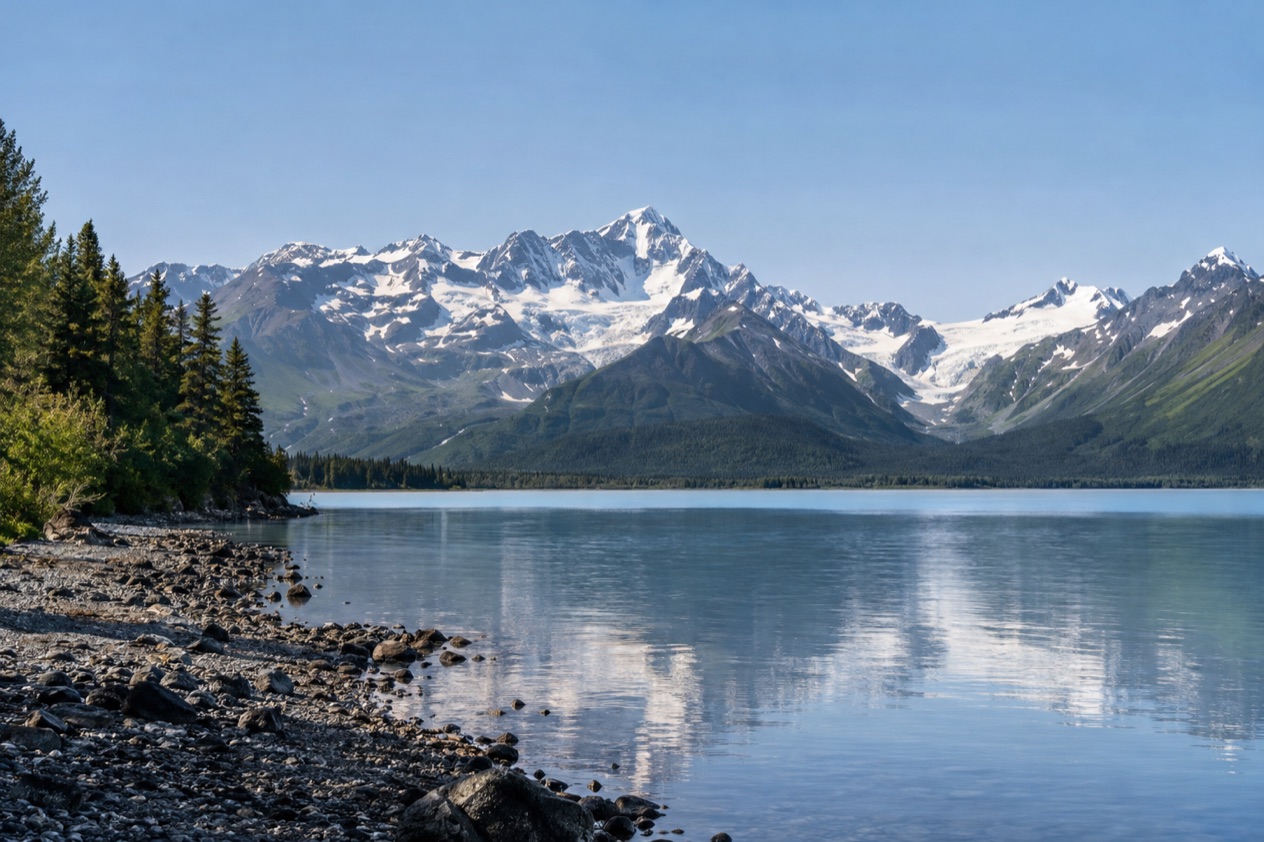
Which national parks are in Alaska?
Some are parks in the classic sense, with a visitor center and rangers. Others are historical parks inside towns, and a few are wilderness so large that the map barely describes them.
The units below are the ones travelers ask about most. Each one is a different kind of trip, so it helps to see them grouped by character rather than alphabetically.
Denali and Kenai Fjords
Denali National Park and Preserve is built around the mountain itself, which rises to 20,310 feet. The park has one road, the Denali Park Road, and most sightseeing is done by bus, either a narrated tour bus or a non-narrated transit bus. Visitors come mainly in the main summer season, from late May to early September, and the park draws roughly 600,000 of them a year.
Kenai Fjords National Park sits near Seward and is a park of ice and coast. The places people name are the coast, Exit Glacier and the Harding Icefield. Camping and cabins are the overnight options, and the Junior Ranger program is open to kids and, as the park puts it, curious adults.
Glacier Bay, Katmai and Lake Clark
Glacier Bay National Park and Preserve holds 2.7 million acres of designated wilderness, and the National Park Service calls the bay a highlight of any Alaska cruise for its scenery and wildlife. On land, the base is Bartlett Cove, where Glacier Bay Lodge and the visitor center are found, and where you can explore the shore and developed trails near park headquarters.
Katmai National Park and Preserve spans over four million acres and contains the site of the largest volcanic eruption of the 20th century. It is best known for brown bears, which live here in high density, and for the sockeye salmon that spawn inside its boundaries. Designated, maintained trails total less than six miles, so this is wilderness first and hiking park second.
Lake Clark National Park and Preserve is undeveloped and has no road access. People come for the coastal brown bears that may be seen grazing on sedges at Silver Salmon Creek or Chinitna Bay, for Dick Proenneke’s historic cabin on upper Twin Lake, and for backpacking over tundra slopes past turquoise lakes.
Wrangell-St. Elias
Wrangell-St. Elias National Park and Preserve is larger than Vermont and New Hampshire combined, and it is organized into five areas where visitor services and things to do are found. The main visitor center is the Wrangell-St. Elias Visitor Center at Park Headquarters in the Copper Center Area.
The size has a practical meaning. Travel times between the visitor service areas are long, longer than you would expect in a national park, so it works better to pick one area and settle in than to try to sample them all.
Gates of the Arctic, Kobuk Valley and Yukon-Charley Rivers
Gates of the Arctic National Park and Preserve covers 8.4 million acres and has no roads, no trails and no established campsites. Kobuk Valley National Park has no roads, trails or campgrounds within its boundary either, and its Great Kobuk Sand Dunes can only be reached by hiring a pilot. Air taxi offices for Kobuk Valley are in Kotzebue and Bettles.
Yukon-Charley Rivers National Preserve lies along the Canadian border in eastern Alaska. In summer you reach it by water or air, and in winter by air or more adventurous options including snowmachines. These three are trips for people with real backcountry experience, and the park service says so plainly.
Historical parks in Skagway and Sitka
Klondike Gold Rush National Historical Park is in Skagway and is about gold rush history and Alaskan beauty. The visit starts at the park visitor center, where you learn about programs, tours and the film. Rangers give short conversations on topics they care about, held in the theater or outside, and the Mascot Saloon, which opened in the gold rush and closed with local prohibition in 1916, is part of the story.
Sitka National Historical Park preserves a landscape that drew Tlingit, Russians and Americans. You wander among totem poles obtained from Haida and Tlingit, see ceremonial and traditional objects from Tlingit and Russian Orthodox cultures, and walk a forest and estuary rich with salmon, berries and otters. The park also includes the site of a significant battle that prepared the way for America’s purchase of Alaska from Russia.
Which are reachable by road?
Only a few Alaska park units have a road you can drive to or into, and even there the road may stop well short of the best scenery. Alaska is mostly without roads, so the parks split into drive-up places, places reached by ferry or small plane, and places reached by neither.
Denali: one road, and a bus for most of it
Denali has just one road, the Denali Park Road. In summer, private vehicles can drive only a short portion of it. Past that point, sightseeing is done on a bus, and you choose between a narrated tour bus and a non-narrated transit bus.
That makes Denali a park you ride through rather than drive through. The pace is set by the bus, with windows for watching the landscape and the occasional stop, and it suits travelers who would rather look than navigate.
Kenai Fjords and Wrangell-St. Elias
Exit Glacier is the part of Kenai Fjords with a road, called Exit Glacier Road. The park says its status is posted under Current Conditions and Alerts, so that is the place to look before you head out. Exit Glacier is one of the key places to visit, along with the coast and the Harding Icefield.
Wrangell-St. Elias has the Nabesna Road, which starts from the Tok Cutoff Highway and runs as a scenic road between the Mentasta and Wrangell Mountains. The main visitor center at Copper Center is the natural first stop for deciding which of the park’s five areas to visit.
Skagway, and why Sitka is different
Skagway is one of only three Southeast Alaska communities with a direct road connection to the North American road system, along with Haines and Hyder. That puts Klondike Gold Rush National Historical Park, in town, within reach of people driving north.
Sitka is not among those three. Southeast communities other than Haines, Hyder and Skagway rely on the Alaska Marine Highway, and the same is true of Juneau, the capital, which is not connected by road to the rest of the continent. Sitka National Historical Park therefore belongs on a trip that already includes the Inside Passage.
No road at all
Lake Clark is not on the road system, and access is primarily by small aircraft. Gates of the Arctic and Kobuk Valley have no roads, and Kobuk Valley’s dunes require a hired pilot. Yukon-Charley Rivers has no road access in summer, when you arrive by water or air.
For Yukon-Charley, visitors find that driving or flying into Eagle and floating the Yukon River is the most reasonable option. Air carriers can return visitors to the put-in point, which means the trip does not have to end with the same river it began on.
How do you choose?
Choose by what you want to be doing: riding a bus past a great mountain, standing in front of a glacier, watching bears, or reading about history in a town. Each of the parks above answers one of those wishes better than the others, and none of them answers all four.
If you want mountains and a classic park visit
Denali is the answer. It has the mountain, a single road, a visitor season running from late May to early September, and a way of seeing the park by bus that does not require backcountry skill. Expect to share the experience with other travelers, since it draws roughly 600,000 visitors a year.
Wrangell-St. Elias is the choice for people who want scale. It is larger than Vermont and New Hampshire combined, and it rewards staying in one of its five areas for a while rather than racing between them.
If you want glaciers and coast
Kenai Fjords gives you a coast, Exit Glacier and the Harding Icefield in one park near Seward. Camping and cabins are available for overnights, and the Junior Ranger program gives children and adults a reason to stop at the ranger programs.
Glacier Bay is the other glacier park, and it is the one tied to cruises. If you are already sailing the Inside Passage, the bay may be part of your itinerary. If you stay on land, Bartlett Cove has the lodge, the visitor center and the developed trails along the shore.
If you want bears and salmon
Katmai and Lake Clark are the two parks the National Park Service ties to brown bears. Katmai has a high density of them and the salmon spawning grounds that feed the Bristol Bay run. Lake Clark has coastal brown bears that may be seen grazing on sedges at Silver Salmon Creek or Chinitna Bay.
Sightings are a chance, never a promise, and both parks are wilderness. Katmai has less than six miles of maintained trail, and Lake Clark is reached primarily by small aircraft, so the trip is built around the flight as much as the destination.
If you want history and culture
Klondike Gold Rush in Skagway and Sitka National Historical Park are the two park units designed around people. In Skagway you start at the visitor center and follow the ranger chats into the gold rush story. In Sitka you walk among Haida and Tlingit totem poles and through the forest and estuary where the battle site is preserved. Sitka suits a trip that already includes Southeast Alaska’s ferry towns, while Skagway fits one that comes up by road or by water.
If you are an experienced backcountry traveler
Gates of the Arctic, Kobuk Valley and Yukon-Charley Rivers are for people who can look after themselves. The park service says Gates of the Arctic visitors should be proficient in outdoor survival skills and ready to care for themselves and their partners in an emergency. Experienced hikers there consider six miles a good day’s travel.
Kobuk Valley asks for seasoned wilderness skills, especially in winter, and commercial businesses offer air taxis, guided rafting and hunting services for its visitors. Yukon-Charley is a river trip, with the Eagle put-in and an air return to the start.
Good to know before you go
Cell phones do not work in Gates of the Arctic, and the same remoteness shapes plans in the other roadless parks, so arrangements for flights and pilots are made before you leave town. Klondike Gold Rush National Historical Park has its own guidance for visits between October and May, which is worth reading if your dates fall in that window. Mailing addresses for Kenai Fjords (PO Box 1727, Seward) and Glacier Bay (PO Box 140, Gustavus) are the parks’ own.
Sources
- Wikipedia, Alaska (https://en.wikipedia.org/wiki/Alaska), checked October 11, 2026
- National Park Service, Denali National Park & Preserve, plan your visit (https://www.nps.gov/dena/planyourvisit/index.htm), checked October 11, 2026
- National Park Service, Kenai Fjords National Park, plan your visit (https://www.nps.gov/kefj/planyourvisit/index.htm), checked October 11, 2026
- National Park Service, Glacier Bay National Park & Preserve, plan your visit (https://www.nps.gov/glba/planyourvisit/index.htm), checked October 11, 2026
- National Park Service, Katmai National Park & Preserve, plan your visit (https://www.nps.gov/katm/planyourvisit/index.htm), checked October 11, 2026
- National Park Service, Wrangell – St. Elias National Park & Preserve, plan your visit (https://www.nps.gov/wrst/planyourvisit/index.htm), checked October 11, 2026
- National Park Service, Lake Clark National Park & Preserve, plan your visit (https://www.nps.gov/lacl/planyourvisit/index.htm), checked October 11, 2026
- National Park Service, Gates of the Arctic National Park & Preserve, plan your visit (https://www.nps.gov/gaar/planyourvisit/index.htm), checked October 11, 2026
- National Park Service, Kobuk Valley National Park, plan your visit (https://www.nps.gov/kova/planyourvisit/index.htm), checked October 11, 2026
- National Park Service, Klondike Gold Rush National Historical Park (Skagway), plan your visit (https://www.nps.gov/klgo/planyourvisit/index.htm), checked October 11, 2026
- National Park Service, Sitka National Historical Park, plan your visit (https://www.nps.gov/sitk/planyourvisit/index.htm), checked October 11, 2026
- National Park Service, Yukon-Charley Rivers National Preserve, plan your visit (https://www.nps.gov/yuch/planyourvisit/index.htm), checked October 11, 2026