
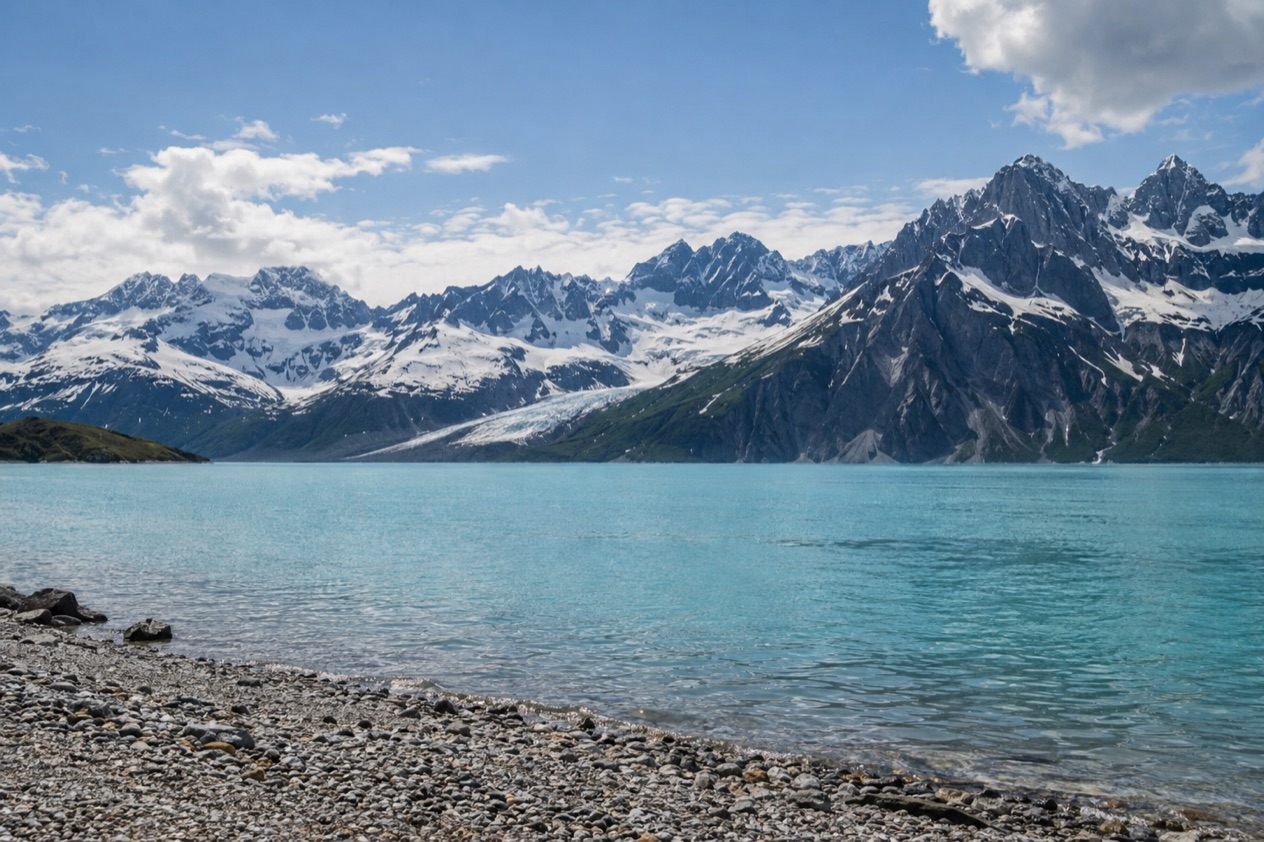
The floatplane drops toward a long turquoise lake, and the mountains on either side close in until you can pick out individual ridges, tundra slopes and a plume of cloud near a volcano. There is no dock crowd and no parking lot, only a gravel runway or a shoreline and the quiet that follows the propeller. Lake Clark National Park and Preserve is a trip for people who want brown bears, wild lakes and a real sense of distance, and who are happy to arrive by air.
Is visiting Lake Clark National Park worth it?
Yes, if you want wilderness more than facilities: bear viewing on the coast, a historic cabin on a mountain lake, paddling and backpacking in country with no road to it. It suits travelers who are comfortable with a small plane, a rugged setting and a trip that depends on weather. It is less suited to anyone hoping to drive up, wander a boardwalk and be back in town for dinner.
What sets it apart from the other Alaska parks is how undeveloped it is. The park is remote, with no road access to any part of it, and it is described as the most remote and least visited of the national parks, with about 5,000 visitors a year.
Two active volcanoes, Mount Iliamna and Mount Redoubt, rise above lakes, glaciers and a salmon-rich coast, all within sight of Cook Inlet. Even the park’s main community, Port Alsworth, is a small lakeside settlement with a runway at its center. There is also no entrance fee, which fits the character of the place: you pay for the flight, the lodge or the guide, not for the gate.
What to see at Lake Clark National Park
The park is a collection of separate places, each reached by air or water, rather than one loop with stops. The coast, the big lakes and the mountain valleys each give a different kind of day.
Silver Salmon Creek and Chinitna Bay
These are the two coastal places where visitors may watch coastal brown bears graze on sedges in the salt marsh, a quieter and more pastoral scene than the salmon-fishing images people expect. Silver Salmon Creek sits midway up the park’s Cook Inlet coast and is a place for bear viewing or for fishing. The bears here are often seen walking the grass, digging clams or resting, and what you notice is how unhurried they seem.
At Chinitna Bay, visitors are sometimes able to see twenty or more brown bears in the salt marsh and on the tidal flats east of Middle Glacier Creek. That is a chance, not a promise, and it depends on the day and the tide. The light over the flats, with glaciated peaks behind, is part of the reward even on a quiet morning.
Dick Proenneke’s cabin on Upper Twin Lake
Richard Proenneke built this log cabin by hand and lived beside the lake for many years, keeping journals and filming his days. His story reached a wide audience through the book One Man’s Wilderness and the film Alone in the Wilderness, which is why visitors come specifically to stand in the place. The cabin is on Upper Twin Lake, northeast of Port Alsworth, and it can be reached by floatplane or by boat from Lower Twin Lake.
You can visit it without a National Park Service permit. What you see is a small, carefully fitted building, tools hung where he left them and a lake that rewards a slow look around. It is a good pairing with a night or two nearby if you want the valley to yourself.
Crescent Lake and the Chigmit Mountains
Crescent Lake is tucked into the coastal Chigmit Mountains, with views of Redoubt Volcano, high bear populations and strong salmon runs. It is a landscape of steep, rough-edged peaks falling to water, the kind of view that makes people reach for a camera before the plane has stopped. Those who come for fishing, paddling or simply a quiet camp find a lake with real mountain presence.
Port Alsworth and the lakes
Port Alsworth, on Lake Clark, is where most visits begin. It has the park visitor center, lodging, air taxis, guide services, gear rentals and a post office, and privately operated lodges sit along the shore.
Around it, the park offers kayaking, rafting, fishing, bird-watching, hiking and camping, and backpacking trips cross tundra slopes and pass turquoise lakes. The Priest Rock Public Use Cabin, on the north shore of Lake Clark, gives a base for those who want to stay in the park itself.
Hours, tickets and rules
There is no gate to open and no ticket to buy. Lake Clark does not require an entrance pass for any visitor, so the park’s lands and waters are not tied to opening hours. The one staffed place with a season is the Port Alsworth Visitor Center, which is open in summer only and sits midway up the eastern-most runway in Port Alsworth.
| Site | Open |
|---|---|
| Lake Clark National Park and Preserve | Park lands and waters |
| Port Alsworth Visitor Center | Summer only |
| Public use cabins (Priest Rock, Joe Thompson) | By reservation |
Visitors do not need National Park Service permits for recreational activities such as backpacking, camping, river running, bear viewing or visiting Dick Proenneke’s cabin. Staying in a public use cabin does require paying fees and making reservations.
Priest Rock accommodates up to six people with three single beds and one queen bed, and Joe Thompson accommodates up to three with two twin beds, where guests must bring their own pads. Sport hunting is permitted in the preserve lands, but in the national park only subsistence hunting by local residents is allowed.
How to get to Lake Clark National Park
You fly. Lake Clark is not on the road system, there is no car access to any part of it, and access is primarily by small aircraft, typically floatplanes. The park is southwest of Anchorage and west of Homer, and those are the two natural starting points for a trip.
The park’s lands and waters are open to fixed-wing aircraft, and almost all visitors arrive that way. There are no fixed runways or FBO services within the park, so landings happen on lakes, beaches and gravel, depending on the destination.
Port Alsworth is the practical hub, with air taxis among the services based there. The air route through Lake Clark Pass, at 1,050 feet in elevation, is the main way between Anchorage and western Alaska through the mountains, which gives the flight in a good deal of its drama.
Some places can also be reached by boat. The park can be reached by boat or small aircraft, and Dick Proenneke’s cabin can be reached by floatplane or by boat from Lower Twin Lake. The public use cabins on the north shore of Lake Clark are reached by boat or floatplane from Port Alsworth. The field office, with a mailing address in Port Alsworth, is the park’s base.
When to visit Lake Clark National Park
Summer is the season built into the park’s services. The Port Alsworth Visitor Center is open in summer only, and summer temperatures are mostly between 50 and 65 °F, with highs around 68 °F. That is mild enough for hiking, paddling and long days outside in layers, though weather in a mountain park with lakes and a coast can change quickly.
Winter lows around 1 °F are a reminder that this is a different park out of season. The park is a rugged wilderness where weather, terrain and wildlife can present challenges, and a flight into a place without runways depends on the sky. A trip into the shoulder months deserves flexibility and a conversation with an air taxi or lodge before you commit.
As for the time of day, nothing in the park opens or closes on a clock, so the rhythm is set by the tide, the light and the pilot.
Tips for your visit
Decide first what kind of trip you want, because the park offers two quite different ones. Rustic camping suits people who plan to carry their own gear, while all-inclusive lodges with guided tours suit those who want someone else to handle the logistics. Port Alsworth has gear rentals and guide services if you need them, and public use cabins give a third option with a roof over your head.
Backpacking in Alaska is unique, and anyone planning a trip should learn the backcountry tips before leaving home. The park describes itself as a rugged wilderness where weather, terrain and wildlife can present challenges. Internet and cellular access is limited, so download what you need ahead of time and plan on being out of touch.
Combine places rather than rushing. A day or more at the bear-viewing coast pairs naturally with time at Port Alsworth, where the visitor center explains the park and lodges and air taxis are based.
Pair Dick Proenneke’s cabin with a stay in the Twin Lakes area if you want to take it in without hurrying. The park’s lands also hold fishing, kayaking, rafting, bird-watching and hiking, so a few extra days are easy to fill.
Families and travelers with limited mobility should talk through the plan with the operator they choose, since landings on lakes and beaches and any time on tundra or shoreline depend on the destination. Public use cabins have beds but guests of Joe Thompson must bring their own pads.
Good to know before you go
Because the park has no entrance fee, most of the money you spend goes to flights, lodging, guides and gear, and cabin stays carry their own fees. Cell and internet service is limited, so a plan made before you leave is a plan you can follow.
Treat weather and wildlife with respect, since both can change a day, and remember that the visitor center keeps only a summer season. The post office, lodging and air taxis in Port Alsworth are the services you can count on locating on arrival.
Sources
- National Park Service, Lake Clark National Park & Preserve, plan your visit: basicinfo (https://www.nps.gov/lacl/planyourvisit/basicinfo.htm), checked October 11, 2026
- National Park Service, Lake Clark National Park & Preserve, plan your visit: conditions (https://www.nps.gov/lacl/planyourvisit/conditions.htm), checked October 11, 2026
- National Park Service, Lake Clark National Park & Preserve, plan your visit: fees (https://www.nps.gov/lacl/planyourvisit/fees.htm), checked October 11, 2026
- Wikipedia, Lake Clark National Park and Preserve (https://en.wikipedia.org/wiki/Lake_Clark_National_Park_and_Preserve), checked October 11, 2026
- Wikivoyage, Lake Clark National Park (https://en.wikivoyage.org/wiki/Lake_Clark_National_Park), checked October 11, 2026