
Step out near Exit Glacier and the first thing you notice is sound: meltwater rushing under the ice and spilling across a wide gravel plain, with cold air drifting down from the glacier. Out on the coast, the same ice meets salt water in long fjords walled by steep rock. Kenai Fjords National Park is a place of ice, rain-fed forest and open water, and a visit here can mean a walk on a trail, a day on a boat, or both.
Is visiting Kenai Fjords National Park worth it?
Yes, if you want to see what a living glacier and an icefield look like up close, and you are happy to spend a day on a trail or a boat rather than ticking off roadside stops. It suits hikers who like a long climb toward ice, travelers who want to watch the coast from the water, and families who enjoy a Junior Ranger booklet as much as a view.
What sets the park apart from other places on the Kenai Peninsula is how much of it is ice. Nearly 51 percent of the park is covered, and the Harding Icefield spreads over more than half of its acreage, feeding glaciers that run down to the sea.
Most of Alaska’s big parks are reached only by plane or boat. Here, one road leads to a glacier, and the rest of the park opens up from the water of Resurrection Bay. The park does not charge an entrance fee, which makes the Exit Glacier side an inexpensive way to stand beside a glacier.
It is also a landscape that asks for respect. The park describes itself as remote, rugged and unpredictable, with wildlife encounters and changing weather part of the picture. Come ready for that and the park rewards you with a lot more than a photograph.
What to see at Kenai Fjords National Park
Exit Glacier and the Edge of Glacier Trail
Exit Glacier is the one part of the park you can reach by road, via the Exit Glacier Nature Center. The glacier is retreating, and the walk shows you how. Recessional moraines along the way are dated, so you can read the glacier’s pullback in the ground itself.
On the Edge of Glacier Trail you can hear meltwater rushing beneath the ice, and the rocks carry fine scratches called striations, left by ice and by gravel frozen inside it. The drive in shows you the shape of the valley too: steep sides and a flat bottom, the classic U carved by ice. Beside the road runs the braided Resurrection River, fed by Exit, Lowell and other glaciers coming off the Harding Icefield.
A safety closure covers the stretch from the toe of the glacier to the end of the canyon where Exit Creek opens onto the outwash plain, so you look at the ice from where the trail allows, not from beneath it.
The Harding Icefield Trail
A network of trails from the nature center leads to the Harding Icefield Trail, which runs 3.9 miles from the trail register to the end. It climbs toward the icefield that gives every glacier here its start. Moist air off the Gulf of Alaska drops about 60 feet of snow on the icefield each winter, and it takes roughly four to ten years for that snow to turn into glacial ice.
What you look for on this trail is the sense of scale: a plain of white where the mountains seem to sink into snow, with the ice stretching on past what you can take in. Glaciers here flow faster in summer than in winter, because meltwater lets them slip along their beds.
The coast and its tidewater glaciers
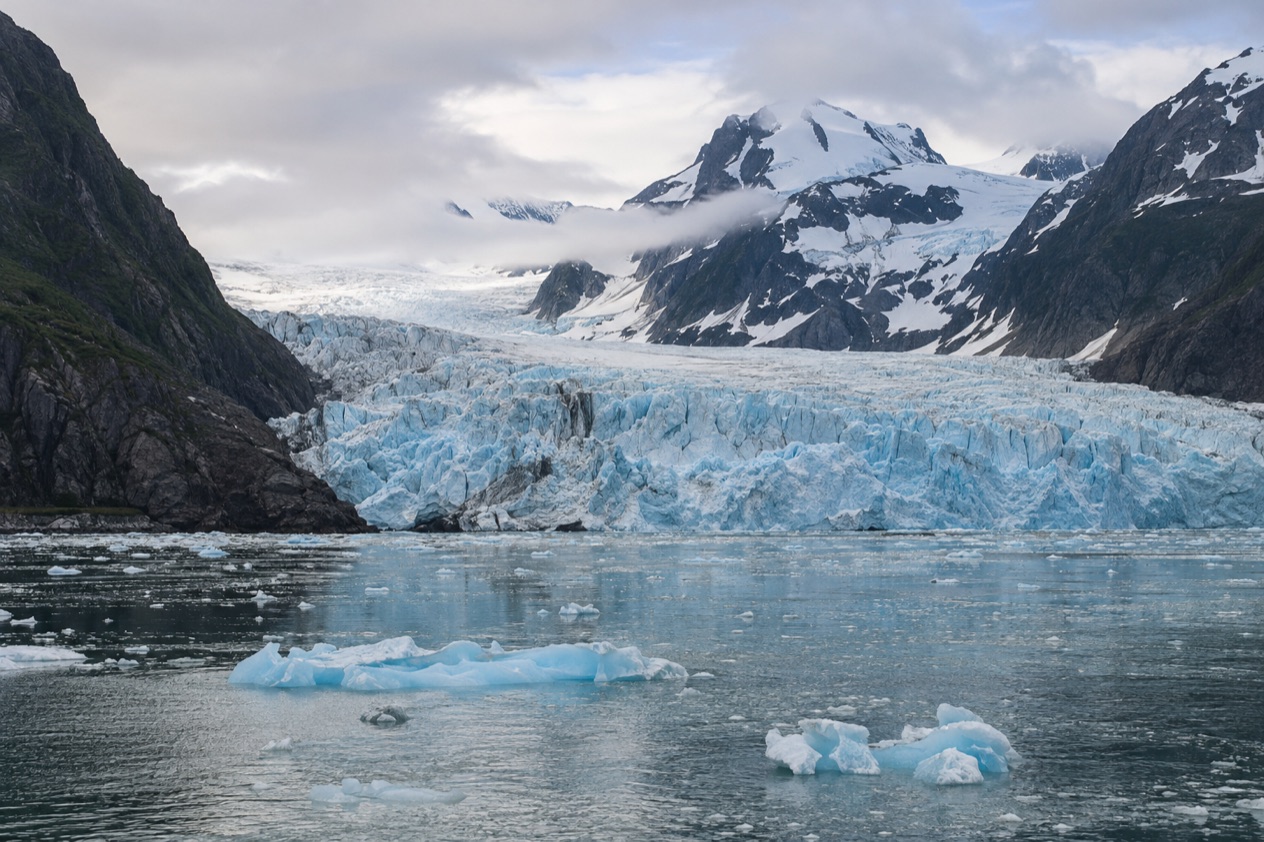
Most of the park lies beyond the road and opens up from the water. Aialik Glacier is a tidewater glacier that drains the Harding Icefield into Aialik Bay, the largest glacier in that bay and a little over 15 miles from Seward. It calves most actively in May and June, when pieces of ice may break off and crash into the water.
Bear Glacier is the largest glacier in the park, marked by two distinct medial moraines, the dark stripes of rock that run along the ice. Boat tours from Seward are the usual way to see the coast. They take in a tidewater glacier, sea lion haul outs and seabird rookeries. Keep your distance from any iceberg you pass, because they can roll or flip without warning.
Wildlife on land and water
The park lists mountain goats, black bears and bald eagles among its wildlife. Boat tours add Steller sea lions, puffins, Dall’s porpoises, and humpback and orca whales to the list of animals you may see. Snowshoe hares live here too.
All of these are chances, never promises. A day on the water can bring a cluster of puffins on a cliff or a pod of whales, or simply a quiet stretch of fjord. Binoculars and patience are the best preparation.
Hours, tickets and rules
The park itself is open year-round, and it asks for no entrance pass or fee and sells no passes. The part that changes with the seasons is the road to Exit Glacier, which is closed to cars for the winter months and much of the spring. In winter, going beyond the state gate to the Exit Glacier Area means another 7 miles, then one more mile to the overlook.
| Site | Open |
|---|---|
| Kenai Fjords National Park | Open year-round |
| Exit Glacier Road | Closed to cars in winter and much of spring |
| Exit Glacier campground (12 sites, tents only) | Tent camping |
| Coastal public use cabins | Summer only |
| Willow Cabin at Exit Glacier | Winter only |
Dogs and other pets are prohibited on trails at all times, and trails are open to foot traffic only, with no bikes. Public use cabins require reservations, and permits must be bought in advance from the park office at the Seward harbor.
Permits and sometimes fees apply to special events, filming and photography, and commercial activities and guiding. Never approach or climb onto an iceberg. If you go out in your own boat or into the backcountry, do not count on mobile phone service, and carry a satellite phone or a GPS emergency locator beacon.
How to get to Kenai Fjords National Park
Almost everything runs through Seward, the nearest large town, on Resurrection Bay just east of the park. Seward sits 130 miles south of Anchorage at the southern end of the Seward Highway, and that highway is the only road that serves the park. From Seward you reach the park’s two faces in different ways: by road to Exit Glacier, or by boat to the coast.
By road to Exit Glacier
Exit Glacier is the only part of the park reachable by road, and Kenai Fjords is one of only three national parks in Alaska you can reach that way. Herman Leirer Road, also called Exit Glacier Road, leads to the nature center, and it is the only road in the park. Because it closes to cars in winter and much of spring, check the park’s Current Conditions and Alerts page for the road status before you set out.
Parking at Exit Glacier is limited in summer, especially in the middle of the day in June, July and August. Bikes and pets may not go past the parking lot on the trails.
By boat, plane or on foot
The rest of the park outside the Exit Glacier road is reached by boat, airplane and hiking. Various companies run boat tours from Seward with views of land and marine wildlife, and most of them last about four to six hours and include a stop at a tidewater glacier and lunch. The park’s own materials call organized marine tours the safest way to enjoy the park.
When to visit Kenai Fjords National Park
For the road to Exit Glacier and the trails, plan for the months when the road is open to cars. It is closed through the winter months and much of the spring.
Summer brings the busiest stretch at Exit Glacier. Parking is limited there from mid-morning to mid-afternoon in June, July and August, so arriving outside those hours gives you more room at the trailhead and on the trail.
For the coast, May and June are when Aialik Glacier calves most actively, which makes those months a good moment to be on the water if you hope to see ice fall. Glaciers also flow faster in summer than in winter, so the ice is on the move while you watch.
Winter has its own character. The icefield collects its huge snowfall, and the cabin at Exit Glacier is available in winter only. Coastal cabins run in summer only, so match your season to the stay you want. Weather here shifts, and the park says to expect changing conditions at any time.
Tips for your visit
A boat tour from Seward takes about four to six hours and includes lunch, so the rest of that day can go to Seward itself. The Exit Glacier side can fill a morning at the Edge of Glacier Trail or a longer day on the Harding Icefield Trail. Visitors do both on separate days, which spreads the effort and the weather risk.
Bring binoculars for the animals on the cliffs and water, and dress for conditions that can change. The park describes the weather as changing, so extra layers are a sensible habit. Keep trails to foot traffic, leave pets at home or in your lodging, and hold back from the glacier closure and from every iceberg.
Families will find a Junior Ranger program for kids and curious adults. The mural of two kayakers near Aialik Glacier, painted by Byron Birdsall, hangs at the park office, which makes it a quick look before or after a trip.
If you want to stay overnight, the park offers camping and cabins, inside and outside its boundaries. The Exit Glacier campground has twelve tent-only sites. Some cabins sit on native corporation lands, with a portion of the use fee going to the native community. After the park, the rest of the Kenai Peninsula is open for exploring.
Good to know before you go
The park spreads over more than 600,000 acres and was designated a national park in 1980. Mobile phone service is not something to rely on in the backcountry or on your own boat. The park mailing address is PO Box 1727, Seward, AK 99664. Because the Exit Glacier road changes with the seasons, look at current conditions before you drive out.
Sources
- National Park Service, Kenai Fjords National Park, plan your visit: basicinfo (https://www.nps.gov/kefj/planyourvisit/basicinfo.htm), checked October 11, 2026
- National Park Service, Kenai Fjords National Park, plan your visit: conditions (https://www.nps.gov/kefj/planyourvisit/conditions.htm), checked October 11, 2026
- National Park Service, Kenai Fjords National Park, plan your visit: fees (https://www.nps.gov/kefj/planyourvisit/fees.htm), checked October 11, 2026
- National Park Service, Kenai Fjords glaciers (https://www.nps.gov/kefj/learn/nature/glaciers.htm), checked October 11, 2026
- Wikipedia, Kenai Fjords National Park (https://en.wikipedia.org/wiki/Kenai_Fjords_National_Park), checked October 11, 2026
- Wikivoyage, Kenai Fjords National Park (https://en.wikivoyage.org/wiki/Kenai_Fjords_National_Park), checked October 11, 2026
- Wikipedia, Aialik Glacier (https://en.wikipedia.org/wiki/Aialik_Glacier), checked October 11, 2026
To plan your stay
- Best Time to Visit Kenai and Soldotna: Salmon Runs, Weather by Month and Seasonal Things to Do
- Where to Stay in Kenai and Soldotna: Kenai River Access, Refuge Gateways and Area Comparison
- Kenai and Soldotna in January: Winter Weather, Short Days and What to Do
- Kenai and Soldotna in February: Weather, Winter Daylight and Two Days on the Kenai River