
DRY TORTUGAS · THE PARK GUIDE · 70 MILES WEST OF KEY WEST
About 70 miles west of Key West, past the end of the Overseas Highway, a brick fort sits in shallow turquoise water with nothing around it. Dry Tortugas National Park has no road and no bridge. The Park Service recognizes four ways in: commercial ferry, permitted tour guides, private vessel, and seaplane. One boat leaves Key West each morning at 8 a.m., and its seats were spoken for a long time ago.
Which makes this a park you settle in advance rather than one you visit on impulse. The ferry sells out months out, campsites cannot be reserved at all, and the island has nothing to buy and no way to pay in notes: the park does not accept cash. Whatever you carry off the dock is what you have for the day, or for the night.
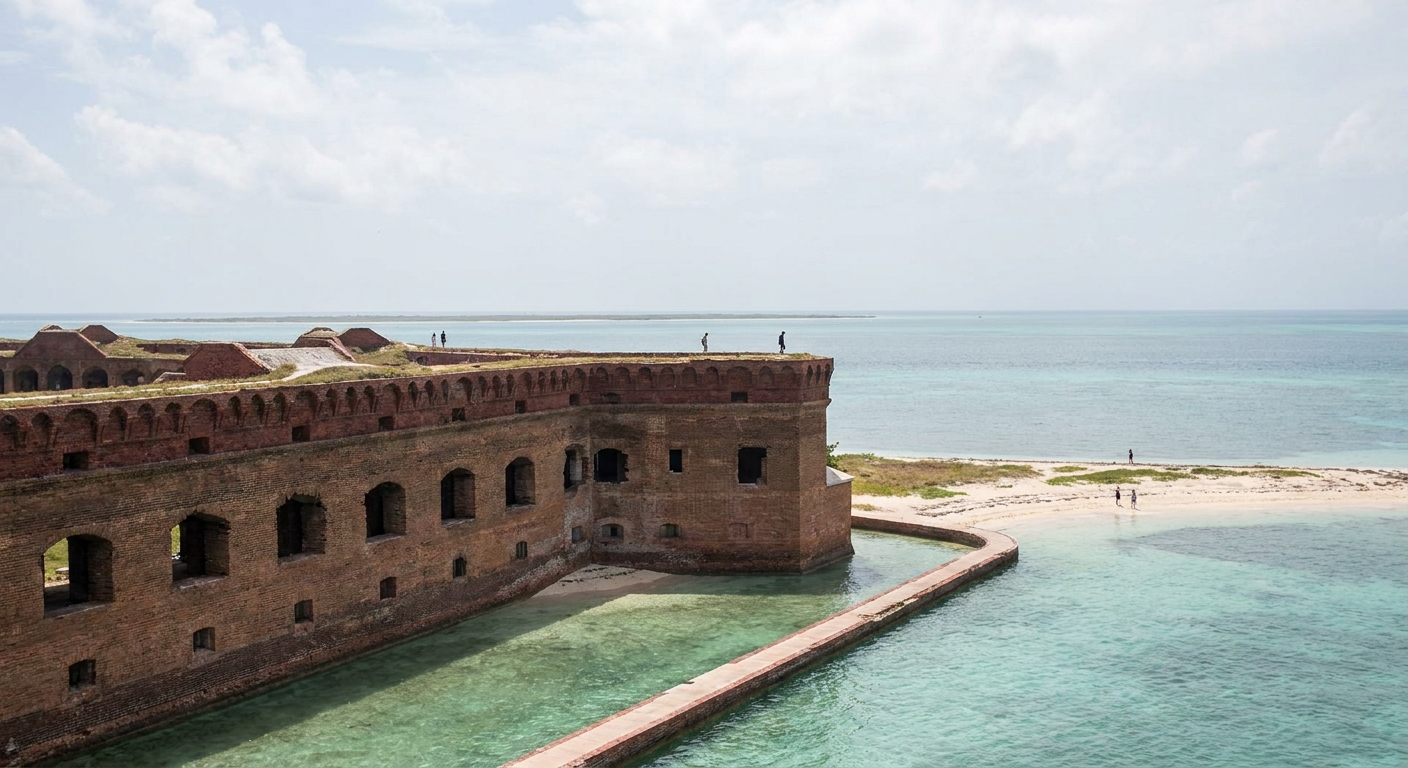
THE PARK AT A GLANCE · DRY TORTUGAS
Book the crossing months ahead, buy the $15 pass before you leave, carry everything you plan to eat and drink, and treat the campsite as something you claim on arrival rather than reserve.
70 MILES OFFSHORE · NO ROAD · ONE MORNING FERRY · CASHLESS PARK
Go for: Fort Jefferson from sunrise, snorkeling with gear the ferry fare already includes, and the moat wall after dark if you land a campsite.
Think twice before: booking between mid-August and mid-October, the most active stretch of a hurricane season that runs June 1 to November 30.
Access, fees, camping: National Park Service · Ferry time and 2026 fare: Yankee Freedom · Hurricane season: NOAA · full sources at the end
On this page
- How to get to Dry Tortugas from Key WestFerry, seaplane or private boat
- The entrance fee, and how to pay it$15, and no cash accepted
- Fort Jefferson opening hoursSunrise to sunset, moat wall after dark
- What a day trip includesOne crossing, meals and snorkel gear
- Camping on Garden Key$15 a night, first come, first served
- Anchoring rules for private boatsOne nautical mile of the harbor light
- Best months, and hurricane season datesJune 1 to November 30, peak September 10
- Where to sleep before a 7:30 a.m. check-inKey West, the staging post
Florida holds eleven National Park Service units, and three of them carry the National Park designation: Biscayne, the Everglades and this one. You can drive to the other two. This one asks for a boarding pass of some kind before anything else, which is why the work starts weeks or months before the alarm goes off in Key West. The full Florida park lineup sorts the rest.
How to get to Dry Tortugas: ferry, seaplane or private boat
| Way in | What is fixed | What it costs |
|---|---|---|
| Commercial ferry | Leaves Key West daily at 8 a.m., check-in before 7:30 a.m. | About $250 adult in 2026, entrance fee, snorkel gear, breakfast and lunch included |
| Seaplane | Recognized by the NPS as an access mode | Not verified by us: no fare, schedule or operator stated here |
| Private vessel | Ranger check-in on arrival at Garden Key | $15 entrance pass, bought ahead on Recreation.gov |
| Permitted tour guides | Varies by operator | Camping fees are never included in a transportation fee |
The park lies about 70 miles west of Key West, and the highway stops a long way short. No road, no bridge, no causeway reaches Garden Key. Three of the four recognized ways in stage out of Key West, which is the argument for sleeping there the night before rather than driving down at dawn: from Miami the run is about 155 miles and close to four hours without stopping, six to eight if you treat the Overseas Highway the way it deserves.
The Yankee Freedom III departs daily at 8 a.m., with check-in closing before 7:30 a.m. The 2026 adult fare runs about $250, and it absorbs most of the day’s spending: the park entrance fee, snorkeling gear, breakfast and lunch all sit inside it. Fares move from season to season, so confirm the number at booking instead of trusting one you read here.
Then the detail that governs the whole trip. The National Park Service states that ferry reservations are limited and sell out months in advance. One operator-side source we read put the window at weeks instead, and we serve the Park Service wording because it is the more cautious of the two. Choose the date, buy the crossing, and let the flights, the room and the rental car arrange themselves afterward. Every other piece of a Florida trip can be rebooked. That seat cannot.
Seaplane service is the fourth recognized way in, and that is as far as we will take it: we have not verified an operator, a schedule or a fare, and a gap beats a guess. Boaters run on their own rules, starting with the digital entrance pass bought ahead and ending with the anchoring limit around the Fort Jefferson harbor light.
Dry Tortugas entrance fee: $15, and no cash accepted on the island
The standard entrance pass costs $15.00 per person. An America the Beautiful pass covers it, Senior passes included, so a household that already carries one pays nothing more at the gate. Ferry passengers have the fee folded into their fare. Anyone arriving under their own power, by private boat or private seaplane, should buy a digital entrance pass in advance through Recreation.gov rather than expecting to settle up on the dock.
And the trap that catches people who prepared for everything else: the park does not accept cash. Plan to go cashless. There is nothing to buy on the island and nowhere to hand over notes, which also means no snack bar, no water refill you can pay for, no forgotten sunscreen bought at the last minute. The twenty in your pocket is dead weight for the entire visit.
Fort Jefferson hours: sunrise to sunset, and the moat wall after dark
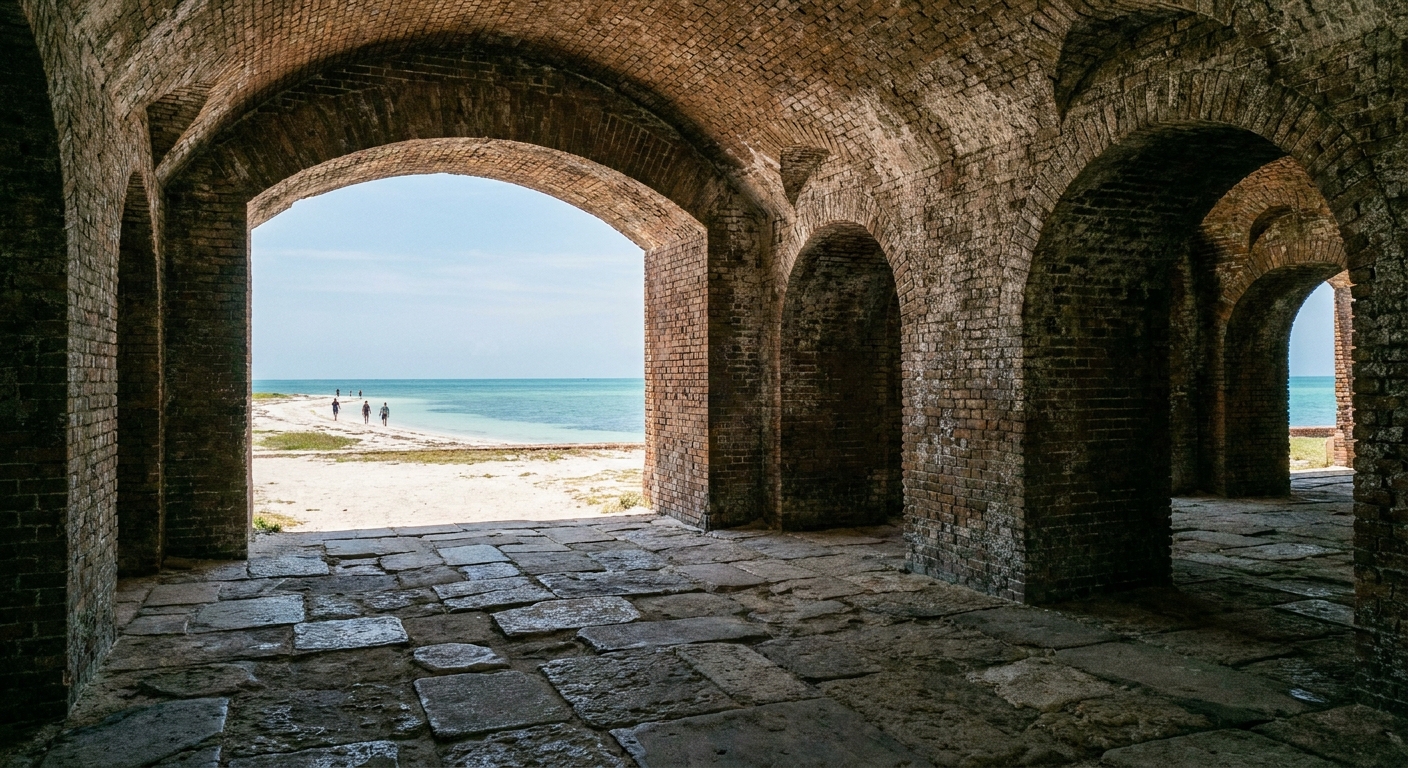
Fort Jefferson occupies almost all of Garden Key. The Park Service describes it as one of the nation’s largest 1800s masonry forts and as the largest masonry fort in the western hemisphere, and we will leave the superlative exactly where the Park Service put it. What the scale means on the ground is simple enough: the walls, the casemates and the moat are the visit, and the island around them takes a few minutes to walk.
The fort itself is open sunrise to sunset. Outside those hours the exterior public areas stay open: the moat wall, the beaches and the open ground remain accessible after dark. Day visitors never meet that distinction, since their boat has a schedule. Campers get the whole second half of it, a fort closed for the night and a moat wall they can still walk.
One warning from the Park Service is worth reading as a packing instruction: many areas inside the fort have uneven walking surfaces. Brick, sand, old masonry and steps that were not built to a modern code do not forgive flip-flops. Keep the sandals for the boat and put something with a real sole in the bag for the fort.
A day trip to Dry Tortugas: one crossing a day, and what the $250 fare covers
A single round trip shapes the entire day. Check-in closes before 7:30 a.m., the boat leaves at 8 a.m., and the return runs on the same fixed clock for everyone aboard. The fort has been open since sunrise by the time passengers land, so there is no waiting for a gate. Nobody stretches the afternoon, either: the departure time is the departure time.
That fare has already handled most of the logistics. Entrance fee, snorkeling gear, breakfast and lunch all come with the ticket, which is why a cashless park causes day visitors so little trouble. What still belongs in your bag is anything personal: sun protection, a hat, a dry layer for the crossing, and shoes that cope with brick.
What one day cannot hold: the island after dark, since the exterior areas stay open but your boat does not wait, and any second attempt at the crossing, since there is one a day. We are also not going to name reefs or wrecks. The Park Service notes the park for its marine life, its birds and its shipwrecks, and below that line we have nothing verified to offer.
Camping on Garden Key: $15 a night, first come, first served
| Camping detail | What the Park Service states |
|---|---|
| Individual site | $15.00 per night |
| Large group site | $30.00 per night |
| Paid through | Recreation.gov |
| Included in the ferry fare? | No. Camping fees are separate from any transportation fee |
| Site assignment | First come, first served once you reach Garden Key |
| Showers | None in the park |
| Composting toilets | Closed approximately 10 a.m. to 3 p.m. |
A site runs $15.00 a night, and the large group site $30.00 a night, both paid through Recreation.gov. Neither figure is included in transportation fees such as the ferry or a permitted guide. So a camper’s arithmetic is two separate payments that have nothing to do with each other: the crossing on one side, the pitch on the other.
Now the reversal that surprises people who booked carefully. The reservation you are holding covers the boat, not the ground. Once you reach Garden Key, camping is first come, first served. There is no confirmation number for a numbered pitch, no map with your name on it, and no arrangement you can make from home to change that.
Comfort is thin by design. There are no public showers anywhere in the park, and the composting toilets close from roughly 10 a.m. to 3 p.m. During those middle hours, visitors use the facilities aboard the commercial ferry boats tied up at the dock, which quietly ties the campground’s daytime routine to a vessel’s schedule.
Everything else comes aboard with you. Nothing is sold on the island, so water, food, fuel, sun protection and anything you want after sundown travels in your own bags. Cards work for the fees, cash works for nothing, and the campground has no counter to forget an item at. Pack as you would for a backcountry night in the Everglades, then add water.
Worth the night if you want the fort at sunrise and the moat wall under a dark sky, and if arriving without a guaranteed pitch does not spoil your week. Not worth it if you need a shower, a reserved site or a bathroom at noon that is not on a boat.
Dry Tortugas by private boat: anchoring within one nautical mile of the harbor light
Overnight anchoring is permitted in the area of sand and rubble bottom within one nautical mile of the Fort Jefferson harbor light. Two conditions come with it: hold to that bottom type inside that radius, and block no designated channel. The limit is small enough that a crowded night at Garden Key leaves less room than a chart suggests.
Check in with a ranger when you land at Garden Key. Buy the $15 digital entrance pass ahead on Recreation.gov as well, since a park that takes no cash also takes none from a boat crew that meant to settle later.
The best time to visit Dry Tortugas: the dry season, and the September 10 hurricane peak
The Atlantic hurricane season runs June 1 to November 30 and peaks on September 10, with most activity falling between mid-August and mid-October. That window is the one to weigh against a non-refundable crossing booked months earlier. Florida’s dry season, November through April, is the calmer half of the year across the state, as our month-by-month verdict lays out.
On an island 70 miles offshore, though, conditions decide more than the calendar does. Everything depends on a single open-water run each morning, and there is no bridge to fall back on and no second sailing to switch to. Book a date with a spare day behind it if your trip allows, and read the marine forecast the night before with more attention than you would give a beach day.
When to go. The month-by-month case for Dry Tortugas — what the normals say, when the sea is warm enough to swim and which weeks fill up — sits on the best time to visit Dry Tortugas.
The last word
Nothing about this park rewards improvisation, and that is most of its appeal. The seat on the 8 a.m. boat is the only piece that cannot be fixed later, so buy it first and let the rest of the trip form around it. Consider the scale of what sits behind that dock: Key West’s airport boarded 740,762 passengers in all of 2024, the smallest count among Florida’s fifteen commercial airports, and one ferry a day serves a national park past the end of the road. Book early, carry your water, and bring a wallet with nothing in it but cards.
Sources & data for this guide
- Access modes, no road or bridge, 70 miles west of Key West · National Park Service, Dry Tortugas · checked Sep 8, 2026
- Entrance fee $15.00, America the Beautiful and Senior passes, advance digital pass on Recreation.gov · NPS Dry Tortugas, Fees & Passes · checked Sep 8, 2026
- Cashless park, nothing to buy on the island · NPS Dry Tortugas · checked Sep 8, 2026
- Camping $15.00 individual and $30.00 group site, paid via Recreation.gov, not included in transportation fees, first come first served, no showers, composting toilets closed approx. 10 a.m. to 3 p.m. · NPS Dry Tortugas, Camping · checked Sep 8, 2026
- Fort Jefferson description, sunrise to sunset hours, exterior areas open after dark, uneven walking surfaces · NPS Dry Tortugas · checked Sep 8, 2026
- Ferry departure 8 a.m., check-in before 7:30 a.m., 2026 adult fare about $250 including entrance, gear and meals · Yankee Freedom · checked Sep 8, 2026 · fares change
- Booking lead time: the NPS writes that ferry reservations sell out months in advance. An operator-side source we read said weeks. We serve the NPS wording and flag the divergence rather than split the difference.
- Overnight anchoring within one nautical mile of the Fort Jefferson harbor light, no blocked channels, ranger check-in · NPS Dry Tortugas · checked Sep 8, 2026
- Hurricane season June 1 to November 30, peak September 10 · NOAA National Hurricane Center · checked Sep 8, 2026
- EYW boardings, 740,762 in CY2024 · Federal Aviation Administration · checked Sep 8, 2026
- Not covered here, for lack of verified data as of Sept 8, 2026: seaplane operators, schedules and fares, and any named dive site, reef or wreck.