
FLORIDA · DRY TORTUGAS · AUGUST
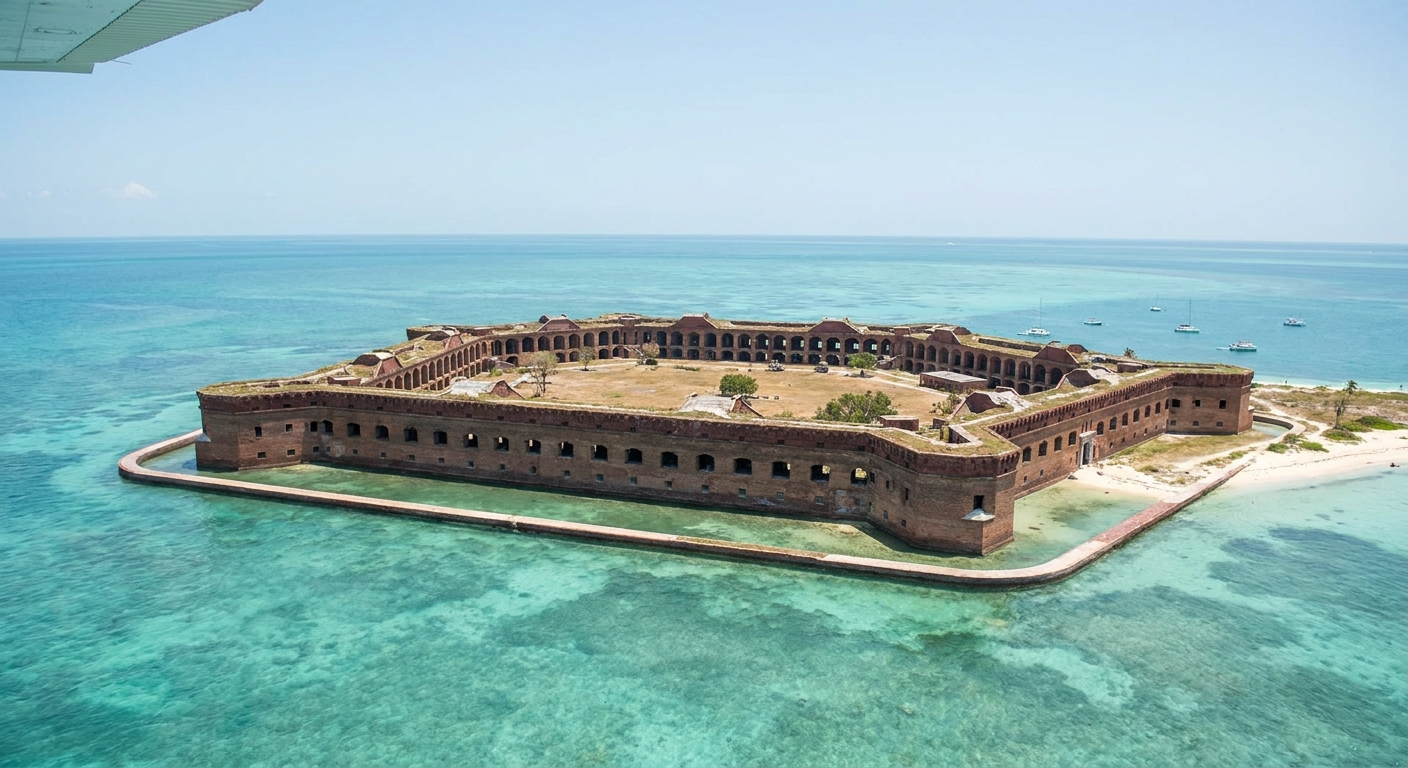
Dry Tortugas in August means a boat or seaplane ride seventy miles west of Key West, a brick fort rising from a sandbar, and a sea that reaches close to 89°F by the warmest hour of the day. Key West’s official normals put the afternoon at 90.6°F and the night at 80.5°F. Pack for a trip where the heat never fully lets go, and where the water is the place you go to cool off.
Compared with July, August brings more rain: 5.37 inches against 3.63 at the Key West station. It keeps the warm water and the long evenings, with the sun setting at 8:02 pm on the 15th. Key West stays your base either way, and our Key West guide covers the town itself, from where to eat to where to sleep.
THE MONTH AT A GLANCE · DRY TORTUGAS IN AUGUST
Go in August for the warmest sea of late summer and long evenings, but book refundable and keep a spare night in Key West in case weather moves your crossing.
HURRICANE SEASON · AIR FIGURES FROM KEY WEST · 70 MILES OFFSHORE
Go for: snorkeling off Garden Key in water near 89°F, 13-hour days, and a sunset over open water after 8 pm if you camp.
Think twice before: booking non-refundable. August sits inside the Atlantic hurricane season (June 1 to November 30), and rain days climb from 6.8 in July to 9.1.
Air: NOAA NCEI, Key West station · Sea: Open-Meteo Marine API · Light: sunrise-sunset.org · full sources at the end
On this page
- Dry Tortugas weather in August90.6°F highs and 9.1 rain days
- Can you swim in Dry Tortugas in August?An 88.8°F sea, by daily maxima
- How busy is Dry Tortugas in August?Booking, lodging tax and hurricane season
- Things to do in Dry Tortugas in AugustFort Jefferson, the moat wall and Garden Key
- A two-day August itineraryA crossing day and a Key West backup day
- August vs July and SeptemberHow rain, heat and sea compare
- Is August a good time to visit?Who should go, and when to shift
Most visitors sleep in Key West and cross to the park as a day trip, while campers on Garden Key stay the night. Three nights in Key West give you one crossing day and one weather day to spare. You’ll fly into Key West or drive down from Miami, and our Florida flights guide sorts the airports.
Dry Tortugas weather in August: average highs, lows and rain days
| August measure | Value | Source |
|---|---|---|
| Average high | 90.6°F | NOAA NCEI 1991–2020, Key West |
| Average low | 80.5°F | NOAA NCEI 1991–2020, Key West |
| Precipitation | 5.37 in | NOAA NCEI 1991–2020, Key West |
| Days with 0.10 in or more | 9.1 | NOAA NCEI 1991–2020, Key West |
| Days with 1 in or more | 1.4 | NOAA NCEI 1991–2020, Key West |
| Daylight, Aug 15 | 13 h 01 min | sunrise-sunset.org |
| Sunrise / sunset, Aug 15 | 7:00 am / 8:02 pm EDT | sunrise-sunset.org |
The air figures below and above come from NOAA NCEI’s 1991–2020 monthly normals for station USW00012836 at Key West: a real thermometer at an official station, not a reanalysis grid cell. That thermometer stands seventy miles east of the fort. Dry Tortugas sits alone in open Gulf, windier, with nothing between it and the weather, so treat the 90.6°F average high and 80.5°F average low as the closest official reading rather than a measurement taken on Garden Key.
An average August logs 9.1 days with at least 0.10 inch of rain, a little under one day in three, for 5.37 inches in all. Florida’s wet season runs on afternoon thunderstorms, as our Florida guide describes. On a crossing day, watch the sky after lunch and know that the fort’s brick casemates give cover if a cell builds over the island.
Only 10.1°F separates the average high from the average low. Nothing in your bag needs to be warm: bring a long-sleeve sun shirt or rash guard for the open boat deck, a wide hat, reef-safe sunscreen and a refillable bottle. Campers can leave the sleeping bag at home and pack a light sheet.
On August 15 the sun rises at 7:00 am and sets at 8:02 pm Eastern Daylight Time, for about 13 hours 01 minutes of daylight, per sunrise-sunset.org. Day visitors get the bright middle of that span. Campers on Garden Key see the light fall on the fort’s walls just after 8 pm and catch the sunrise again at seven.
Swimming in Dry Tortugas in August: sea temperature
Open-Meteo’s Marine API puts the sea surface off Dry Tortugas at 88.8°F in August, averaged over 2015–2024. That figure is a mean of daily maxima, the warm peak of each day, so it runs a shade warmer than a 24-hour average would. It also comes from a different source and a different decade than the NOAA air normals from Key West.
Near 89°F, you walk into the water without a gasp, and a long snorkel off Garden Key’s beach needs no wetsuit. Water this warm cools you less than you’d hope, though. Swim in the morning when the peak has not yet built, drink between sessions, and keep the sun shirt on in the water to protect your back.
Our sources carried no August wind or swell series for Dry Tortugas, so we give no figure. What we do know is that the island is windier than Key West and fully exposed to open Gulf. On the day, the operator’s decision on the crossing is the forecast that counts.
How busy is Dry Tortugas in August? Crowds and prices
August falls in Florida’s wet season and inside the Atlantic hurricane season (June 1 to November 30, per our Florida guide). That much is calendar. We found no occupancy series or monthly hotel rates for Key West or the park, so we crown no month cheap or expensive.
We could not verify how far ahead the ferry or seaplane sells out in August, so we give no week count. Book the crossing as soon as your flight is fixed, then build the Key West nights around that date. Our Florida trip-cost guide helps set the budget around it.
We could not verify the Monroe County lodging-tax rate, so we give no percentage. When you compare Key West rooms, ask for the total with taxes and fees included before you commit.
Paying for flexibility is the one line that changes August: a refundable fare, and a room you can extend by a night. With 9.1 rain days in an average month and the hurricane season underway, a spare night turns a canceled crossing into a rescheduled one.
Things to do in Dry Tortugas in August
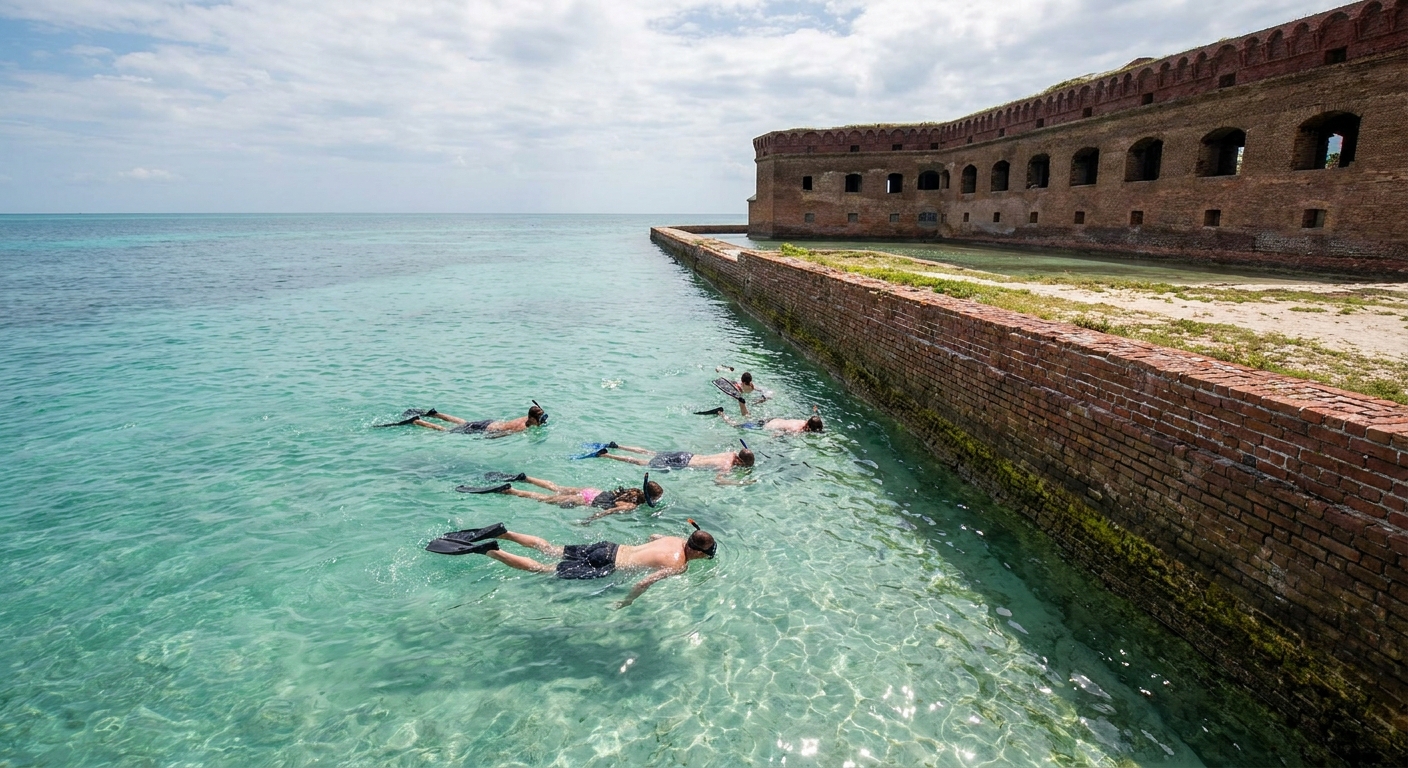
The sea off Dry Tortugas peaks at 88.8°F in August by Open-Meteo’s daily maxima, a tenth of a degree above July and half a degree above September. For a snorkeler, that means the longest comfortable sessions of late summer, with no wetsuit to rent or carry across.
Everything sits on or around Garden Key. Fort Jefferson takes up most of the island, with its casemates on the lower level and a view over open water from the top. The moat wall circles the fort and draws snorkelers along its outer face, and Garden Key’s beaches give easy entry to the water. We could not verify current park entry fees or crossing fares, so we give no price, and our Florida national parks guide points to the National Park Service listing.
The water barely moves from month to month here, while the land heats hard. Key West’s 90.6°F August high sits 1.8°F above the 88.8°F sea, and the fort’s brick and the pale sand hold that heat. Walk the fort’s upper level in the first hour after you land, and save the middle of the day for the water.
We could not verify an August fee waiver or free-entry day, so we name none. Once you have paid the crossing and entry, the moat-wall walk and the snorkeling cost nothing more, and campers get the 8:02 pm sunset over open Gulf for free.
Dry Tortugas in August: a two-day itinerary
Day one, the crossing. Reach the Key West dock at the boarding time your operator gives you, with water, hat and sunscreen already packed. On Garden Key, tour Fort Jefferson’s casemates and upper level while the morning is at its coolest. Snorkel the moat wall through midday, eat in the shade, and head for the casemates if a storm cell builds after lunch. Back in Key West, dinner can wait until after the 8:02 pm sunset.
Day two, the backup. If weather canceled day one’s crossing, day two becomes the rebooked crossing and the plan repeats. If both days hold, spend the second in Key West itself, with our Key West guide for the sights, and time the waterfront for sunset. Campers flip the order: town first, then the island night on Garden Key and the 7:00 am sunrise over the fort.
Dry Tortugas in August vs July and September
| Measure | July | August | September |
|---|---|---|---|
| Average high (Key West) | 90.2°F | 90.6°F | 89.0°F |
| Average low (Key West) | 80.6°F | 80.5°F | 79.2°F |
| Precipitation (Key West) | 3.63 in | 5.37 in | 7.24 in |
| Days with 0.10 in or more | 6.8 | 9.1 | 10.2 |
| Sea surface, mean of daily maxima (Open-Meteo, 2015–2024) | 88.7°F | 88.8°F | 88.3°F |
By the Key West normals, August is the warmest afternoon of the three at 90.6°F, against 90.2°F in July and 89.0°F in September. Rain rises every month: 3.63 inches in July, 5.37 in August, 7.24 in September, with rain days going from 6.8 to 9.1 to 10.2. The sea, from Open-Meteo’s marine data, hardly shifts, at 88.7°F, 88.8°F and 88.3°F.
Moving four weeks earlier to July saves you 1.74 inches of rain and 2.3 rain days for a sea just 0.1°F cooler. Moving four weeks later to September buys a high 1.6°F lower and a low 1.3°F lower, but adds 1.87 inches of rain, 1.1 more rain days and puts you nearer the hurricane season’s statistical peak around September 10.
Is August a good time to visit Dry Tortugas?
Yes, for snorkelers and swimmers who can hold a spare day and book refundable: the water is as warm as it gets in late summer and the days run past 8 pm. No, if you have one fixed day, a non-refundable fare, or little patience for 90°F heat on a brick fort with no escape but the sea.
If the answer is no, look at Dry Tortugas in July. By the Key West station it logs 6.8 rain days instead of 9.1, its sea is 88.7°F by the same marine data, and it sits further from the September peak. For the cooler, drier months of the year, our Florida best-time guide maps the whole calendar.
August pairs the warmest sea of the late-summer trio, 88.8°F by daily maxima, with a sunset at 8:02 pm on the 15th.
The last word
Book the crossing first, then fit the Key West bed around it with one night to spare, and pack for water near 89°F. An average August still brings 1.4 days with an inch or more of rain at the Key West station, and that spare night is what saves the trip if one of them falls on your boat day.
Sources & data for this guide
- August, July and September air normals, precipitation and rain days · NOAA NCEI monthly normals 1991–2020, station USW00012836 (Key West, seventy miles east of Dry Tortugas) · read Sep 8, 2026 · checked Sep 24, 2026
- Sea surface temperature, July to September · Open-Meteo Marine API, mean of daily maxima 2015–2024 · read Sep 8, 2026 · checked Sep 24, 2026
- Daylight, sunrise and sunset on August 15 · sunrise-sunset.org, converted from UTC to Eastern Daylight Time · checked Sep 24, 2026
- Hurricane season dates and September 10 peak · NOAA National Hurricane Center, via our Florida guide · checked Sep 24, 2026
- We found no wind or swell series, no occupancy data, no crossing fares, no park fees and no lodging-tax rate we could verify, so we give none. Check the operator and the National Park Service when you book.
To plan your stay
- Best Time to Visit Dry Tortugas: Weather, Sea Temperature and the Quiet Months
- Dry Tortugas in July: Weather, Sea Temperature, Rain Days and Daylight
- Dry Tortugas in September: Weather, Sea Temperature, Crowds and Prices
- Dry Tortugas in June: Weather, Sea Temperature, Rain Days and Crowds vs May and July