
DRY TORTUGAS · JANUARY · 70 MILES WEST OF KEY WEST
Dry Tortugas in January means afternoons near 75.8°F, water that reaches 76.5°F by day, and a sun that sets just after six. You reach the park by boat or seaplane from Key West, 70 miles across open water to Fort Jefferson on Garden Key.
You have already picked the park. January adds cooler afternoons than December or February, one more rain day than February, and water within 0.2°F of February’s. For the crossing, the fort’s history and everything that holds steady all year, start with our Key West guide and Florida’s national parks.
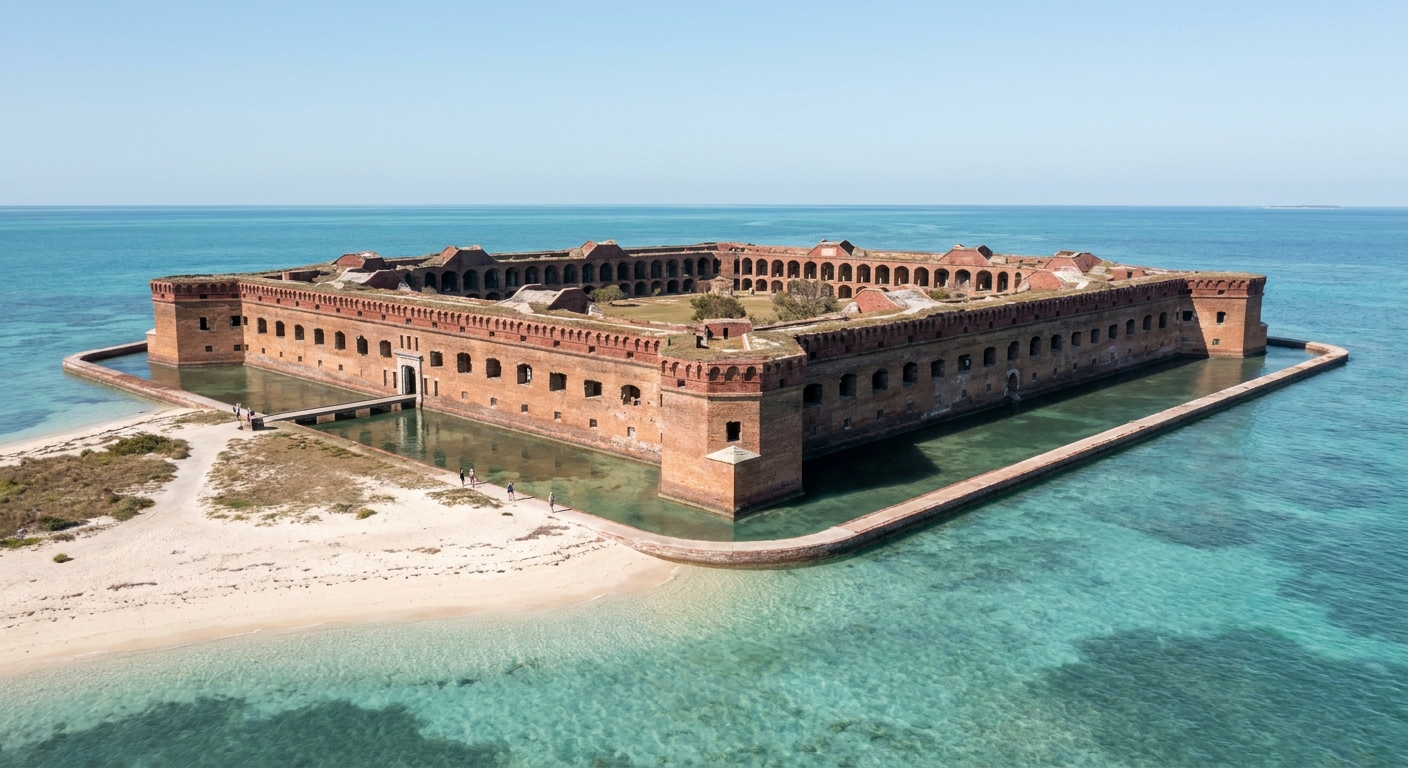
THE MONTH AT A GLANCE · DRY TORTUGAS IN JANUARY
Go in January to snorkel the moat wall in water that reaches 76.5°F by day and walk the fort in 75.8°F afternoons, with a warm layer for 65.5°F mornings on an exposed boat deck.
HIGHS 75.8°F · SEA 76.5°F BY DAY · 3.3 RAIN DAYS · SUNSET 6:01 PM
Go for: a Fort Jefferson walk in 75.8°F afternoons, moat-wall snorkeling in water that reaches 76.5°F by day, and a 6:01 p.m. sunset from the island if you camp.
Think twice before: booking one fixed island day with no spare, since crossings depend on the weather, or counting on warm water if you chill easily.
Air: NOAA NCEI, Key West station · Sea: Open-Meteo Marine · Light: sunrise-sunset.org · full sources at the end
On this page
- Dry Tortugas weather in JanuaryHighs of 75.8°F and 3.3 rain days
- Can you swim in January?Sea at 76.5°F by day, and what it feels like
- Crowds and prices in JanuaryDry-season demand and Key West lodging
- Things to do in JanuaryFort Jefferson, the moat wall and Loggerhead Key
- A two-day Dry Tortugas itineraryTwo days between a 7:11 a.m. sunrise and a 6:01 p.m. sunset
- January vs December or FebruaryHow the three months compare on heat, rain and sea
- Is January a good time to go?Who January suits, and when to go instead
Every figure here for air and rain comes from a thermometer in Key West, 70 miles east, because we found no official normals station on the islands themselves. Dry Tortugas sits alone in open Gulf, windier than Key West and with nothing between it and the weather, so read the normals below as the nearest official record and expect the park to feel breezier. The sea temperature is the one number measured off the park itself.
Dry Tortugas weather in January: average highs, lows and rain days
| January | Value | Source |
|---|---|---|
| Average high | 75.8°F (24.3°C) | NOAA NCEI, Key West |
| Average low | 65.5°F (18.6°C) | NOAA NCEI, Key West |
| Precipitation | 1.83 in | NOAA NCEI, Key West |
| Days with 0.10 in or more | 3.3 | NOAA NCEI, Key West |
| Daylight, Jan 15 | 10 h 49 min | sunrise-sunset.org |
| Sunrise / sunset, Jan 15 | 7:11 a.m. / 6:01 p.m. EST | sunrise-sunset.org |
Our air figures are the NOAA National Centers for Environmental Information normals for 1991 to 2020, read from station USW00012836 at Key West: a real thermometer with thirty years behind it, not a reanalysis grid cell. They give January an average high of 75.8°F, an average low of 65.5°F and 1.83 inches of precipitation. Because that station stands 70 miles east of Fort Jefferson, treat the numbers as a close neighbor’s record for the park.
Measurable rain, 0.10 inch or more, falls on 3.3 days in an average Key West January, about one day in nine. For a two-day trip, the odds favor two dry days. Spread the 1.83-inch monthly total over those few wet days and you get a little over half an inch each, closer to a passing soaking than a lost week. Pack a light shell for the boat all the same.
From the 75.8°F average high to the 65.5°F average low is a swing of 10.3°F, and at Dry Tortugas the cool end tends to meet you on a moving boat in open-Gulf wind. Bring a fleece or windbreaker for the crossing, a rash guard for the water, and, if you are camping on Garden Key, a warm layer and a proper sleeping bag for the night.
On January 15 the park gets about 10 hours 49 minutes of daylight. Converted from UTC to Eastern Standard Time, sunrise comes at 7:11 a.m. and sunset at 6:01 p.m. Plan photographs of the fort walls for the last hour before 6:01 p.m., and finish any snorkel well before dusk.
Can you swim in Dry Tortugas in January? Sea temperature and what it feels like
Sea surface off Dry Tortugas averages 76.5°F in January, according to the Open-Meteo Marine API averaged over 2015 to 2024. The figure is a mean of daily maxima, the warmest reading of each day, so it runs a shade warmer than a 24-hour average would. It also comes from a different source and period than the NOAA air normals, and we could not read a round-the-clock figure to set beside it.
Yes, you can swim. The water sits within a degree of the afternoon air, 76.5°F against a 75.8°F average high, so stepping in at midday feels mild for most swimmers. The chill comes from wind on wet skin after you climb out. A rash guard or thin wetsuit top helps on a long snorkel along the moat wall, and a towel with a dry layer should wait on the beach beside you.
Our sources carry no wind or swell figures for January, so we give none. We do know where the air record was taken: Key West, 70 miles east, while Dry Tortugas stands exposed in open Gulf. Boat and seaplane crossings depend on conditions, so check the marine forecast the day before and keep a spare day in your plan.
How busy is Dry Tortugas in January? Crowds and prices
January falls inside Florida’s dry season, November through April, the stretch the state’s winter travel trade is built on (our best-time guide covers the full year). We found no monthly visitor count or fare series for the park, so we call January neither the busiest nor the cheapest month.
Seats on the boats and the seaplane are limited, and so are campsites on Garden Key. We could not verify how many weeks ahead they sell out in January. Book the crossing as soon as your dates are firm, then book Key West nights around it on a flexible rate, since a weather cancellation can push your island day back by 24 hours. Where to stay in Florida covers the Key West bases.
The islands have no hotel, so any lodging tax you pay lands on the Key West room. We could not verify the lodging-tax rate that applies there, so we give no percentage. Ask for the all-in nightly total before you pay, and see what a Florida trip costs for budget tiers.
A night camping on Garden Key is where extra spending changes January most. It costs more than a day trip once you add gear and boat logistics, and we could not verify the campsite fee. Campers see the 6:01 p.m. sunset and the 7:11 a.m. sunrise from the island, hours that day visitors spend on the water or back in Key West.
Things to do in Dry Tortugas in January
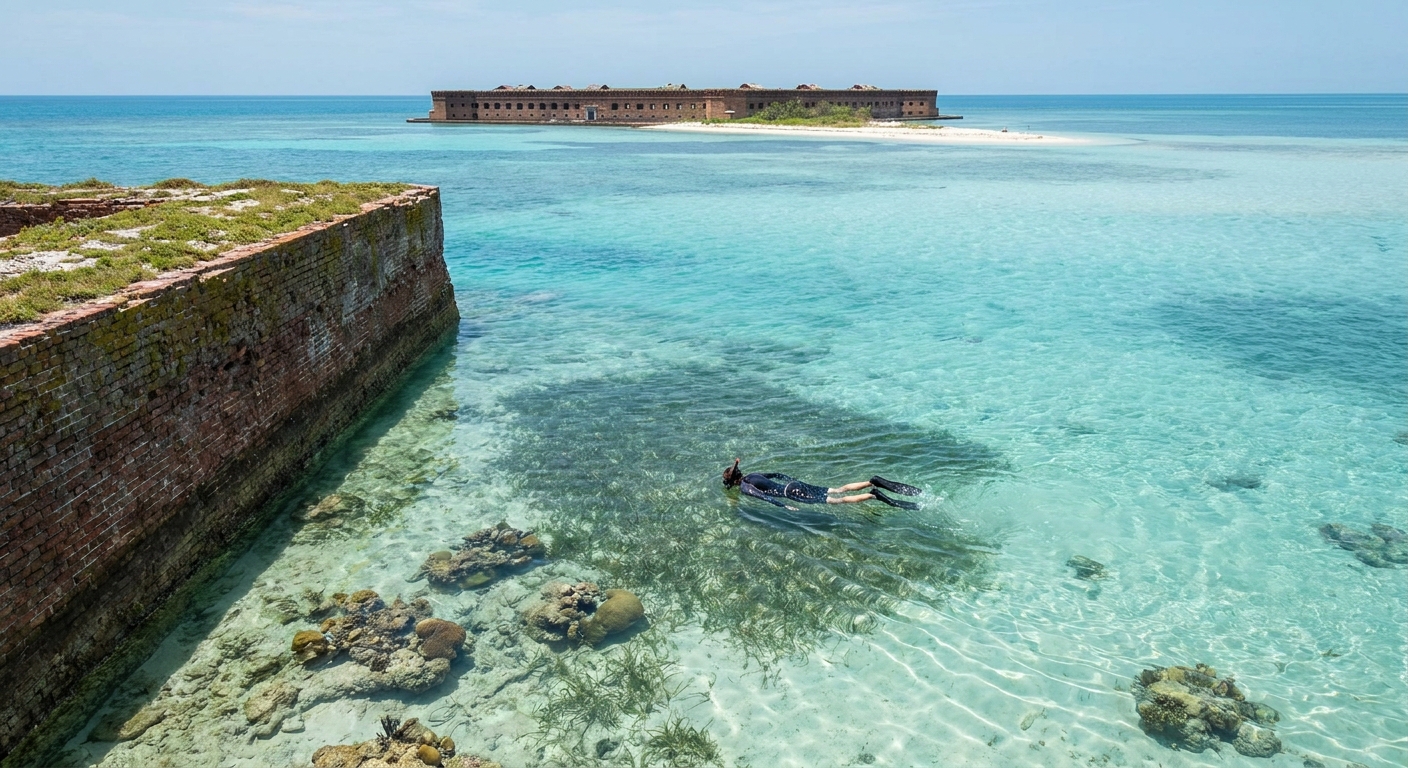
January brings the coolest afternoons of the three winter months on the Key West record, 75.8°F against 77.7°F in December and 77.4°F in February. On Garden Key the day splits between the fort’s brick walls and the water, with no town to retreat to, so a degree or two off the midday sun makes the fort walk easier.
Fort Jefferson fills most of Garden Key, and the walk runs through its brick casemates and up to the top tier for views across the water. The moat wall outside is the classic snorkel, in water averaging 76.5°F by day this month. Loggerhead Key, with its lighthouse, and Bush Key, a bird nesting site, sit nearby. Access to both varies by season and by operator, and we could not verify January’s rules or the park entrance fee.
The air shifts more than the sea as the winter moves on. Off the park, the water drops only 1.1°F from December to January, while average lows fall 2.8°F, to 65.5°F. So a morning on the fort’s upper tier feels fresh in January, and the midday water feels warm against the air: 76.5°F of sea beside a 75.8°F average high.
Our sources carry no free-entry day and no event for Dry Tortugas in January, so we list none. Once the crossing and the park fee are paid, the fort walk and a moat-wall snorkel with your own mask and fins cost nothing extra, and campers get the top-tier sunset thrown in.
Dry Tortugas in January: a two-day itinerary
Day one, the island. Fly into Key West the day before (our Florida flights guide has the routes), then leave your room early for the morning crossing. We could not verify January departure times, so confirm them at booking and bring a fleece for the 70 miles of open water. On Garden Key, walk Fort Jefferson first while the morning is still cool, then snorkel the moat wall around midday, when air and water both sit in the mid-70s. Campers should be on the top tier by 5:30 p.m. for the 6:01 p.m. sunset.
Day two, the spare. Campers get the 7:11 a.m. sunrise over the moat and a second snorkel before packing up. Day-trippers can spend it in Key West, or hold it as the fallback crossing if wind cancels day one. If the weather turns, swap the two days: keep the boat booking flexible, spend the rough day in town with our Key West guide, and cross once the forecast settles.
Dry Tortugas in January vs December and February
| Measure | December | January | February |
|---|---|---|---|
| Average high (NOAA, Key West) | 77.7°F | 75.8°F | 77.4°F |
| Average low (NOAA, Key West) | 68.3°F | 65.5°F | 67.1°F |
| Precipitation (NOAA, Key West) | 2.16 in | 1.83 in | 1.54 in |
| Days at 0.10 in or more | 3.1 | 3.3 | 2.4 |
| Sea surface, daily maxima (Open-Meteo, 2015-2024) | 77.6°F | 76.5°F | 76.3°F |
January trails both neighbors on the Key West thermometer. Its 75.8°F average high sits 1.9°F under December’s and 1.6°F under February’s, and its 65.5°F low sits 2.8°F and 1.6°F under theirs. It also logs the most rain days of the three, 3.3 against 3.1 and 2.4, though December carries more total rain at 2.16 inches to January’s 1.83. On the Open-Meteo marine figures, January’s 76.5°F sea is 1.1°F cooler than December’s 77.6°F and 0.2°F warmer than February’s 76.3°F.
Moving four weeks later to February keeps the water within 0.2°F, lifts the average high by 1.6°F and trims measurable-rain days from 3.3 to 2.4. Moving four weeks earlier to December adds 1.1°F of sea and nights 2.8°F warmer, along with the wettest total of the three. Our sources chart no booking pattern for either month, so price your Key West nights for both before you decide.
Is January a good time to visit Dry Tortugas?
Yes, if you snorkel comfortably in 76.5°F water with a rash guard, want to walk Fort Jefferson in afternoons near 75.8°F, and can sleep through a 65.5°F night on Garden Key. January suits you less if you run cold in the water, or if your dates cannot flex around a canceled crossing.
If January is a no, go in February: the same water within 0.2°F, afternoons 1.6°F warmer, and 2.4 rain days instead of 3.3. Choose December only if the sea matters most to you, since its 77.6°F is the warmest of the three months.
Among the three winter months we compared, January alone pairs the coolest afternoons for the fort walk, 75.8°F, with a sea that runs warmer than the average high.
The last word
Book the crossing first and build the rest of the trip around it, because a January day at Fort Jefferson depends on a boat seat and a calm sea more than on anything the averages promise. Then pack for the surprise they hide: a day with an inch or more of rain turns up 0.4 times in an average Key West January, roughly two Januarys in five. Carry a dry bag for the camera and hold one spare night in Key West.
Sources & data for this guide
- Air normals for January, December and February (highs, lows, precipitation, days at 0.10 in and 1 in or more) · NOAA NCEI monthly normals 1991-2020, station USW00012836, Key West, 70 miles east of the park · checked Sep 24, 2026
- Sea surface temperature for January (76.5°F), December (77.6°F) and February (76.3°F), mean of daily maxima · Open-Meteo Marine API, 2015-2024 average · checked Sep 24, 2026
- Daylight, sunrise and sunset on January 15 · sunrise-sunset.org, converted from UTC to EST (UTC-5) · checked Sep 24, 2026
- Dry season November to April · our Florida best-time guide, National Weather Service · checked Sep 24, 2026
- What we could not verify: ferry, seaplane and campsite rates and schedules, the park entrance fee, January access rules for Loggerhead and Bush Keys, the Key West lodging-tax rate, and any wind or swell data for the park. Confirm with the operators and the National Park Service before you book.