
DRY TORTUGAS · SEPTEMBER · THE MONTH GUIDE
Dry Tortugas in September means Fort Jefferson’s brick walls under an average high of 89.0°F, a sea that reaches about 88.3°F on a typical afternoon, and 7.24 inches of rain across the month at the nearest official weather station. The boat or seaplane ride out of Key West is the same in any month. September changes the weather you cross in and the water you step into at Garden Key.
It is also the heart of the Atlantic hurricane season, which NOAA’s National Hurricane Center places between June 1 and November 30, with a peak around September 10 (our Florida overview carries the dates). A trip that depends on a crossing of seventy miles of open water should be booked with a refund option, with a spare day held in Key West.
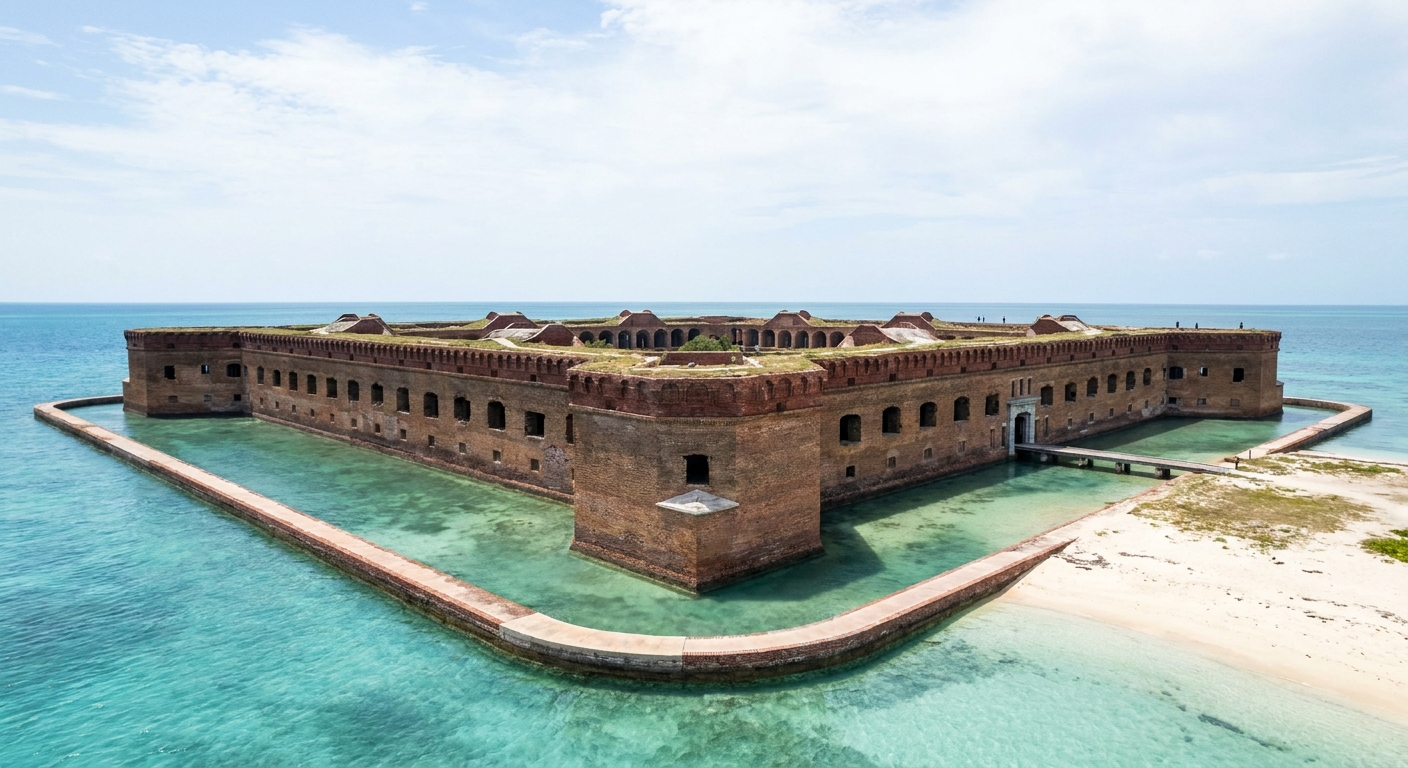
THE MONTH AT A GLANCE · DRY TORTUGAS · SEPTEMBER
September gives Garden Key a sea near 88°F and warm nights, in exchange for the wettest of the three late-summer months and the peak of hurricane season, so go with a flexible booking.
HURRICANE SEASON PEAK · KEY WEST STATION NORMALS · BOAT OR SEAPLANE ONLY
Go for: long snorkel sessions along the moat wall in water near 88°F, warm nights for Garden Key campers, and air 1.6°F below August’s average high.
Think twice before: booking a non-refundable crossing in the month of the hurricane-season peak, with a single fixed date and no spare day in Key West.
Climate: NOAA NCEI, Key West station · Sea: Open-Meteo Marine API · Light: sunrise-sunset.org · full sources at the end
On this page
- Dry Tortugas weather in SeptemberHighs of 89.0°F and 10.2 rain days
- Sea temperature in SeptemberAn 88.3°F daily-maximum sea
- Crowds and prices in SeptemberHurricane season, refunds and taxes
- Things to do in SeptemberFort Jefferson, Garden Key, Loggerhead Key
- Two-day Dry Tortugas itineraryKey West and Garden Key, hour by hour
- September vs August and OctoberHow the three months compare
- Is September a good time to visit?Who should go and who should wait
The Key West departure, the camping rules and the park fees change little from month to month, so we cover them elsewhere: our Key West guide for the town you sail from, Florida National Parks for fees and passes, and the Florida flights guide if you still need a way to fly into Key West. Planning a month earlier? The August conditions are on Dry Tortugas in August.
Dry Tortugas weather in September: average highs, lows and rain days
| September normal | Value |
|---|---|
| Average high | 89.0°F |
| Average low | 79.2°F |
| Precipitation | 7.24 in |
| Days with 0.10 in or more | 10.2 |
| Days with 1 in or more | 1.9 |
| Daylight, Sept 15 | 12 h 19 min |
| Sunrise / sunset, Sept 15 | 7:12 a.m. / 7:31 p.m. EDT |
Every figure here comes from NOAA’s National Centers for Environmental Information: the official 1991-2020 normals for the Key West station (USW00012836). That is a real thermometer, not a reanalysis grid cell, but it stands seventy miles east of Fort Jefferson. Dry Tortugas sits alone in open Gulf water, windier and with nothing between it and the weather. Treat the average high of 89.0°F and low of 79.2°F as Key West’s reading, from a close neighbor with more land around it.
The same station logs at least 0.10 inch of rain on 10.2 days of an average September, roughly one day in three. Of those, 1.9 days cross the inch mark and the other 8.3 stay below it. A day under an inch can still bring a storm cell over the boat ride or cut a snorkel session short, so pack a light rain shell and a dry bag for phone and camera.
The gap between the 89.0°F average high and the 79.2°F low is 9.8°F, so no sweater is needed on Garden Key, even after dark. Pack for sun and sweat instead: a wide-brimmed hat, reef-safe sunscreen, a long-sleeved sun shirt for the fort’s open upper level, and more drinking water than the day seems to call for. Campers should bring their lightest sleeping layer.
On September 15, sunrise-sunset.org gives about 12 hours 19 minutes of daylight, with sunrise at 11:12 UTC and sunset at 23:31 UTC, which converts to 7:12 a.m. and 7:31 p.m. Eastern Daylight Time. If you hold a Garden Key campsite, that sunset is yours to watch from the island. Day visitors should check their boat’s return time against it when they book.
Can you swim in Dry Tortugas in September? Sea temperature
Open-Meteo’s Marine API puts the sea surface off Dry Tortugas at 88.3°F in September, averaged over 2015-2024. That value is a mean of daily maxima, the warmest reading of each day, so it runs a shade warmer than a 24-hour average would. Its period and source also differ from the air normals above, which cover 1991-2020 at a station seventy miles away.
At 88.3°F, walking in off Garden Key’s beach brings no cold shock, and a snorkeler can stay out along the moat wall without a wetsuit for warmth. Water that warm cools the body very little, though. Rest in shade and drink between sessions, and wear a rash guard against the sun rather than a wetsuit.
We could not read a wind or swell series for Dry Tortugas in September, so we give no figure. The station caveat still applies: the island is exposed in open Gulf and windier than Key West. Crossings can be canceled or turned back for weather, so keep the booking flexible and read our Florida safety guide for hurricane advice before you travel.
How busy is Dry Tortugas in September? Crowds and prices
September falls inside hurricane season, a calendar position we can state. A price or crowd ranking is another matter: we found no ferry-occupancy or monthly fare series, so we call no month cheap, busy or empty.
We could not verify how far ahead the Key West boats sell out in September, so we give no number of weeks. Our advice rests on the calendar instead. Book a fare with a refund or date-change option, and hold one buffer day in Key West so a weather cancellation moves the trip instead of ending it. Our Florida overview gives the same advice for any fall booking.
We could not verify the lodging-tax rate on a Key West hotel stay, so we give no percentage. Ask for the total with taxes and fees when you book the nights before and after the crossing. Camping on Garden Key is a separate reservation under National Park Service rules.
Flexibility is the one line where paying more changes a September trip. A refundable boat fare or hotel rate costs more than a locked one (we could not verify by how much), but with NOAA placing the hurricane peak around September 10, the refund protects the whole trip. Our Florida trip-cost guide prices the rest of the budget.
Things to do in Dry Tortugas in September
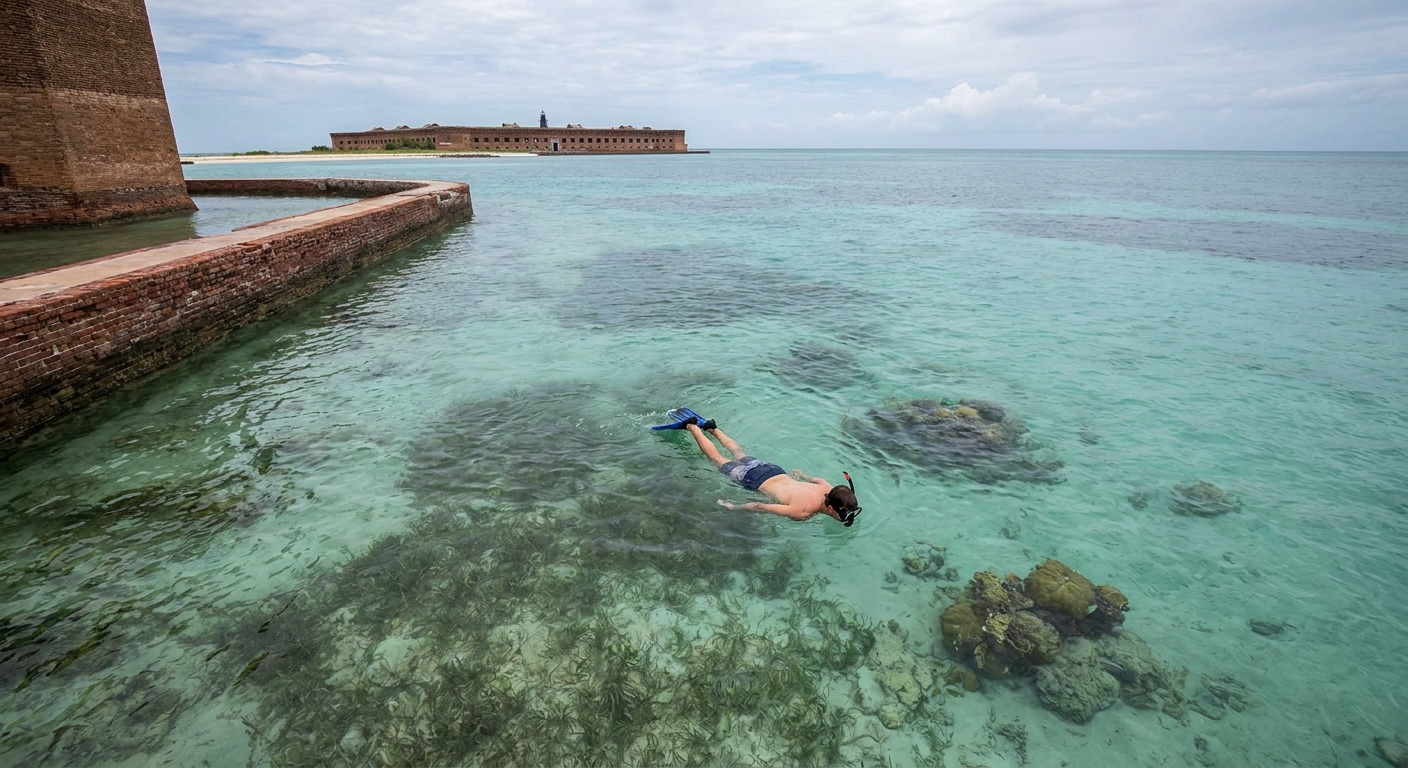
September keeps the sea within half a degree of August, at 88.3°F against 88.8°F on the Open-Meteo daily maxima, while the Key West average high eases from 90.6°F to 89.0°F. October’s water drops to 84.2°F, still swimmable, under a high 3.2°F lower. Swimmers who want warm water and air a notch below August’s peak get both in September.
Fort Jefferson is the reason for the crossing: a brick fortress covering most of Garden Key, with a moat wall that doubles as the island’s snorkel route. Garden Key’s small beaches give the easy water entry. Loggerhead Key and its lighthouse lie farther west and need a separate boat. We could not verify the 2026 fort hours or the park entrance fee, so we quote neither. Our Florida national parks guide carries fees and passes. Every snorkel spot shares the 88.3°F sea reading.
The fort’s bricks hold the day’s heat, and that is the September variable. The sea stays near 88.3°F from morning to afternoon, while the air climbs toward an 89.0°F average high with little shade on the upper level. Walk the walls in the first hours after landing and save the moat wall for the hottest stretch of the day.
We could not confirm a National Park Service fee-free day in September, so we name none. Once you are on Garden Key, the moat-wall snorkel with your own gear and the walk around the fort’s perimeter cost nothing extra, and campers add the 7:31 p.m. sunset.
Dry Tortugas in September: a two-day itinerary
Day one is crossing day. Sunrise is at 7:12 a.m. Be at the Key West dock for the earliest boat you could book, with hat, water and snorkel gear packed. On landing, walk Fort Jefferson’s upper level first, while the heat is still building toward the 89.0°F average. Take lunch in the shade of the casemates, then spend the early afternoon in the water along the moat wall, where the sea runs near 88.3°F. Day visitors follow their boat’s return time, and campers stay for the 7:31 p.m. sunset.
Day two is for Key West, or for Garden Key if you camped: an early swim before your boat picks you up, then the crossing back. If the weather turns (the station counts 1.9 days a month with an inch or more of rain), swap the days. Spend the storm in Key West, where our Key West guide lists the indoor options, and cross on the buffer day. A cancellation notice from the operator overrides any plan.
Dry Tortugas in September vs August and October
| Normal | August | September | October |
|---|---|---|---|
| Average high (Key West station) | 90.6°F | 89.0°F | 85.8°F |
| Average low (Key West station) | 80.5°F | 79.2°F | 76.8°F |
| Precipitation | 5.37 in | 7.24 in | 5.67 in |
| Days with 0.10 in or more | 9.1 | 10.2 | 7.6 |
| Sea surface, daily max (Open-Meteo, 2015-2024) | 88.8°F | 88.3°F | 84.2°F |
Against August, September loses 1.6°F off the average high and 1.3°F off the low, gains 1.87 inches of rain (7.24 against 5.37) and 1.1 more wet days, and gives up 0.5°F of sea temperature. October drops a further 3.2°F in the high and 2.4°F in the low, falls to 5.67 inches over 7.6 wet days, and loses 4.1°F of sea, down to 84.2°F. Of the three months, September carries the most rain.
Moving four weeks earlier into August buys 1.87 fewer inches of rain and half a degree more sea, for a hotter 90.6°F average high. Moving four weeks later into October trades 4.1°F of water for 2.6 fewer rain days and an 85.8°F high on the fort walls. Both neighbors still fall inside the June 1 to November 30 hurricane season, so the refundable booking stays the rule either way.
Is September a good time to visit Dry Tortugas?
Yes, for travelers who want water near 88°F at Garden Key and can book flexibly: an 88.3°F sea and a 9.8°F day-night spread make snorkeling and camping easy on the body. No, for anyone with one fixed date and a non-refundable fare, since September holds the hurricane-season peak and 7.24 inches of rain at Key West.
If the answer is no, pick October. Its 5.67 inches and 7.6 wet days sit below September’s 7.24 and 10.2, the average high falls to 85.8°F, and the sea still reads 84.2°F on the Open-Meteo daily maxima. October is still hurricane season, so flexibility still counts, but the fort walk runs 3.2°F cooler.
September gives Dry Tortugas water within half a degree of August’s 88.8°F under an average high 1.6°F lower.
The last word
Book the refundable fare, add a spare night in Key West, and pick the crossing day from the forecast. For campers, one more number: the 88.3°F daily-maximum sea reading sits 9.1°F above Key West’s 79.2°F average low, so a swim off Garden Key after the 7:31 p.m. sunset happens in water that reads warmer than the night air. Pack the mask for the evening as well as the morning.
Sources & data for this guide
- Air normals for August, September and October (highs, lows, precipitation, rain days), 1991-2020 · NOAA NCEI monthly normals, Key West station USW00012836, seventy miles east of Dry Tortugas · checked Sep 24, 2026
- Sea surface temperature, mean of daily maxima, 2015-2024 · Open-Meteo Marine API · checked Sep 24, 2026
- Daylight, sunrise and sunset on September 15 (UTC, converted to EDT) · sunrise-sunset.org · checked Sep 24, 2026
- Hurricane season dates and September 10 peak · NOAA National Hurricane Center, via our Florida overview · checked Sep 24, 2026
- We could not verify 2026 ferry fares, departure times, fort hours, the park entrance fee, the Key West lodging-tax rate or any wind and swell series, so we quote none of them. Check operators and the National Park Service when you book.