
FLORIDA · DRY TORTUGAS · FEBRUARY
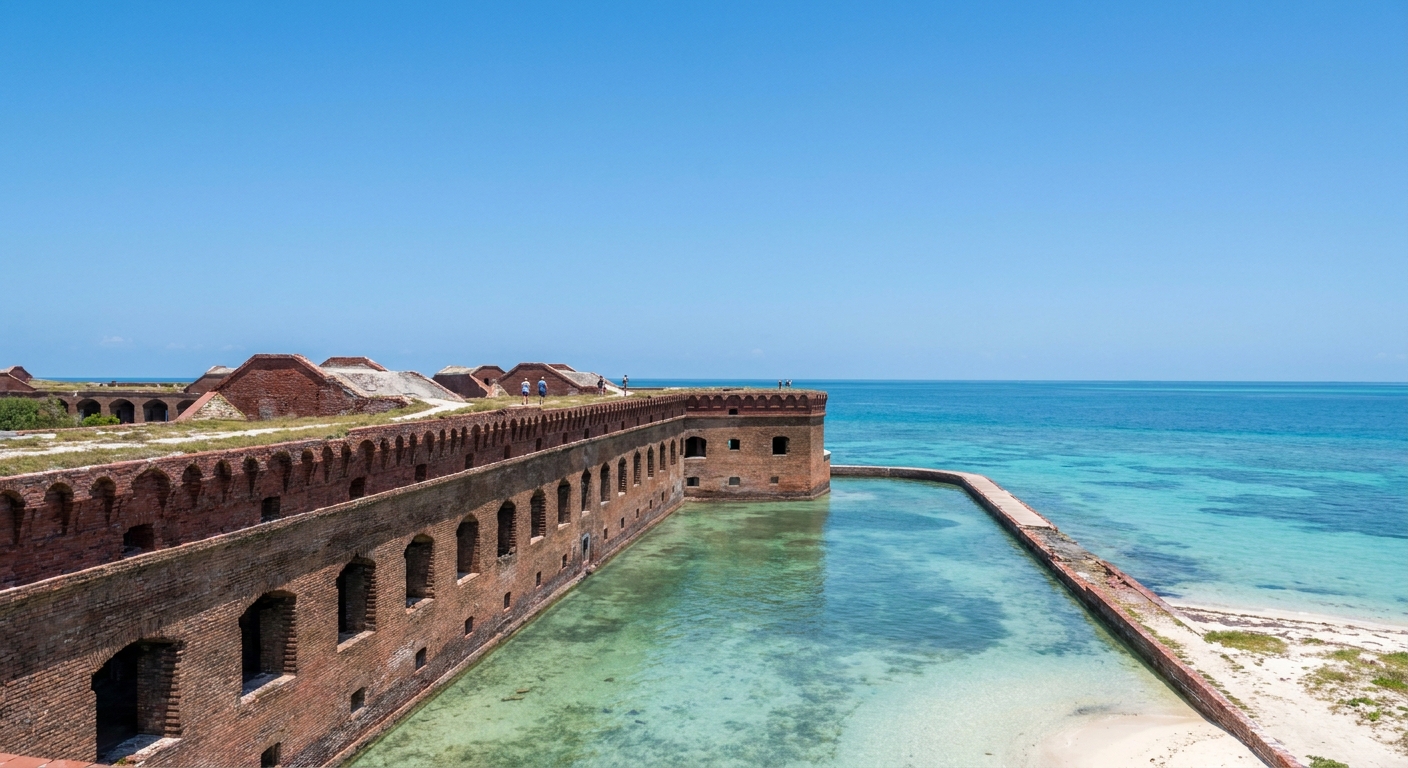
Dry Tortugas sits about seventy miles west of Key West. It is a cluster of low keys around a brick fort, and you reach it only by boat or seaplane. February brings afternoons of 77.4°F, water around 76°F and fewer rain days than either January or March. The planning work is getting a seat on the crossing and packing for wind on the water.
February also has a catch. The weather that matters out there is the wind over open water, and the best measurements come from land in Key West. We keep what was measured apart from what we could not verify. The park basics are in our Florida national parks guide, and the town half of the trip is in our Key West guide.
FEBRUARY AT A GLANCE · DRY TORTUGAS
February pairs 77.4°F afternoons with 76.3°F water and the fewest rain days of January to March, so book the Key West crossing first, pack a layer for the boat and swim at midday.
DRY SEASON · 2.4 RAIN DAYS · BOAT OR SEAPLANE ONLY
Go for: a full outdoor day on the fort walls, snorkeling along the moat wall, and dry nights for campers on Garden Key.
Think twice before: planning around the warmest water of spring. March runs 2.3°F warmer at sea.
Air: NOAA NCEI, Key West station · Sea: Open-Meteo Marine API · Light: sunrise-sunset.org · full sources at the end
On this page
- Dry Tortugas weather in February77.4°F highs, 67.1°F lows, 2.4 rain days
- Is the water warm enough to swim?76.3°F sea surface, and what it feels like
- Crowds, booking and lodging taxDry-season demand and the Key West room
- Things to do in FebruaryFort Jefferson, the moat wall, Loggerhead Key
- A two-day February itineraryGarden Key from sunrise at 6:59 a.m.
- February vs January and MarchHow the three months compare, air to sea
- Is February a good time to go?Who should go, and when to go instead
Every figure here comes from instruments or models that are not on the island itself. The air normals are from the NOAA station at Key West, seventy miles east, while Dry Tortugas stands alone in open Gulf, windier and with nothing between it and the weather. Take them as the baseline and add wind. The month before runs on the same station in Dry Tortugas in January.
Dry Tortugas weather in February: average highs, lows and rain days
| February normal | Value |
|---|---|
| Average high (Key West station, 1991–2020) | 77.4°F |
| Average low (Key West station, 1991–2020) | 67.1°F |
| Precipitation, whole month | 1.54 in |
| Days with 0.10 in or more | 2.4 |
| Daylight on February 15 | 11 h 23 min |
| Sunrise / sunset, February 15 | 6:59 a.m. / 6:22 p.m. EST |
NOAA’s National Centers for Environmental Information publish the 1991–2020 normals for station USW00012836, a real thermometer at Key West rather than a reanalysis grid cell. For February it records an average high of 77.4°F, an average low of 67.1°F and 1.54 inches of precipitation across the month. At Garden Key the air arrives straight off open water, so read the temperatures as a guide and expect more wind than the town gets.
Measurable rain, 0.10 inch or more, falls on 2.4 days in an average February. That works out to about one day in twelve, so a three-day window usually stays dry. When a wet day does land, the fort’s covered casemates give shelter on the island. A squall over the crossing is the bigger concern, because the boat is the only way on and off.
The gap between the 77.4°F afternoon and the 67.1°F night is 10.3°F, and on the water it feels wider. A morning crossing leaves in air near the low, with wind across open Gulf, and snorkelers climb out wet into that same breeze. Pack a windbreaker, a dry top for after the swim and, if you camp on Garden Key, a warm layer for the hours after dark.
On February 15 the island gets about 11 hours 23 minutes of daylight. Converted to Eastern Standard Time, sunrise comes at 6:59 a.m. and sunset at 6:22 p.m. Campers on Garden Key are the visitors who see that sunset from the island, and the last hour before it puts the softest light of the day on the brick.
Can you swim in Dry Tortugas in February? Sea temperature and what it feels like
The Open-Meteo Marine API puts the sea surface off Dry Tortugas at 76.3°F in February, averaged over 2015–2024. That figure is the mean of daily maxima, the warmest reading of each day, so it runs a shade above a 24-hour mean. Tables built on round-the-clock averages will print a lower number for the same water, and both describe it correctly from different angles.
In practice, the water sits about a degree below the 77.4°F afternoon high and roughly nine degrees above the 67.1°F night. Going in at midday, closest to the day’s maximum, is the gentlest version. A rash guard or a thin wetsuit top makes an hour along the moat wall comfortable for most swimmers. The chill usually comes when you step out into the wind.
We could not read a wind or swell series for Dry Tortugas in February, so we give no knots and no wave heights. Its position we do know: open Gulf, seventy miles from the Key West station, with no land to break the weather. Check the marine forecast the evening before the crossing and keep the second day of your trip free in case the boat stays in port.
How busy is Dry Tortugas in February? Crowds and prices
February falls inside Florida’s November-to-April dry season, the busy stretch of the state’s calendar, as our best-time guide lays out. We found no monthly visitor count for the park and no Key West room-rate series, so we rank no month as the busiest or the most expensive. Plan like a peak-season traveler.
Every visit runs through a limited number of boat and seaplane seats out of Key West. We could not verify how many weeks ahead February departures sell out, so we give no count. Book the crossing first, then the Key West room around it, and fly in or drive the Overseas Highway once the seat is confirmed. Our flights guide covers the airports.
We could not verify the lodging-tax rate for Key West or Monroe County, so we print no percentage. Ask for the total with taxes when you book the room, and set it against the budget lines in our Florida trip-cost guide.
Paying more changes February on one line: a refundable Key West room, or a second night held in reserve. If weather calls off a crossing, a flexible booking lets you slide the island to the next morning instead of losing it. Our where-to-stay guide compares the options.
Things to do in Dry Tortugas in February
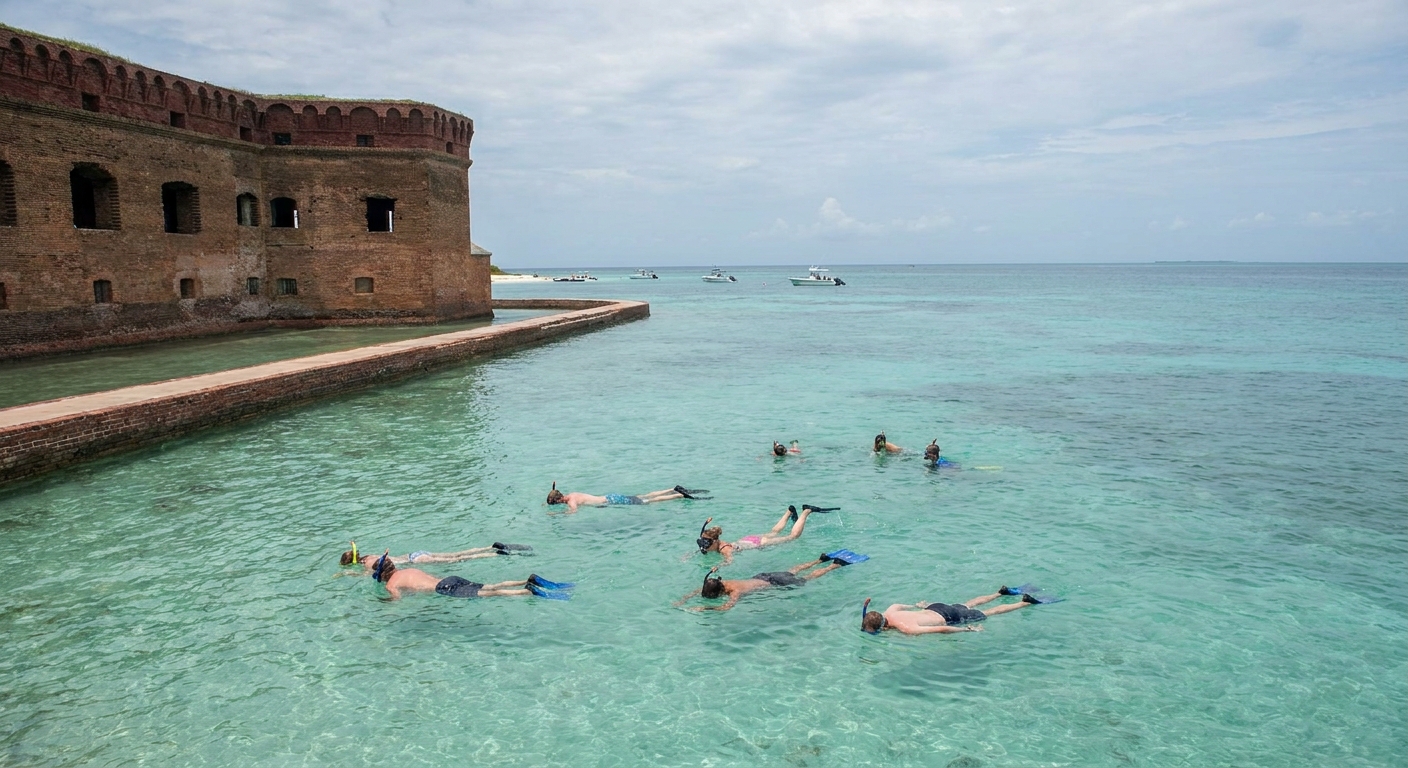
February pairs the fewest rain days of the January-to-March run, 2.4, with afternoons of 77.4°F. On a small key, that allows a full day outside on the fort walls without the 90-degree wet-season heat described in our Florida overview.
Fort Jefferson covers most of Garden Key, and its brick walls, casemates and upper tier make up the walking half of the day. The snorkeling half runs along the outside of the moat wall, in the 76.3°F water measured off the islands. Across the channel, Loggerhead Key and its lighthouse make the farther goal. We could not verify a February boat schedule or fare to reach it, so we list none.
The water barely moves between January and February, 76.5°F to 76.3°F, while the afternoon air climbs 1.6°F. In January the sea is 0.7°F warmer than the average high. February flips that, with the air leading the water by 1.1°F, so drying off on the beach after a snorkel gets easier.
We could not verify the current park entrance fee or any fee-free day in February, so we call nothing free. Confirm three costs before you go: the crossing, the entrance fee and, for campers, the site fee.
Dry Tortugas in February: a two-day itinerary
Day one: sleep in Key West and be at the dock before the 6:59 a.m. sunrise, windbreaker on for a crossing in air near 67.1°F. Walk Fort Jefferson’s walls and casemates in the morning, while the low sun lights the brick. Snorkel the moat wall around midday, when the water is closest to the daily maximum behind its 76.3°F average. Campers stay on Garden Key and watch the 6:22 p.m. sunset from the island.
Day two opens at 6:59 a.m. on the fort’s upper tier, followed by a second snorkel before the boat back. If the forecast turns and the crossing is called off, spend the day in Key West with our Key West guide and move the island to the next calm morning. A passing shower on the island itself matters less, since the casemates stay dry.
Dry Tortugas in February vs January and March
| Normal | January | February | March |
|---|---|---|---|
| Average high (NOAA, Key West, 1991–2020) | 75.8°F | 77.4°F | 79.6°F |
| Average low (NOAA, Key West, 1991–2020) | 65.5°F | 67.1°F | 69.3°F |
| Precipitation | 1.83 in | 1.54 in | 1.53 in |
| Days with 0.10 in or more | 3.3 | 2.4 | 2.9 |
| Sea surface (Open-Meteo Marine, 2015–2024) | 76.5°F | 76.3°F | 78.6°F |
February’s average high sits 1.6°F above January’s and 2.2°F below March’s, on the same Key West station and period. Rain days fall from 3.3 in January to 2.4 in February, then rise to 2.9 in March. Monthly rain totals are nearly flat between February and March, 1.54 and 1.53 inches. At sea, the Open-Meteo Marine figures put February 0.2°F under January, while March jumps 2.3°F to 78.6°F.
Moving four weeks earlier costs you 1.6°F of afternoon air and nearly one extra rain day, for water that is 0.2°F warmer. Moving four weeks later gains 2.2°F of air and 2.3°F of sea for half a rain day more. Our Florida overview flags March as spring-break month in the state’s beach towns. We have no visitor count for the park itself.
Is February a good time to visit Dry Tortugas?
Yes, for snorkelers comfortable in 76.3°F water with a layer, for campers who want dry nights around 67.1°F, and for anyone building a Key West trip around one island day. No, if warm water is the point: February’s sea is the coolest of the three months, and March runs 2.3°F warmer.
Go in March if the water decides it: 78.6°F on the same marine model, a 79.6°F average high, and 2.9 rain days against February’s 2.4. You trade half a rain day for 2.3°F of sea.
Of January, February and March, February alone combines the fewest rain days with an afternoon that runs warmer than the sea.
The last word
Book the crossing before anything else, and keep a spare day in Key West behind it. A downpour of an inch or more lands on 0.4 day in an average February at the Key West station, roughly two Februaries in five. Pack a dry bag anyway, and keep your phone and camera inside it for the ride out across open Gulf.
Sources & data for this guide
- February air normals (77.4°F high, 67.1°F low, 1.54 in, 2.4 days at 0.10 in+, 0.4 day at 1 in+) · NOAA NCEI monthly normals 1991–2020, station USW00012836, Key West · checked Sep 24, 2026
- Station placement · the Key West station sits about seventy miles east of Dry Tortugas, and conditions on the island run windier · NOAA NCEI · checked Sep 24, 2026
- January and March air normals · NOAA NCEI 1991–2020, same station · checked Sep 24, 2026
- Sea surface for January, February and March · Open-Meteo Marine API, mean of daily maxima 2015–2024 · checked Sep 24, 2026
- Daylight and sunrise/sunset on February 15 · sunrise-sunset.org, converted from UTC to EST · checked Sep 24, 2026
- What we could not verify: ferry and seaplane fares and schedules, the Loggerhead Key boat, park entrance and camping fees, the lodging-tax rate, monthly visitor counts, and wind or swell data. We give no figure for any of them. Confirm with the park and the operators when you book.
To plan your stay
- Best Time to Visit Dry Tortugas: Weather, Sea Temperature and the Quiet Months
- Dry Tortugas in January: Weather, Sea Temperature, Crowds and a Two-Day Plan
- Dry Tortugas in March: Weather, Sea Temperature, Crowds and a Two-Day Itinerary
- Dry Tortugas in April: Weather, Sea Temperature, Crowds and a Two-Day Itinerary