
MIAMI · THE CITY GUIDE · 25.8° N
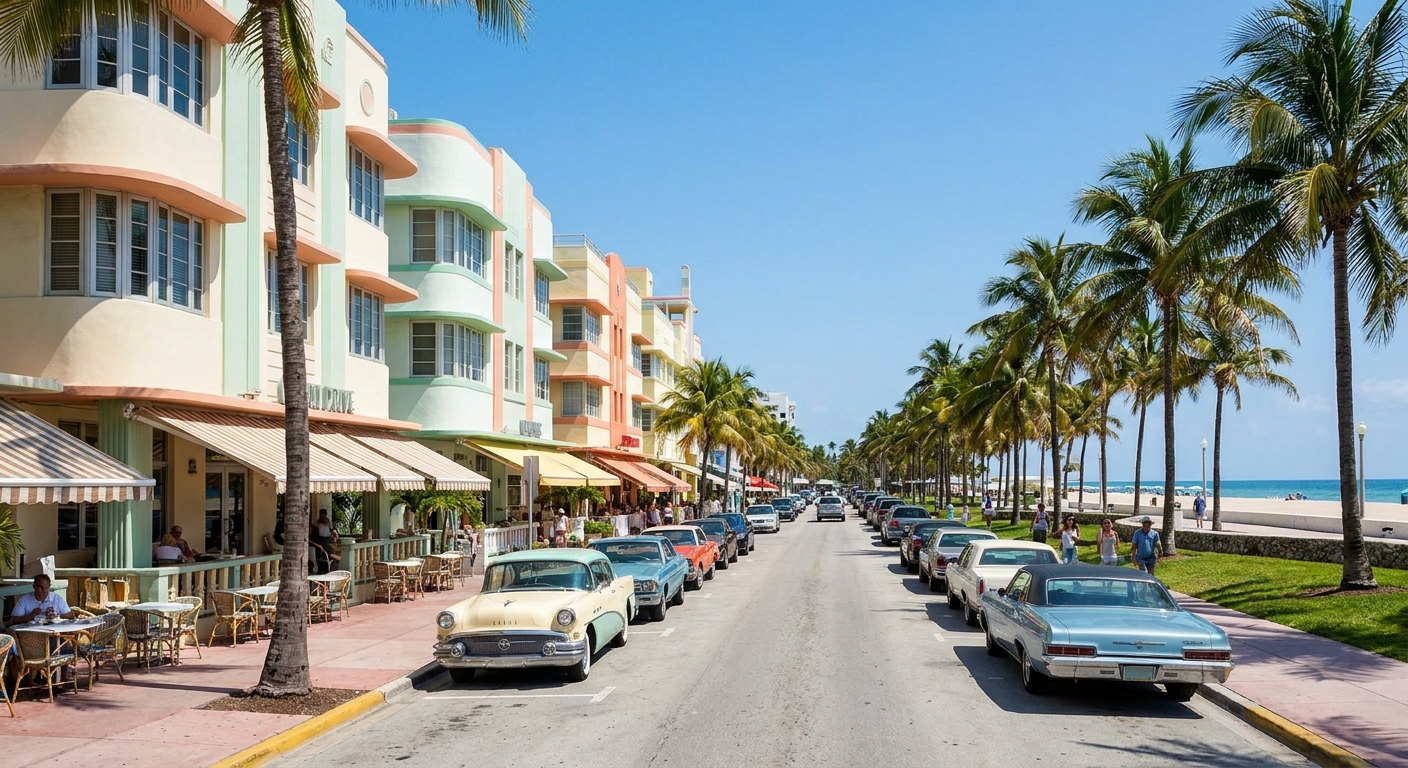
Say “Miami” out loud and you may be naming more than one city government. The pastel hotels along Ocean Drive and the sand in front of them belong to Miami Beach, built on natural and man-made barrier islands. The murals of Wynwood, the coffee windows of Little Havana and the free Metromover loop belong to the City of Miami, on the mainland. Biscayne Bay lies between the two.
That distinction is not trivia, it is your morning. Each side runs its own free transit and neither network crosses the water, so the bay is the gap you plan around: Metrobus Route 120, the Beach MAX, is what bridges it, at $2.25. Get the address right and Miami becomes one of the few Florida trips that runs with no car at all. That matters most in March, when the island’s garages switch to flat rates.
THE CITY AT A GLANCE · MIAMI
Book the island for a walk-to beach at Lummus or the mainland for Vizcaya and a free Metromover, then cross the bay on Route 120. The spring-break parking and towing figures quoted here are Miami Beach’s 2026 measures.
DRY SEASON DEC–APR · HOTEL RATES HIGHEST FEB–APR · TWO CITY GOVERNMENTS, ONE NAME
Go for: a free beach at Lummus, Vizcaya at $20 while restoration work is underway, PAMM free on Thursday evenings, and a week that works without a rental car.
Think twice before: driving into South Beach in March, when the four Art Deco District garages go to flat rates and non-resident towing ran $548 in 2026.
Fares and Metromover: Miami-Dade County · Trolley and Lummus Park: City of Miami Beach · full sources at the end
On this page
- Miami or Miami Beach: which city to bookThe two cities, with 2020 census figures
- Things to do in Wynwood, Little Havana and Coconut GroveThe neighborhoods, and Vizcaya’s hours
- A free beach in South BeachLummus Park, and parking rates elsewhere
- Best months to visit MiamiDecember to April, and what summer is
- Getting from MIA to South BeachMIA Mover, Metrorail, Route 150
- Getting around Miami without a carFree trolley, free Metromover, Route 120
- Miami in March 2027Ultra, the Miami Open, 2026’s parking rates
- Everglades day trip from MiamiThe $35 vehicle fee and the drive between gates
Biscayne Bay is the whole complication. The two cities travelers mean when they say Miami sit on opposite shores of it, the free rides on each side stop at the water, and the bus that crosses charges a fare. Everything below is sorted by which side of that water you wake up on.
Miami or Miami Beach: where to stay and how the two differ
| City | Where it sits | Population (2020 census) | What’s at the address |
|---|---|---|---|
| City of Miami | Mainland, west of Biscayne Bay | 442,241 | Wynwood, Little Havana, Coconut Grove and Vizcaya, Downtown and Brickell with the free Metromover |
| City of Miami Beach | Barrier islands, east across the bay | 82,890 | South Beach, Lummus Park along Ocean Drive, the free trolley on five routes |
| City of Coral Gables | A separate municipality of Miami-Dade, not part of the City of Miami | Not in our sources | Its own police force and zoning code since April 29, 1925 |
Miami Beach is a city, not a district of Miami. It stands on natural and man-made barrier islands with the bay behind it, and the 82,890 residents counted there at the 2020 census are outnumbered roughly five to one by the 442,241 counted the same year in the City of Miami. Two governments, two transit systems, one name on the airport signs.
There is a third city in the mix, and it is the one that trips people up. Coral Gables is not inside the City of Miami: it was incorporated on April 29, 1925 and runs its own police and planning, one of several separate municipalities in Miami-Dade County. Wynwood, Little Havana and Coconut Grove are a different case. Those three are mainland neighborhoods of the City of Miami, and Vizcaya stands in Coconut Grove, not in Coral Gables.
What the address changes is which free ride waits at your door. From a bed on the island, the trolley stops within a few blocks and Lummus Park is a walk. From Brickell or Downtown, the Metromover comes every 90 seconds at rush hour and the Metrorail Orange Line reaches the airport. Nothing free connects the two sides, so a room on the wrong shore adds a bus fare to every plan you make.
If you want both, splitting the week beats commuting across the bay twice a day: nights on the island for beach mornings, then nights on the mainland for Vizcaya, the murals and the museum evenings. Prefer one hotel? Base Downtown, where the Metromover is at the corner, and take Route 120 over the MacArthur Causeway on beach days. One bus fare each way is cheaper than the flat-rate garages.
Miami neighborhoods: South Beach, Wynwood, Little Havana and Coconut Grove
South Beach is the southernmost neighborhood of Miami Beach, and it stacks the Art Deco blocks, the sand and the noise into the same square mile. The beach fronting Ocean Drive is Lummus Park. Days here are short on ticketed sights and long on walking, with the trolley’s South Beach Loops A and B circling the same streets you have already covered on foot.
Across the bay, the City of Miami gives you Wynwood’s murals and Little Havana’s coffee counters, both neighborhoods to walk rather than single addresses. Then Coconut Grove, where Vizcaya Museum and Gardens overlooks Biscayne Bay: Wednesday to Monday from 9:30 a.m., last admission 4:30 p.m., closed Tuesdays, $20 for adults during restoration work instead of the usual $25, $5 for children 6 to 12 and free under six. The Vizcaya Metrorail station is a few minutes’ walk away.
Downtown and Brickell are Metromover country, and the Pérez Art Museum Miami sits on the bayfront there. Admission is free from 5 to 9 p.m. every Thursday, and free all day on the second Saturday of each month, with art-making from 11 a.m. to 3 p.m. Coral Gables belongs on an afternoon list too, with the reminder that it is a city of its own rather than a quarter of either neighbor.
Miami beaches: Lummus on Ocean Drive, plus South Pointe and Crandon parking
Lummus Park is the beach in front of Ocean Drive, running between 5th and 15th Streets in South Beach. Entry is free, the sand is open 24 hours, and the city posts lifeguards, public restrooms and picnic tables along it. A beach day here can cost nothing at all. The costs start at the parking meter, which is a separate conversation from the sand.
Two other named beaches carry a charge, and it lands on the car rather than the person. South Pointe Park is free to walk into; its public lot starts at $2 an hour and flips to a $20 flat day rate on weekends and public holidays. Crandon Park, over on Key Biscayne, charges $7 to park on weekdays and $10 at weekends. Both figures are parking rates, not admission, and both are the kind of rate that changes: check before you drive.
Best time to visit Miami: dry season months, summer heat and hurricane season
December through April is the dry, warm season, with days roughly 65°F to 80°F and none of the summer humidity. Hotel rates do not follow the whole block evenly: market data puts the lows in August to October and the highs in February to April, a trend from the industry rather than an official statistic. Early December brings Art Basel Miami Beach to the Miami Beach Convention Center in South Beach, and published 2026 dates differ between sources, so confirm before booking flights around it.
The winter sea is the argument for coming here in January rather than anywhere else in the country. It averages about 72°F through the winter and is the warmest water in the United States outside the tropical islands in December, January and February. Sources disagree on the January number, somewhere between about 72°F and 76°F. Either way, people swim.
Summer is a different trip wearing the same address. Highs reach about 90°F with humidity between 85 and 90 percent, afternoon thunderstorms are part of the day, and rain peaks in June. The Atlantic hurricane season runs June 1 to November 30 and peaks on September 10, with most activity between mid-August and mid-October. Those are also the months when the room rate falls, and the reason it falls.
Miami airport (MIA) to Downtown and Mid Beach: MIA Mover, Metrorail, Route 150
MIA sits about 12 miles from South Beach, a 20 to 45 minute drive depending on traffic, and Fort Lauderdale is about 25 miles out, 35 to 50 minutes on I-95 (drive times indicative, not timetables). From the terminals, the MIA Mover is free and runs to the Miami Intermodal Center, where the Metrorail Orange Line heads to Downtown Miami roughly every 15 minutes from about 5 a.m. to midnight. One ride is $2.25 whatever the distance, transfers to and from Metrobus cost nothing, and fare capping stops the day at $5.65. A proposed fare increase was voted down, so that figure stands.
Route 150, the Miami Beach Airport Express, is the one-seat ride to the island. It leaves from the airport’s Metrorail station, crosses the Julia Tuttle Causeway and runs seven days a week from about 5 a.m. to midnight, roughly every 30 minutes, with luggage racks on board and the same single fare each way. Read the destination carefully: it sets you down in Mid Beach, not South Beach. From there the free trolley takes over, with the Middle Beach route and the Collins Express working the length of Collins Avenue.
Getting around Miami without a car: the free trolley
The Miami Beach trolley costs nothing and runs 8 a.m. to 11 p.m., seven days a week, about every 20 minutes, on five routes: South Beach Loop A and B, Middle Beach, North Beach and the Collins Express, a limited-stop run along the full length of Collins Avenue. Note the 11 p.m. finish. Dinner on Ocean Drive fits inside it; a late night out means walking home or paying for a car.
On the mainland, the Metromover is also free: an elevated loop through Downtown Miami and Brickell, with cars every 90 seconds at rush hour and every three minutes off-peak. Its hours are the one detail our sources will not settle. Miami-Dade publishes 5:30 a.m. to 10 p.m., seven days a week, while other sources give 5 a.m. to midnight. Plan a late return on the earlier figure and you cannot be wrong.
Neither free network touches the other. The trolley stops at the water, the Metromover never leaves the mainland, and the crossing is the part you pay for. Metrobus Route 120, the Beach MAX, is the bus that makes it: from the Downtown Bus Terminal over the MacArthur Causeway into Miami Beach, then north along Collins Avenue through Surfside and Bal Harbour to Aventura, for $2.25, the same as Metrorail. That one route is what makes a car-free week possible on both shores.
March 2027 in Miami: Ultra and the Miami Open
Two fixtures shape March 2027, and only one of them is firm. Ultra Music Festival takes Bayfront Park in Downtown Miami on March 26, 27 and 28, 2027. The Miami Open runs March 14 to 28 at Hard Rock Stadium in Miami Gardens, with its dates published as subject to change. The overlap is the tournament’s last three days: a Downtown festival and a stadium finish in the same weekend, at opposite ends of the county.
Spring break brings its own apparatus to the island, and the figures here are Miami Beach’s 2026 measures, not 2027’s: the city reworks the plan each year and publishes it in winter. For 2026, the four Art Deco District garages between 5th and 16th streets, from Washington Avenue to Ocean Drive, went to flat rates of $40 to $100. Non-resident towing in the Art Deco District was $548, double the regular rate, plus administrative fees. Police ran a traffic plan from 6 p.m. each Thursday through Sunday around South of Fifth and Flamingo Park.
Planned high-impact measures in 2026 included garage and lot closures in South Beach, restricted beach access and DUI checkpoints. What was not in force is worth knowing too: no blanket curfew, and the beaches did not close at 6 p.m., with a curfew reserved for cases where the police chief determined that incidents required one. The city manager’s line stood at “We are still very much broken up with spring break.” The move that spares you all of it is arriving without a car.
Day trips from Miami: the Everglades
Everglades National Park charges $35.00 per private vehicle, valid seven days. The distance that matters is not the one from your hotel but the one inside the park: its three entrances and the Flamingo Visitor Center each sit at least an hour’s drive from one another, so choosing an entrance is the day’s real decision. Our Everglades guide covers the trails and boardwalks, and the month-by-month calendar sets the wildlife season against yours.
The last word
The choice that shapes this trip is which city hall your hotel answers to: the island for a beach you walk to at Lummus, the mainland for Vizcaya, the murals and a free Metromover at the corner. Whichever side wins, read the booking page to the bottom. Miami Beach hotels commonly add a nightly resort fee on top of the room rate, and published amounts diverge widely, from around $25 on average to $35 or $95 at individual properties. The rest of the state waits up the road in our Florida orientation.
Sources & data for this guide
- Fares, $5.65 day cap and the rejected fare increase · Miami-Dade County, Transit Fares and Parking Fees · checked Sep 14, 2026
- MIA Mover (free), Metrorail Orange Line, Route 150 and Route 120 Beach MAX · Miami-Dade Transit + Miami International Airport · checked Sep 14, 2026
- Free trolley hours, frequency and five routes · City of Miami Beach, Citywide Free Trolley · checked Sep 14, 2026
- Metromover frequency and hours (Miami-Dade gives 5:30 a.m.–10 p.m., other sources 5 a.m.–midnight) · checked Sep 14, 2026
- Populations, 442,241 and 82,890 · US Census 2020 · checked Sep 14, 2026
- Coral Gables incorporated April 29, 1925 as a separate municipality · Miami-Dade County municipalities list · checked Sep 14, 2026
- Vizcaya hours, Tuesday closure and $20 restoration-period admission, plus the Vizcaya Metrorail station · vizcaya.org, Directions and Parking · checked Sep 14, 2026
- PAMM free Thursday evenings and second Saturdays · pamm.org · checked Sep 14, 2026
- Lummus Park: free, 24 hours, lifeguards, restrooms · City of Miami Beach + Greater Miami tourism office · checked Sep 14, 2026
- South Pointe Park and Crandon Park parking rates (subject to change) · City of Miami Beach + Miami-Dade Parks · checked Sep 14, 2026
- Spring break 2026 garages, $548 non-resident towing, traffic plan and curfew position · City of Miami Beach via NBC 6, CBS News Miami, Time Out and WLRN · checked Sep 14, 2026
- Ultra 2027 dates and Miami Open 2027 dates, the latter published as subject to change · ultramusicfestival.com + miamiopen.com · checked Sep 14, 2026
- Everglades entrance fee and the driving time between entrances · National Park Service
- Hurricane season dates and the September 10 peak · NOAA National Hurricane Center
- Sea temperature about 72°F, with sources diverging on January between roughly 72°F and 76°F · seatemperature.org and Current Results · checked Sep 14, 2026
- Correction: an earlier version of this guide placed Coral Gables inside the City of Miami and Vizcaya in Coral Gables. Both were wrong, and both are fixed above · corrected Sep 7, 2026
- Resort fees, hotel-rate seasonality and airport drive times are market signals and estimates, not official figures · confirm with the property and the operator when you book