
MIAMI · WHERE TO STAY · 25.8° N
Book a room “in Miami” and you may well end up in a different city. Miami Beach is its own municipality, laid out on natural and man-made barrier islands, with Biscayne Bay between it and the mainland City of Miami. The bridge crossing is short. The two places run separate police departments, separate parking rules and separate nightly add-ons.
That split shapes a week more than any hotel feature does. On the island you walk to the sand and pay to park. On the mainland you ride a free elevated loop through Downtown and Brickell, then bus or drive to the beach. Neither is wrong, and one of them will annoy you.
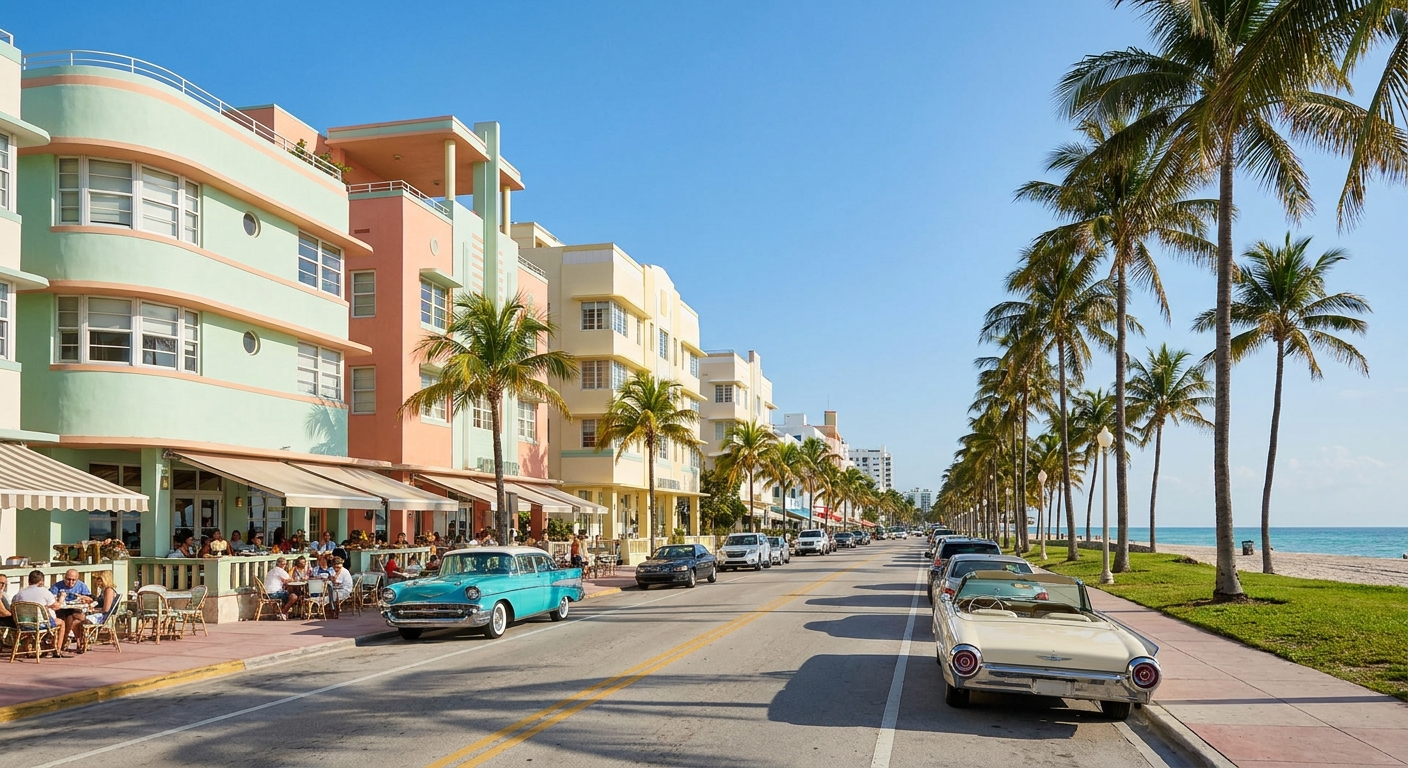
WHERE TO STAY · MIAMI
First visit with no car: sleep in South Beach and budget for a resort fee nobody will quote you in advance. City-forward or repeat trip: Brickell, where the Metromover costs nothing.
TWO SEPARATE CITIES · FREE TROLLEY 8 A.M. TO 11 P.M. · RESORT FEES ON TOP OF THE ROOM RATE
Go for: a door-to-sand walk, a free trolley on five routes, and a Downtown people-mover that runs every 90 seconds at rush hour.
Think twice before: a spring-break weekend in South Beach. The city’s 2026 plan closed garages and lots, restricted beach access and ran DUI checkpoints from 6 p.m. Thursday through Sunday.
Municipalities: Miami-Dade County · Transit: Miami-Dade Transit · Trolley: City of Miami Beach · full sources at the end
On this page
- Miami or Miami Beach for a first visitTwo cities, two governments
- Where to stay in South BeachLummus Park, Ocean Drive and the night noise
- A base with no rental carDowntown and Brickell, on the free Metromover
- Resort fees and parking costsWhat gets added to the rate, and the $548 tow
- Getting from South Beach to the mainlandTrolley, Route 120 and the $2.25 fare
- How many nights in MiamiThree, four, and what the fourth buys
No hotel names and no nightly rates appear below, by policy: ranges swing by month and belong with the numbers in what a Florida trip costs. The market pattern is worth knowing before you shop. Rooms run cheapest from August to October and dearest from February to April, a trade you can weigh against the weather on the January and September pages.
Miami vs Miami Beach: where to stay
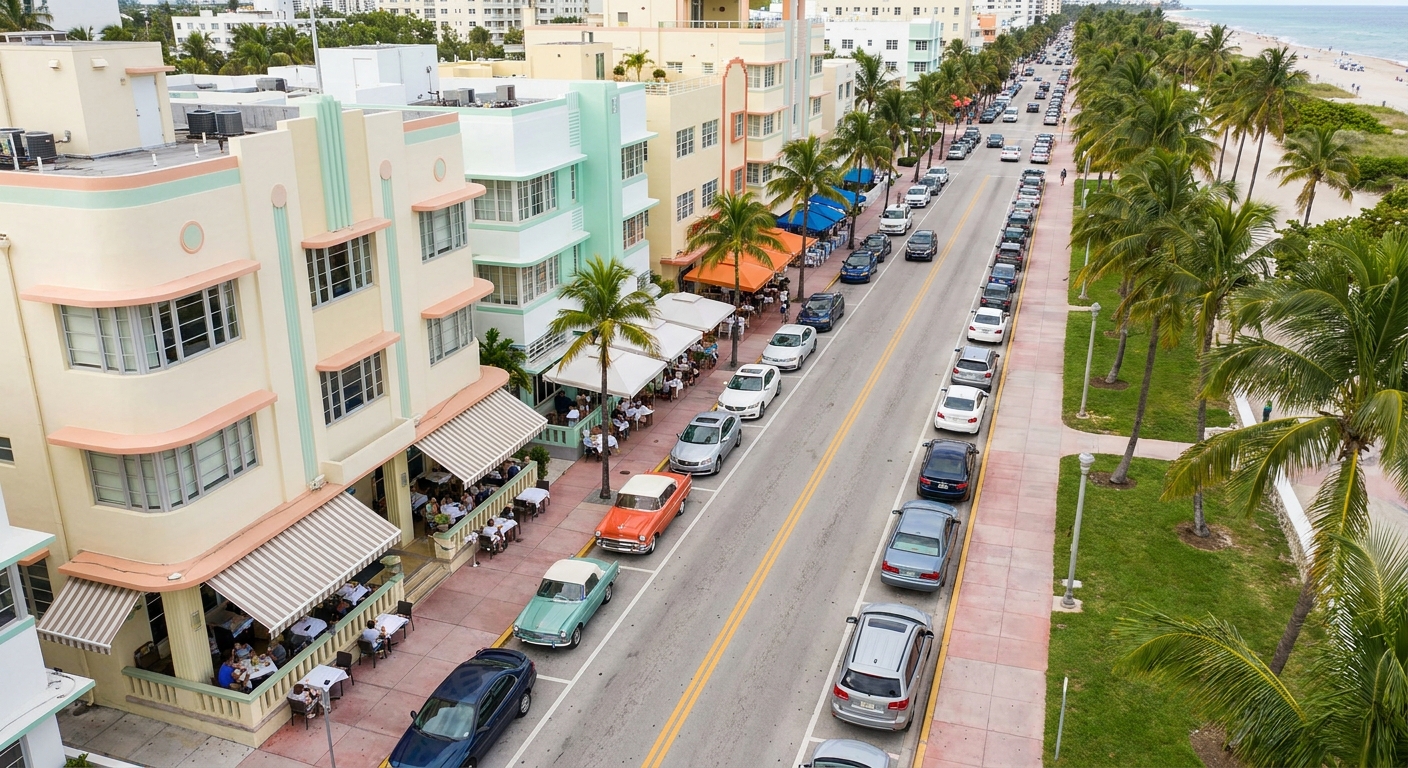
Miami and Miami Beach are two cities, not two neighborhoods. Each has its own commission, police force and parking authority. Miami-Dade County holds more of them than visitors expect: Coral Gables has been an independent municipality since April 29, 1925, with its own police and its own zoning. Wynwood, Little Havana and Coconut Grove are mainland neighborhoods inside the City of Miami. South Beach is the southernmost neighborhood of Miami Beach, out on the island.
The size gap explains much of the rest. The City of Miami counted 442,241 residents at the 2020 census. Miami Beach counted 82,890 at the same one. One is a metropolitan core with a financial district and a commuter rail line. The other is a small barrier-island city whose daytime population is largely made up of people who flew in.
Where this costs you is at checkout. A room advertised as Miami may sit in Miami Beach, where a nightly resort fee is standard and street parking is metered. Or the reverse: a Brickell tower that photographs like waterfront and sits across a bay from the nearest sand. Read the street address, then check which city it names. If the plan is beach mornings, a mainland base adds a bridge to every single one.
That bridge is Biscayne Bay. From Downtown, Route 120 runs over the MacArthur Causeway into Miami Beach, then north on Collins Avenue through Surfside and Bal Harbour to Aventura, for one $2.25 fare. MIA sits about 12 miles from South Beach, a drive of 20 to 45 minutes depending on traffic. FLL is roughly 25 miles and 35 to 50 minutes on I-95, and both of those durations are indicative rather than published schedules.
Where to stay in South Beach
South Beach hands you a walkable grid of Art Deco blocks and a beach at the end of most of them, from South Pointe Park up to the Miami Beach Convention Center, where Art Basel Miami Beach lands in early December. The 2026 dates differ between the fair’s own listing and the tourism office, so treat the first week as the window and confirm before booking around it. North of the Convention Center the blocks lengthen, restaurants thin out and the trolley stops being optional.
The beach fronting Ocean Drive is Lummus Park, running between 5th and 15th Streets. It is free, open 24 hours, with lifeguards on duty, restrooms and picnic tables, which means the hotels on that strip sell you a view of it rather than access to it. Walk south instead and South Pointe Park is also free to enter, though its public lot starts at $2 an hour and jumps to a $20 flat day rate on weekends and public holidays.
Evenings on Ocean Drive are loud, and the streets one block back are not much better. Music carries off the sidewalk cafés late, engines included, and a low floor facing the street hears all of it. South of Fifth stays calmer, and so do the blocks above the Convention Center. Ask for a room turned away from Ocean Drive or Collins Avenue before you pay, not at check-in.
Where to stay in Downtown Miami and Brickell
The mainland gives you the rest of the city without a rental. Brickell and Downtown sit close to Wynwood’s murals and Little Havana’s coffee counters, both inside the City of Miami, and to the Pérez Art Museum Miami, free from 5 to 9 p.m. every Thursday and free all day on the second Saturday of the month, with art-making from 11 a.m. to 3 p.m. Vizcaya stands in north Coconut Grove, a few minutes’ walk from its own Metrorail station.
The Metromover is what makes a car-free city base work. It is free, it serves Downtown and Brickell, and cars arrive every 90 seconds at rush hour and every three minutes off-peak. Its hours are published two ways: Miami-Dade gives 5:30 a.m. to 10 p.m. seven days a week, while other sources give 5 a.m. to midnight. We could not reconcile the two, so read the station board for the last car before you count on a late ride home.
It is the wrong base if the week is about sand. From Brickell, every beach morning opens with a bus or a bridge, and the Route 120 crossing is no sprint at nine in the morning. Families lose the walk-back-for-a-nap rhythm the island allows, as do swimmers who want the water before breakfast. Downtown also quiets down on weekends outside event nights, which reads as peace to some travelers and as emptiness to others.
Resort fees in Miami Beach
Miami Beach hotels commonly add a nightly resort fee on top of the room rate. It is billed per room per night, at the property rather than at booking, and it is usually described as covering the pool, the beach chairs, the gym and the wifi, whether you use them or not. The number you compared across four tabs online is not the number that leaves your card.
How much is exactly where the record breaks down. Published amounts diverge sharply by source and by category: one set of comparisons puts the island average near $25 a night, others report $35 to $95 depending on the property. We could not settle on one figure that holds, so we are not printing one. Ask the hotel for the fee in dollars per night, in writing, and add it yourself before you compare two bases.
Parking is the second line item. For spring break 2026 the city moved its four Art Deco District garages, between 5th and 16th Streets from Washington Avenue to Ocean Drive, to flat rates of $40 to $100. Those were the announced 2026 measures. Miami Beach reissues and adjusts the plan each year and publishes the current one in winter, so check the city’s page for your dates rather than assuming these carry over.
Getting it wrong is the expensive version. The non-resident towing rate in the Art Deco District is $548, double the regular rate, with administrative fees on top. Under the same plan, police ran traffic control from 6 p.m. each Thursday through Sunday around the South of Fifth and Flamingo Park neighborhoods, with garage and lot closures, restricted beach access and DUI checkpoints. For 2026 there was no blanket curfew and beaches did not close at 6 p.m.: one applies only if the police chief determines that incidents require it.
Stack the lines before you choose a side of the bay. A South Beach rate plus an unquantified nightly fee plus a garage is a different animal from a mainland rate plus a $2.25 bus ride, and the gap opens widest from February through April, when island rooms hit their annual high. Ranges live in the Florida cost guide. The posted rate is where the arithmetic starts, not where it ends.
Getting around Miami without a car
The Miami Beach trolley is free and runs 8 a.m. to 11 p.m. seven days a week, about every 20 minutes, on five routes: South Beach Loop A and B, Middle Beach, North Beach, and the Collins Express, which covers the length of Collins Avenue with limited stops. That 11 p.m. cutoff matters when dinner runs long. Nothing on the island demands a car if you can stand waiting 20 minutes for the next one.
Crossing the bay costs $2.25. Route 120, the Beach MAX, links the Downtown Bus Terminal to Miami Beach over the MacArthur Causeway, then heads north on Collins to Aventura. Metrorail charges the same fare from the airport’s Intermodal Center into Downtown, roughly every 15 minutes from about 5 a.m. to midnight, transfers to Metrobus free, with fare capping at $5.65 a day. Arriving with suitcases, take Route 150 across the Julia Tuttle Causeway to Mid Beach, about every 30 minutes, luggage racks included. Statewide logic sits in getting around Florida.
How many nights in Miami
Three nights is the working minimum, and all three belong on the island: beach mornings, the Deco blocks, one dinner across the bay. At four, move the last night to Brickell and let the free Metromover handle Wynwood, Little Havana and the museums. At five or more, split it three and two, then give a full day to the Everglades, where entry is $35 per private vehicle for seven days and the three entrances sit at least an hour’s drive apart.
High season changes the booking rather than the itinerary. Rooms peak February through April, the 2027 Miami Open runs March 14 to 28 at Hard Rock Stadium in Miami Gardens, and Ultra takes Bayfront Park in Downtown on March 26, 27 and 28, the tennis overlapping its last three days. Every climate figure here comes from NOAA’s 1991-2020 normals at the Miami International Airport gauge, not from a beach thermometer: January averages a high of 76.2°F and 1.83 inches of rain. The March page carries the rest.
A fourth night mostly buys the places that keep hours, the ones weighed up in our Miami guide. Vizcaya opens Wednesday to Monday with last admission at 4:30 p.m., closed Tuesdays, $20 for adults while restoration work continues, down from the usual $25. The Pérez free window is Thursday evening. Neither survives a day that already holds a beach morning and an airport run. The extra night is what lets you take those hours as they are given, with room left to ride Route 120 back over the causeway at dusk.
Sources & data for this guide
- Miami Beach as a separate city, barrier islands, Biscayne Bay · Miami-Dade County municipal list, with Wikipedia and New World Encyclopedia · checked Sep 10, 2026
- Populations: City of Miami 442,241 and Miami Beach 82,890 · US Census 2020 · checked Sep 10, 2026
- Coral Gables incorporated April 29, 1925 as an independent municipality · Wikipedia and Miami-Dade County · corrected Sep 7, 2026 after an earlier version of our notes placed it inside the City of Miami
- Free trolley, five routes, 8 a.m. to 11 p.m. · City of Miami Beach, Citywide Free Trolley · checked Sep 10, 2026
- Metromover frequencies and the unresolved hours (5:30 a.m. to 10 p.m. per Miami-Dade against 5 a.m. to midnight elsewhere) · we could not reconcile the two · checked Sep 10, 2026
- Fares: $2.25 single, $5.65 daily cap, free Metromover, routes 120 and 150, Metrorail from the airport · Miami-Dade Transit · checked Sep 10, 2026. A rise to $2.75 was proposed and then rejected, so $2.25 stands.
- Spring break 2026: garage flat rates of $40 to $100, $548 non-resident tow, traffic plan, curfew position · City of Miami Beach via NBC 6, CBS News Miami, WLRN · checked Sep 10, 2026
- Resort fees · comparison sites and local guides diverge from about $25 average to $35 to $95 by property, so no single figure is printed here · checked Sep 10, 2026
- January normals, high 76.2°F and 1.83 inches · NOAA NCEI 1991-2020, station USW00012839, Miami International Airport · checked Sep 10, 2026
- Lummus Park, South Pointe Park and Crandon Park access and parking rates · City of Miami Beach and Miami-Dade Parks · checked Sep 10, 2026. Parking rates change without notice.
- Vizcaya hours and admission, Pérez Art Museum free windows, Everglades vehicle fee · vizcaya.org, pamm.org, National Park Service · checked Sep 10, 2026
- Neighborhood character is editorial. Hotel names and nightly rates are excluded by policy · confirm fees with the property when you book.