
MIAMI · KNOW BEFORE YOU GO · FLORIDA
A taxi from MIA to South Beach crosses water. That detail undoes more first trips than any weather forecast: the beach in the brochure is not in the city on the hotel confirmation, and the road between them runs over a causeway that fills at the wrong hours.
Regrets here tend to be small and expensive rather than dramatic. A rental car that slept in a $20 lot all Saturday. A hotel total nobody quoted at booking. An art museum entered at full price on the one evening it costs nothing, two days after the free ride that passes its door.
BEFORE YOU GO · MIAMI
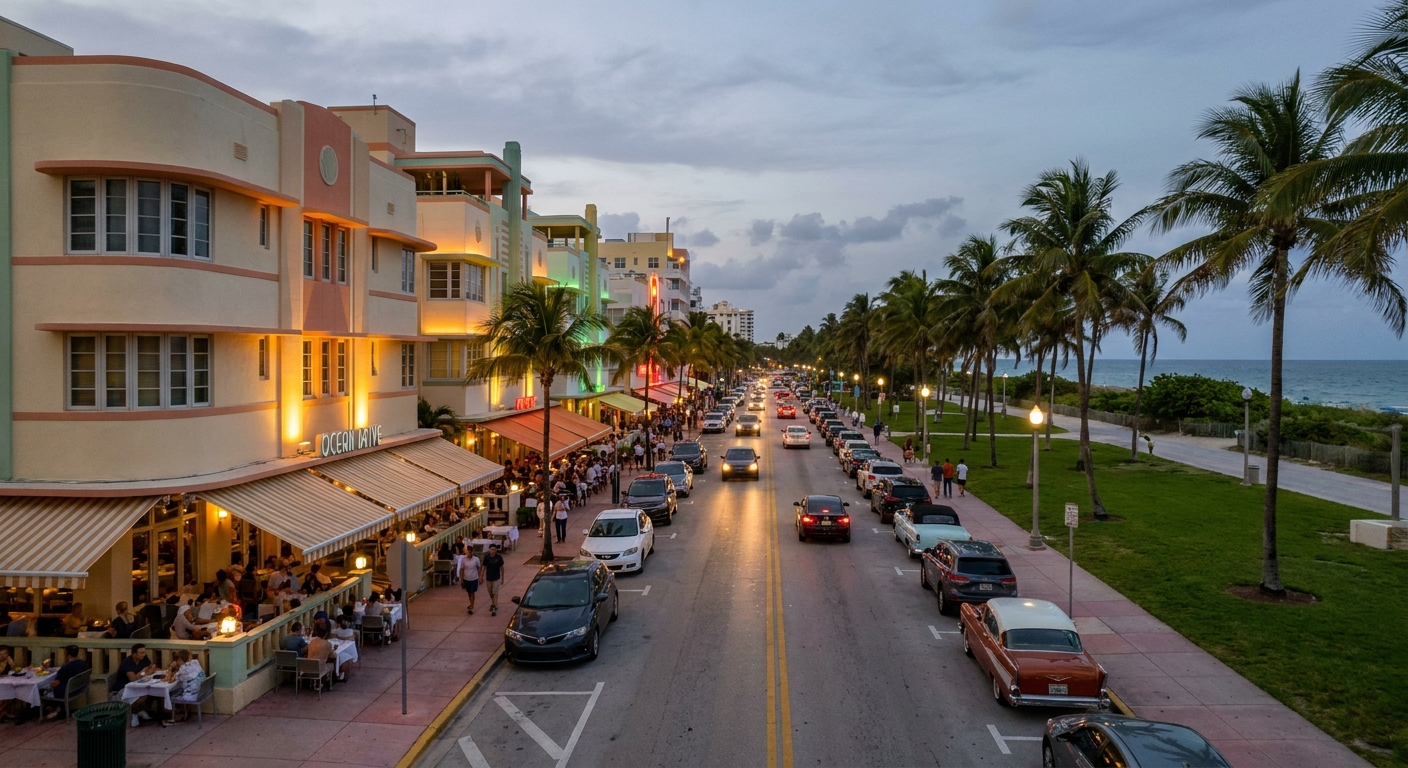
Miami and Miami Beach are separate cities on either side of Biscayne Bay: choose the side your days will actually happen on, then decide whether a car is worth what the island charges to park it.
SEPARATE CITY GOVERNMENTS · FREE METROMOVER & BEACH TROLLEY · SPRING BREAK IS MARCH · CAR OPTIONAL
Go for: a winter city that works without a car, free transit on both sides of the bay, and Lummus Park, free and open 24 hours with lifeguards, restrooms and picnic tables.
Think twice before: driving into South Beach in March, when the city’s spring break plan closes garages and lots and a non-resident tow runs $548 plus administrative fees.
Municipalities: Miami-Dade County · Fares: Miami-Dade Transit · Free trolley: City of Miami Beach · full sources at the end
On this page
- Miami or Miami Beach for a first visitThree separate city governments, named
- What costs nothing in MiamiMetromover, trolley and PAMM’s two free windows
- Parking rates in Miami Beach$2 an hour, $20 weekends, $548 to be towed
- Spring break rules and curfewThe 2026 traffic plan, 6 p.m. Thursday to Sunday
- Why the hotel total is higherResort fees and why we won’t quote one figure
- Best month for weather and pricesMiami month by month
Airport distance sets the shape of a first day: MIA sits about 12 miles from South Beach, a 20 to 45 minute drive depending on traffic, and FLL about 25 miles, 35 to 50 minutes on I-95. Both are indicative drive times, not published schedules. Every climate figure here comes from the NOAA 1991-2020 normals at the Miami International Airport gauge rather than from the sand: a 76.2°F average high in January against 90.6°F in July, with 1.83 inches of rain in January and 7.36 in July.
What is the difference between Miami and Miami Beach?
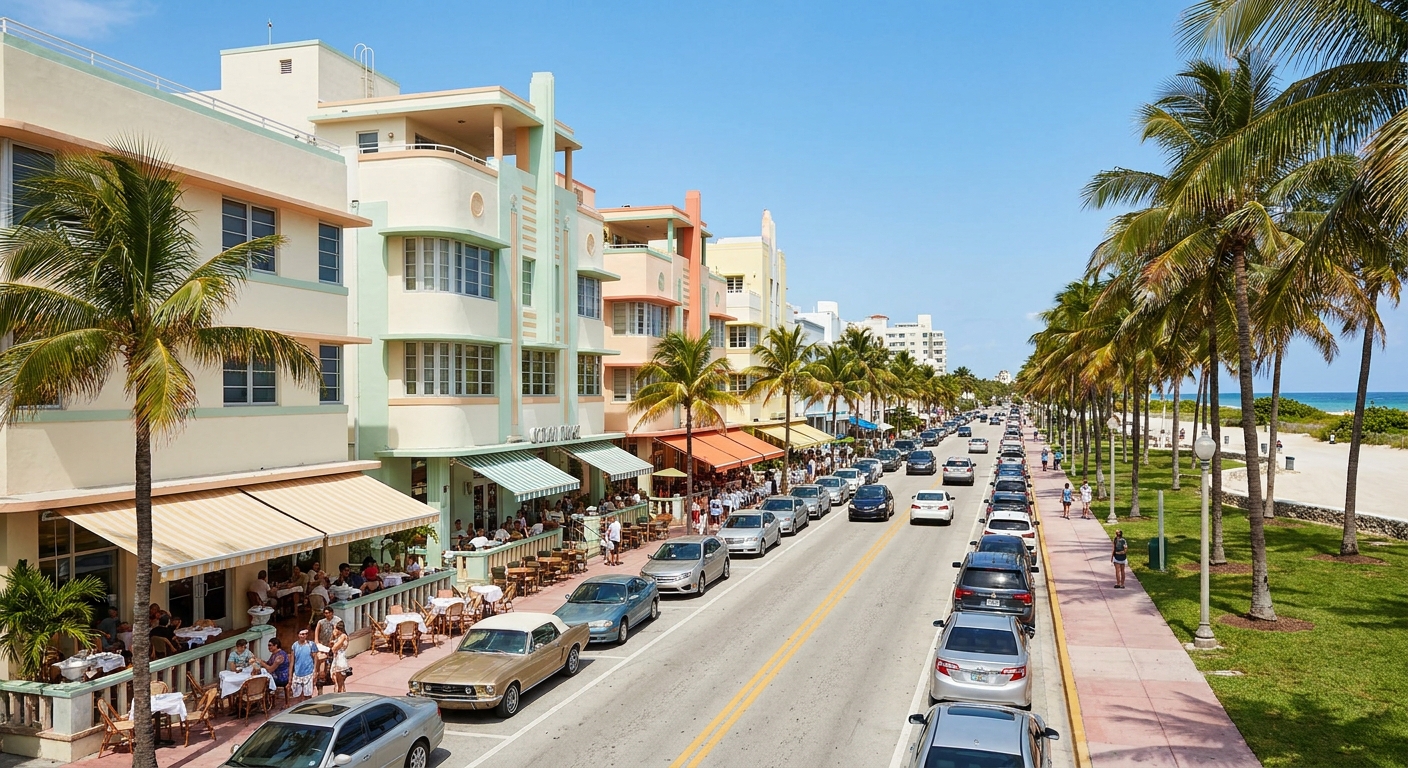
Miami-Dade County holds several cities that visitors blend into one name. The City of Miami counted 442,241 residents at the 2020 census and sits on the mainland. The City of Miami Beach counted 82,890 at the same census and sits offshore, on natural and man-made barrier islands. Coral Gables is a third, independent municipality, incorporated on April 29, 1925, with its own police force and its own planning rules. Booking a room in one city and planning your mornings in another is the standard first-trip error, and it costs a causeway crossing twice a day.
Travelers from other big metros read Miami Beach as a borough, the way Brooklyn belongs to New York. It has its own city hall and its own parking enforcement instead, which is why the free trolley is a Miami Beach service and the Metromover is a county one, and neither crosses the bay to cover for the other. Wynwood, Little Havana and Coconut Grove are all inside the City of Miami. So is Vizcaya, which stands in north Coconut Grove above Biscayne Bay and gets filed under Coral Gables by half the internet.
Biscayne Bay does the real dividing. A Miami Beach base gives you sand, Collins Avenue and a trolley. A Downtown or Brickell base gives you the Metromover, Vizcaya’s Metrorail station a few minutes’ walk from the gates, and somewhere to keep the car you need for the Everglades, where entry is $35 per private vehicle for seven days. Route 120, the Beach MAX, is the crossing: Downtown Bus Terminal over the MacArthur Causeway, then north on Collins through Surfside and Bal Harbour, $2.25 a ride. Our where-to-stay guide argues the two sides out.
What is free in Miami?
The Metromover costs nothing, with no ticket and no tap, and it loops Downtown Miami and Brickell with cars every 90 seconds at rush hour and every three minutes off-peak. One reserve comes with it: the published hours disagree. Miami-Dade gives 5:30 a.m. to 10 p.m., seven days a week, while other local sources give 5 a.m. to midnight. We could not settle which is current, so read the platform sign before you count on a late ride back.
Across the bay, the Miami Beach trolley is also free, 8 a.m. to 11 p.m., seven days a week, roughly every 20 minutes, on five routes: South Beach Loop A, South Beach Loop B, Middle Beach, North Beach, and the Collins Express, which runs the length of Collins Avenue with limited stops. That 11 p.m. end matters more than the price. A dinner in North Beach that runs long turns into a paid ride home.
The Pérez Art Museum Miami opens two free windows: Thursdays from 5 to 9 p.m., and all day on the second Saturday of every month, when art-making runs 11 a.m. to 3 p.m. Both sit on the Metromover line, so the ride and the museum cost the same amount. Families are better off aiming at the second Saturday, where the workshop hours are the whole point.
The beach charges nothing either. Lummus Park, the sand fronting Ocean Drive between 5th and 15th Streets, is free and open 24 hours, with lifeguards on duty, public restrooms and picnic tables. South Pointe Park is free to walk into, and its public lot is what costs: from $2 an hour, with a $20 flat day rate on weekends and public holidays. Over on Key Biscayne, Crandon Park asks $7 to park on weekdays and $10 at weekends.
Stack all that and a full day on either side of the bay can cost food and nothing else. The paid layer starts with the car and the ticketed sights: Vizcaya asks $20 for adults while restoration work is underway, down from a usual $25, $5 for children 6 to 12 and free under 6, and it closes on Tuesdays. If you do use Metrorail or Metrobus, a single ride is $2.25 full fare and $1.10 reduced, and fare capping stops charging at $5.65 in a day. The things-to-do guide prices the rest.
Parking in Miami Beach
Begin with what the city publishes. The South Pointe Park lot starts at $2 an hour and switches to a $20 flat day rate on weekends and public holidays, which is the figure that ambushes Saturday visitors. For spring break, the four Art Deco District garages, between 5th and 16th Streets from Washington Avenue to Ocean Drive, drop hourly pricing and go to flat rates of $40 to $100. What a street meter costs elsewhere on the island is not in the material we read: ask the city’s parking department, or your hotel, for the current rate.
Then there is the number that ends trips. A non-resident towed from the Art Deco District pays $548, double the regular rate, plus administrative fees whose amounts we could not find published anywhere official. That $548 is the city’s own announced figure rather than a worst-case estimate, and the administrative add-on stays a live question, worth asking before you leave a car in a space you are unsure about.
Visitors say the same thing afterward: the car, not the room, was the line they misjudged. A Miami Beach stay does not need one, between the free trolley and a compact island. Rent it for the day you drive west into the Everglades, where $35 per private vehicle covers seven days and the three entrances sit at least an hour’s drive from each other, then hand it back. Getting around Florida makes the statewide case for wheels; trip cost carries the budget lines.
What is spring break like in Miami Beach?
Miami Beach police run a traffic plan from 6 p.m. each Thursday through Sunday, concentrated around the South of Fifth and Flamingo Park neighborhoods. The announced high-impact measures include garage and lot closures in South Beach, restricted beach access and DUI checkpoints. If your hotel sits inside those blocks and your plan has you arriving by car on a Friday evening, that is the collision to see coming.
For 2026 there is no blanket curfew, and the beaches do not close at 6 p.m. A curfew applies only if the police chief determines that incidents require one, which is a conditional power rather than a scheduled shutdown. The city manager’s position has not softened: “We are still very much broken up with spring break.”
Those flat rates, tow figures and closures are the ones Miami Beach announced for spring break 2026. The city renews and adjusts the package every year and publishes the coming season’s version in winter, so a March 2027 trip should be planned against the 2027 notice rather than against the numbers above.
March asks for a decision instead of avoidance. The 2027 Miami Open runs March 14 to 28 at Hard Rock Stadium in Miami Gardens, with dates given as subject to change, and Ultra takes Bayfront Park Downtown on March 26, 27 and 28, so the tournament’s final three days overlap the festival. Rooms sit at their yearly peak from February through April, a market pattern rather than an official statistic. Miami in March lays the month out day by day.
Why is a Miami hotel bill higher than the rate?
Miami Beach hotels commonly add a nightly resort fee on top of the room rate, and the published amounts do not converge. One comparator puts the average near $25; others list $35 to $95 depending on the property and its category. Picking a single number out of that spread would be inventing one. Ask the hotel, before booking, for the nightly fee in dollars and what it covers, and ask separately whether parking is inside it or billed on its own.
What arrives at checkout is rarely one big number. It is the nightly fee multiplied by seven, a parking line if the car came along, and a rate that was already at its February-to-April high, on an island where August to October is the cheapest stretch of the year. Get the all-in nightly total in writing, then leave the car wherever it sleeps until the morning you drive west, and ride the free trolley up Collins at 8 a.m., when the sand still belongs to the lifeguards and the dog walkers.
Sources & data for this guide
- Separate cities, barrier islands and Biscayne Bay between them · Miami-Dade County municipal list, City of Miami and Miami Beach records · checked Sep 11, 2026
- Populations 442,241 and 82,890 · US Census 2020 · checked Sep 11, 2026
- Coral Gables as an independent municipality, incorporated Apr 29, 1925; Vizcaya in north Coconut Grove, inside the City of Miami · Miami-Dade County and vizcaya.org · checked Sep 11, 2026 · an earlier version of our notes placed Coral Gables inside the City of Miami and Vizcaya inside Coral Gables; both were wrong and are corrected here
- Metromover free, 90-second and three-minute headways · Miami-Dade County · checked Sep 11, 2026 · published operating hours diverge (5:30 a.m.–10 p.m. per the county, 5 a.m.–midnight elsewhere) and we could not settle it
- Free trolley hours and five routes · City of Miami Beach, Citywide Free Trolley · checked Sep 11, 2026
- Free admission windows · pamm.org · checked Sep 11, 2026
- Lummus Park and South Pointe Park lot rates · City of Miami Beach · Crandon Park $7/$10 · Miami-Dade Parks · checked Sep 11, 2026 · parking rates change
- Fares $2.25 and $1.10, daily cap $5.65 · Miami-Dade County transit fares · checked Sep 11, 2026 · a proposed increase to $2.75 was rejected by the commission, so that figure is not served here
- Spring break garages $40–$100, non-resident tow $548 plus administrative fees, Thursday-to-Sunday traffic plan, no blanket curfew for 2026 · City of Miami Beach relayed by NBC 6 South Florida, CBS News Miami, Time Out Miami and WLRN · checked Sep 11, 2026 · these are the 2026 measures and the city republishes each winter
- Vizcaya hours and admission ($20 adult during restoration, usually $25) · vizcaya.org · checked Sep 11, 2026
- Resort fees · resort-fee comparators and local guides · checked Sep 11, 2026 · amounts diverge widely, from about $25 on average to $35–95 by property, so no single figure is defensible
- January and July normals at the Miami International Airport gauge · NOAA NCEI 1991-2020, station USW00012839 · checked Sep 11, 2026
- Everglades entry $35 per vehicle for seven days · National Park Service · checked Sep 11, 2026
- Ultra 2027 (Mar 26–28) and Miami Open 2027 (Mar 14–28, subject to change) · ultramusicfestival.com and miamiopen.com · checked Sep 11, 2026
- Room-rate seasonality is market data relayed by local guides, not an official statistic; usage notes and lessons are editorial · confirm fees, hours and parking with operators when you book.