
FLORIDA · MIAMI VS SIESTA KEY · ATLANTIC VS GULF
Two Florida beach trips wear the same state name and almost nothing else. Miami is a city of 442,241 people at the 2020 census, with a second, separate city of 82,890 on the barrier islands across Biscayne Bay, which is where the beach actually is. Siesta Key is one Gulf barrier island in Sarasota County, its quartz-crystal sand ranked the best beach in the United States for 2026 by U.S. News & World Report.
The choice usually comes down to water and dates. In January the sea off Miami averages 77.0°F while the sea off Siesta Key averages 65.2°F, and by July the order flips, 89.8°F off the key against 88.2°F off Miami. Rain barely separates them in winter: 3.8 days at 0.10 inch or more at the Miami gauge, 3.6 at the Sarasota-Bradenton gauge.
THE VERDICT · MIAMI VS SIESTA KEY
For a winter trip where swimming matters, Miami’s water runs 11.8 degrees warmer in January; for a June-to-August beach week, Siesta Key’s sea is the warmer one, and the lodging tax is 12% either way.
SEA 77.0°F VS 65.2°F IN JANUARY · SAME 12% ON THE ROOM · 976 BEACH SPACES ON THE KEY
Go for: Miami if the trip falls December to April and swimming matters, Siesta Key if it falls June to August or the plan is one beach for a week.
Think twice before: driving to Siesta Key Public Beach after mid-morning between January and April: 976 spaces, and accesses 2, 3, 10 and 13 have no parking.
Climate: NOAA 1991-2020 normals, stations USW00012839 and USW00012871 · Tax: Florida form DR-15TDT · full sources at the end
On this page
- Which one, in one answerMiami or Siesta Key
- Sea temperature and rain days by monthBoth tables, 12 months side by side
- Which weather station each figure comes fromUSW00012839 and USW00012871
- Beach parking and spring-break rulesGarage rates, towing, 976 spaces
- Lodging tax and admission prices6.0% county tax, Vizcaya at $20
- Things to do on each sideVizcaya, PAMM, Siesta Beach, Lido Key
- The month that splits them mostJanuary, with both sets of figures
The detail lives on each pillar: the Miami guide carries the neighborhoods, the transit fares and twelve month pages, while Siesta Key Beach carries the numbered accesses and the parking. Every figure below comes from one tax form, two NOAA stations and one marine model, all read in September 2026.
Miami or Siesta Key
Book Miami for a winter trip and Siesta Key for a summer one. The water decides it: the Atlantic off Miami averages 77.0°F in January and 79.1°F in December, against 65.2°F and 68.1°F off Siesta Key. Miami also carries the car-free option, with Metrobus and Metrorail at $2.25 a ride, the Metromover free through Downtown and Brickell, and the Miami Beach trolley free from 8 a.m. to 11 p.m.
Siesta Key is the better booking for a family that wants one beach for a week rather than a city plus a beach, and for anyone traveling June through August, when the Gulf there averages 86.3°F, 89.8°F and 89.3°F. It also suits travelers who would rather not drive between sights: the 77 Islander trolley is free and runs daily, roughly every 30 minutes from 8 to 10 a.m., and the free BayRunner reaches Lido Key every 20 to 30 minutes from 8 a.m. to noon.
The lodging tax is identical. Sarasota County and Miami-Dade both levy a 6.0% transient rental tax, filed and paid with the 6% state sales tax. Hurricane season covers the two equally, June 1 to November 30 with a September 10 peak. And the rain-day columns run within a day of each other through late winter: 3.8 against 3.6 in January, 3.6 against 3.1 in February, 3.5 against 3.6 in March.
Check your month against the sea column before anything else. Miami’s water is the warmer of the two in nine months of the twelve, and Siesta Key’s only in June, July and August. If the dates land in March, read the Miami Beach spring-break plan the city publishes each winter as well: the 2026 version put four Art Deco District garages on flat rates of $40 to $100.
Miami vs Siesta Key weather: temperature, rain and sea
| Month | Miami high / low °F | Siesta Key high / low °F | Sea, Miami | Sea, Siesta Key | Days ≥0.10 in (Miami / Key) |
|---|---|---|---|---|---|
| Jan | 76.2 / 61.0 | 72.5 / 52.3 | 77.0°F | 65.2°F | 3.8 / 3.6 |
| Feb | 78.2 / 63.2 | 74.9 / 54.6 | 76.9°F | 67.5°F | 3.6 / 3.1 |
| Mar | 80.6 / 65.6 | 78.2 / 58.1 | 78.4°F | 73.9°F | 3.5 / 3.6 |
| Apr | 83.6 / 69.8 | 82.5 / 62.7 | 79.6°F | 77.4°F | 4.3 / 3.0 |
| May | 86.7 / 73.4 | 87.5 / 68.2 | 83.0°F | 82.9°F | 6.9 / 3.8 |
| Jun | 89.3 / 76.3 | 90.0 / 73.6 | 85.4°F | 86.3°F | 12.6 / 9.0 |
| Jul | 90.6 / 77.5 | 91.1 / 75.2 | 88.2°F | 89.8°F | 11.1 / 10.7 |
| Aug | 90.7 / 77.7 | 91.5 / 75.3 | 88.3°F | 89.3°F | 13.3 / 11.7 |
| Sep | 89.0 / 76.9 | 90.2 / 74.1 | 87.8°F | 87.1°F | 13.1 / 8.3 |
| Oct | 85.9 / 74.2 | 86.3 / 68.3 | 84.5°F | 80.4°F | 9.0 / 4.1 |
| Nov | 81.3 / 68.3 | 80.0 / 60.1 | 81.7°F | 75.0°F | 4.7 / 2.5 |
| Dec | 78.2 / 64.3 | 75.2 / 55.2 | 79.1°F | 68.1°F | 3.7 / 3.0 |
Across the winter the two columns of daily highs stay within four degrees of each other, and from May through October the Sarasota-Bradenton column is the warmer one.
Nights are where the spread opens. Miami’s average low is 61.0°F in January and 64.3°F in December, against 52.3°F and 55.2°F at Sarasota-Bradenton, differences of 8.7 and 9.1 degrees. That station also records 0.8 nights at 32°F or below in an average January and 0.3 in December, and we found no equivalent freeze-night normal in the Miami series we read. By August the daytime order has reversed, 91.5°F against 90.7°F.
The sea splits them harder than the air does. In January the difference is 11.8 degrees, 77.0°F off Miami against 65.2°F off Siesta Key, cold enough that most swimmers stay out. The Gulf side catches up fast in spring, 73.9°F in March and 77.4°F in April, and passes Miami from June to August. Both sea figures come from the same marine model, averaged 2015 to 2024 and taken as the mean of daily maxima, so each reads a shade warmer than a 24-hour mean.
Miami and Siesta Key weather averages
Two different gauges produce those columns, and neither stands on sand. Miami’s normals are read at NOAA station USW00012839 at Miami International Airport, inland from the beach. Siesta Key’s come from USW00012871 at Sarasota-Bradenton Airport, inland and north of the key, not on Siesta Beach itself. On a barrier island that distance shows up after dark, when water moderates the sand and a runway does not, so take those 0.8 January freeze nights as an airport figure. Neither station’s elevation appears in the normals table we read.
The rain columns are the fair comparison. Both count days recording at least 0.10 inch, from the same NOAA 1991 to 2020 monthly normals product, so 3.8 against 3.6 in January is a real difference rather than a difference of method. The heavy-rain line matches exactly that month, 0.4 days at an inch or more on each side.
Permits and rules in Miami and Siesta Key
Miami Beach publishes a dated spring-break plan, and the 2026 version was specific. Four Art Deco District garages, between 5th and 16th streets from Washington Avenue to Ocean Drive, went to flat rates of $40 to $100. The non-resident towing rate in the district was $548, double the regular rate, plus administrative fees. Police ran a traffic plan from 6 p.m. each Thursday through Sunday around South of Fifth and Flamingo Park. There was no blanket curfew, and beaches did not close at 6 p.m. The chief could impose one if incidents required it.
We did not find an equivalent seasonal enforcement plan for Siesta Key in the Sarasota County and Visit Sarasota sources we read. What those sources do publish is capacity and timing: 976 spaces at Siesta Key Public Beach and Pavilion, lots that fill fast at peak times and through the January to April season, and numbered accesses with no parking at all, or a single accessible space, at Access 2, 3, 10 and 13. That is what we could read, not the whole of the county code.
A March Saturday therefore prepares differently on each side. On Miami Beach the question is whether to bring a car at all: route 150, the Miami Beach Airport Express, runs about every 30 minutes for $2.25 with luggage racks, and fare capping stops at $5.65 a day. On Siesta Key the question is what time you arrive, since those 976 spaces go early in peak season and the free 77 Islander trolley runs roughly every 30 minutes between 8 and 10 a.m.
Tourist tax and ticket prices in Miami and Siesta Key
| What you pay | Miami side | Siesta Key side |
|---|---|---|
| County transient rental tax | 6.0% (Miami-Dade) | 6.0% (Sarasota County) |
| State sales tax, filed with it | 6% | 6% |
| Public transit ride | $2.25 Metrobus or Metrorail · Metromover free · $5.65 daily cap | 77 Islander trolley free · BayRunner to Lido Key free |
| Named admission | Vizcaya $20 adult, $5 ages 6-12, under 6 free | Not in the sources we read |
| Beach parking | South Pointe Park lot from $2/hour, $20 flat weekends and holidays · Crandon Park $7 weekdays, $10 weekends | 976 spaces at Siesta Key Public Beach, price not in the sources we read |
| Nightly lodging | No rate series in the pillar | No rate series in the pillar |
Both counties levy the same lodging tax: 6.0% in Miami-Dade and 6.0% in Sarasota County, each filed and paid with the 6% state sales tax, so 12% goes onto the room either way. Florida’s form DR-15TDT, the document we read, gives rates and no capped dollar amount, which means the tax rises with whatever the room costs. The only capped figure anywhere in this comparison is Miami-Dade transit, where fare capping stops at $5.65 a day for unlimited Metrorail and Metrobus.
Named tickets sit almost entirely on the Miami side. Vizcaya Museum and Gardens, in north Coconut Grove inside the City of Miami, charges $20 for adults while restoration work is underway, down from a usual $25, with children 6 to 12 at $5 and under-6 free. It opens Wednesday to Monday at 9:30 a.m., takes its last admission at 4:30 p.m. and closes Tuesdays. The Pérez Art Museum Miami is free from 5 to 9 p.m. on Thursdays and free all day on the second Saturday of the month. Both Siesta Key trolleys cost nothing.
Neither pillar carries a room rate. There is no nightly price for a named hotel on either side, no condo rental figure, no airfare and no car rental rate, so nothing here ranks one as the cheaper trip. One asymmetry is worth naming: the Miami material includes a market pattern, rates lowest August to October and highest February to April, plus a resort-fee range its own sources dispute, from about $25 on average to $35 and $95 depending on the property. We found no matching pattern or fee for Sarasota County.
Things to do in Miami vs Siesta Key
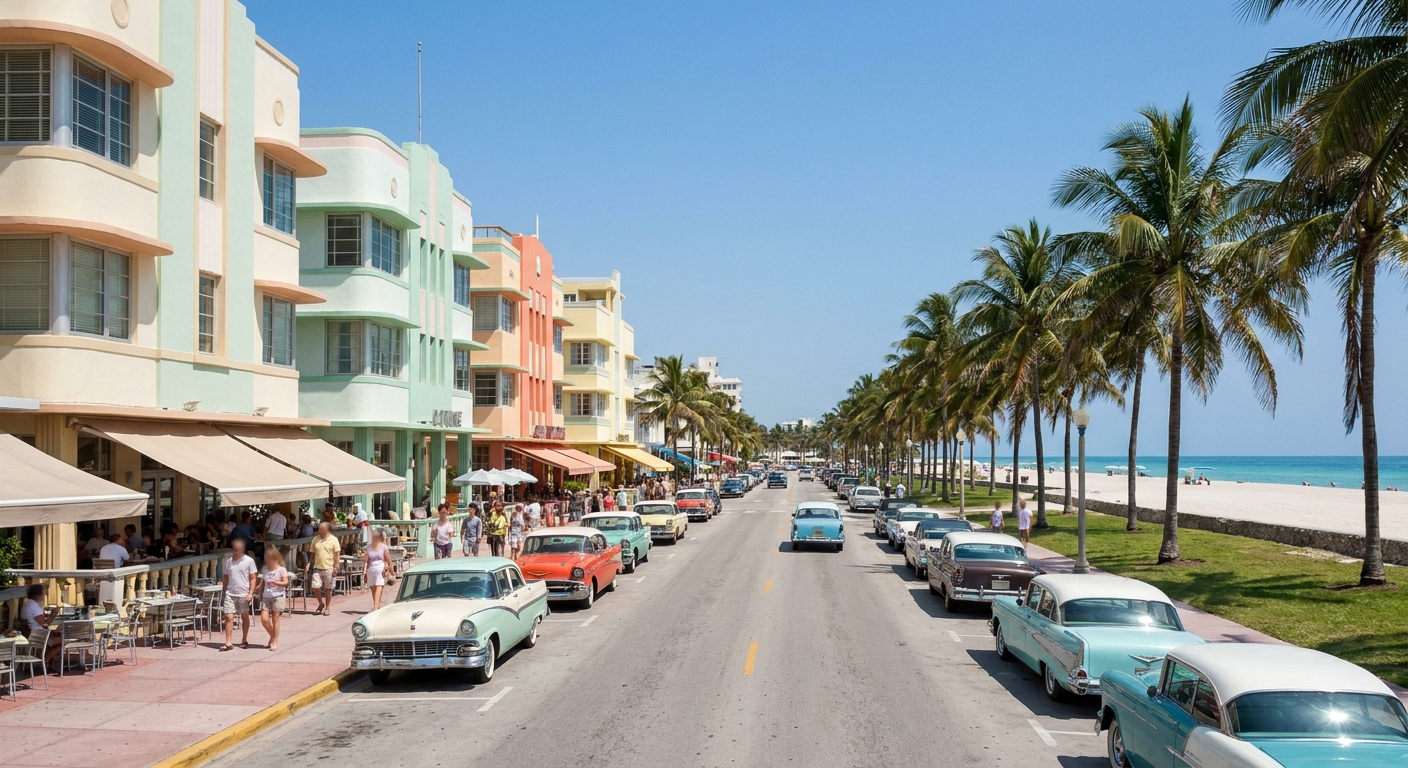
Miami’s list is urban and ticketed. Vizcaya’s bayfront house and gardens sit a few minutes’ walk from the Vizcaya Metrorail station, the Pérez Art Museum runs its free Thursday evening, Wynwood and Little Havana are mainland neighborhoods inside the City of Miami, and the beach fronting Ocean Drive, Lummus Park between 5th and 15th Streets, is free and open 24 hours with lifeguards, restrooms and picnic tables. The Metromover threads Downtown and Brickell at no charge, cars every 90 seconds at rush hour and every three minutes off-peak.
Siesta Key answers with sand and shorter distances. Siesta Beach’s quartz-crystal grain and shallow turquoise water took the U.S. News & World Report top ranking for 2026, and Turtle Beach and Crescent Beach are separate beaches on the same key rather than other names for the same strand. Lido Key is a free trolley ride away, every 20 to 30 minutes from 8 a.m. to noon. The accesses, the sand and the parking are laid out in the Siesta Key Beach guide.
Miami or Siesta Key by month
January splits them widest. Miami averages a 76.2°F high, a 61.0°F low and a 77.0°F sea. Sarasota-Bradenton averages 72.5°F and 52.3°F with a 65.2°F sea offshore, and records 0.8 nights at freezing, while the rain columns sit almost on top of each other at 3.8 and 3.6 days. Read the month through Miami in January, then through Siesta Key Beach, and if the dates are still open, the 12-month view of Florida sorts the rest.
The last word
Pick the coast your dates want, then book the beds early on whichever one you chose, because February to April is the Miami peak and January to April is when the Siesta lots fill. One more figure belongs in the comparison: Miami International sits about 12 miles from South Beach, 20 to 45 minutes depending on traffic, and Fort Lauderdale-Hollywood about 25 miles, 35 to 50 minutes on I-95, both indicative drive times rather than published schedules. Getting around Florida takes the car question from there.
Sources & data for this guide
- Miami monthly normals, rain days and freeze data · NOAA NCEI 1991-2020, station USW00012839, Miami International Airport · checked Sep 11, 2026
- Siesta Key monthly normals, rain days and freezing nights · NOAA NCEI 1991-2020, station USW00012871, Sarasota-Bradenton Airport · checked Sep 11, 2026
- Sea surface figures, both coasts · Open-Meteo Marine API, 2015-2024 mean of daily maxima · checked Sep 11, 2026
- Transient rental tax, both counties · Florida Department of Revenue, form DR-15TDT · checked Sep 11, 2026
- Hurricane season dates and September 10 peak · NOAA National Hurricane Center · checked Sep 11, 2026
- Metrorail, Metrobus, Metromover, route 150 fares and the $5.65 cap · Miami-Dade County Transit Fares and Parking Fees · checked Sep 11, 2026
- Spring-break garage rates, $548 non-resident tow and the 2026 curfew position · City of Miami Beach, relayed by NBC 6, CBS News Miami and WLRN · checked Sep 11, 2026 · these are the 2026 measures, published anew each winter
- Siesta Key parking, 976 spaces, trolley times and the 2026 ranking · Visit Sarasota County and Sarasota County Facility Directory · checked Sep 11, 2026
- Vizcaya hours and admission, PAMM free windows · vizcaya.org and pamm.org · checked Sep 11, 2026
- Where a line says a figure is not in our sources, it means we could not read one, not that none exists. Miami Beach resort fees diverge sharply between published comparisons, so we give the range only.