
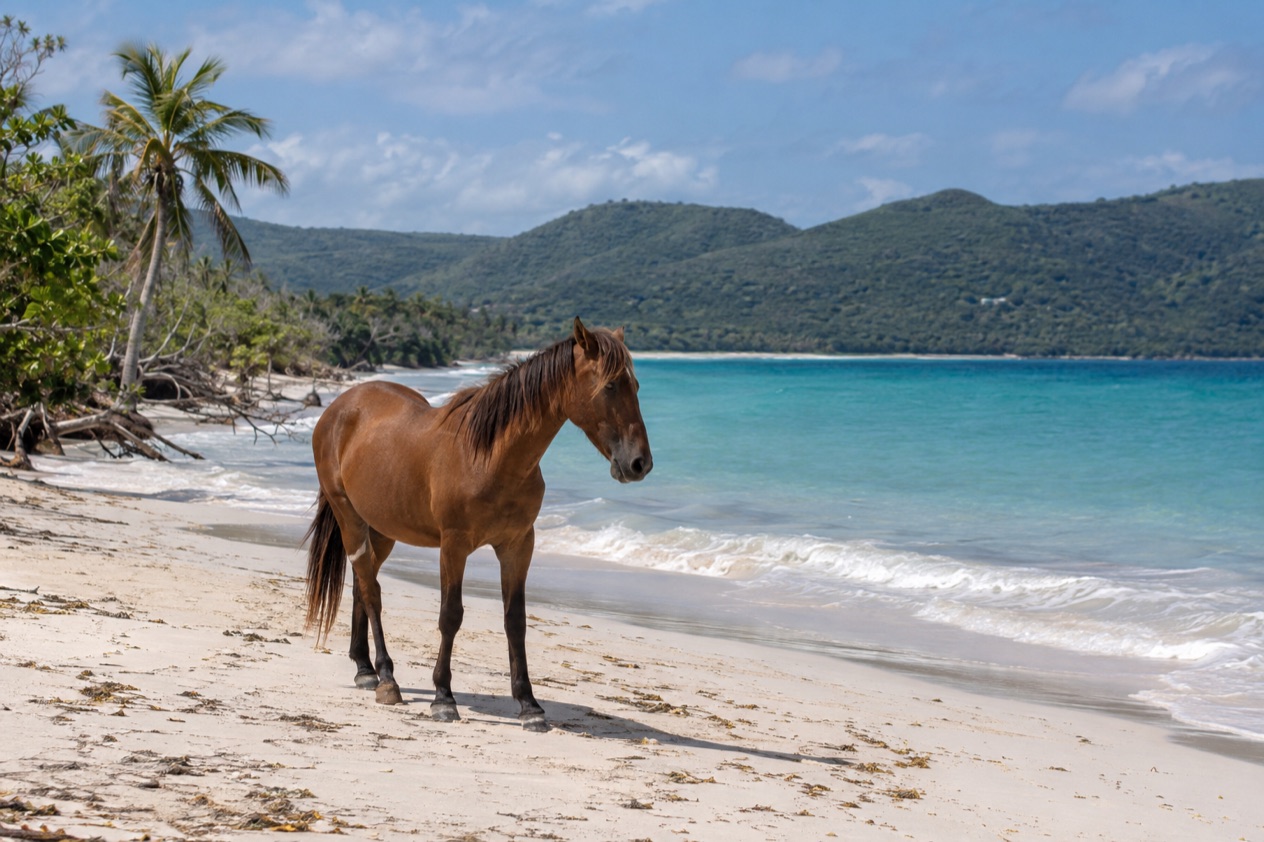
At dusk on Vieques, a chestnut horse wanders across the road with no one in charge of it, and the cars simply wait. Down the coast, kayak paddles start to stir a dark bay that glows blue-green around every stroke. This is a small island east of the main island of Puerto Rico, a place of long empty beaches, open-air dinners and a slow rhythm that suits travelers who want to unplug for a few days.
Where is Vieques and what is it like?
Vieques is an island and municipality of Puerto Rico, sitting about eight miles east of the main island and southeast of Fajardo, in the Caribbean. It is a sleepy, green, sparsely built place where wild horses graze along the roadsides and the beaches often stretch out with hardly a footprint on them.
The island is long and narrow, about twenty miles from end to end, and it feels bigger than it looks because there is so little between the villages. Much of its land was once a U.S. Navy range, and the protests against the bombing, which ended with the Navy’s departure in 2003, made Vieques known far beyond Puerto Rico. Today the former Navy lands are a national wildlife refuge, and that history is the reason so much shoreline stayed undeveloped.
Two settlements anchor daily life. Isabel Segunda is the ferry town on the north coast, with a fort on the hill, a small plaza and the everyday shops and bakeries where residents run their errands. Esperanza, on the south coast, is the laid-back waterfront village with guesthouses, open-air restaurants and a boardwalk where people drift from lunch to a swim to a sunset drink.
Vieques is promoted under an ecotourism banner, and it lives up to that in mood if not in nightlife. Evenings are for dinner by the water and stargazing, not for clubs.
If you want a resort with a long list of scheduled activities, or a lively late night scene, the main island will suit you better. If you love simple beaches, kayaks, snorkeling masks and early bedtimes, you will probably want to stay longer than you planned.
What is there to do in Vieques?
The big reasons to come are a glowing bay, a string of beaches, a wildlife refuge with roaming horses, and two villages that make good bases for eating well and doing very little. What sets Vieques apart from its neighbors is how much of it is left wild, so even the busiest beach days feel spacious.
Mosquito Bay at night
Mosquito Bay (Puerto Mosquito) is the island’s big night-time draw. Guinness World Records declared it the brightest bioluminescent bay in the world in 2006. Tiny organisms in the water light up when disturbed, so a paddle leaves a trail of glowing blue, and fish darting beneath you can look like streaks of light.
Visits are by kayak or electric boat with a guide, and kayaking can be arranged through local vendors. The glow is strongest on moonless nights, so a trip planned around the new moon gives you the best chance of a vivid show.
A bright moon can mute the glow, so treat it as a chance rather than a promise. Wear dark, quick-drying clothes and keep your phone put away, because the water is best seen with your own eyes.
Beaches: Sun Bay, Red Beach, Blue Beach and Caracas
Sun Bay (Sun Bay Beach Park), Red Beach and Blue Beach are among the most visited beaches on the island. Sun Bay is the long, curving public beach near Esperanza, with palms for shade and horses sometimes strolling the sand behind you. Red Beach, also called Caracas Beach, and Blue Beach lie on the eastern end, in the old Navy territory, and are known for their clear water and quieter, more natural settings.
Conditions change from beach to beach and day to day. Some shores are sheltered and others catch surf, so look at the water before you go in, and follow any flag, sign or lifeguard instruction where one is present.
Bring water, snacks and a hat, since these stretches are wild and shade can be limited. In some springs and summers, sargassum seaweed can reach east and south coasts, so a beach may look different from one week to the next.
The wildlife refuge and the wild horses
Vieques National Wildlife Refuge covers most of the former Navy lands and is considered one of the most ecologically diverse refuges in the Caribbean, as well as the largest National Wildlife Refuge there. It shelters sixteen federally listed plant and animal species, including the endangered Puerto Rican boa, and in winter the migratory peregrine falcon appears. It is open to the public year-round, and entrance fees are not required.
A large part of the eastern refuge is closed because of unexploded ordnance and the clean-up that continues, so stay on the areas that are open and respect every sign. Drones are prohibited. The wild horses are the everyday spectacle: you see them on roads, beaches and in village yards. Give them room, drive slowly, and enjoy the fact that you are sharing the island with them.
Esperanza and Isabel Segunda
Esperanza is where most visitors spend their evenings. The waterfront is lined with casual restaurants and bars with open sides, and you can watch boats rock at their moorings while you eat fresh fish, tostones or a plate of rice and beans. It is an easy place to stroll and linger over a second drink.
Isabel Segunda is more of a working town. Come for a walk past the plaza and the fort, a coffee and a look at how islanders live, then head back to the water. Between the two villages, the road passes through scrubby hills and open pasture, which is a good place to spot the horses at dusk.
How many days do you need in Vieques?
A long weekend is the minimum that feels worthwhile, and a few more days is where the island starts to work its slow magic. Because getting here takes a ferry or a small plane, a single day trip will mostly be spent on the logistics, and a night is better than nothing.
With a long weekend, you can fit in a beach day at Sun Bay, a morning at one of the eastern beaches, an evening in Esperanza and one night on Mosquito Bay. That covers the main reasons people come. Plan Mosquito Bay for your first or second night, so if clouds or rain spoil the glow you still have another evening to try again.
With a longer stay, the island stops being a checklist. You can spend a whole day on a single beach with a book, wander the roads to look for horses, try a different restaurant each night and make time for the refuge.
A longer visit also gives you a better chance of catching a moonless night when the bay is at its brightest. Travelers who like to snorkel or kayak will find enough to fill several days without getting bored.
If you have extra time on the main island side, Ceiba, the gateway town for the ferry and the small flights, makes a sensible stop before or after. It has beaches such as Los Machos, mangroves at Medio Mundo y Daguao, and the natural pools of Charco Frío y Las Tinajas. El Yunque is also within reach for a rainforest day on either end of the trip.
Where to stay in Vieques
The two natural bases are Esperanza on the south coast and Isabel Segunda on the north, and they feel very different. Esperanza is the choice for most vacationers. It has guesthouses, small inns and rentals within walking distance of the boardwalk, restaurants and the water, and it is the easiest place to settle into a beachside routine without needing to plan each day.
Isabel Segunda suits travelers who want to be close to the ferry dock, to groceries and to ordinary local life. It is quieter in the evenings and has fewer waterfront dining choices, so it works best if you plan to move around, or if you simply want a simple, practical bed near the arrival point.
Beyond the two villages, many travelers choose a rental house or a small property tucked into the hills or along a quiet stretch of coast. These give you more privacy and a view, but you will be further from restaurants, so think about how you will get around and where you will eat. The island’s wild character means that even a short drive can take you somewhere dark, quiet and far from other people.
Whichever area you pick, think about your priorities. Choose Esperanza if you want evenings out and an easy stroll to the sea. Choose Isabel Segunda for convenience and a local feel. Choose a hillside or remote rental if you want silence, star-filled skies and the sound of tree frogs after dark. Rooms in the villages are usually small and informal, which is part of the charm.
How do you get to Vieques and get around?
You reach Vieques by public ferry from Ceiba or by small plane. Ceiba is on the northeast coast of Puerto Rico, south of Fajardo, and is about an hour’s drive from San Juan. The ferry runs from Ceiba several times a day and is operated by the Autoridad de Transporte Marítimo (ATM). The public ferries to Vieques leave from Ceiba, not from Fajardo.
Flying is the faster option. Antonio Rivera Rodríguez Airport on Vieques handles only small propeller planes. Flights come from San Juan’s Luis Muñoz Marín International Airport and from Isla Grande Airport in 20 to 30 minutes, and from Ceiba Airport in about five minutes. The views of the coast and the turquoise water on the way in are a good start to the trip.
Once on the island, the distances between villages and beaches are long enough that you will want some kind of transportation. Ask your lodging about transportation before you arrive, since some of the best beaches sit well outside the villages. Within Esperanza, many restaurants, the boardwalk and the waterfront are close together.
Check your ferry or flight departure time directly with the operator before traveling. Pack light, bring any medicine you need, and keep a layer of patience for the slower pace. Arriving earlier in the day leaves time to settle in and enjoy a first evening by the water.
When is the best time to visit Vieques?
The best months are generally December through April, the drier season, when days are sunny, trade winds keep the heat bearable and the sea is inviting. This is also the busiest stretch, and it includes the long Puerto Rican Christmas season, Three Kings Day on January 6 and the weeks around Holy Week, which moves every year. Rooms are in demand, so book early if you are coming then.
May to November is the wetter season, with hot, humid days and showers that often arrive as brief downpours, sometimes with a stormy afternoon. The Atlantic hurricane season runs from June 1 to November 30, with the peak in September. A visit in that window can mean quieter beaches and an easier time finding a room, but you should follow the National Hurricane Center and local official alerts, since forecasts can change quickly.
For Mosquito Bay, the calendar that matters most is the moon, not the month. The bay glows all year, and the darkest nights around the new moon give the best show. Turtles nest on some beaches in spring and summer, and in some springs and summers sargassum can reach the east and south coasts. Pick the dry season for the easiest beach days and the wet one for fewer crowds.
Good to know before you go
U.S. citizens need no passport and no visa to visit Vieques, and the currency is the U.S. dollar. Spanish and English are both official, and a few words of Spanish are always welcome.
Use ordinary travel habits with your belongings, and keep to marked areas in the refuge, since unexploded ordnance remains in the closed lands. Follow beach flags and signs where they exist, and keep an eye on hurricane-season forecasts if you travel between summer and fall.
Sources
- U.S. Fish and Wildlife Service, Vieques National Wildlife Refuge (https://www.fws.gov/refuge/vieques), checked October 8, 2026
- Wikipedia, Vieques (https://en.wikipedia.org/wiki/Vieques,_Puerto_Rico), checked October 8, 2026
- Wikipedia, Ceiba (https://en.wikipedia.org/wiki/Ceiba,_Puerto_Rico), checked October 8, 2026
- Wikipedia, Caja de Muertos Island (https://en.wikipedia.org/wiki/Caja_de_Muertos_Island), checked October 8, 2026
- NOAA National Hurricane Center, Climatology (https://www.nhc.noaa.gov/climo/), checked October 8, 2026
All our pages
When to go
- Best Time to Visit Vieques: Weather by Month, Beaches, Crowds and Festivals
- Vieques in January: Weather, Beaches, Mosquito Bay and a Two-Day Plan
- Vieques in February: Weather, Beaches, Bioluminescent Bay and a Two-Day Plan
- Vieques in March: Beaches, Bioluminescent Bay, Wild Horses and Weather
- Vieques in April: Weather, Beaches, Bioluminescent Bay and a Two-Day Plan
- Vieques in May: Weather, Beaches, Mosquito Bay and a Two-Day Plan
- Vieques in July: Weather, Beaches, Bioluminescent Bay and a Two-Day Plan
- Vieques in August: Warm Seas, Mosquito Bay and Wild Horse Beaches
- Vieques in September: Warm Seas, Quiet Beaches, Bioluminescent Nights and Hurricane Season
- Vieques in October: Weather, Swimming, Mosquito Bay and a Two-Day Plan
- Vieques in November: Weather, Bioluminescent Bay, Beaches and a Two-Day Plan
- Vieques in December: Weather, Beaches, Mosquito Bay and a Two-Day Plan
Things to do
- Things to Do in Vieques: Mosquito Bay, Wild Beaches and Esperanza Evenings
- 3 Days in Vieques: Beaches, Mosquito Bay and a Slow Island Plan