
ERICEIRA · PORTUGAL · AUGUST
Ericeira spends most of the year as a fishing town that happens to surf, and one month as the whole coast’s living room. August is that month. The Portuguese weather service’s 1991-2020 normals put the average high at 84.2°F and the average low at 65.3°F, the warmest pair of the three summer months, with 0.20 inches of rain for the entire month: nearly double July’s 0.11, and about a seventh of September’s 1.41.
What the date takes back is room to improvise. Beds go to people who booked in spring, anything that depends on parking near the water is easier before ten in the morning, and dinner cannot start before the sun goes at 20:32 because nobody in town wants it to. Shift four weeks to September and the afternoon air only drops to 80.2°F, but the rain multiplies by seven. That trade is the question worth answering.
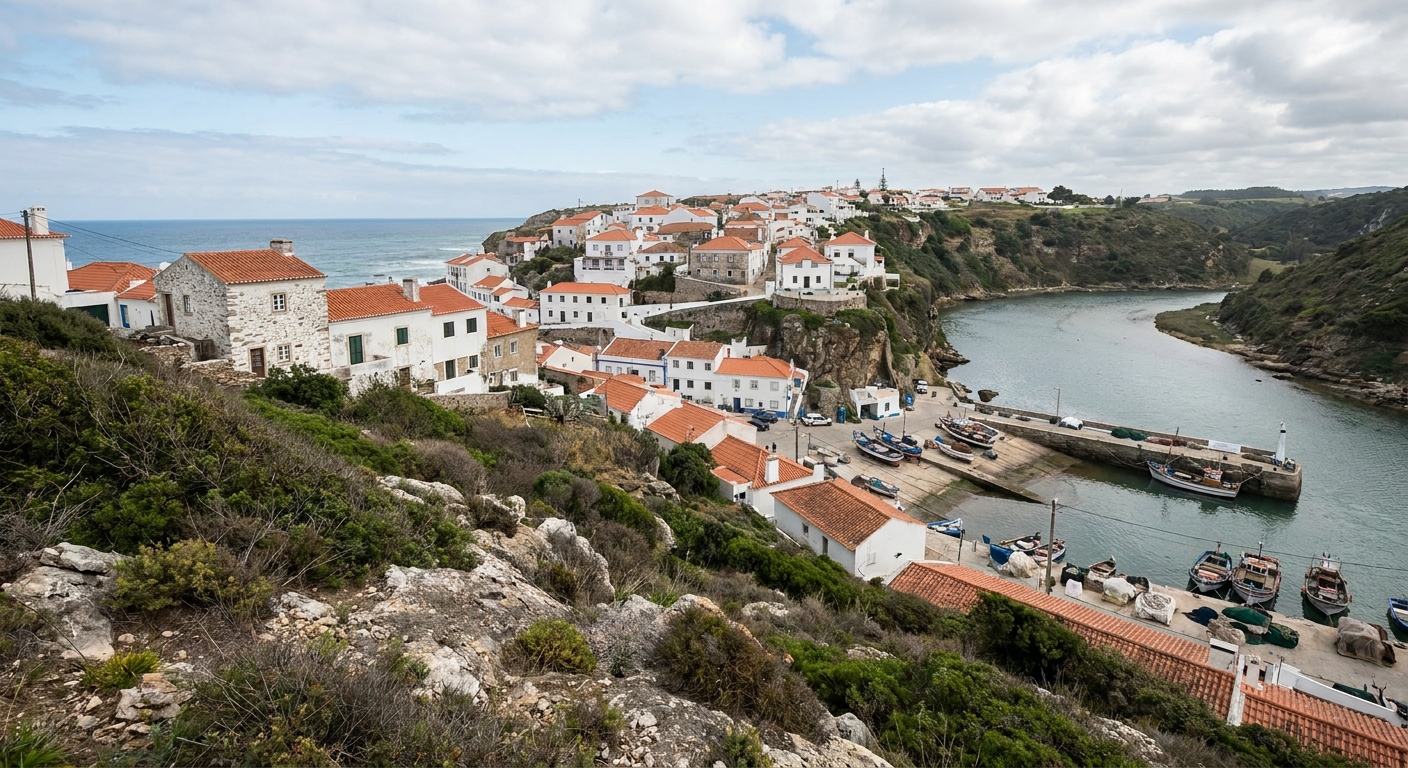
AUGUST AT A GLANCE · ERICEIRA
August is the warmest of Ericeira’s three summer months at 84.2°F and still close to rainless at 0.20 inches, and it is also the school-holiday peak: book the bed before anything else and let the 20:32 sunset set the day’s schedule.
AVG HIGH 84.2°F · AVG LOW 65.3°F · 0.20 IN OF RAIN · 13 H 43 MIN OF DAYLIGHT ON AUG 15
Go for: the warmest air of the three summer months at 84.2°F, evenings that stay outdoors long after the 20:32 sunset, and a month where a wet day is the exception at 1.0 in an average August.
Think twice before: arriving without a room. August is the heart of the European school holidays, and we found no occupancy figures that would let us soften that.
Normals: IPMA station 579, 1991-2020 · Daylight: sunrise-sunset.org · full sources at the end
On this page
- Average highs, lows and rain days in AugustThe IPMA normals for the month
- How warm it gets, day and night84.2°F days, 65.3°F nights, and the water
- Crowds and prices at the August peakWhat we can price and what we cannot
- Things to do in Ericeira in AugustPraia dos Pescadores, Foz do Lizandro, Ribeira d’Ilhas
- A two-day plan built around August lightFrom the 06:49 sunrise to the 20:32 sunset
- August vs July and SeptemberHow the three months compare, degree by degree
- Is August a good month to come?Who should book it, who should shift
One caveat before any of these numbers go to work. Every figure here comes from IPMA, the Portuguese weather service, and specifically from station 579 at Lisbon’s airport, a real instrument sitting 103.9 m up and inland. Ericeira faces the open Atlantic from a cliff, so the coast runs breezier than an airport reading suggests, and the high ground inland is colder and far wetter again. We looked for a long-run station in Ericeira itself and did not find one.
Ericeira weather in August: average highs, lows and rain days
| Measure | August normal |
|---|---|
| Average high | 84.2°F (29.0°C) |
| Average low | 65.3°F (18.5°C) |
| Precipitation | 0.20 in |
| Days with 0.04 in (1 mm) or more | 1.0 |
| Days with 0.39 in (10 mm) or more | 0.1 |
| Daylight on August 15 | 13 h 43 min |
| Sunrise / sunset, August 15 | 06:49 / 20:32 local |
IPMA’s 1991-2020 normals give August an average high of 84.2°F, an average low of 65.3°F and 0.20 inches of precipitation across the month. That is a station normal, read off an instrument, rather than a reanalysis grid cell averaged out of a model, and the two do not always agree on the overnight minimum. The precision costs something in place: the thermometer is at an inland airport, not on the seafront you will be standing on.
Rain here is an event rather than a pattern in August. One day in an average month records at least 0.04 inch (1 mm). Check the threshold before you set that beside an American table: IPMA counts from 1 mm, while US summaries usually start at 0.10 inch, so the two counts are not interchangeable and the Portuguese one will tend to look higher for the same sky. In plain terms, a single day of the month gets wet enough to notice and the other thirty do not.
Between the 84.2°F afternoon peak and the 65.3°F before dawn there are 18.9 degrees, and the Atlantic wind an inland airport never feels widens the gap further. Pack one warm layer per person for the terrace at nine, swimwear that dries between sessions, and a long-sleeved shirt for the harbor at dusk. Sandals all day, closed shoes for the cliff path. Our Portugal packing guide has the rest of the list.
August 15 brings 13 hours 43 minutes of daylight, sunrise at 06:49 and sunset at 20:32 in local time (05:49 and 19:32 UTC). The whole day slides late as a result. The sand is still pleasant at seven in the evening, tables fill around nine, and if you want the beach with nobody on it, take it between seven and nine in the morning before the first car parks.
How warm is Ericeira in August, and can you swim?
Those two headline figures are averages of daily extremes, not the extremes themselves: 84.2°F is what a typical afternoon peaks at, and individual days run above it, just as individual nights fall under 65.3°F. Nearly nineteen degrees separate the two averages, which is the widest thing about an otherwise very steady month. Nothing in the normals suggests August surprises anyone on this coast.
In practice you dress twice a day. Mornings on the cliff want a shirt over the swimsuit until the sun clears the roofs, because the sea breeze arrives before the heat does. From noon to about six it is shade, water and hats, with the afternoon climbing toward that 84.2°F average. After the sunset the temperature starts its slide toward the overnight 65.3°F, and the layer you carried around all day earns itself back on a terrace.
Frost is not a question here in August. We found no freezing-night count in the normals, and with a mean minimum of 65.3°F the issue does not arise. The water is the gap we could not close: we found no published sea-surface series for Ericeira, so we give no water temperature. When you do read one for this coast, check what it measures, because published sea temperatures are usually averages of daily maxima and sit a touch above a true 24-hour mean.
How busy is Ericeira in August? Crowds, prices and the school-holiday peak
August is the middle of the European school holidays, and a small surf town an hour from a capital city takes the full weight of that. Lisbon weekenders, Portuguese families on their annual month off, surf schools running back-to-back sessions. That much is calendar and needs no data. What we cannot give you is a number: we found no occupancy series for Ericeira and no monthly room-rate index, so we crown no month the cheapest or the dearest.
Book the bed first, and book it refundable. With no vacancy data, we will not turn that into a count of weeks, and you should treat any “book X weeks ahead” figure with the same suspicion, including one from us. What does hold up: give priority to a room you can walk from, because shifting a car around town in August is the part nobody enjoys. Flights run on their own calendar, which our guide to flying in from the US covers.
On a municipal tourist tax, we have to leave a blank. We could not verify whether one applies in Ericeira or at what nightly rate, so we quote no figure at all. Ask the property directly when you reserve, and ask specifically whether it is charged per person per night and whether it stops after a set number of nights. Our Portugal cost guide sets out what the rest of a trip runs.
If one line of the budget deserves the upgrade this month, it is where the bed sits rather than how nice the room is. A place you can leave on foot at eight in the evening, with the sun going at 20:32 and dinner after it, converts a crowded month into an easy one. A rental car mostly buys you a parking problem in August, though it pays off the moment you leave town, as our car guide lays out.
Things to do in Ericeira in August: the town beaches, Foz do Lizandro and Ribeira d’Ilhas
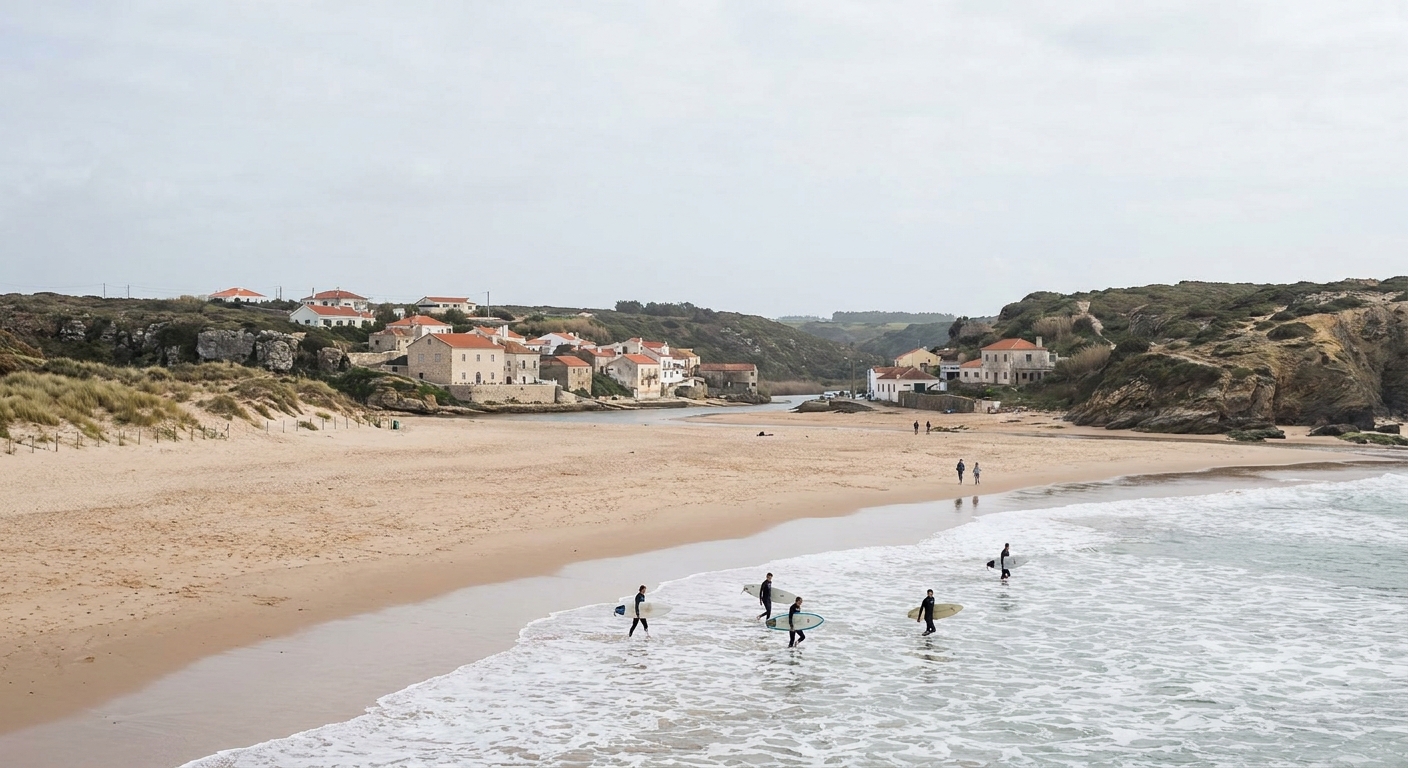
Thirteen hours forty-three minutes of daylight and a single rain day change what fits between breakfast and bed. Swim in the morning, eat a long lunch out of the sun, get back in the water at six, then sit down to dinner at nine with light still on the horizon. That sequence belongs to high summer. September’s 3.7 rain days start pulling it apart, and the earlier sunset finishes the job.
The town beaches are directly underneath the streets: Praia dos Pescadores beside the fishing harbor, and Praia do Sul in the next cove down, both walkable from the main square. South of town, Foz do Lizandro opens out wide and shallow where the river meets the sea, the obvious choice for families and first lessons. North, Ribeira d’Ilhas, São Lourenço and Coxos are the reef and point breaks surfers travel for.
With no water temperature to quote, read the air instead, and the air is the part that moves. The same stretch of sand sits under an 84.2°F average high in August and an 80.2°F one in September, a four-degree step that decides whether an afternoon swim is relief or effort. Inside a single August day the swing is larger still: by nine at night the beach is heading toward a 65.3°F low, and the swimmers leave well before the light does.
Free, this month and every month: the sand, the cliff path that links the coves, the harbor at the end of the afternoon when the boats come back in, and a 20:32 sunset that costs nothing from any wall facing west. Indoor tickets are our blind spot. We could not verify opening hours or admission for any museum or monument in town, so we name no price and send you to the door instead.
Ericeira in August: a two-day itinerary
Day one runs early and late with a hole in the middle. The sun is up at 06:49, so the sand is walkable and the light is good by half past seven. Swim before eleven, while the air is still climbing toward 84.2°F. Give lunch and the two hours after it to shade, indoors or under an awning above the harbor. Back in the water around five, then hold a table for nine, just after the sun has gone at 20:32.
Day two heads north along the coast to the point breaks, on foot or by car, in the same shape: water in the morning, shade at two, the cliff path when the heat breaks. If the sky turns, and one day of an average August does record measurable rain, drive inland instead. Sintra’s palaces are the standard wet-day detour from this stretch of coast and Lisbon is a full day on its own. Doing either without a car is its own question.
Ericeira in August vs July and September
| July | August | September | |
|---|---|---|---|
| Average high | 82.9°F | 84.2°F | 80.2°F |
| Average low | 64.4°F | 65.3°F | 63.3°F |
| Precipitation | 0.11 in | 0.20 in | 1.41 in |
| Days with 0.04 in (1 mm) or more | 0.4 | 1.0 | 3.7 |
Across the three months the thermometer barely moves and the rain does all the work. August tops the highs at 84.2°F, July sits 1.3 degrees under it at 82.9, September falls to 80.2. The nights follow the same narrow line: 65.3, 64.4 and 63.3. Precipitation is where they separate, 0.11 inches in July, 0.20 in August, then 1.41 in September, seven times the August total and spread across 3.7 days instead of one. No sea temperature exists for any of the three in our sources, so the water breaks no ties.
Shift four weeks forward and you hand back 4.0 degrees of afternoon heat and most of the dry weather, in exchange for a month outside the school holidays. Shift four weeks back into July and the rain all but vanishes, 0.11 inches over 0.4 days, with highs a degree and a bit below August’s. Neither move is dramatic on the thermometer. Both are dramatic on the sky, and the sky is the half we can prove. Our July page runs the same figures from the other side, and the national calendar lines up all twelve months.
Is August a good time to visit Ericeira?
Yes, if you have come for the water and the evenings. An 84.2°F average high, one wet day in thirty-one and light until 20:32 make the swim-and-dinner version of this trip close to a sure thing, and that is worth a great deal when you are flying six hours to get here. No, if space is the point: this is the school-holiday peak, and we can only tell you that as a calendar fact, since no occupancy number reached us.
When the answer lands on no, September is the shift to make. The high only slips to 80.2°F and the low to 63.3, the holidays are over, and the price is rain: 1.41 inches across 3.7 days instead of 0.20 across one. If you want dry weather above all and will accept company, July is drier still at 0.11 inches with 0.4 rain days. September changes the town, July changes almost nothing.
On our figures, no other month puts 84.2°F afternoons, a single rain day and daylight to 20:32 into the same thirty-one days.
The last word
Book the bed, then stop planning, because August makes most of the decisions for you: water in the morning, shade after lunch, dinner once the sun has gone at 20:32. One figure we have held back finishes the argument. IPMA counts 0.1 days a month at 0.39 inch (10 mm) of rain or more, so a genuine downpour turns up in roughly one August in ten. Pack for the other nine, and take a sweater for the terrace anyway.
Sources & data for this guide
- August highs, lows, precipitation and rain-day counts · IPMA, 1991-2020 climate normals, station 579 Lisboa Gago Coutinho, altitude 103.9 m · checked Sep 23, 2026
- July and September normals used in the comparison table, same station and same 1991-2020 period · IPMA · checked Sep 23, 2026
- Sunrise 05:49 UTC, sunset 19:32 UTC and 13 h 43 min of daylight on August 15, converted to local time · sunrise-sunset.org · checked Sep 23, 2026
- Station caveat: the instrument sits inland at Lisbon’s airport, not on Ericeira’s cliff, and it does not describe high ground elsewhere in the region, which is colder and wetter. We searched for a long-run station in Ericeira and found none.
- Sea-surface temperature: we found no published series for Ericeira, so we give no water figure. Where such numbers are published for this coast they are generally averages of daily maxima, slightly above a 24-hour mean.
- Crowds, room rates and tourist tax: we could not verify occupancy data, a monthly rate index or a municipal tax rate, so we give no percentages and rank no month by price.
- Beaches, the harbor and the coast path are editorial description. Lifeguard dates, parking and opening hours change · check locally before you go.