
BRAGA · WHEN TO GO · INLAND MINHO
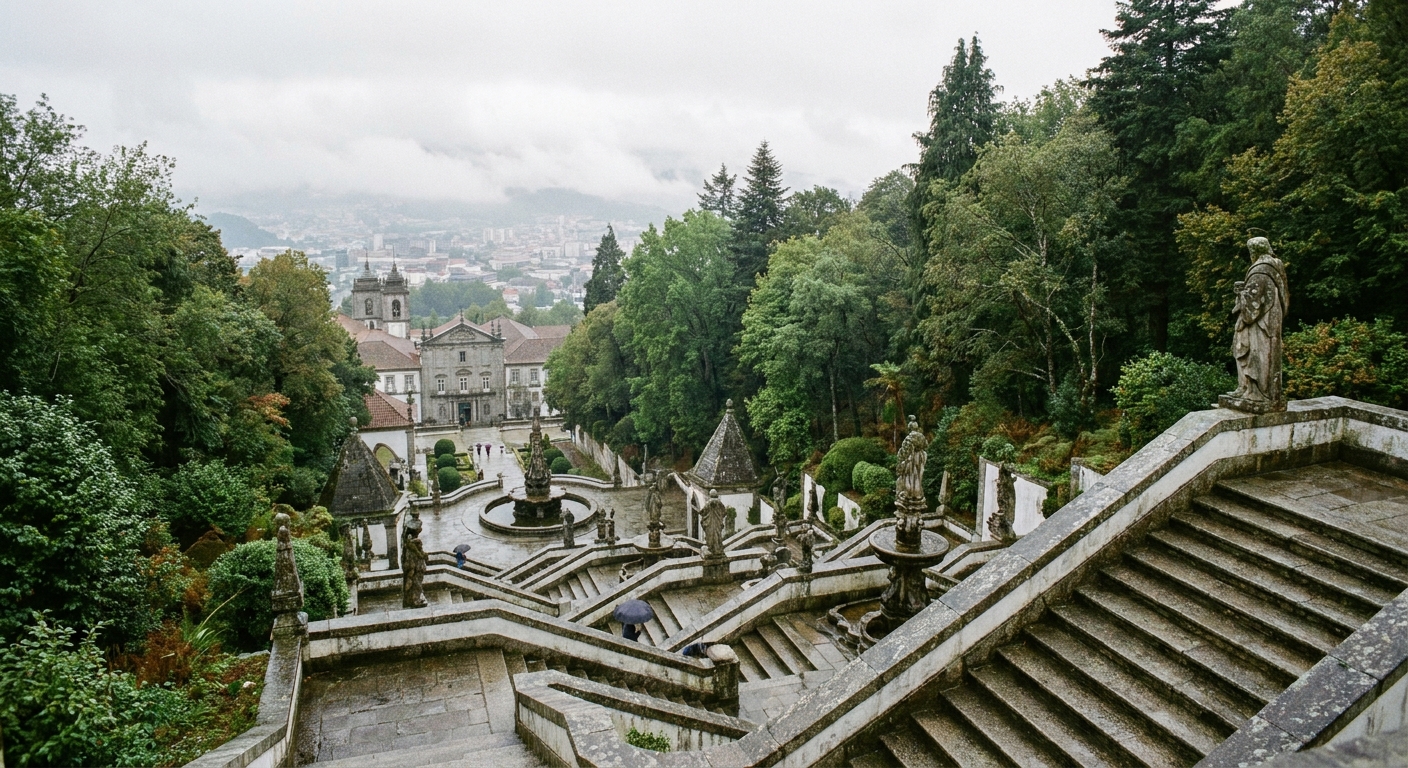
Braga is granite and baroque stacked on a valley floor, a cathedral older than the country around it, and a hillside stairway at Bom Jesus do Monte that photographs better than it climbs. It is also, by Portuguese standards, a rainy city. That single fact decides more about your trip than any list of sights, and it moves a long way between February and October.
So here is the verdict up front: June. Afternoons average 79.0°F, only 5.7 days record measurable rain, and mid-month gives 15 hours 14 minutes of daylight, the longest reading of the year. July and September are the two credible alternates. October is the month most first-timers book by accident and regret in a rain jacket.
THE YEAR AT A GLANCE · BRAGA
June is Braga’s cleanest bet: 79.0°F afternoons, 5.7 wet days and the longest light of the year, with July and September as close alternates.
BEST MONTH: JUNE · WETTEST: OCTOBER, 7.79 IN · DRIEST: JULY, 1.10 IN · LOW SEASON: NOV–FEB
Go for: long-evening summers (June, July and August each average under 6 wet days), a compact center you cross on foot, and the Peneda-Gerês high ground within a rental-car morning.
Think twice before: booking an outdoor trip in October or December: 7.79 and 7.49 inches of rain, across 12.0 and 13.3 wet days.
Normals: IPMA station 622, Braga Merelim, 1991-2020 · Daylight: sunrise-sunset.org · full sources at the end
On this page
- Braga weather month by monthThe twelve-month table
- The best month to visit BragaJune, with the numbers
- Swimming near BragaThe nearest coast, and the river beaches
- Braga’s low seasonNovember to February
- The month to avoid in BragaOctober and its 7.79 inches
- Shoulder season in BragaMay and September, side by side
Braga sits in the Minho, the green corner of Portugal, and the green has a cause. Atlantic fronts queue up against the hills from October through April and unload on the valley. Then summer flips the switch: the station logs 1.10 inches in an average July against 7.79 in October, a sevenfold gap inside one city.
Braga weather month by month: highs, lows, rain days and daylight
| Month | Avg high | Avg low | Rain | Days ≥ 1 mm | Days ≥ 10 mm | Daylight (15th) |
|---|---|---|---|---|---|---|
| January | 57.4°F | 37.6°F | 7.07 in | 13.1 | 6.2 | 9h33 |
| February | 59.9°F | 38.1°F | 4.37 in | 9.6 | 4.3 | 10h40 |
| March | 64.0°F | 42.6°F | 5.91 in | 11.8 | 5.0 | 11h59 |
| April | 67.3°F | 46.0°F | 5.04 in | 12.0 | 5.1 | 13h24 |
| May | 73.4°F | 50.7°F | 3.54 in | 8.9 | 3.5 | 14h36 |
| June | 79.0°F | 55.8°F | 1.60 in | 5.7 | 1.1 | 15h14 |
| July | 82.8°F | 57.7°F | 1.10 in | 4.0 | 0.9 | 14h56 |
| August | 83.7°F | 57.2°F | 1.36 in | 3.8 | 1.3 | 13h53 |
| September | 80.4°F | 54.3°F | 2.66 in | 6.2 | 1.9 | 12h31 |
| October | 72.0°F | 50.2°F | 7.79 in | 12.0 | 6.0 | 11h09 |
| November | 62.6°F | 42.8°F | 6.70 in | 12.9 | 5.8 | 9h54 |
| December | 58.8°F | 38.7°F | 7.49 in | 13.3 | 6.1 | 9h14 |
The shape of the year is a deep dry trough between two wet plateaus: three summer months under 6 wet days each (5.7, 4.0, 3.8), and six months from October to April that never drop below 9.6.
Two months do the switching. May pulls rain down to 3.54 inches over 8.9 days, from April’s 5.04 inches over 12.0. October reverses it in a single step, going from September’s 2.66 inches and 6.2 wet days to 7.79 inches and 12.0. February is the odd one in the wet half: at 4.37 inches it runs 2.70 inches drier than January and drier than both March and April, with 3.5 fewer wet days than January.
January is the hardest month for anyone who came to walk the city. Afternoons top out at 57.4°F, nights fall to 37.6°F, and 6.2 days record 10 mm (0.39 in) or more, the highest heavy-rain count of the twelve. Mid-January hands you 9 hours 33 minutes of daylight, with the sun gone by 5:29 p.m. local.
Every figure above comes from one thermometer: IPMA station 622 at Braga Merelim, 68.4 m above sea level, on the 1991-2020 normals. Two cautions travel with it. The national service counts a wet day at 1 mm (0.04 in) and a heavy day at 10 mm (0.39 in), while US tables usually count at 0.10 in, so the columns do not line up. And this reading describes the valley floor. The Peneda-Gerês high ground east of the city runs colder and far wetter, and the coast west of it has weather of its own.
When is the best time to visit Braga?
June, for almost everyone. Highs of 79.0°F and lows of 55.8°F make the granite center walkable at noon and the terraces usable at ten at night. Rain amounts to 1.60 inches across 5.7 wet days, with just 1.1 day heavy enough to cancel a plan. On June 15 the sun rises before 6 a.m. local and sets at 9:11 p.m., 15 hours 14 minutes of light to spend on the Bom Jesus stairway and the market.
July is warmer and drier on paper, 3.8°F above June with 1.10 inches instead of 1.60. The gap that matters runs the other way. Heavy-rain days are effectively identical (1.1 in June against 0.9 in July), while June’s mid-month daylight beats July’s by 18 minutes and August’s by 1 hour 21 minutes. Choose July if you want the driest possible fortnight. Choose June if you want the long evenings that make a small city feel bigger.
For how Braga’s June fits a wider route, our twelve-month verdict for Portugal sets it against Lisbon and the Algarve, and Porto and the North covers the region it anchors. Pack from the rain column rather than the temperature one, as the packing guide argues.
Can you swim in Braga? The nearest sea and coast
Not in Braga itself. The city sits inland at 68.4 m, and our source carries no water temperature at all for it, because there is no water to measure. The Atlantic is a drive west, at the Minho beach towns, and the region’s river beaches on the Cávado and up toward Gerês are the local answer on a hot afternoon. Air temperature is the only reliable guide we can give: 82.8°F in July, 83.7°F in August, still 80.4°F in September.
One caution before you borrow a sea figure from elsewhere. Coastal water tables usually publish an average of daily maxima, the warmest reading of each day, not a 24-hour mean, so the number you see runs above what you feel at nine in the morning. We are not going to invent one for a city that has no coast. Judge the beach day on the air, the wind and the rain count instead.
Braga’s low season: November to February, prices and daylight hours
The quiet stretch is a calendar fact before it is anything else: November through February falls outside the summer school break, outside Holy Week, and outside the Christmas and New Year fortnight that briefly refills the city. Those four months run 62.6°F, 58.8°F, 57.4°F and 59.9°F for afternoon highs, with nights between 37.6°F and 42.8°F.
February is the pick of them. At 4.37 inches over 9.6 wet days, it is drier than October (7.79 inches, 12.0 days) and lighter than mid-winter: 10 hours 40 minutes of daylight on the 15th, a full hour and seven minutes more than mid-January. That is enough for a morning at the cathedral, an afternoon in the Biscainhos gardens and a café hour before dark at 6:07 p.m.
What you give up is stated in two columns. December delivers 13.3 wet days, the year’s highest, and 9 hours 14 minutes of light, with sunset at 5:06 p.m., a full six hours shorter than mid-June. Mountain plans suffer worst: the Gerês high ground is colder and wetter than the valley station shows, so a winter hiking trip is a gamble the numbers here cannot settle for you.
Which month should you avoid in Braga? October, at 7.79 inches
At 7.79 inches October is the wettest of the twelve months, and it is worst for the short-trip traveler. It carries 5.13 inches more rain than September and nearly double the wet days (12.0 against 6.2). Half of those wet days are heavy ones, 6.0 at 10 mm (0.39 in) or more, the highest such share of the year. On a three-day visit built around Bom Jesus, the Sameiro ridge or a Gerês trail, that arithmetic is unkind.
It is not a write-off. October afternoons still reach 72.0°F, 4.7°F warmer than April, and daylight holds at 11 hours 9 minutes with sunset at 6:53 p.m. before the clocks change. The vines around the city turn, the granite looks better wet than dry, and Braga has enough indoors to absorb a lost morning. Book it for the food and the museums, not for the ridge walk.
Is the shoulder season worth it in Braga? May and September, side by side
The two shoulders are May (73.4°F high, 50.7°F low, 3.54 in, 8.9 wet days) and September (80.4°F, 54.3°F, 2.66 in, 6.2 wet days). Measured against August’s 83.7°F, May runs 10.3°F cooler and September only 3.3°F cooler. September is summer with the edge filed off.
May gives what the peak cannot: hillsides still green before the dry weeks bleach them, and 14 hours 36 minutes of daylight on the 15th, within 38 minutes of the June maximum. September gives warm stone at 7:44 p.m., when the light goes.
Each shoulder charges for it. May takes 3.2 more wet days than June and 1.94 inches more rain. September takes daylight instead: 12 hours 31 minutes, 2 hours 43 minutes short of mid-June, so the evening ends while you are still at dinner. Both are further from the driest week than July’s 4.0 wet days.
The trade cuts cleanly. Want warmth and the fewest compromises outside high summer, take September and accept 2.4 more wet days than August. Want long evenings and cooler walking on the stairways, take May and pack for 8.9 wet days out of 31. Either way, finish before the first week of October, when the column jumps by more than five inches.
The last word
Book June and stop optimizing. If June is gone, September holds 80.4°F over 6.2 wet days, and the month to distrust is April: it reads like spring at 67.3°F and then delivers 12.0 wet days, exactly October’s count, at ten degrees less comfort. Whichever month you land in, climb the Bom Jesus stairway early, before the coaches, and take the water-counterweight funicular down when your legs vote.
Sources & data for this guide
- Monthly normals 1991-2020 (highs, lows, precipitation) · IPMA, station 622 Braga Merelim, altitude 68.4 m · checked Sep 14, 2026
- Wet-day counts at 1 mm (0.04 in) and heavy days at 10 mm (0.39 in) · IPMA thresholds, not the 0.10-inch threshold used in US tables · checked Sep 14, 2026
- Daylight length, sunrise and sunset on the 15th of each month, converted to Europe/Lisbon · sunrise-sunset.org · checked Sep 14, 2026
- No sea temperature series is published for Braga and none is estimated here: the city is inland at 68.4 m.
- We hold no crowd or price statistics for Braga. The low season named on this page is a calendar statement about school breaks and festival dates, not a measured ranking.
- Festival mentions (Holy Week, the Bom Jesus and Sameiro pilgrimages) are editorial and their dates move · confirm with the city before booking.